
When Clean Water Can’t Wait: Finding the Right Portable Survival Water Filter
A portable survival water filter can be the difference between staying healthy and getting seriously ill in the backcountry. Contaminated streams look clean. Giardia and E. coli are invisible. And when you’re two days from the trailhead, you don’t get a second chance.
Here are the best portable survival water filters at a glance:
| Filter | Best For | Removes Viruses? | Lifespan |
|---|---|---|---|
| Sawyer Squeeze | Personal / small groups | No | 100,000 gal |
| LifeStraw Peak Squeeze | Personal use | No | 500 gal / 2,000 L |
| MSR Guardian Purifier | Turbid water / international travel | Yes | 2,642+ gal / 10,000+ L |
| Platypus GravityWorks | Small groups | No | 1,500 L |
| Grayl GeoPress | International travel / heavy metals | Yes | ~300 uses |
| Waterdrop Gravity | Budget / home emergency | No | 5,300 L |
The stakes are real. Waterborne pathogens like Cryptosporidium and Giardia are found in even the most remote mountain streams. Bacteria like E. coli can turn a backcountry trip into a medical emergency. The right filter removes 99.9999% of bacteria and 99.99% of protozoa — but not every filter handles viruses or heavy metals.
This guide cuts through the noise. We tested and compared the top-rated models so you can pick the right filter for your pack, your group size, and your risk level.
Understanding the Different Types of Portable Survival Water Filters
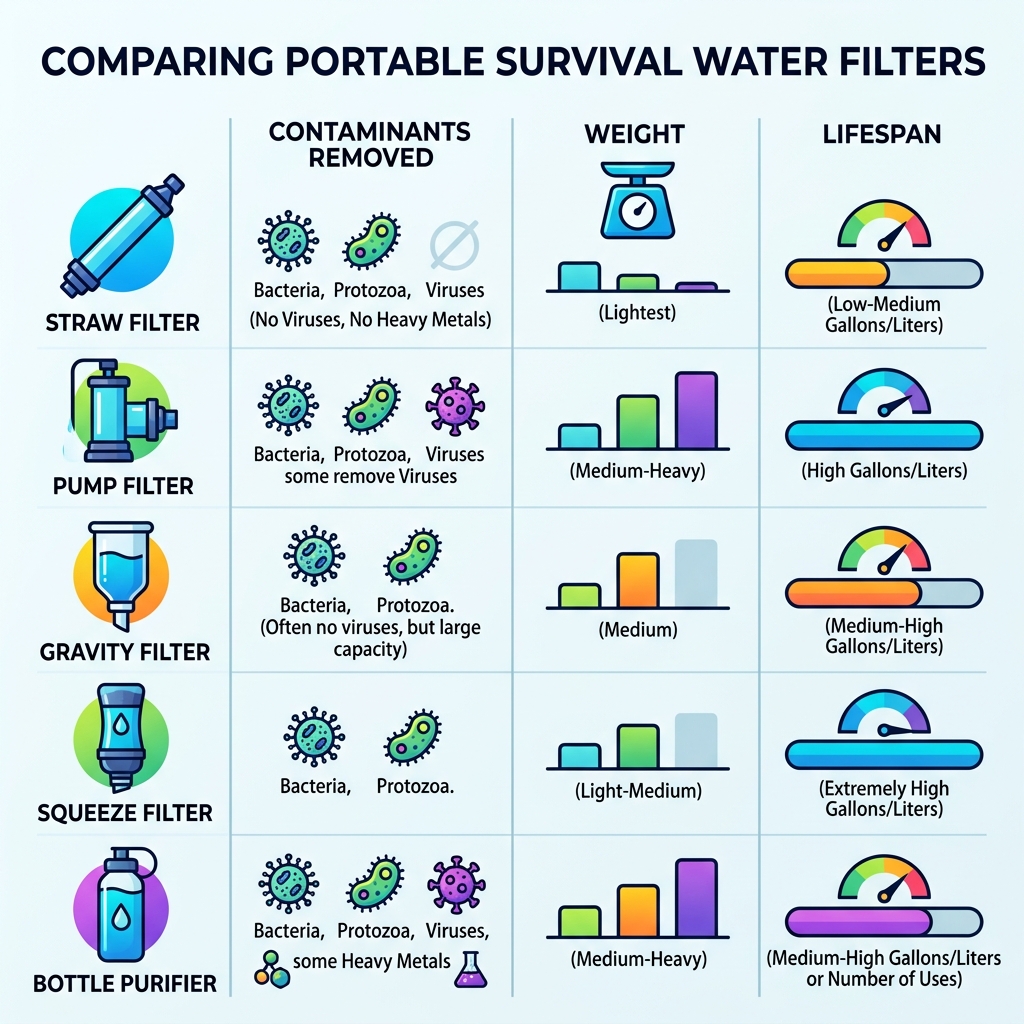
When you are staring down a murky puddle or a rushing river during a crisis, the “how” of your filtration matters just as much as the “what.” In our experience at Total Cobre, we’ve found that survivalists often get overwhelmed by the sheer variety of gadgets available. To simplify things, we categorize these devices by their mechanical action.

- Pump Filters: These use a manual hand pump to pull water through a filter and out a hose. They are excellent for shallow water sources where you can’t easily dip a bag.
- Gravity Systems: You fill a “dirty” bag, hang it from a tree, and let physics do the work. Water flows through a line into a “clean” reservoir. It’s the ultimate “set it and forget it” method for groups.
- Squeeze Filters: These involve a collapsible pouch that you fill with raw water and then physically squeeze through the filter element. They are lightweight and incredibly popular for solo hikers.
- Straw Filters: The most basic form of a portable survival water filter. You stick one end in the water and suck through the other. While portable, they can be tiring to use for large volumes of water.
- Bottle Presses: Think of these like a French Press for water. You fill the outer shell, press the inner filter down, and you have a bottle of clean water ready to drink.
- UV Purification: These use ultraviolet light to scramble the DNA of pathogens, preventing them from reproducing. Note: UV doesn’t “remove” dirt or sediment; it just neutralizes the bugs.
- Chemical Treatments: Drops or tablets (like chlorine dioxide) kill pathogens over time. They are the lightest backup option but often leave a distinct “pool water” taste.
For a deeper dive into these categories, check out our guide on Unveiling Personal Water Filtration Devices for Hiking.
Pros and Cons of Gravity-Fed vs. Pump Systems
Choosing between gravity and pump systems usually comes down to how much work you want to do after a long day of trekking.
Gravity Systems (like the Platypus GravityWorks) are the champions of group efficiency. They offer high flow rates—some systems like the LifeStraw Mission can produce up to 3.1 gallons per hour—without you having to break a sweat. The downside? They require a place to hang the bag and can be slightly heavier and bulkier than solo options.
Pump Systems (like the MSR Guardian) are more versatile in “difficult” water. If you are dealing with a tiny trickle in a rock crevice, a pump hose can get in there where a gravity bag cannot. However, they involve moving parts that can eventually break, and the physical act of pumping 4 liters of water can be a real workout. We discuss these trade-offs extensively in our Best Portable Water Filters for Backpackers review.
When to Use Straw vs. Squeeze Filters
Straw filters are the “break glass in case of emergency” tool. They are feather-light—the Sawyer MINI weighs just 3.5 ounces—making them perfect for a bug-out bag or a pocket. However, drinking through a straw for three days straight is a chore.
Squeeze filters, such as the LifeStraw Peak Squeeze or the Sawyer Squeeze, offer more versatility. You can use them as a straw, but you can also squeeze the water into a cooking pot or another bottle. This versatility makes them our top pick for Personal Water Filtration Devices for Trails.
What Contaminants Does a Portable Survival Water Filter Actually Remove?
Not all filters are created equal. Most “microfilters” have a pore size of about 0.1 to 0.2 microns. This is small enough to catch:
- Bacteria (99.9999%): Including E. coli, Salmonella, and Cholera.
- Protozoa (99.99%): Such as Giardia and Cryptosporidium (which are famously resistant to chemical drops).
- Microplastics (100%): Most modern hollow-fiber membranes catch these easily.
However, viruses are much smaller than bacteria. To stop a virus, you need a “purifier” with a pore size of roughly 0.02 microns. This is the difference between a standard filter and a high-end survival tool. Some specialized products have proven test results that show they remove 99.99% of viruses, making them safe for international travel where waterborne viruses like Hepatitis A are a concern.
Do All Filters Handle Viruses and Heavy Metals?
The short answer is no. Most standard backpacking filters leave viruses behind. If you are in a true disaster scenario or traveling in a developing nation, you need a membrane ultrafilter.
The Grayl GeoPress is a standout here because it uses electroadsorption and activated carbon to pull out viruses, heavy metals, and chemicals like chlorine. The MSR Guardian is another powerhouse, designed for the military to handle the world’s messiest water. If you’re interested in these “all-in-one” solutions, see our research on High-Capacity Water Purification Bottles.
Key Factors for Choosing the Best portable survival water filter
When we evaluate gear at Total Cobre, we look at several critical metrics. A filter that works in a lab but fails in the mud is useless to a survivalist.
- Effectiveness: Does it meet EPA and NSF standards? Look for “Log 6” reduction for bacteria and “Log 4” for viruses.
- Flow Rate: How long does it take to get a liter of water? The LifeStraw Peak Squeeze clocks in at about 35 seconds per liter, while some budget options might take minutes.
- Weight: In a survival situation, every ounce counts. Chemical drops weigh 3 oz, while the LifeStraw Max weighs 15 lbs. Choose based on your mobility needs.
- Durability: Can it survive a 6-foot drop onto concrete? The MSR Guardian can. Many plastic straw filters cannot.
- Filter Lifespan: This is the total volume of water the filter can process before the “pores” are permanently clogged.
Check out our detailed breakdown of these Top Features to Look for in Portable Water Filters for Hiking.
Understanding Filter Lifespan and Capacity
Lifespan varies wildly. The Sawyer Squeeze is legendary, boasting a lifetime rating of 100,000 gallons. In contrast, the LifeStraw Peak Squeeze is rated for 2,000 liters (about 500 gallons).
Why the difference? Sawyer uses a more robust hollow-fiber membrane that can be backflushed almost indefinitely. Other filters, like the Grayl, use cartridges that must be replaced after about 250 liters because the carbon and electroadsorptive media “fill up” with contaminants. We’ve compiled more data on this in our Emergency Water Filter Reviews for Hikers.
Comparing Top-Rated Models for Every Scenario
Finding the “best” filter depends entirely on your mission profile.
| Scenario | Recommended Filter | Why? |
|---|---|---|
| Solo Ultralight | Sawyer Squeeze | 3 oz, lasts forever, very affordable. |
| Small Group (2-4) | Platypus GravityWorks | Fast, hands-free, 4L capacity. |
| Large Group/Basecamp | LifeStraw Mission | 12L bag, removes viruses, high volume. |
| International Travel | Grayl GeoPress | Removes heavy metals and viruses from taps. |
| Turbid/Muddy Water | MSR Guardian | Self-cleaning, won’t clog in the mud. |
For a more granular look at these models, see our list of the Best Portable Water Filters for Adventurous Hikers.
Best portable survival water filter for Budget-Conscious Preppers
If you are stocking up for a family on a budget, the Waterdrop Gravity system is a fantastic value. It offers a 4-stage 0.1-micron filtration process and a 5,300-liter lifespan for a fraction of the cost of premium brands. While the flow rate might require some “de-bugging” (like clearing air bubbles), it’s a solid choice for those following our guide on Top Rated Portable Water Filters for Budget Conscious Adventurers.
Chemical Treatments vs. Mechanical Filtration
We always recommend carrying a “backup to the backup.” Aquamira Drops or Katadyn Micropur tablets are essential additions to any kit.
- Mechanical Filters: Instant results, removes dirt and sediment, but can clog or freeze.
- Chemicals: No moving parts, won’t freeze, but take 30 minutes to 4 hours to work and don’t remove “floaties” or dirt.
Learning How to Assemble Your Own Portable Water Purification Kit often involves combining these two methods for maximum safety.
Maintenance and Real-World Usage in a Crisis
A portable survival water filter is a precision instrument. If you don’t maintain it, it becomes a very expensive straw that doesn’t work.
The most important skill is backflushing. This involves forcing clean water backward through the filter to push out trapped sediment. Most Sawyer filters come with a large syringe for this purpose. If the flow slows down to a trickle, it’s time to backflush.
Another critical tip: Don’t let your filter freeze. If water is inside the hollow fibers and it freezes, the ice will expand and crack the membranes. This creates microscopic holes that pathogens can swim right through. In cold weather, sleep with your filter in your sleeping bag.
For more maintenance tips, see our guide on Assembling a Practical Portable Water Purification Kit.
Maintaining Your portable survival water filter for Longevity
To extend the life of your filter, especially in “dirty” water, use a pre-filter. A simple piece of cheesecloth or a coffee filter over the intake can catch the large chunks of sand and silt that would otherwise clog your expensive 0.1-micron membrane.
We’ve found that frequent backwashing—even when the flow seems fine—prevents “biofilm” from building up inside the unit. This is a “must-know” for Must-Have Portable Water Filters for Frequent Backpackers.
Frequently Asked Questions about Survival Water Filtration
How do I filter extremely turbid or muddy water?
If the water looks like chocolate milk, let it sit in a bucket for an hour to let the sediment settle to the bottom. Carefully scoop the clearer water from the top to filter. This will save your filter from immediate clogging. The MSR Guardian is the only filter specifically designed to handle “sludge” thanks to its self-cleaning mechanism.
Can these filters remove salt from ocean water?
No. Standard portable survival water filters cannot remove dissolved salts. For that, you would need a desalinator or a distillation setup. Filtering salt water through a hollow-fiber membrane will likely ruin the filter.
How do I know when my filter needs to be replaced?
Most modern filters have an “end-of-life” safety feature where the flow simply stops. If you backflush the unit and the water still won’t move through, the membrane is full, and the unit must be replaced.
Conclusion
In a crisis, water is life. At Total Cobre, we believe that your portable survival water filter should be the most reliable piece of gear in your bag. Whether you choose the “buy it for life” durability of the Sawyer Squeeze or the virus-killing power of the Grayl GeoPress, the key is to practice before the emergency hits.
Don’t wait for a disaster to read the manual. Get out there, find a stream, and learn how your gear handles real-world conditions. For more gear reviews and trail-tested advice, check out More info about our services. Stay hydrated, stay safe, and we’ll see you on the trail.
