
Clean Water on the Trail Starts With the Right Portable Water Purifier System
A portable water purifier system can be the difference between a safe adventure and a trip cut short by waterborne illness. Bacteria, viruses, protozoa, and microplastics can all hide in streams and lakes that look perfectly clean.
Here’s a quick look at the top-rated options to help you choose fast:
| System Type | Best For | Example | Removes Viruses? |
|---|---|---|---|
| Straw filter | Solo hikers | LifeStraw Personal | No |
| Squeeze filter | Solo/small groups | Sawyer Squeeze | No |
| Gravity filter | Groups/basecamp | Platypus GravityWorks | No |
| Pump filter | Turbid water | MSR Guardian | Yes (0.02 micron) |
| UV purifier | International travel | Katadyn SteriPen | Yes |
| Chemical drops | Backup/emergency | Aquamira Drops | Yes (slow) |
| Pump + carbon | Comprehensive | Survivor Filter PRO | Yes (0.01 micron) |
The best choice depends on how you hike — solo or with a group, fast and light or multi-day basecamp style.
The LifeStraw Personal Water Filter has earned over 119,000 ratings averaging 4.8 out of 5 stars, making it one of the most trusted names in personal filtration. But it’s far from the only strong option.
In this roundup, we break down the real differences between filter types, what contaminants each one handles, and which systems deliver the best value for adventurous hikers.
Understanding Your Portable Water Purifier System Options
When we head into the backcountry, we aren’t just looking for water that tastes good; we’re looking for water that won’t make us sick. Navigating filtration can feel like chemistry class, but it basically boils down to how the water moves through the device.
- Straw Filters: These are the ultimate “light and fast” tools. You stick one end in the water source and sip through the other. They are perfect for emergency kits or solo day hikes where you don’t want to carry extra weight.
- Squeeze Systems: These involve a collapsible pouch that you fill with “dirty” water. You then screw a filter onto the mouth and squeeze the water into your clean bottle or directly into your mouth. The Sawyer Squeeze and LifeStraw Peak Squeeze are icons in this category.
- Gravity Filters: If we are hiking with a crew, we don’t want to spend an hour pumping or squeezing. Gravity systems like the Platypus GravityWorks use a “dirty” bag hung from a tree and a “clean” bag sitting below. Nature does the work for us while we set up camp.
- Pump Filters: These use a manual hand pump to draw water through a ceramic or pleated glass fiber element. They are excellent for shallow puddles where a bag is hard to fill.
- UV Purifiers: Devices like the Katadyn Steripen use ultraviolet light to scramble the DNA of pathogens, making them harmless. They require clear water to work effectively and batteries to stay powered.
- Chemical Treatments: Chlorine dioxide drops or tablets (like Aquamira or Katadyn Micropur) are the lightest backup possible. They kill everything, including viruses, but they often require a wait time of up to four hours for full effectiveness against tough bugs like Cryptosporidium.
For more detailed strategies on deployment, check out our guide on the effective use of portable water purifiers.
Key Factors for Choosing a Filtration System
Choosing a portable water purifier system isn’t just about the price tag; it’s about the “cost per liter” and how much sweat it takes to get that liter. Here is what we look for when testing gear for our readers:
- Weight and Packability: For ultralight backpackers, every ounce counts. A Sawyer Mini weighs just 2 ounces, while a heavy-duty pump like the MSR Guardian weighs over 20 ounces.
- Flow Rate: This is how fast the water moves. A fast filter (like the LifeStraw Peak Squeeze) can process a liter in about 35 seconds. A clogged or slow filter can take minutes, which feels like an eternity when you’re dehydrated.
- Filter Lifespan: Some filters, like the Sawyer Squeeze, are rated for up to 100,000 gallons (378,541 liters). Others, like the LifeStraw Peak Series, last for about 500 gallons (2,000 liters).
- Maintenance: Can you clean it in the field? Most hollow-fiber filters require “backflushing”—pushing clean water backward through the filter to clear out sediment.
To dive deeper into the specific mechanics, see our breakdown of the top features to look for in portable water filters for hiking.
Top-Rated Systems for Every Adventure

Whether you are thru-hiking the Appalachian Trail or preparing for a “boil water” advisory at home, there is a specific tool for the job. Not all filters are created equal when it comes to international travel, where viruses (which are much smaller than bacteria) are a larger concern.
For those looking for a comprehensive list of field-tested gear, our experts have compiled the best portable water filters for adventurous hikers.
Best Portable Water Purifier System for Solo Hikers
For the solo adventurer, the goal is simplicity. We want something that can be used as a straw, screwed onto a standard plastic bottle, or used as a squeeze system.
The Sawyer Squeeze remains the “Goldilocks” of this category. It is lightweight (approx. 3 oz for the filter itself) and incredibly durable. It uses hollow fiber membranes with a 0.1-micron pore size, which physically blocks 99.99999% of bacteria and 99.999% of protozoa.
The LifeStraw Peak Squeeze is another top contender, praised for its improved durability over older collapsible bottle designs. It is rated for 2,000 liters and features a versatile cap that protects the mouthpiece from dirt. These personal water filtration devices for trails are essential for anyone who prefers to move fast without the bulk of a large system.
High-Capacity Portable Water Purifier System for Groups
When we are out with a group, we need volume. The Platypus GravityWorks is a standout here. It can treat 4 liters of water in about 2.5 minutes without a single pump. It’s a “set it and forget it” system that allows the group to focus on cooking or resting.
For more extreme needs, systems like the MSR AutoFlow XL provide up to 10 liters of storage, making it perfect for basecamp hydration. If you are heading to a region with high virus risks, the LifeStraw Max or MSR Guardian are the heavy hitters. The Guardian, specifically, is a pump-style purifier that handles turbid (muddy) water with ease and removes viruses using a 0.02-micron filter.
Learn more about why gravity fed water filters the perfect solution for group camping trips to see if this style fits your next expedition.
Advanced Filtration and Maintenance
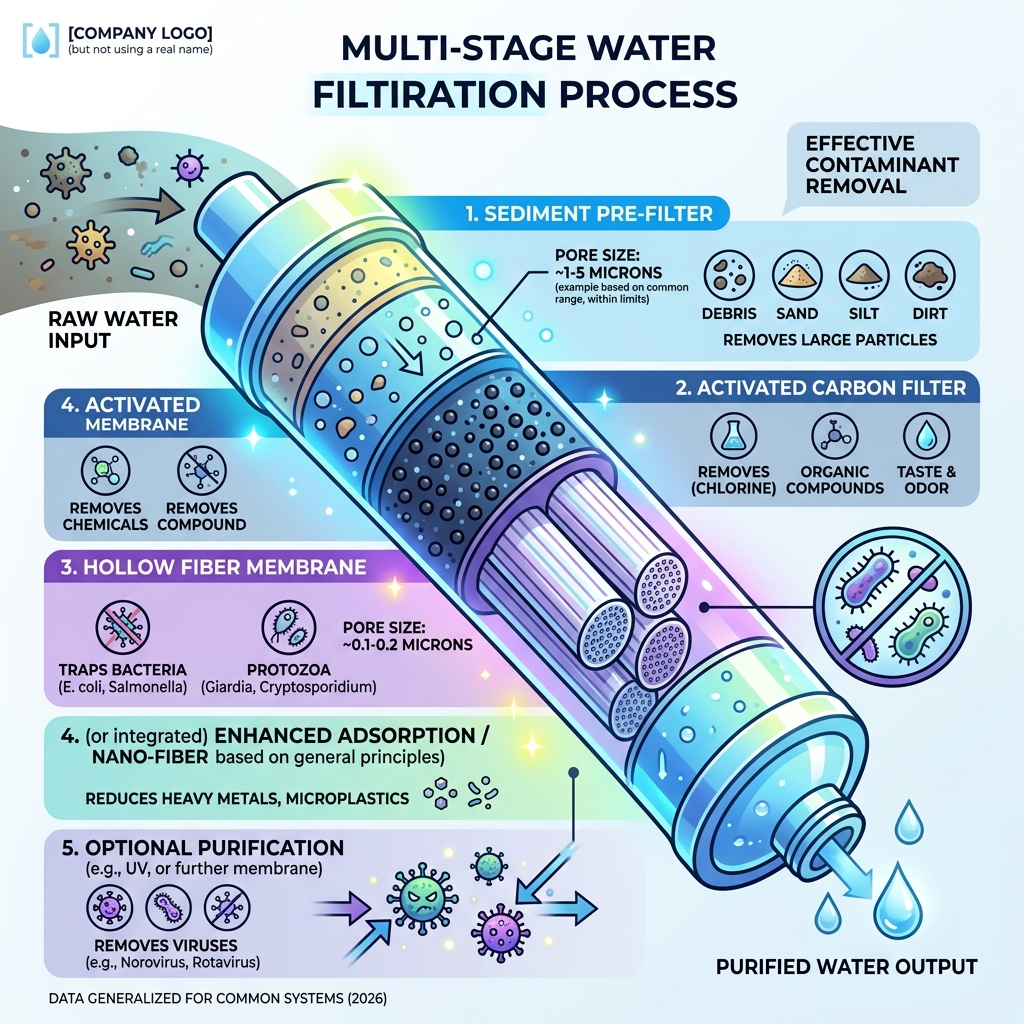
If you are looking at a portable water purifier system for international travel or disaster relief, you need to understand micron ratings. A standard “filter” usually has a pore size of 0.1 to 0.2 microns. This is small enough to catch bacteria (like E. coli) and protozoa (like Giardia).
However, viruses are much smaller. To catch a virus, you need a “purifier” with a pore size of around 0.02 microns. The Survivor Filter PRO is an impressive example, offering 0.01-micron filtration. This system has been lab-tested to remove 99.999% of viruses, along with heavy metals like lead and mercury.
For those carrying gear over long distances, we have a specialized guide on lightweight water purifiers for backpacking.
How do I maintain my filter in the field?
Maintenance is the key to longevity. If your flow rate slows down, it’s usually because the tiny pores are “constipated” with silt and sediment.
- Backwashing: Most systems come with a large syringe. Fill it with clean water and force it through the filter in the opposite direction of normal flow. This “blows out” the trapped debris.
- Sediment Settling: If the water is particularly turbid, don’t filter it immediately. Let it sit in a bucket or bag for an hour. The heavy dirt will settle to the bottom, allowing you to draw the clearer water from the top, which saves your filter’s life.
- Pre-filtration: Using a simple bandana or coffee filter over the intake can catch large chunks of “gunk” before they ever reach your expensive filter element.
- Storage: Never let a hollow-fiber filter freeze after it has been used. The water inside the fibers will expand, shattering the filter and making it useless. In cold weather, we sleep with our filters in our sleeping bags!
What is the difference between a filter and a purifier?
The industry uses these terms specifically based on what is removed, often referencing the NSF/ANSI P231 standard for microbiological water purifiers.
- Water Filters: Remove bacteria and protozoa. Most backpacking filters (Sawyer, Katadyn Hiker) fall into this category.
- Water Purifiers: Remove bacteria, protozoa, AND viruses. These are required for international travel or areas with high human impact. Purifiers achieve this either through smaller pore sizes (0.02 microns), UV light, or chemical treatment.
The MSR Guardian and Grayl GeoPress are purifiers. The Grayl is particularly unique because it uses electroadsorption and activated carbon to “pull” contaminants out of the water, also removing chemicals and heavy metals that a standard hollow-fiber filter would miss.
How long do portable filters typically last?
Lifespan varies wildly by brand and technology:
- Sawyer Squeeze: 100,000 gallons. This is essentially a lifetime filter if you backwash it regularly.
- LifeStraw Peak Squeeze: 500 gallons (2,000 liters).
- Katadyn Pocket Filter: Rated for up to 50,000 liters thanks to its robust ceramic element.
- Aquamira Drops: One set of 1 oz bottles treats about 30 gallons.
You’ll know your filter is reaching its end when the flow rate becomes a trickle despite frequent backwashing. Some filters, like LifeStraw’s membrane models, are designed to stop flowing entirely once they are “full,” ensuring you never accidentally drink contaminated water.
Conclusion
At Total Cobre, we believe that staying hydrated shouldn’t be a gamble. Whether you choose the ultralight simplicity of a Sawyer Squeeze or the group-friendly volume of a Platypus GravityWorks, having a reliable portable water purifier system is the most important prep you can do for the trail.
Remember to consider your environment: if you’re in the high Sierras, a 0.1-micron filter is usually plenty. If you’re traveling through regions with poor sanitation, step up to a 0.02-micron purifier or a UV system.
Stay safe, stay hydrated, and we’ll see you on the trail! For more gear reviews and trail tips, visit us at www.totalcobre.com/.
