
Why a UV Light Water Purifier for Camping Could Save Your Trip
A UV light water purifier camping tool is one of the fastest, lightest ways to make natural water safe to drink on the trail.
Here’s a quick answer if you’re short on time:
| Feature | What to Know |
|---|---|
| How it works | UV-C light damages the DNA of bacteria, viruses, and protozoa so they can’t reproduce |
| Treatment time | 48 seconds for 0.5L, 90 seconds for 1L |
| What it kills | Bacteria, viruses, Giardia, Cryptosporidium |
| Key limitation | Only works on clear water — turbid water needs pre-filtering first |
| Typical weight | 76–140 grams depending on model |
| Battery life | ~50 treatments per charge (USB rechargeable) |
Now for the bigger picture.
Imagine getting seriously ill for nearly a week after drinking from a mountain stream that looked perfectly clean. That’s a real risk hikers face every day. Natural water sources — even remote alpine streams — can carry invisible threats like Giardia, Cryptosporidium, and viruses that no amount of visual inspection can detect.
The good news? A handheld UV purifier fits in your palm, weighs less than a granola bar, and can make a full liter of water safe to drink in 90 seconds — with no chemicals, no pumping, and no bad taste.
This guide will walk you through everything you need to know before choosing and using one on your next trip.
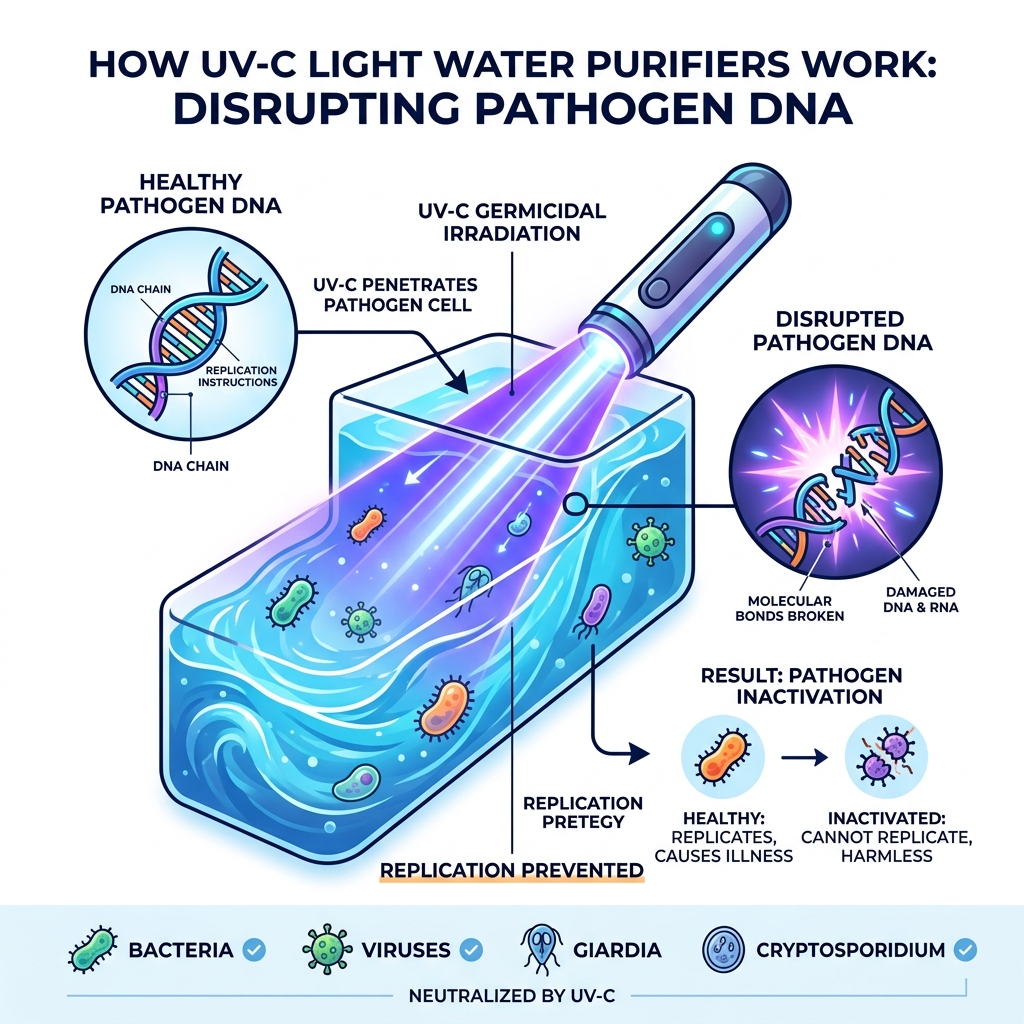
How UV Technology Destroys Pathogens
To understand why a uv light water purifier camping device is so effective, we have to look at the science of light. Ultraviolet light is divided into three types: UV-A, UV-B, and UV-C. While UV-A and UV-B are what cause sunburns, UV-C is the “germicidal” hero of our story.
The UV-C wavelength (specifically between 200 and 280nm) is a high-energy form of light that penetrates the cells of microorganisms. When this light hits a pathogen, it targets the DNA and RNA—the genetic “instruction manual” for life. The UV rays break the molecular bonds in the DNA, essentially scrambling the code.
Once the DNA is disrupted, the microbe is “inactivated.” It isn’t necessarily “dead” in the traditional sense, but it is rendered incapable of reproducing. Since these pathogens only cause illness by multiplying inside your gut, a microbe that can’t reproduce is harmless. This process is highly effective against:
- Bacteria: Such as E. coli and Salmonella.
- Viruses: Including Norovirus and Hepatitis A (which many standard filters miss).
- Protozoa: Specifically hard-shelled cysts like Giardia and Cryptosporidium.
We have found that harnessing-uv-light-purifiers-for-safe-backpacking-trips is one of the most reliable ways to ensure your water is biologically safe without the wait time of chemical drops.
Comparing Purification Methods for Backpackers
When we head into the backcountry, we usually choose between four main methods of water treatment. Each has its place, but UV technology offers a unique balance of speed and weight.
| Method | Treatment Speed | Weight | Virus Removal? | Taste |
|---|---|---|---|---|
| UV Light | 90 seconds | 76g – 140g | Yes | No change |
| Hollow-Fiber Filter | 30 – 60 seconds | 50g – 400g | No (mostly) | No change |
| Chemical Tablets | 30 mins – 4 hours | < 20g | Yes | Chemical/Bleach |
| Boiling | 5 – 10 minutes | Fuel weight | Yes | Flat/Burnt |
If you are looking for a standard mechanical filter to pair with your UV setup, you can Check price at Amazon (on sale!) for some of the top-rated squeeze models. Alternatively, if you prefer a straw-style system for quick sips, Check price at REI to see current deals on popular ultralight gear.
Why Choose a uv light water purifier camping Over Filters?
The most common question we get is: “Why not just use a squeeze filter?” While filters like the Sawyer Squeeze are excellent, they have one major weakness: clogging. If you are hiking in an area with high mineral content or micro-algae, a mechanical filter can slow to a crawl, requiring constant backflushing.
A uv light water purifier camping pen has no mechanical parts to clog. You simply stir it in the water. Furthermore, standard hollow-fiber filters (with 0.1 or 0.2-micron pores) are generally unable to remove viruses because viruses are too small. UV light doesn’t care about size; it neutralizes viruses just as easily as large protozoa.
With a weight of around 140g (about 5 ounces) for a rechargeable model like the Steripen Ultra, you’re getting a device that provides 99.9% protection in 90 seconds. For those who prioritize speed and safety, merging-convenience-and-efficiency-uv-light-water-purifiers-for-hikers is the logical choice for modern trail life.
Best Practices for Using a uv light water purifier camping
Using a UV pen isn’t rocket science, but there is a “technique” to ensure you don’t end up with a bellyache.
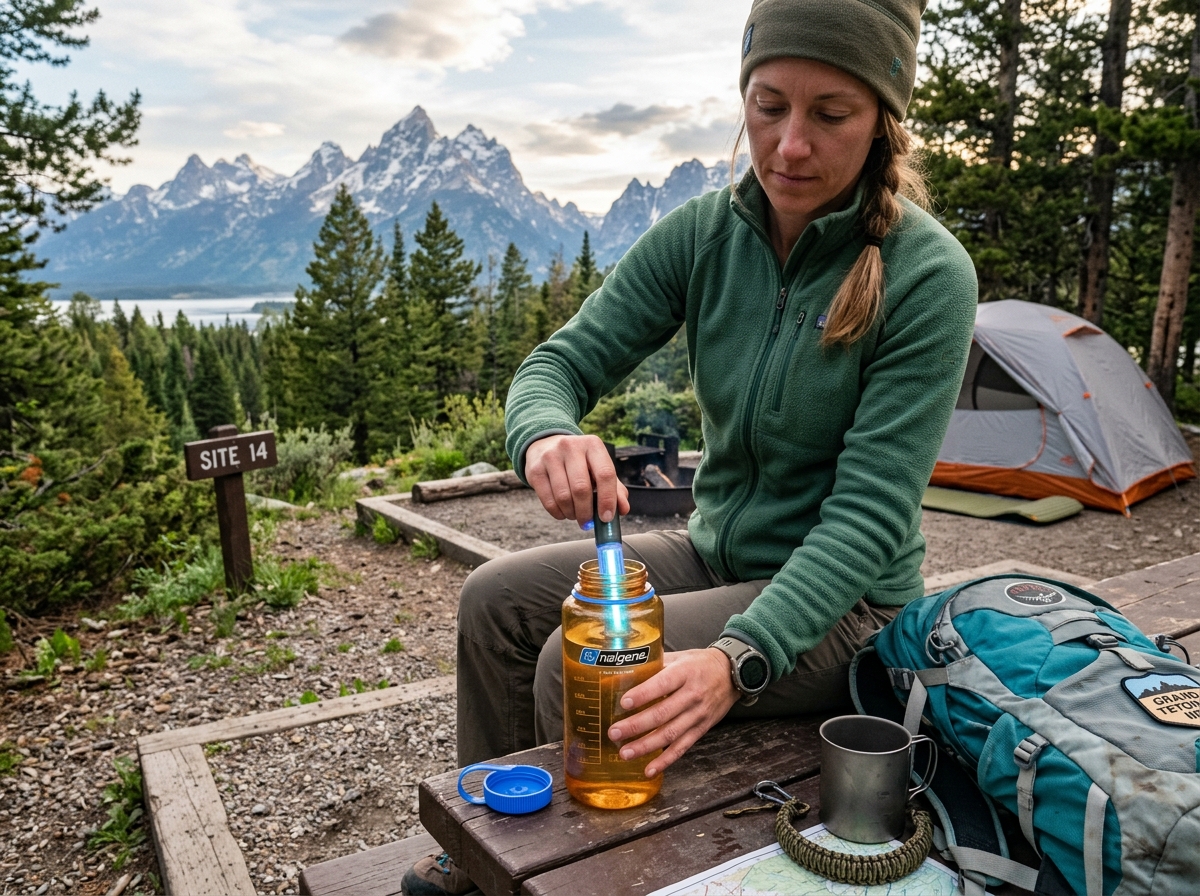
- Select the Right Container: UV pens work best in wide-mouth bottles (like a 1L Nalgene). The opening needs to be at least 1.75 inches wide so the lamp can fit comfortably and you can stir the water effectively.
- Submerge the Sensors: Most models have small metal sensors near the lamp. These must be fully submerged for the device to activate. This is a safety feature to prevent the UV lamp from turning on in your hand and potentially damaging your eyes or skin.
- The Stirring Motion: Don’t just hold the pen still. You need to stir the water gently but consistently. This ensures that every drop of water—and every hidden pathogen—is exposed to the UV-C rays.
- Volume Selection: Most devices have two settings. Press the button once for a 1-liter treatment (90 seconds) or twice for a 0.5-liter treatment (48 seconds).
- Watch the Display: Modern units like the Steripen Ultra feature an OLED display. A “smiley face” means you’re good to go; a “frowning face” means the treatment failed (usually because the sensors lost contact with the water) and you need to start over.
Understanding the advantages-of-using-uv-light-purifiers-for-backpacking-trips means knowing that while the process is fast, it requires your full attention for those 90 seconds.
Limitations of a uv light water purifier camping in Turbid Water
There is one golden rule for UV purification: The water must be clear.
If you try to treat “muddy” or turbid water, you run into the “shadowing effect.” Suspended particulate matter—silt, dirt, or even heavy tea-colored tannins—can act as a shield for microbes. If a bacterium is hiding behind a grain of sand, the UV light can’t reach it, and that bacterium remains active and dangerous.
If you find yourself at a murky pond, you must use pre-filtration:
- The Bandana Method: Strain the water through a tightly woven bandana or a buff to remove large chunks.
- Settling Time: Fill a spare bladder with the turbid water and let it sit for 30–60 minutes. The heavy sediment will settle to the bottom, allowing you to pour the clearer water off the top into your treatment bottle.
- Commercial Pre-filters: Some brands sell specific mesh screens that fit over the mouth of your bottle.
Learning how-uv-purification-systems-enhance-your-health-on-hikes involves recognizing that UV is a biological treatment, not a physical one. It won’t remove the “crunch” from your water; it just makes the crunch safe to swallow.
Maintenance and Field Reliability
Because a uv light water purifier camping tool is an electronic device, it requires a different kind of care than a plastic pump.
Battery Management Most modern UV purifiers use integrated lithium-ion batteries rechargeable via USB. On a full charge, you can typically expect about 50 treatments. For a solo hiker drinking 3 liters a day, that’s over two weeks of water. However, we always recommend maximizing-efficiency-using-uv-light-purifiers-for-backpacking-trips by carrying a small power bank or solar charger for extended trips.
Lamp Life The UV lamps themselves are incredibly durable, often rated for 8,000 activations. If you treated 2 liters of water every single day, the lamp would last you more than 10 years. You are far more likely to lose the device or drop it on a rock than you are to “burn out” the bulb.
Field Care The glass lamp is the most fragile part. Most units come with a neoprene case—use it. Never toss the bare device into your pack where it can clatter against tent poles or cooking pots. Also, keep the sensors clean. If you notice the device is failing to activate, it might be due to mineral buildup on the metal sensors. A quick wipe with a damp cloth (or a bit of vinegar if you’re at home) usually fixes the issue.
Frequently Asked Questions about UV Water Safety
Is it safe to ingest DNA from UV-killed pathogens?
This is a common concern for first-time users. When the UV light disrupts the DNA of a virus or bacterium, the “remains” of that organism are still in the water. However, these are microscopic fragments of protein and genetic material. They are completely harmless and are digested by your stomach just like any other organic matter. In fact, most municipal tap water in major cities is treated with UV light, so you’ve likely been drinking “UV-killed” DNA your entire life!
What backup methods should campers carry?
We are firm believers in the “two is one, one is none” rule for the backcountry. Electronics can fail, batteries can die, and glass can break. We always recommend carrying a small bottle of Aquamira drops or a few Katadyn Micropur tablets as a lightweight backup. If your UV device fails, these chemical treatments will ensure you aren’t forced to hike out dehydrated.
Can UV purifiers be used in freezing temperatures?
Yes, but with a caveat. Lithium-ion batteries perform poorly in sub-zero temperatures. If you are winter camping, sleep with your UV purifier inside your sleeping bag to keep the battery warm. Some models, like the Steripen Adventurer Opti, use CR123 batteries which tend to handle the cold better than USB-rechargeable versions. Also, ensure the lamp is completely dry before it freezes, as expanding ice could theoretically stress the seal around the bulb.
Conclusion
At Total Cobre, we know that nothing ruins a beautiful backpacking trip faster than a waterborne illness. While there are many ways to treat water, the uv light water purifier camping method stands out for its ability to tackle viruses and protozoa in under two minutes without affecting the taste of your mountain spring water.
Whether you are a solo ultralight hiker or a family camper, a UV pen is a worthy investment for your gear closet. It offers peace of mind, environmental benefits by reducing plastic bottle waste, and the convenience of “stir and drink” hydration. Just remember to keep your water clear, your batteries charged, and your sensors submerged.
For more deep dives into trail safety and gear reviews, check out our More info about outdoor gear services to stay ready for your next adventure. Safe trails and happy hydrating!
