
Clean Water in the Backcountry: Why Your Filter Choice Matters
Portable water filters for camping are essential gear for any hiker or backpacker heading into the wilderness. Here are the top options to consider:
Best portable water filters for camping — quick picks:
| Filter | Best For | Weight | Filter Lifespan |
|---|---|---|---|
| LifeStraw Peak Squeeze | Solo backpacking | 3.8 oz | 2,000 L (500 gal) |
| Sawyer Squeeze | Thru-hiking, best value | 3 oz | 378,541 L (100,000 gal) |
| Sawyer Mini | Ultralight solo use | 2 oz | 378,541 L (100,000 gal) |
| Platypus GravityWorks | Groups, hands-free | 11.5 oz | 1,500 L (396 gal) |
| MSR Guardian | Turbid water, international travel | 20.5 oz | 10,000+ L |
| Katadyn BeFree | Fast flow, easy cleaning | 2.3 oz | 1,000 L |
Every stream, lake, and river you encounter on the trail can carry invisible threats — bacteria like E. coli and salmonella, parasites like giardia, and protozoa like cryptosporidium. Drinking unfiltered backcountry water is one of the fastest ways to ruin a trip.
The good news? Modern portable filters are lightweight, fast, and incredibly effective. The right one can weigh as little as 2 ounces and filter enough water to last a lifetime of adventures.
But with over 4,000 water filter products available on Amazon alone, choosing the right one feels overwhelming. The wrong pick — too slow, too heavy, or not effective enough for your water source — can leave you dehydrated or sick miles from the nearest trailhead.
This guide cuts through the noise. We’ll cover every major filter type, break down the specs that actually matter, and give you honest, research-backed recommendations for every camping scenario.
Understanding Different Types of Portable Water Filters for Camping
When we talk about a portable water filter for camping, we aren’t just talking about one device. There is a whole world of gadgets designed to keep your insides from staging a protest. Depending on whether you are solo trekking or setting up a basecamp for the whole family, the “best” type will change.

Straw Filters
These are the simplest tools in the shed. You stick one end in the water and suck through the other. They are ultralight and great for emergencies, though they can be a bit of a workout for your cheeks if the filter is old. The LifeStraw Personal Water Filter is a legend here, with over 122,500 reviews on Amazon.
Squeeze Systems
These are current favorites for most backpackers. You fill a flexible pouch with “dirty” water, screw the filter onto the top, and squeeze the water into your clean bottle. They are fast, light, and very versatile. You can learn more about picking these in our guide on how-to-choose-the-best-portable-water-filter-for-your-hiking-needs.
Gravity Filters
If you hate manual labor (don’t we all?), gravity filters are your best friend. You fill a large bag, hang it from a tree, and let physics do the work. Water flows through a hose, through the filter, and into a clean reservoir. These are the gravity-fed-water-filters-the-perfect-solution-for-group-camping-trips because they can process liters of water while you’re busy setting up your tent.
Pump Microfilters
These use a hand pump to force water through a filter element. They are excellent for drawing water from shallow puddles where a bag might be hard to fill. They are often more “rugged” but also heavier.
UV Purifiers and Bottle Purifiers
UV pens like the Steripen use ultraviolet light to scramble the DNA of bacteria and viruses, making them harmless. Bottle purifiers, like the Grayl GeoPress, use a “French press” style action to push water through a purifier cartridge that even removes heavy metals and chemicals.
Chemical Treatments
Drops and tablets (like Aquamira or Potable Aqua) are the ultimate backup. They weigh almost nothing but usually require a wait time of 30 minutes to 4 hours to be fully effective.
Key Performance Metrics: Pore Size, Flow Rate, and Lifespan
Before you buy, you need to understand the “math” of clean water. It isn’t just about how pretty the bottle is; it’s about what stays out of your stomach.
Pore Size: The 0.1 vs. 0.02 Debate
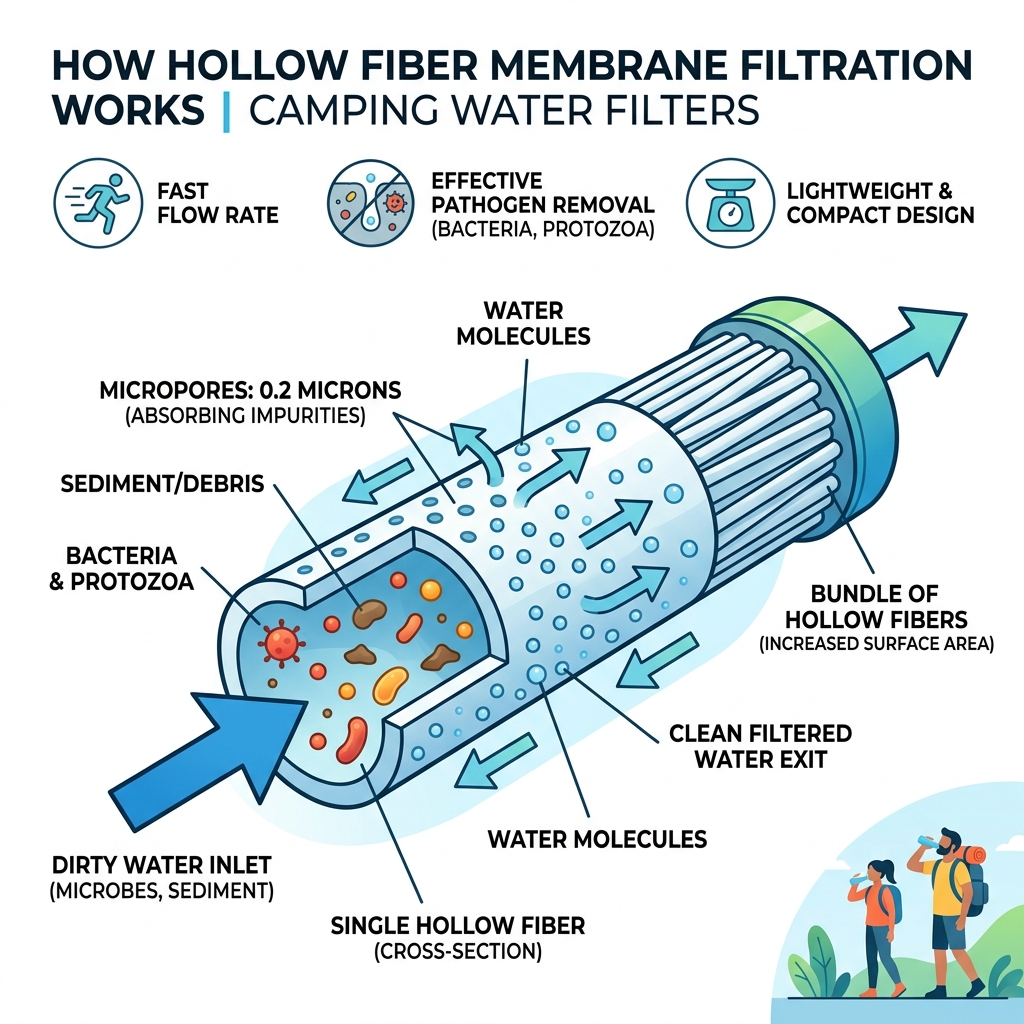
Most standard filters have a pore size of 0.1 or 0.2 microns. This is small enough to catch 99.9999% of bacteria (like Salmonella) and protozoa (like Giardia). However, viruses are much smaller. To catch a virus, you need a “purifier” with a pore size around 0.02 microns, like the MSR Guardian.
According to Scientific research on water filter testing and standards, filters are generally sufficient for North America, but purifiers are recommended for international travel or areas with high human/animal waste.
Flow Rate and Lifespan
Flow rate is how fast you get your drink. A fast filter like the Katadyn BeFree can move 2 liters per minute, while a clogged straw might feel like drinking a thick milkshake through a pinhole.
Lifespan varies wildly. A LifeStraw Peak Squeeze is rated for 2,000 liters, which is plenty for most. But the Sawyer Squeeze is rated for a staggering 378,541 liters (100,000 gallons). At that rate, your grandkids might still be using it!
For those looking to shave every gram, check out our analysis of lightweight-water-purifiers-for-backpacking.
Top-Rated Portable Water Filter for Camping Models Reviewed
We’ve looked at the data and the field tests. Here are the heavy hitters currently dominating the trails.
LifeStraw Peak Squeeze
This is a modular marvel. It corrects many of the durability issues found in older collapsible bottles. It’s easy to use as a straw, a squeeze, or even inline.
- Pros: Durable, high flow, modular.
- Cons: Shorter lifespan than Sawyer models.
- Check price at Amazon (on sale!)
Sawyer Squeeze
The “gold standard” for thru-hikers. We’ve seen these used for over 8,000 miles on the PCT and CDT. It’s nearly impossible to beat the value here.
- Pros: Incredible lifespan, very lightweight (3 oz), affordable.
- Cons: Included bags can sometimes leak; requires backflushing.
Platypus GravityWorks
The king of the campsite. It treats 4 liters of water in under 4 minutes without you lifting a finger.
- Pros: Effortless, great for groups, fast.
- Cons: Bulky and heavier (11.5 oz).
- Check price at REI
MSR Guardian
The “tank” of water purifiers. It was originally built for military use. It handles the muddiest water and removes viruses. It even self-cleans with every pump stroke.
- Pros: Removes viruses, works in “chocolate milk” water, extremely durable.
- Cons: Very expensive ($400 range) and heavy (over 1 lb).
Best Portable Water Filter for Camping for Solo Backpackers
For the solo adventurer, weight and packability are everything. You don’t want a filter that takes up half your pack.
The Sawyer Mini is a classic choice here. Weighing just 2 ounces, it fits in the palm of your hand. While the flow rate is slower than the full-sized Squeeze, its versatility is unmatched. You can screw it onto a standard disposable bottle or use it as a straw. We’ve done a deep dive into reviewing-compact-water-filters-for-long-distance-hikers if you want to see how it stacks up against the competition.
Another great solo option is the Katadyn BeFree. It features a wide-mouth flask that is much easier to fill in shallow streams than the narrow Sawyer bags. It’s a favorite for trail runners and fast-packers who need water now.
High-Capacity Systems for Groups and Basecamps
When you’re camping with a group, the “squeeze” method becomes a chore. No one wants to spend an hour squeezing bags for four people.
This is where gravity bags shine. Systems like the MSR AutoFlow XL (10L capacity) or the Waterdrop Gravity system allow you to process massive amounts of water at once. The Waterdrop is particularly noted as a “best deal” for budget-conscious groups, though it may require some “flow rate de-bugging” occasionally.
Properly setting-up-gravity-water-filters-at-campsites-a-comprehensive-guide involves finding a sturdy branch and ensuring your clean reservoir is protected from ground contaminants.
Maintenance and Durability: Keeping Your Filter Functional
A portable water filter for camping is a precision instrument. If you don’t take care of it, it will stop taking care of you.
The Art of the Backflush
Most hollow fiber filters (Sawyer, LifeStraw, etc.) will eventually clog with silt and sediment. To fix this, you use a “backflush syringe” to force clean water backward through the filter. This blows out the gunk and restores your flow rate.
Pre-Filtering and Turbid Water
If the water looks like coffee, don’t just shove your filter in. Use a pre-filter like a bandana, coffee filter, or even a piece of pantyhose to strain out the big chunks of sand and organic matter. This will save your filter’s life.
The “Death by Freezing” Rule
This is the most important rule: Never let your filter freeze after it has been used. Because these filters use tiny hollow fibers filled with water, freezing will cause the water to expand and shatter the fibers. The filter will look fine on the outside, but it will no longer be filtering out pathogens. If you’re camping in the cold, sleep with your filter in your sleeping bag!
For more tips on field maintenance, see our guide on the effective-use-of-portable-water-purifiers.
Frequently Asked Questions about Portable Water Filters
What is the difference between a filter and a purifier?
In short: viruses. A “filter” (microfilter) removes bacteria and protozoa (Giardia/Crypto). A “purifier” goes a step further to remove or neutralize viruses. In the US and Canada, a filter is usually enough. If you’re traveling to developing countries or camping near heavy livestock areas, a purifier is safer. You can find a more technical breakdown at water filters vs. water purifiers.
How do chemical treatments compare to mechanical filters?
Chemicals like Aquamira drops are foolproof. They can’t break, they can’t freeze, and they can’t clog. However, they don’t remove “floaties” (dirt/sand), and they take time to work. Most require 30 minutes for bacteria and 4 hours for Cryptosporidium. They also can leave a slight chemical taste, though chlorine dioxide (like in Aquamira) is much better than old-school iodine.
Which filter is best for turbid or muddy water?
The MSR Guardian is the undisputed champ of mud. It was designed to handle glacial flour and silty river water that would kill a Sawyer in seconds. The Katadyn Pocket is another “rugged workhorse” with a ceramic element that can be abraded (scrubbed) in the field to restore flow.
Conclusion
At Total Cobre, we believe that having gear you can trust is the difference between an epic adventure and a miserable trek. Choosing the right portable water filter for camping depends entirely on your style.
If you’re a solo hiker looking for the best bang for your buck, the Sawyer Squeeze is your winner. If you’re heading out with the family and want ease of use, grab a Platypus GravityWorks. And if you’re exploring remote international trails, don’t settle for anything less than a purifier like the MSR Guardian.
Remember to always carry a backup (like tablets), keep your filter from freezing, and practice your backflushing technique before you hit the trail. For more in-depth advice, check out our ultimate-guide-to-portable-water-filters-for-outdoor-adventures.
Stay hydrated and happy trails!
