
Why Personal Water Filtration Matters for Every Hiker
Personal water filtration is the process of removing harmful contaminants from natural water sources — like streams, lakes, and rivers — so you can drink safely without carrying heavy supplies.
Here’s a quick overview of your main options:
| Filter Type | Best For | Weight | Removes Viruses? |
|---|---|---|---|
| Straw filter | Day hikes, emergency kit | ~46g | No |
| Squeeze filter | Backpacking, travel | ~57g | No |
| Filter bottle | All-around use | ~268g | No (most) |
| Gravity system | Camp, group use | Varies | No (most) |
| Pressurized purifier | Groups, emergencies | Heavy | Yes |
The short answer: For most hikers, a lightweight squeeze or straw filter removes bacteria, parasites, and microplastics — which covers the main risks from backcountry water sources. If you’re traveling internationally or need virus protection, you’ll want a purifier with a finer membrane (0.02 micron).
You’re miles from the trailhead. The only water nearby is a creek running over rocks. Is it safe to drink?
That’s the question personal water filtration is built to answer — and the technology behind it is more capable than most hikers realize.
Modern portable filters are small enough to fit in your palm, yet powerful enough to strip out dangerous bacteria like E. coli and parasites like Giardia before water ever touches your lips. Some go even further, blocking microplastics and improving taste along the way.
But not all filters work the same way. A $20 straw and a $100 squeeze system are very different tools. Understanding how they work helps you pick the right one for your pack — and your safety.
The Science of Personal Water Filtration
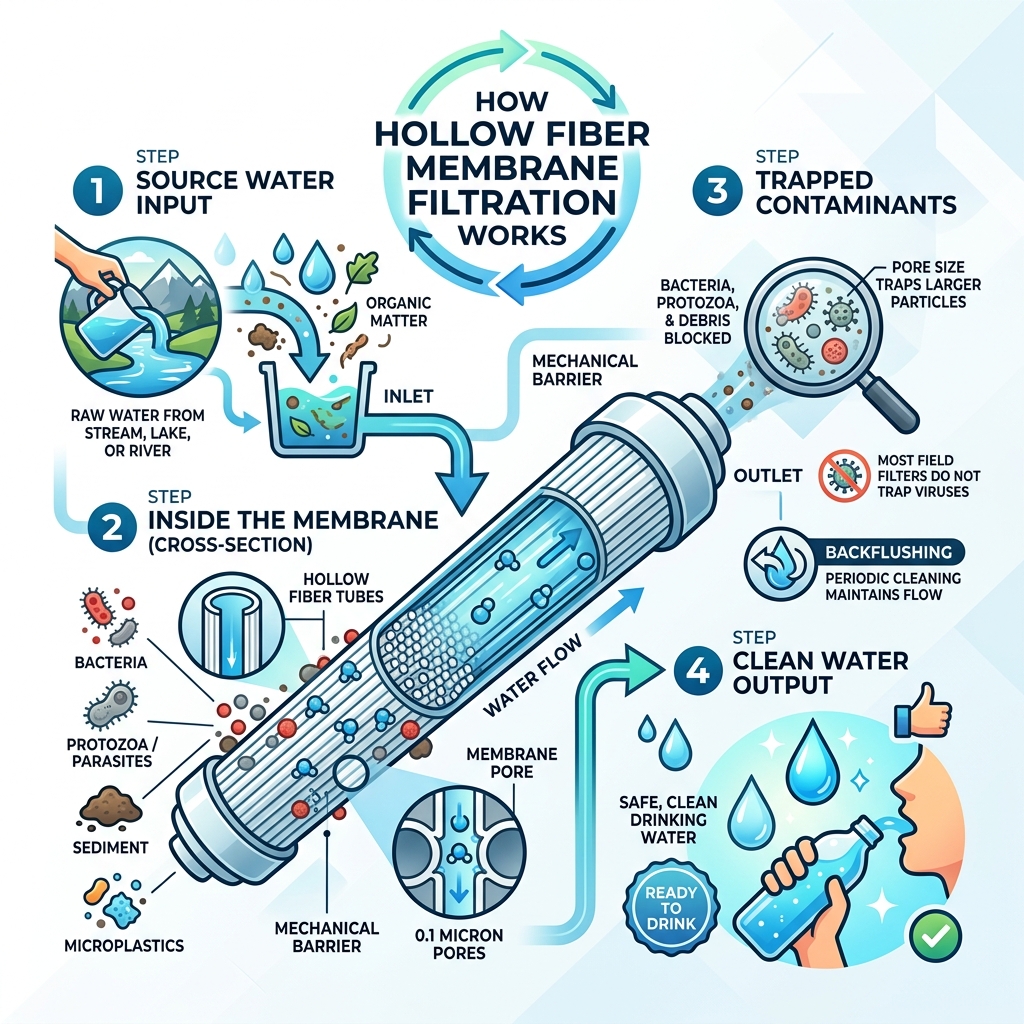
At its core, personal water filtration is a game of “keep away.” Most portable systems we use on the trail rely on mechanical filtration. Imagine a very fine microscopic strainer. This strainer is usually made of a hollow-fiber membrane—thousands of tiny, straw-like tubes with even tinier holes (pores) in their sides.
When you push or pull water through these tubes, the water molecules are small enough to pass through the pores. However, bacteria, parasites, and dirt are physically too large to fit. They get trapped on the outside of the membrane, while clean water flows through to the center of the tube and into your mouth.
Some advanced systems add a second stage called adsorption, often using activated carbon. While the hollow fibers catch the “big” stuff (biomass), the carbon works like a magnet for chemicals, pesticides, and heavy metals. This is also how many filters improve the taste of the water, removing that “pond” flavor or chlorine smell. For a deeper dive into these mechanics, you can check out our guide on the effective use of portable water purifiers.
Understanding Micron Ratings in Personal Water Filtration
The “tightness” of that microscopic strainer is measured in microns. One micron is one-millionth of a meter. To put that in perspective, a human hair is about 70 microns wide.
- 0.2 Micron: This is a common standard for many straw filters. It is effective at stopping 99.999999% of bacteria and 99.999% of parasites and microplastics.
- 0.1 Micron Absolute: Some premium squeeze filters use a 0.1-micron absolute rating. “Absolute” means that every single pore in the filter is 0.1 microns or smaller—nothing larger can slip through. This provides a higher margin of safety and is rated to remove 100% of microplastics.
- 0.02 Micron (Ultrafiltration): This is where we move from “filters” to “purifiers.” These pores are ten times smaller than a standard microfilter. They are so small they can actually block viruses, which are much tinier than bacteria.
According to the Performance Data Sheet, these ratings are verified through rigorous Lab Information to ensure they meet safety claims.
Certification Standards and EPA Protocols
When we talk about safety, we aren’t just taking the manufacturer’s word for it. Look for filters that meet NSF P231 and US EPA standards. These protocols require the filter to demonstrate a specific “log reduction” of pathogens:
- Bacteria: 6-log reduction (99.9999%)
- Protozoa/Parasites: 3-log reduction (99.9%)
Some systems also meet NSF 42 (for chlorine and taste) or NSF 53 (for heavy metals like lead). If a filter doesn’t list these certifications, it might just be a sediment filter, which won’t protect you from getting sick.
Comparing Filter Styles for Different Activities
Choosing the right personal water filtration device depends entirely on your “mission.” Are you running a trail marathon, or are you setting up a basecamp for a week?
Straws and Squeeze Systems for Backpackers
For the ultralight crowd, weight is everything.
- Straw Filters: These are the ultimate “just in case” tool. Weighing only about 1.6 oz (46g), they allow you to drink directly from a source. They have an unlimited shelf life if kept dry, making them perfect for emergency kits.
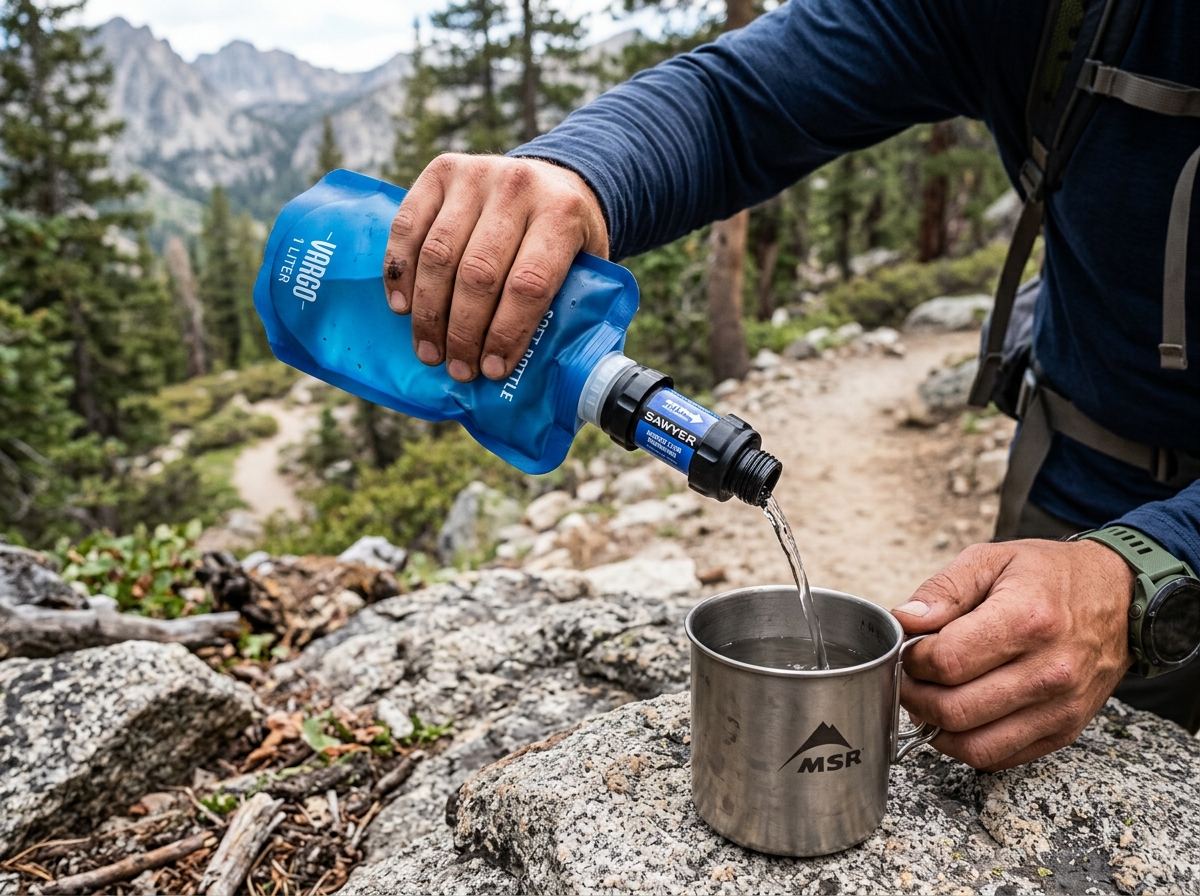
- Squeeze Systems: These are our favorite for versatility. Many feature 28mm threading, allowing them to screw directly onto standard plastic water bottles or collapsible pouches. You can “squeeze” the water into a clean bottle or attach them to hydration bladders for inline filtering while you walk.
If you’re looking for recommendations on the best gear for your next trip, see our list of the best portable water filters for hiking.
Gravity and Pressurized Systems for Groups
If you are filtering water for four people, nobody wants to spend an hour squeezing a bag.
- Gravity Systems: You hang a large “dirty” bag from a tree, connect a hose to the filter, and let gravity pull the water through into a “clean” reservoir. It’s hands-free and high-capacity.
- Pressurized Systems: These are the heavy hitters. Often used in humanitarian aid or remote job sites, these can hold over 5 gallons of water and deliver more than 1 liter per minute. Because they are pressurized, they can utilize ultrafiltration membranes (0.02 micron) to remove viruses without the slow flow rates usually associated with such tiny pores.
Contaminants Removed vs. Remaining Limitations
It is a common myth that all filters remove everything. Here is the reality of what personal water filtration handles:
- Bacteria: Removes E. coli, Salmonella, and Vibrio cholerae.
- Parasites (Protozoa): Removes Giardia and Cryptosporidium.
- Microplastics: Most 0.1 and 0.2-micron filters remove 99.9% to 100% of microplastics.
- Viruses: Standard microfilters do not remove viruses. You need an ultrafilter or a chemical/UV treatment for that.
Addressing Taste, Odors, and Minerals
While hollow fibers catch the “bugs,” they don’t always fix the taste. If your water tastes like a swimming pool or a swamp, you need a filter with an activated carbon stage. This reduces chlorine and organic matter.
However, there is a limitation: most portable filters do not remove minerals. This is a specific concern for users with health conditions like MAC (Mycobacterium avium complex) & Bronchiectasis. While the filters can remove the bacteria (like Pseudomonas or Staph), the dissolved minerals remain. If you boil filtered water for medical equipment, you may still see a white mineral film. In these cases, users often combine filtration with distilled water or boiling for maximum safety.
Maintenance, Storage, and Real-World Performance
A filter is only as good as its last cleaning. Over time, silt and “gunk” from turbid water (cloudy water) will clog the pores, slowing your flow rate to a crawl.
Backwashing is the most critical maintenance step. Most systems include a backwash syringe or a cleaning coupling. By forcing clean water backward through the filter, you pop the trapped sediment out of the membrane. This can restore up to 98.5% of the original flow rate.
Performance in the Wild
- Freezing Weather: This is the “filter killer.” If water inside the hollow fibers freezes, it expands and cracks the membrane. This damage is invisible, meaning you could be drinking contaminated water without knowing it. In freezing temps, keep your filter in an inside jacket pocket or at the bottom of your sleeping bag.
- High Altitude: Flow rates can actually slow down at higher elevations due to changes in air pressure.
- Turbid Water: If you have to filter from a muddy puddle, use a pre-filter (like a coffee filter or a bandana) to catch the big chunks first. This saves your expensive membrane from clogging prematurely.
Detailed instructions on care can be found in the User Manual or the Long Term Storage and Cleaning Instructions.
Maximizing the Lifespan of Personal Water Filtration Systems
How do you know when it’s time to say goodbye to your filter?
- Flow Stoppage: Most modern membranes are designed to “fail safe.” When the pores are completely full, water will simply stop flowing. You can’t “break” it by sucking harder; it’s just reached the end of its life.
- Rated Capacity: Straws typically last about 1,000 gallons (4,000L), while some squeeze filters are rated for up to 100,000 gallons.
- Hydrophilic Properties: If a filter dries out completely during long-term storage, the membrane can become “hydrophobic” (water-repelling). Follow the Long Term Storage Instructions to keep the membrane primed.
Frequently Asked Questions about Portable Filters
Do these filters remove minerals or help with MAC and Bronchiectasis?
Standard personal water filtration removes biological threats like bacteria and parasites, which is helpful for those with MAC. However, they do not remove dissolved minerals. If you need mineral-free water for medical devices, you must use distilled water.
How do I prevent my filter from breaking in freezing temperatures?
Once a filter has been wetted, it must never freeze. The best method is to keep it against your body (in a pocket) during the day and in your sleeping bag at night. If you suspect your filter has frozen, it is safest to replace it, as the internal damage cannot be seen.
What is the difference between a $20 straw and a premium pressurized system?
A $20 straw is a lightweight, single-user tool meant for drinking directly from a source. It has a slower flow rate and doesn’t remove viruses. A premium system (which can cost significantly more) often includes multi-stage filtration, virus protection, high-volume output for groups, and pressurized pumping that makes filtering effortless.
Conclusion
At Total Cobre, we believe that having the right gear is the difference between an epic adventure and a miserable trip to the emergency room. Personal water filtration technology has come a long way, moving from bulky pumps to palm-sized straws that can save lives.
Beyond your own safety, using these filters has a massive environmental impact. One filter can replace thousands of single-use plastic bottles, keeping our trails pristine. Furthermore, many brands in this space have incredible social impact programs, where a single purchase can provide a year of clean water for a child in need.
Whether you’re a weekend warrior or a thru-hiker, choosing the right system is about balancing weight, flow rate, and the specific contaminants in your area. For more help narrowing down your choice, read our guide on how to choose the best portable water filter for your hiking needs.
Stay hydrated, stay safe, and we’ll see you on the trail!
