
The Best Gravity Water Filters for Backpacking in 2026
Gravity water filter backpacking setups are one of the smartest ways to get clean drinking water on the trail — no pumping, no effort, just hang and wait.
Here are the top picks at a glance:
| Filter | Best For | Weight | Flow Rate |
|---|---|---|---|
| Platypus GravityWorks 4L | Groups | 11.5 oz | 1.75 L/min |
| Katadyn BeFree 3L | Ultralight solo | 6.8 oz | Fast |
| Sawyer Squeeze (gravity mode) | Versatile/budget | 3 oz | Moderate |
| MSR AutoFlow XL 10L | Large groups | 12 oz | 1.75 L/min |
| MSR Guardian Gravity | Virus protection | 18 oz | 0.5 L/min |
Most backpackers in North America do well with a hollow-fiber gravity filter rated at 0.2 microns — it removes bacteria and protozoa like Giardia and Cryptosporidium from backcountry streams. Gravity filters are especially popular with groups because they work hands-free while you set up camp or eat lunch.
The tradeoff? They weigh more than squeeze or straw filters, and slow flow can be frustrating with silty water. But for reliable, low-effort hydration — especially with two or more people — few systems beat them.
Below, we break down the best setups, what to look for, and how to keep your filter running for the long haul.
Understanding the Gravity Water Filter for Backpacking
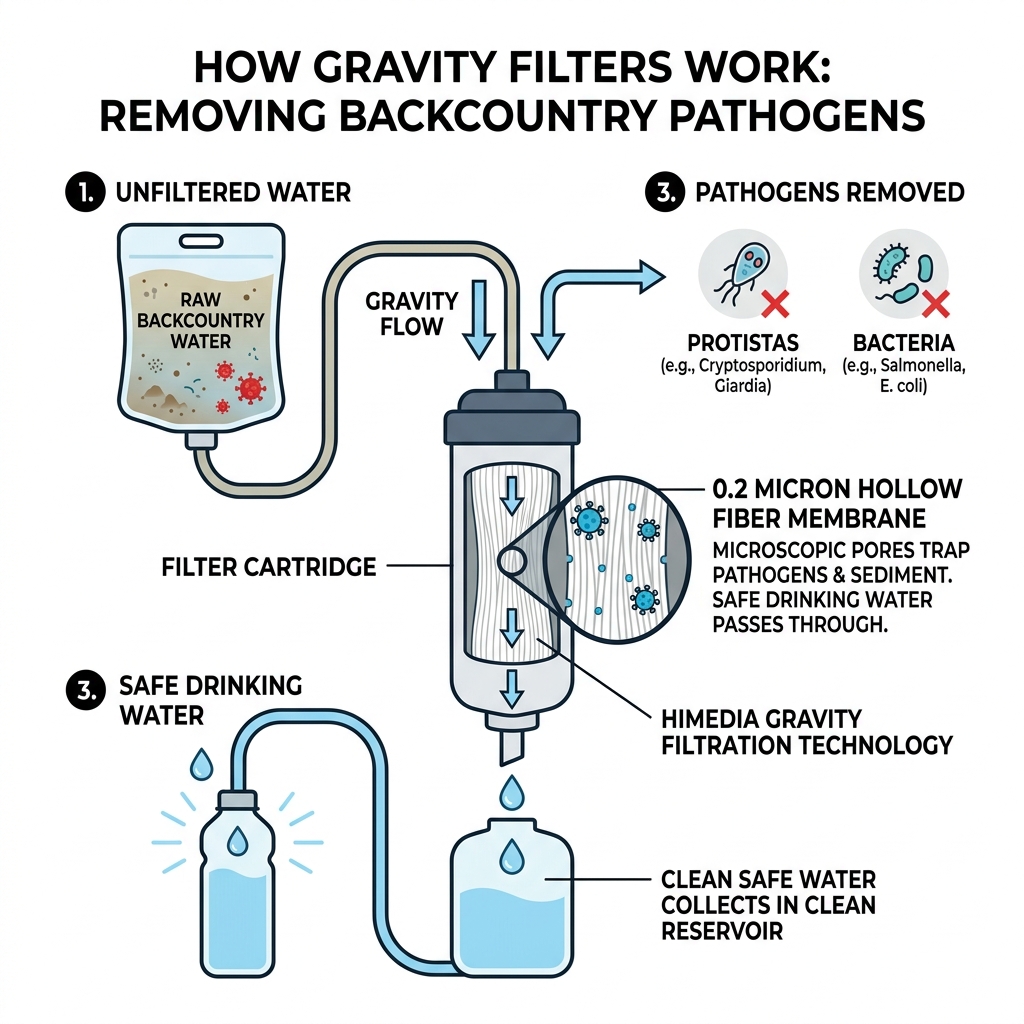
At its core, a gravity filter is a study in simplicity. While pump filters require muscle and squeeze filters require grip strength, a gravity water filter backpacking system uses the weight of the water itself to push liquid through a filtration membrane.

The setup typically consists of a “dirty” reservoir (where you scoop the creek water), a “clean” reservoir (where the good stuff ends up), and a filter cartridge connected by food-grade hosing. Most modern systems utilize hollow-fiber technology. These are essentially thousands of tiny straw-like tubes with microscopic pores, usually around 0.2 microns in size. These pores are small enough to trap 99.9999% of bacteria (like E. coli and Salmonella) and 99.9% of protozoa (like Giardia and Cryptosporidium), but large enough to allow water molecules to pass through freely.
The beauty of this system is the “set and forget” nature of the process. You can hang your dirty bag from a sturdy branch, connect the lines, and go about pitching your tent or starting your stove. By the time you’ve unrolled your sleeping bag, you have several liters of potable water waiting for you. This efficiency is why we often suggest that gravity-fed-water-filters-the-perfect-solution-for-group-camping-trips are the gold standard for anyone not hiking solo.
Key Factors for Choosing a Gravity Water Filter Backpacking System
When we evaluate these systems at Total Cobre, we look at more than just the price tag. A filter that works in a laboratory might fail when you’re staring at a silty puddle in the middle of a five-day trek.
Weight and Packability
For the ultralight crowd, every ounce is a prisoner. While a standard gravity water filter backpacking kit like the Platypus GravityWorks weighs about 11.5 oz, more minimalist setups can get down to 6-8 oz. However, this weight often includes your water storage. If the system replaces two heavy hard-sided bottles, the “weight penalty” might actually be a net gain.
Flow Rate and Capacity
Flow rate is measured in liters per minute (L/min). A high-performance system can process 1.75 L/min, meaning a 4-liter bag is finished in under three minutes. Capacity is equally vital. If you are hiking the Appalachian Trail with a partner, a 4L system is ideal. For larger groups or basecamps, you might want to look at 6L or even 10L reservoirs to minimize trips to the water source.
Field Cleanability and Integrity Testing
Backcountry water isn’t always crystal clear. Silt and tannins will eventually slow your flow to a crawl. You need a filter that is “field cleanable”—usually through a process called backflushing, where you force clean water backward through the filter to dislodge debris.
Additionally, we highly value filters that allow for “integrity testing.” Because hollow fibers are fragile, a single drop onto a rock or a night of freezing temperatures can create invisible cracks in the membrane. Some brands, like Katadyn and Platypus, have specific procedures to check if the filter is still safe to use.
Materials and Safety
Always ensure your reservoirs are made from BPA-free materials. Many top-tier bags also feature antimicrobial treatments (like SlimeGuard) to keep the plastic from developing that “swampy” taste after a few days on the trail. For a deeper dive into the logistics of camp placement, check out our guide on setting-up-gravity-water-filters-at-campsites-a-comprehensive-guide.
Top Recommended Gravity Filter Setups for the Trail
If you’re looking for the best all-around performer, the Platypus GravityWorks 4L is the industry benchmark. It’s a complete kit that includes both dirty and clean reservoirs, high-quality hoses with quick-connect valves, and a hollow-fiber cartridge that is incredibly fast. In our experience, it’s the most user-friendly system for pairs and small groups. It even features a shutoff clamp so you can use the clean bag like a tap for washing hands or filling pots.
Best Ultralight Gravity Water Filter Backpacking Setup
For those who want the benefits of gravity without the bulk, the BeFree 3L gravity system by Katadyn is a revelation. Weighing only 6.8 ounces, it’s significantly lighter than most competitors.
The BeFree uses a unique “StayClean” drink nozzle and a collapsible 3L Hydrapak reservoir. The filter itself is a hollow-fiber membrane that sits at the top of the bag. Cleaning is as simple as shaking the bag with some clean water inside—no syringes or extra hoses required. It’s perfect for the “fast and light” hiker who wants to process 3 liters of water quickly at camp before collapse into their quilt.
Best Versatile Gravity Water Filter Backpacking Option
The Sawyer Squeeze is arguably the most famous filter in backpacking history. While usually used as a “squeeze” filter, it is incredibly easy to convert into a gravity system. By using the included inline adapters, you can connect the Squeeze between two reservoirs or even a Smartwater bottle and a bladder.
The Sawyer Squeeze features a 0.1 micron absolute rating, which is slightly finer than many other brands. It also boasts a legendary lifespan—Sawyer claims it can filter up to 100,000 gallons if maintained properly. It’s the ultimate “choose your own adventure” filter for the DIY gear nerd.
High-Capacity Group Solutions
When you’re responsible for the hydration of a scout troop or a large family, you need volume. The MSR AutoFlow XL provides a massive 10L reservoir, allowing you to filter huge quantities of water in one go. It’s surprisingly light for its size (12 oz) and features a debris-shunning pre-filter at the intake.
However, if you are traveling internationally or in areas where human waste is a major concern, you might need more than a filter. You need a purifier. The MSR Guardian Gravity water purifier is one of the few gravity systems that meets military-grade standards for virus protection. With a 0.02-micron pore size, it physically removes viruses, which are much smaller than bacteria. While it’s heavier (18 oz) and has a slower flow rate (0.5 L/min), it offers peace of mind that standard filters simply can’t match.
Maintenance and Field Care for Longevity
A gravity water filter backpacking system is an investment, and like any piece of precision gear, it requires some TLC. If you treat your filter like a rock, it will eventually perform like one.
The Art of the Backflush
The most common reason for filter failure is “clogging.” To prevent this, you should backflush your filter regularly. For systems like the Platypus GravityWorks, this is easy: simply hold the clean bag above the dirty bag for a few seconds. The reverse flow of clean water will “burp” the air bubbles out and flush out sediment. For Sawyer systems, you’ll use a provided backflushing syringe. We recommend doing this at the end of every day, or more frequently if the water is murky.
Freezing: The Silent Killer
Hollow-fiber filters contain water even when they look dry. If that water freezes, it expands and shatters the tiny glass-like fibers inside. Once this happens, the filter is useless, as pathogens can sail right through the cracks. If you expect temperatures to drop below freezing, keep the filter cartridge in your pocket or at the bottom of your sleeping bag in a sealed Ziploc. Never trust a filter that you suspect has frozen.
Long-Term Storage
When you get home from your trip, don’t just throw the wet filter in your gear bin. You need to disinfect it to prevent mold and “biofilm” from growing inside the fibers. A common method is to run a liter of water with a few drops of bleach through the system. Let it air dry completely—which can take several days—before packing it away for the season.
Frequently Asked Questions about Gravity Water Filter Backpacking
How do gravity filters handle silty or murky water?
Silty water is the nemesis of the gravity water filter backpacking setup. Fine glacial flour or mud will clog pores almost instantly. To manage this, we suggest “pre-settling.” Fill your dirty bag and let it sit for 30-60 minutes; the heavy sediment will sink to the bottom. You can also use a bandana or pantyhose as a pre-filter over the mouth of the bag to catch larger organic matter. If the flow slows down, backflush immediately to restore performance.
Are gravity filters effective against viruses in the backcountry?
Standard gravity filters (0.1 to 0.2 microns) are not effective against viruses. In most of North America and Europe, viruses aren’t a major concern in the backcountry because they usually require a human host. However, if you are hiking in high-traffic areas or developing countries, you need a purifier like the MSR Guardian Gravity or a secondary treatment like UV treatment or Katadyn Micropur Tablets.
What is the typical lifespan of a gravity filter membrane?
Lifespan varies wildly by brand and water quality. A Platypus filter is generally rated for about 1,500 liters, while a Sawyer Squeeze is rated for 100,000 gallons. In reality, most hikers replace their cartridges every 2-3 years not because they’ve reached the gallon limit, but because mineral deposits or improper storage have degraded the flow rate.
Conclusion
At Total Cobre, we believe that gear should make your outdoor experience better, not more complicated. Choosing a gravity water filter backpacking system is a commitment to a more relaxed camp life. Instead of spending twenty minutes hunching over a stream pumping water, you can spend that time enjoying the sunset or planning tomorrow’s route.
Whether you choose the ultralight efficiency of the Katadyn BeFree, the group-friendly Platypus GravityWorks, or the bombproof protection of the MSR Guardian, the result is the same: safe, clean, and effortless hydration. Stay safe out there, practice Leave No Trace, and always carry a backup treatment method just in case.
Explore more expert hiking gear reviews at Total Cobre to find the perfect setup for your next adventure.
