
Why Every Trail Runner Needs a Reliable Water Filter
A good trail running water filter can be the difference between a safe backcountry adventure and a trip-ending illness. Whether you’re grinding out a 20-mile loop or racing an ultra with aid stations 50km apart, access to clean water is non-negotiable.
Here are the top trail running water filters to know:
| Filter | Weight | Flow Rate | Best For |
|---|---|---|---|
| Katadyn BeFree 0.6L | 59g | ~2L/min | Overall best, soft flask use |
| HydraPak 42mm Filter Cap | 57g | >1L/min | Runner-up, vest compatibility |
| Sawyer Mini | 57g | Fast | Budget pick, inline bladder use |
| LifeStraw Peak Series | 102g | Moderate | Long-distance durability |
| Platypus QuickDraw 1L | Moderate | 3L/min | Group use |
| SteriPen Ultralight UV | Light | 1L/90 sec | Virus-prone areas |
| Aquatabs Tablets | Negligible | 30 min/tablet | Emergency backup |
Wild water sources — streams, ponds, desert potholes — can carry bacteria, protozoa, and other pathogens that cause serious illness. You can’t tell if water is safe just by looking at it.
The good news? Modern filters are incredibly light. Many weigh under 60 grams and fit right into your hydration vest pocket. Elite ultrarunners like Hillary Allen carry one on every long run — not just for safety, but because filtering on the go means carrying less water weight from the start.
As Allen put it, a lightweight filter is a genuine game-changer for trail runners — it opens up bigger loops, longer days, and true self-sufficiency in the backcountry.
This guide breaks down the best options so you can find the right filter for your terrain, pace, and pack.
Essential Features of a High-Performance Trail Running Water Filter
When we’re deep in the pain cave at mile 20, the last thing we want to do is fight with a clunky piece of gear. A high-performance trail running water filter needs to be an extension of your running vest—unobtrusive, lightning-fast, and reliable. But what actually makes one “high-performance”? It comes down to the science of the squeeze.
Pore Size: The Gateway to Safety
The most critical technical spec is pore size. Most modern filters used by runners utilize hollow fiber membrane technology. These membranes are essentially a bundle of tiny straws with microscopic holes in the sides. For a filter to be effective against the “big two” trail terrors—bacteria (like E. coli) and protozoa (like Giardia and Cryptosporidium)—it needs a pore size between 0.1 and 0.2 micrometers.
To put that in perspective, a Giardia cyst is roughly 9-11 microns, and Cryptosporidium is about 4-5 microns. A 0.1-micron filter catches these easily, removing 99.9999% of bacteria and 99.99% of protozoa. However, viruses are much smaller (often 0.02 to 0.1 microns) and can slip through standard filters. If you’re running in areas with known virus risks, you’ll need to step up to a purifier.
Flow Rate and Weight
For us runners, flow rate is king. We don’t want to spend ten minutes crouching by a creek while our heart rate drops and our muscles stiffen. The best personal-water-filtration-devices-for-trails offer flow rates of at least 1 liter per minute.
Weight is the other non-negotiable. Every extra ounce in your vest contributes to shoulder fatigue and “vest bounce.” We look for systems that weigh under 100 grams. Many of the top-tier options today, like the Katadyn BeFree or the Sawyer Mini, hover around the 57-59 gram mark—roughly the weight of a single energy gel.
Packability and Integration
A filter is only good if you actually carry it. We prefer filters that integrate directly with the gear we already use. This means choosing a trail running water filter that screws onto a standard 42mm soft flask or fits inline with a hydration bladder hose. If it can be rolled up to the size of a candy bar when empty, it’s a winner in our book.
Best Overall Trail Running Water Filter for Speed: Katadyn BeFree 0.6L
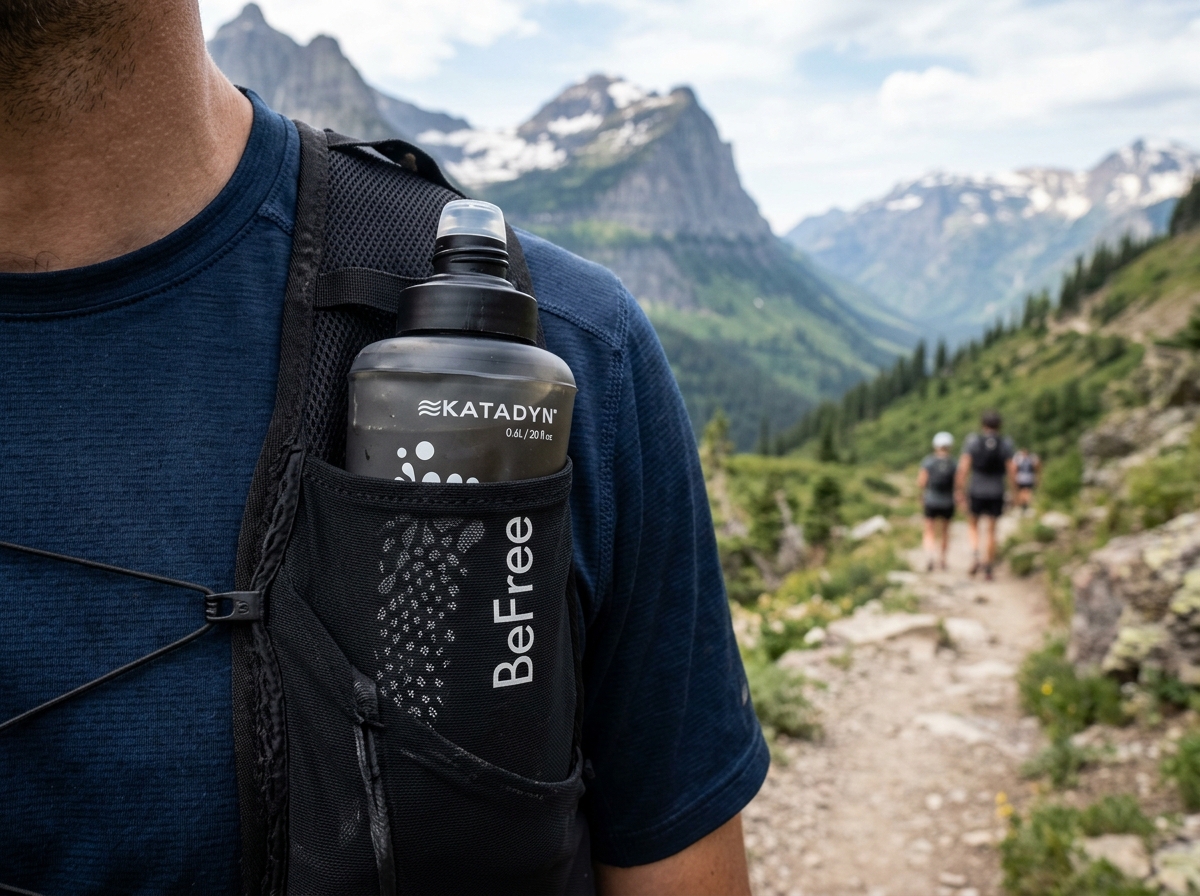
The Katadyn BeFree 0.6L is widely considered the gold standard for a reason. It was the original “filter-on-a-flask” that changed the game. Weighing in at just 59 grams (including the flask), it boasts an incredible initial flow rate of up to 2 liters per minute.
You simply scoop water from a stream, screw the cap on, and drink. There’s no setup, no hoses, and no waiting. It fits perfectly in the front pockets of almost every major running vest brand. If you are wondering how-to-choose-the-best-portable-water-filter-for-your-hiking-needs, the BeFree is the simplest answer for those who prioritize speed and weight.
Most Durable Trail Running Water Filter for Long Distance: LifeStraw Peak Series
If your adventures take you into rugged terrain where gear gets beat up, the LifeStraw Peak Series Collapsible Squeeze (650ml) is a top contender. While slightly heavier at 102 grams, it is built with thicker, more durable materials that resist punctures better than thinner TPU flasks.
It has a 2,000-liter lifespan and a versatile design that allows it to be used as a squeeze bottle, a straw, or even connected to a gravity system. For those checking out the best-portable-water-filters-for-hiking, this model offers a great balance of longevity and trail performance.
Best Budget-Friendly Filtration for Ultrarunners: Sawyer Mini
The Sawyer Mini is a legend in the ultralight community. For about $20-$25 (often sold in two-packs), you get a filter that weighs only 57 grams and is rated for a staggering 100,000 gallons. While its flow rate is slightly slower than the BeFree, its versatility is unmatched.
It can be used with the included squeeze pouch, attached to the end of a straw, or—most importantly for many—installed inline on a hydration bladder hose. This allows you to fill your bladder with “dirty” water and filter it as you sip. It’s a staple for top-rated-portable-water-filters-under-50 because it simply refuses to quit.
Top-Rated Filtration Systems for All-Terrain Use
When we look beyond the “big three,” several other specialized tools deserve a spot in your vest depending on the environment.
The HydraPak 42mm Filter Cap
This is a brilliant piece of engineering for runners who already own a fleet of HydraPak or Salomon soft flasks. It’s just the cap and filter—no extra bottle required. It weighs 57 grams and has a flow rate exceeding 1 liter per minute. In our testing, it has proven to be a very close runner-up to the BeFree, with some users finding it easier to clean over long-term use.
Salomon Soft Flask XA Filter
Specifically designed for Salomon vest users, this 490ml flask features a long, cylindrical filter. It’s incredibly comfortable against the chest because the filter is tucked inside the flask. At 57 grams, it’s a lightweight specialist, though it holds slightly less water than the 600ml BeFree.
SteriPen Ultralight UV: The Virus Specialist
If you’re running in international locations or areas where human/animal waste is a major concern, you might need a purifier rather than a filter. The SteriPen Ultralight UV treats 1 liter of water in 90 seconds using ultraviolet light to “scramble” the DNA of microbes, including viruses. It’s tiny and weighs only 77 grams. However, it doesn’t remove sediment or “floaties,” so it’s best used in clear water or in tandem with a pre-filter.
Platypus QuickDraw 1L: The Group Hero
Running with a crew? The Platypus QuickDraw is a favorite for group use. It has a massive flow rate (up to 3 liters per minute) and a sturdy 1-liter reservoir that rolls up small. One person can filter water for three runners in the time it takes to eat a stroopwafel. For More info about lightweight water purifiers, the QuickDraw is a standout for its “shake-to-clean” simplicity.
Maintenance and Longevity: Protecting Your Investment
A trail running water filter is a precision instrument. If you don’t take care of it, those microscopic pores will clog with silt, algae, and minerals, turning your high-speed filter into a useless piece of plastic.
Field Cleaning and Flow Restoration
Most filters will slow down over time. This is normal. To fix it, you need to “backwash” or “swish.”
- Swish/Shake: For the Katadyn BeFree, simply fill the flask with clean water and swish the filter element around vigorously. This dislodges debris from the outside of the fibers.
- Backwashing: Filters like the Sawyer Mini and LifeStraw Peak come with a syringe. You force clean water backward through the filter to blow out trapped particles.
The Winter Danger: Freezing
This is the most important rule of filter ownership: Never let your filter freeze after it has been used. Because hollow fiber filters work by trapping water inside tiny tubes, that water will expand if it freezes, bursting the fibers. This creates invisible cracks that allow pathogens to pass through.
If you’re running in sub-freezing temps, keep your filter in an inside pocket against your body heat. If you suspect your filter has frozen, it’s time to replace it. There is no reliable way to “test” it for microscopic cracks in the field.
Proper Storage
Don’t just toss your wet filter in a gear bin after a run. Mold and algae love damp filters.
- Clean it: Backwash with a weak bleach solution (a few drops per liter) to kill any lingering bacteria.
- Dry it: Let it air dry completely before storing.
- Saline Solution: LifeStraw actually recommends storing their filters in a saline solution to keep the membranes from drying out and becoming brittle.
We also strongly support initiatives that bring these technologies to those in need. You can Learn more about Sawyer’s clean water initiatives to see how the same technology we use for recreation is saving lives globally. Keeping your gear in top shape is part of reviewing-compact-water-filters-for-long-distance-hikers and ensuring you’re always ready for the next peak.
Frequently Asked Questions
Are water filters safe against all pathogens?
Standard water filters are incredibly effective—removing 99.9999% of bacteria and 99.99% of protozoa—but they are not a silver bullet. They do not remove viruses, which are generally only a concern in areas with high human impact or poor sanitation. They also don’t remove dissolved chemicals, heavy metals, or salt. For most North American backcountry running, a standard 0.1-micron filter is perfectly safe. If you’re searching-for-the-best-water-filters-to-keep-you-hydrated-on-trails, always check the local water quality reports for the region you’re visiting.
How much water should I carry on a trail run?
The “filter vs. carry” debate is all about the math. Water weighs 1 kilogram per liter (2.2 lbs). If you carry 2 liters, you’re lugging nearly 5 pounds. If you carry a 60g filter and refill every 5 miles, you save massive amounts of energy.
A general rule of thumb is to drink to thirst, but aim for roughly 500ml per hour in moderate conditions. If you’re using top-hiking-hydration-systems-with-filters, you can carry just 500ml at a time and “camel up” (drink a lot at the source) to keep your pack light.
What happens if my filter freezes?
As mentioned, freezing is the “silent killer” of water filters. If the water inside the hollow fibers turns to ice, it expands and breaks the membrane. You won’t see the damage, but the filter will no longer protect you from Giardia or Cryptosporidium.
In cold weather, always carry a backup. Aquatabs are our favorite emergency option. They are tiny, weigh almost nothing, and one tablet treats up to 2 liters of water. They take 30 minutes to work, but they don’t break if they get cold. For more on cold-weather safety, check out our guide on essential-water-filtration-systems-for-trekking-enthusiasts.
Conclusion
At Total Cobre, we believe that the right gear shouldn’t just help you survive the trail—it should help you enjoy it. Choosing the right trail running water filter is about more than just avoiding a stomach bug; it’s about the freedom to run farther, climb higher, and stay out longer without being tethered to a heavy water supply.
Whether you choose the lightning-fast Katadyn BeFree, the indestructible LifeStraw Peak, or the versatile Sawyer Mini, you’re investing in your safety and your performance. We specialize in these specialized gear guides because we know that for the adventurous hiker and runner, clean water is the ultimate fuel.
Visit Total Cobre for more outdoor gear reviews and stay rugged, stay ready, and stay hydrated out there!
