
Clean Water in the Backcountry: What Every Hiker Needs to Know
Hiking water filtration systems are essential gear for any backcountry trip where safe drinking water isn’t guaranteed.
Here’s a quick overview of your main options:
| System Type | Best For | Removes Viruses? | Avg. Weight |
|---|---|---|---|
| Squeeze filter | Solo hikers | No | 3-4 oz |
| Gravity filter | Groups/basecamp | No | 10-12 oz |
| Pump filter | All-around use | No (most) | 7-16 oz |
| Straw filter | Emergency/backup | No | 2 oz |
| UV purifier | International travel | Yes | 3-4 oz |
| Chemical drops | Backup treatment | Yes (most) | <1 oz |
| Pump purifier | High-risk water | Yes | 17-20 oz |
Even a crystal-clear mountain stream can make you seriously ill. Waterborne pathogens like Giardia and Cryptosporidium are invisible to the naked eye — and increasingly common due to growing human and animal activity in wilderness areas.
The good news? You have a lot of solid options. The tricky part is matching the right system to your trip style, group size, and water source conditions — without loading your pack with gear you don’t need.
Whether you’re a solo thru-hiker counting every ounce or a group leader setting up a basecamp, this guide breaks it all down in plain language so you can make a confident choice.
Comparing the Main Types of Hiking Water Filtration Systems
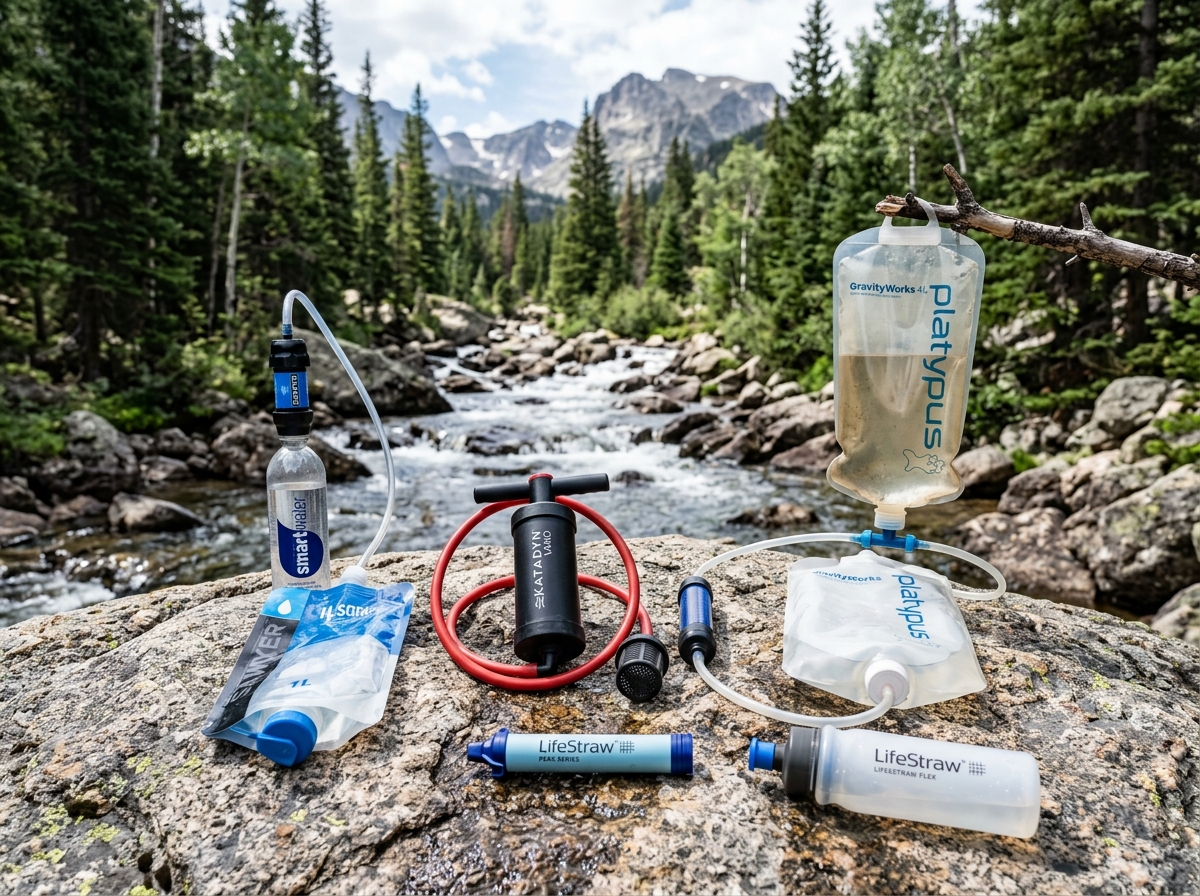
Choosing between different hiking water filtration systems can feel like trying to solve a puzzle while dehydrated. To make it easier, we need to look at the mechanics of how these devices actually get the “gunk” out of your drink. Most modern systems rely on mechanical straining, but the way you move the water through that strainer varies wildly.
Pump Filters
These are the “old reliable” of the backpacking world. You drop a hose into the water source and use a hand lever to pump water through a filter cartridge into your bottle.
- Pros: Great for shallow seeps or puddles where you can’t easily submerge a bag. They often include a carbon core to improve taste.
- Cons: They involve moving parts that can break, and they require a fair bit of elbow grease. The MSR MiniWorks EX, for example, requires about 85 strokes to process a single liter.
Gravity Systems
If you’re like us and prefer to let nature do the heavy lifting, gravity systems are a dream. You fill a “dirty” bag, hang it from a tree, and let gravity pull the water through an inline filter into a “clean” reservoir.
- Pros: Completely hands-free. While the water filters, you can set up your tent or start dinner.
- Cons: They can be bulky and require a sturdy branch or high point to work effectively.
Squeeze Bags
This is currently the most popular choice for thru-hikers and ultralight enthusiasts. You fill a soft-sided pouch, screw the filter onto the top, and squeeze the water into your mouth or a clean bottle.
- Pros: Extremely lightweight and simple. Systems like the Sawyer Squeeze or Katadyn BeFree weigh just a few ounces.
- Cons: The bags can eventually develop leaks if you squeeze too hard, and the flow rate can slow down as the filter clogs.
Straw-Style Filters
Think of these as the ultimate emergency backup. You stick the straw directly into the water source and drink.
- Pros: Very cheap and light. The classic LifeStraw weighs only 2 ounces.
- Cons: You have to get down on your hands and knees to drink, and you can’t easily use them to filter water for cooking or for your friends.
UV Light Purifiers and Chemical Drops
These don’t “filter” out dirt; they “purify” by killing or neutralizing pathogens. UV pens like the Steripen Ultra use ultraviolet light to scramble the DNA of bacteria and viruses, while chemical treatments like Aquamira drops use chlorine dioxide to do the job.
- Pros: UV is fast (about 60-90 seconds), and chemicals are the lightest option possible.
- Cons: UV requires batteries and clear water (it won’t work in muddy water). Chemicals often require a wait time of 30 minutes to 4 hours to be fully effective.
For a deeper dive into the mechanics, check out our guide on Essential Water Filtration Systems for Trekking Enthusiasts.
Lightweight Hiking Water Filtration Systems for Solo Backpackers
When we’re hiking solo, we prioritize speed and weight. Most solo hikers gravitate toward hollow fiber membrane technology. These filters contain thousands of tiny “straws” with microscopic holes (usually 0.1 to 0.2 microns) that allow water through while trapping bacteria and protozoa.
The Sawyer Squeeze is the undisputed king of the trail for a reason. It has a legendary lifetime capacity—rated for up to 100,000 gallons (378,541 liters). For most of us, that’s more water than we’ll drink in several lifetimes. It filters about a liter in 40 seconds, making it one of the fastest lightweight options.
Another fantastic solo option is the BeFree 1.0 liter system. It weighs less than 3 ounces and features a wide-mouth flask that is much easier to fill in a stream than the narrow-neck bags that come with other systems. The LifeStraw Peak Squeeze is another contender, offering a projected lifespan of 2,000 liters (500 gallons) and a very durable, tear-resistant bag.
High-Volume Hiking Water Filtration Systems for Groups and Basecamps
If you’re hiking with a partner, your kids, or a large group, squeezing individual bags of water becomes a chore very quickly. This is where high-volume gravity systems shine.
The Platypus GravityWorks is a favorite in our group trips. It comes in 4L and 6L capacities and can filter a liter of water in about 52 seconds without you having to lift a finger. For massive groups or basecamps, the MSR AutoFlow XL offers a 10-liter reservoir, ensuring everyone has enough water for hydration, cooking, and the occasional trail “shower.”
Using a gravity system allows for “multi-tasking” in camp. While you’re busy setting up your sleep system or inflated pads, the gravity bag is doing the work for you. For more tips on group setups, see why Gravity Fed Water Filters The Perfect Solution for Group Camping Trips are a game-changer.
Filters vs. Purifiers: Understanding Contaminant Removal
This is the most important distinction in hiking water filtration systems, and getting it wrong can lead to a very unpleasant trip.
- Water Filters: These remove bacteria (like E. coli and Salmonella) and protozoa (like Giardia and Cryptosporidium). Most use a 0.1 or 0.2-micron pore size. This is perfectly adequate for 99% of backpacking in the United States and Canada.
- Water Purifiers: These do everything a filter does, plus they neutralize viruses (like Norovirus and Hepatitis A). Viruses are significantly smaller than bacteria, often measuring just 0.02 microns, which allows them to slip through standard filters.
When do you need a purifier?
In most remote wilderness areas, viruses aren’t a major concern because they are usually spread through human waste. However, if you are traveling internationally (especially in developing countries) or hiking in areas with extremely high human impact and poor sanitation, a purifier is a must.
The MSR Guardian Purifier is a beast in this category. It uses a 0.02-micron pore size to remove 99.9999% of bacteria, 99.99% of protozoa, and 99.99% of viruses. It’s also one of the few filters that can handle extremely turbid (muddy) water without instantly clogging, thanks to its self-cleaning mechanism.
Regardless of which system you choose, always follow LNT.org Principles by keeping your camp and toilet areas at least 200 feet away from any water source to protect the ecosystem for others.
Maintenance and Reliability: Keeping Your System Flowing
A water filter is only good as long as water can actually pass through it. Over time, sediment, minerals, and “biological bits” will clog the microscopic pores of your filter.
Backflushing
Most hollow fiber filters (like the Sawyer or LifeStraw Peak) require “backflushing.” This involves forcing clean water backward through the filter to push out the trapped debris. Many systems come with a large syringe for this purpose. If your flow rate starts to drop—for example, if your Sawyer Squeeze is taking 2 minutes to filter a liter instead of 40 seconds—it’s time to backflush.
The Danger of Freezing
This is the “hidden” danger of hollow fiber filters. If water is inside the tiny fibers and it freezes, the ice expands and cracks the fibers. This creates large holes that allow pathogens through. A frozen filter is a broken filter, and there is often no way to tell it’s damaged just by looking at it.
If you’re hiking in freezing conditions, you must keep your filter in your pocket during the day and inside your sleeping bag at night to keep it warm. Some filters, like the MSR Guardian, are specifically rated to withstand freezing, but for most, a single night of frost means you need a new filter.
Integrity Testing
Some high-end filters, like the Katadyn BeFree or MSR Guardian Gravity, allow for a “manufacturer-approved integrity test.” This usually involves trying to blow air through the filter while it’s wet; if you can blow air through, the membrane is compromised. We feel this is a mandatory feature for anyone doing long-term thru-hikes or international travel.
For more maintenance hacks, read our guide on How to Effectively Use a Portable Water Filter on Your Next Trail Adventure.
Building a Complete Water Storage and Treatment Kit
A filter is just one part of your hydration strategy. To stay healthy and efficient, you need a complete system that includes storage and redundancy.
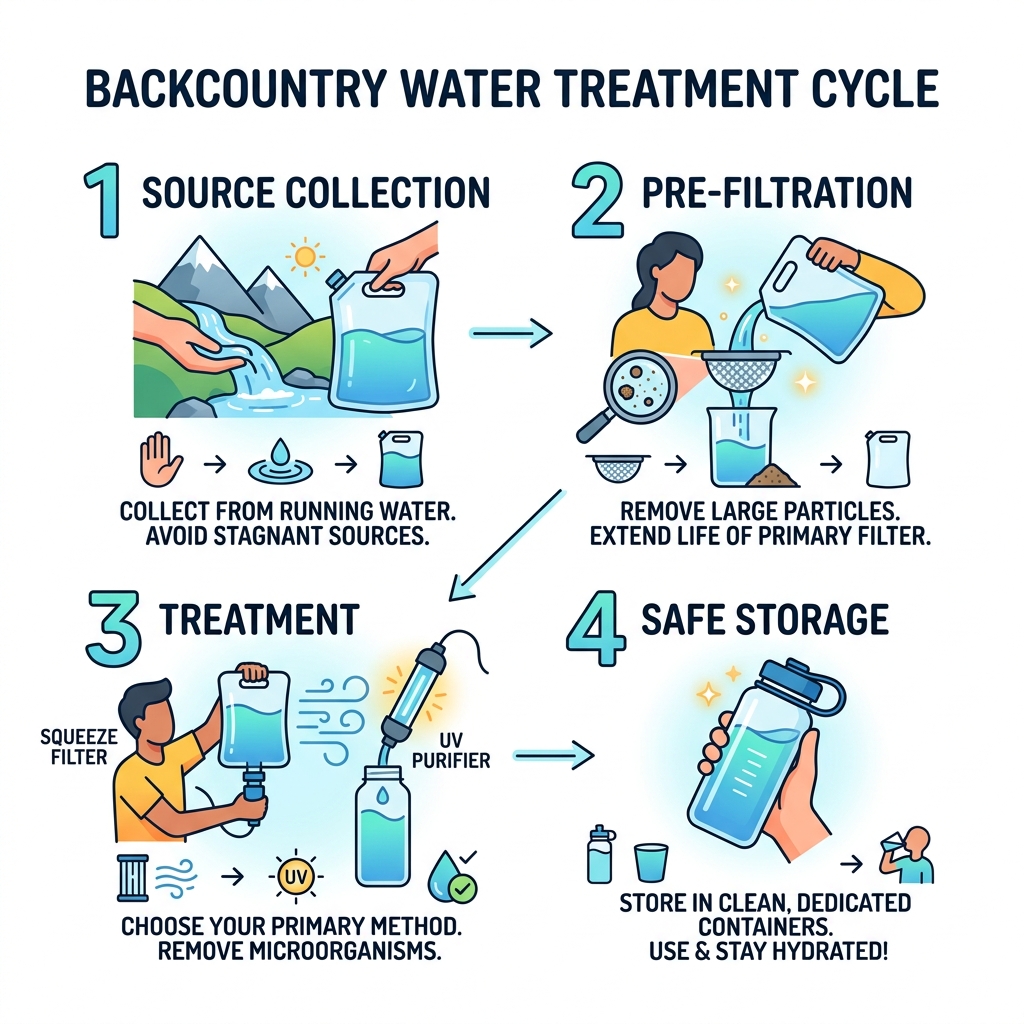
The “Dirty” vs. “Clean” Setup
We recommend clearly labeling your containers. Using a soft-sided bladder like the Cnoc VectoX for your “dirty” water is a pro move. It has a wide back opening that makes it easy to scoop water from a lake. You then filter that water into a “clean” vessel, like the Igneous NOBO (a durable, hard-sided HDPE bottle) or a standard reusable sport bottle.
Redundancy is Key
What happens if your filter clogs, breaks, or freezes? We always carry a backup. A small 10-pack of AquaTabs or a small bottle of Aquamira weighs almost nothing and can save your trip if your primary filter fails. Think of it as insurance for your intestines.
Pre-filtering
If you’re forced to take water from a muddy puddle or a silty river, don’t just shove it into your filter. Use a pre-filter—even a bandana or a coffee filter over the mouth of your bag—to catch the big chunks. This will significantly extend the life of your expensive filter cartridge.
For a step-by-step checklist, see our article on Assembling a Portable Water Purification Kit for Outdoor Use.
Frequently Asked Questions about Water Treatment
How do I protect my filter from freezing?
As mentioned, hollow fiber filters are very fragile when it comes to ice. During the day, keep the filter in an internal jacket pocket where your body heat keeps it thawed. At night, tuck it into a sealed Ziploc bag (to prevent leaks) and put it at the bottom of your sleeping bag. If you suspect your filter has frozen, do not trust it; switch to your backup chemical treatment.
When is a water purifier necessary over a filter?
If you are hiking in the “lower 48” of the U.S. or in most of Canada, a standard 0.1 or 0.2-micron filter is usually enough. However, if you are traveling to areas with poor water infrastructure (parts of Central/South America, Africa, or SE Asia) or areas where human waste is likely present in the water (popular “party” lakes or flood zones), you need a purifier that handles viruses.
How do I treat turbid or muddy water?
Muddy water is the enemy of hiking water filtration systems. The best strategy is “settling.” Fill a large bag with the muddy water and let it sit for an hour or two. The sediment will settle to the bottom. Carefully scoop the clearer water from the top to run through your filter. If you must filter muddy water directly, use a system like the MSR Guardian, which is designed to handle high silt loads.
Conclusion
At Total Cobre, we believe that the best water filter is the one you actually feel comfortable using. If a pump filter feels too much like a gym workout, go for a gravity bag. If you’re an ultralight hiker who wants to “fill and go,” a squeeze system is your best friend.
Remember the golden rules:
- Match the tool to the trip: Squeeze for solo, Gravity for groups, Purifiers for international travel.
- Maintain your gear: Backflush often and never let a hollow fiber filter freeze.
- Always have a backup: Carry those chemical tabs!
Clean water is the fuel that keeps your adventure going. By choosing the right system and taking care of it, you can focus on the views instead of worrying about what’s in your bottle. For more gear reviews and trail-ready advice, check out More info about outdoor gear and stay hydrated out there!
