
The Hands-Free Way to Stay Hydrated in the Backcountry
Gravity water filters for camping are the easiest way to get clean drinking water on multi-day trips without pumping, squeezing, or waiting around.
Here are the top picks at a glance:
| Filter | Capacity | Weight | Best For |
|---|---|---|---|
| LifeStraw Peak Series 3L | 3L reservoir | 8.1 oz | Solo to small groups |
| Platypus GravityWorks 4L | 4L reservoir | 11.5 oz | Small groups |
| Katadyn BeFree Gravity 6L | 6L reservoir | 9.3 oz | Groups up to 10 |
| MSR Guardian Gravity | 10L reservoir | 18 oz | Virus-risk areas |
| Glacier Fresh | Up to 3G system | Varies | Basecamp use |
You hang the dirty bag, walk away, and come back to clean water. No effort needed.
That simplicity is exactly why gravity filters have become a go-to choice for campers and backpackers who need to hydrate a group without turning water treatment into a chore. While you set up camp, cook dinner, or rest your legs, the filter does the work.
But not all gravity filters are equal. Flow rates, filter lifespan, weight, and what contaminants they actually remove vary a lot from model to model.
This guide cuts through the noise so you can pick the right one for your next trip.
Understanding the Gravity Water Filter for Camping
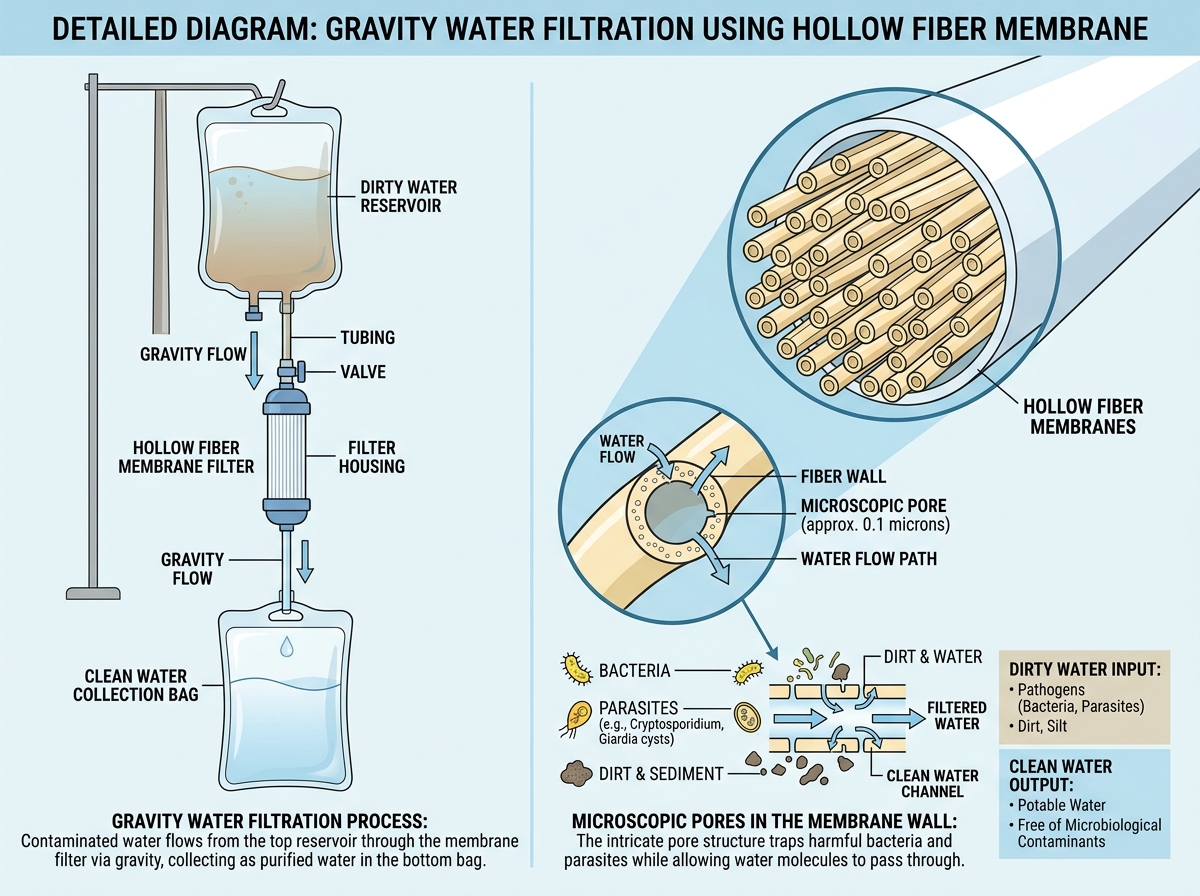
At its core, a gravity water filter for camping is a passive system. Unlike pump filters that require muscle or squeeze filters that require grip strength, gravity systems use the weight of the water itself to push liquid through a filtration medium.
Most modern systems utilize hollow fiber membrane technology. Imagine thousands of tiny straws with microscopic holes in the sides. These holes are typically 0.2 microns in size. To put that in perspective, a human hair is about 70 microns wide. These tiny pores are small enough to trap 99.9999% of bacteria (like E. coli and Salmonella) and 99.9% of protozoan parasites (like Giardia and Cryptosporidium).
What They Remove (and What They Don’t)
When you are out in the wild, your primary threats are biological. A high-quality gravity water filter for camping protects against:
- Bacteria: 99.999999% removal (LifeStraw Peak Series standards).
- Parasites: 99.999% removal.
- Microplastics: 100% removal in many top-tier models.
- Silt and Sand: Essential for protecting your stomach and the longevity of the filter.
However, standard filters do not remove viruses. Viruses are significantly smaller than bacteria, requiring a “purifier” with a pore size of roughly 0.02 microns. If you are traveling internationally or in areas with high human impact, you might need a system like the MSR Guardian Gravity, which meets the rigorous NSF P248 military-grade standards for virus removal. For more technical details on how these membranes hold up under pressure, you can Download Performance Data Sheet to see the lab results.
Top-Rated Gravity Water Filter for Camping Systems
Choosing the right system depends on whether you’re a solo gram-counter or the “camp chef” for a group of six. We’ve analyzed the top performers based on flow rate, durability, and ease of use.
| Model | Reservoir | Filter Life | Flow Rate | Weight |
|---|---|---|---|---|
| LifeStraw Peak 3L | 3 Liters | 2,000 L | 1.7 L/min | 8.1 oz |
| Platypus GravityWorks | 4 Liters | 1,500 L | 1.75 L/min | 11.5 oz |
| Katadyn BeFree 6L | 6 Liters | 1,000 L | 2.0 L/min | 9.3 oz |
| MSR Guardian Gravity | 10 Liters | 3,000+ L | 0.5 L/min | 18.7 oz |
| Glacier Fresh | 8.5 Liters | 3,000 Gal | Slow/Steady | Varies |
LifeStraw Peak Series 3L
The LifeStraw Peak Series 3L is a masterclass in versatility. It’s not just a bag you hang; the filter itself is modular. You can unscrew the filter and use it as a straw, or attach it to a standard water bottle. It weighs only 8.1 ounces, making it light enough for backpacking but high-capacity enough for a small group.
The membrane is designed to stop flowing once it reaches the end of its 500-gallon (2,000L) lifespan, so you never have to guess if you’re drinking “bad” water. For a step-by-step on how to swap between modes, Download User Manual.
Platypus GravityWorks 4L
If you’ve ever been on a group trip, you know the Platypus GravityWorks. It is often cited as the “Gold Standard” for group hydration. It features a dual-bag system: a “Dirty” bag for collection and a “Clean” bag for storage.
This setup is incredibly efficient for basecamps. You fill the dirty bag, hang it, and 4 liters of water are ready in under three minutes. It’s a bit bulkier than solo options, but the time saved is worth every ounce. You can Check price at REI to see if it fits your budget for the upcoming season.
Budget-Friendly Options: Glacier Fresh and Waterdrop
Not everyone needs a $150 titanium-reinforced system. For car camping or established basecamps, brands like Glacier Fresh and Waterdrop offer incredible value.
Glacier Fresh systems are often stainless steel and designed to sit on a table rather than hang from a tree. They use activated carbon and hollow fiber to remove up to 200 contaminants, including chlorine and heavy metals, which improves taste significantly. They are perfect for those who want a “set it and forget it” solution for the weekend. You can often find a great See Deal on Amazon for these high-capacity units.
Choosing the Right Gravity Water Filter for Camping
When we go out to test gear at Total Cobre, we look at several key factors. A gravity water filter for camping isn’t just about the filter; it’s about the “system.”
Capacity and Group Size
- Solo Campers: A 2L or 3L system (like the LifeStraw Peak) is plenty. It provides enough for a full day of drinking and a dehydrated meal at night.
- Small Groups (2-4 people): The 4L Platypus or 3L Katadyn BeFree are the sweet spots. They balance weight with the need for frequent refills.
- Large Basecamps: Look for 6L to 10L reservoirs. The Katadyn BeFree Gravity 6L or MSR AutoFlow XL (10L) allow you to filter once in the morning and once at night, providing enough water for cooking, cleaning, and drinking for a large crew.
Flow Rate and Performance
Flow rate is measured in liters per minute (L/min). While manufacturers often claim speeds up to 2 L/min, real-world conditions (like silty lake water) will slow this down.
- High Flow: Katadyn BeFree (2 L/min) is exceptionally fast thanks to its large surface area membrane.
- Steady Flow: MSR Guardian (0.5 L/min). While slower, it is much more consistent in “gnarly” water because it is designed to handle heavy sediment without a total clog.
Maintenance and Field Care for Peak Performance
The biggest enemy of a gravity water filter for camping is sediment. Silt, glacial flour, and tannins can clog those 0.2-micron pores faster than you can say “Giardia.”
Backflushing: Your Best Friend
Backflushing is the process of forcing clean water backward through the filter to pop out trapped debris.
- Platypus: Simply lower the dirty bag below the clean bag for 4 seconds.
- LifeStraw/Sawyer: Use the included syringe to blast clean water through the outlet.
- Katadyn: Just “shake or swish” the filter in clean water to dislodge gunk.
Pro Tips for Longevity
- Pre-Filtering: If the water looks like chocolate milk, wrap a bandana or a piece of pantyhose around the intake. This catches the “big stuff” before it hits your expensive filter.
- Air Locks: If water stops flowing but the bag is full, you likely have an air bubble in the hose. Lift the hose above the bag and let the air escape upward.
- Freeze Protection: Hollow fiber filters contain water. If that water freezes, it expands and cracks the fibers, rendering the filter useless. If it’s going to be a cold night, keep the filter cartridge in your sleeping bag.
- Storage: Never store a wet filter for the winter. It will grow mold. For detailed steps on long-term care, Download Storage Instructions.
Frequently Asked Questions
How do gravity filters handle silty or turbid water?
Most gravity filters can handle some cloudiness, but high turbidity will slow the flow rate significantly. In places like the Colorado River or glacial runoff areas, you may need to backflush every 2-3 liters. The MSR Guardian is the only gravity purifier designed specifically to handle “muck” without constant maintenance, as it is self-cleaning.
Can I use a squeeze filter in gravity mode?
Yes! Popular squeeze filters like the Sawyer Squeeze or LifeStraw Peak Squeeze are “gravity-compatible.” By using an adapter kit or a compatible bladder (like a Cnoc Vecto), you can hang your squeeze bag and let it flow. It won’t be as fast as a dedicated 4L gravity system, but it’s a great way to save weight for solo trips.
What is the average lifespan and replacement cost?
Filter life varies wildly. A Sawyer Squeeze can last for 100,000 gallons (essentially a lifetime), while a Katadyn BeFree typically lasts about 1,000 liters. Replacement cartridges usually cost between $25 and $40. At Total Cobre, we recommend checking the “cost per liter” if you are a frequent hiker.
Conclusion
Switching to a gravity water filter for camping is one of the best gear upgrades you can make. It transforms a tedious chore into a background task, giving you more time to enjoy the views and less time hunched over a stream bank.
Whether you choose the modular LifeStraw Peak Series 3L, the group-friendly Platypus GravityWorks, or a budget-friendly Glacier Fresh system, the key is proper maintenance. Keep it clean, keep it from freezing, and it will keep you safe for years of adventure.
Stay hydrated, stay safe, and we’ll see you on the trail!
Looking for more gear advice? Check out our category/gear-reviews or our guide on essential-water-filtration-systems-for-trekking-enthusiasts.
