
The Best Compact UV Purifier Hiking Options Right Now
Compact UV purifier hiking gear has become one of the smartest upgrades a backpacker can make. But if you just want the quick answer, here it is:
Top compact UV purifiers for hiking:
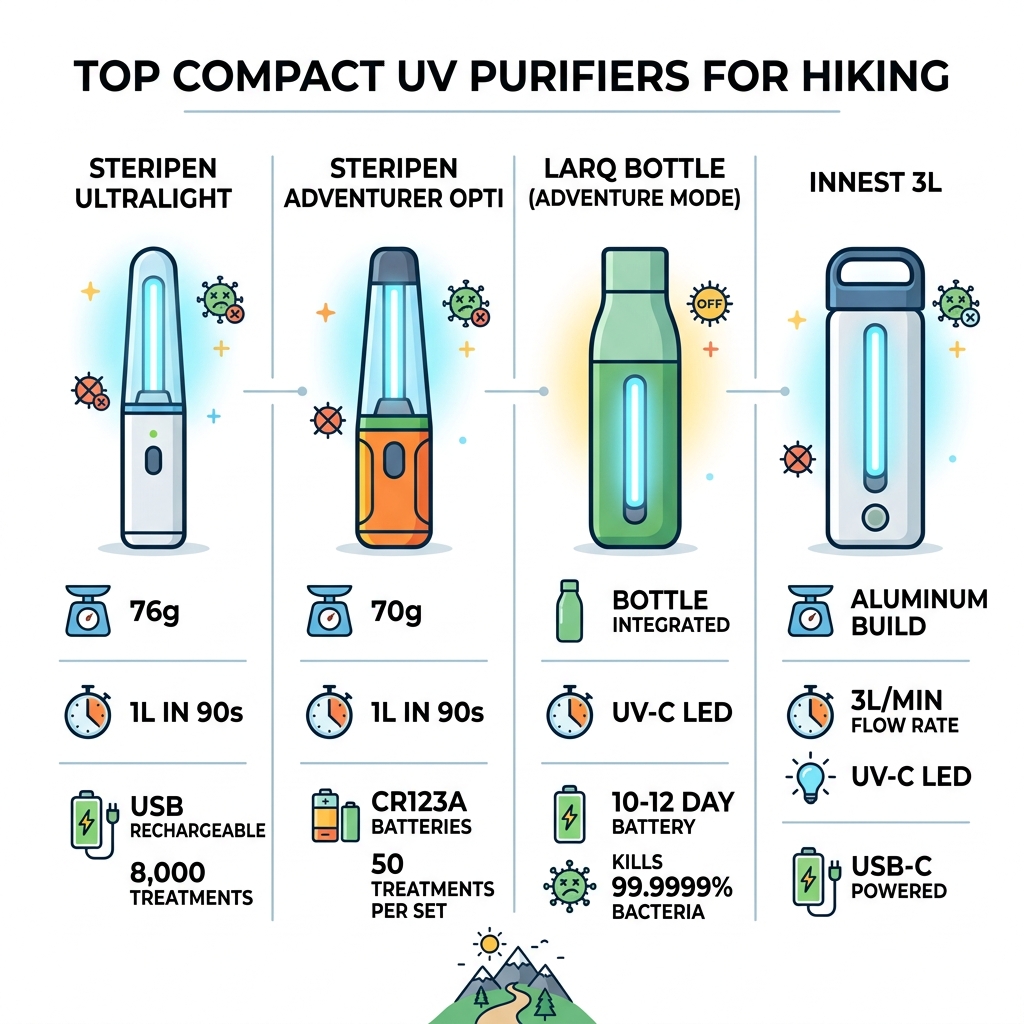
- Steripen Ultralight – 76g, USB rechargeable, 1L in 90 seconds, 8,000 treatments
- Steripen Adventurer Opti – 70g, CR123A batteries, 50 treatments per set, 1L in 90 seconds
- LARQ Bottle (Adventure Mode) – UV-C LED, 10-12 day battery, kills 99.9999% bacteria
- Innest 3L – USB-C powered, UV-C LED, 3L/min flow rate, aluminum build
All four kill bacteria, viruses, and protozoa – including Giardia and Cryptosporidium – without chemicals, without clogging, and without adding any taste to your water.
You’re deep in the backcountry. Your water bottle is empty. The stream ahead looks clean, but looks are deceiving – waterborne pathogens like Giardia and Cryptosporidium are invisible to the naked eye. A heavy pump filter works, but it slows you down and clogs at the worst moments.
That’s exactly the problem a compact UV purifier solves.
These devices weigh as little as 70 grams – less than most energy bars – and can purify a full liter of water in 90 seconds flat. No pumping. No waiting 30 minutes for chemicals to work. No filter membranes to backflush or freeze and crack overnight.
The technology is simple but powerful: a shortwave UV-C light disrupts the DNA of pathogens so they can’t reproduce, even if they’re still technically present in the water. You drink. They die. You stay healthy.
This guide covers the best compact UV purifiers for hiking, how they compare on weight and battery life, where they shine, and where they fall short.
How UV Technology Revolutionizes Water Safety
At the heart of every compact uv purifier hiking device is a small but mighty lamp emitting UV-C light. Specifically, these devices target a shortwave UV wavelength of approximately 254nm. This isn’t just a bright light; it is a germicidal powerhouse.
When you stir a UV purifier in your water bottle, the light penetrates the cells of harmful microorganisms. It doesn’t necessarily “kill” them in the traditional sense of exploding them, but it does something much more effective: it destroys their DNA. By scrambling their genetic code, the UV light renders bacteria, viruses, and protozoa unable to reproduce. Since they cannot replicate in your digestive system, they cannot make you sick.
According to World Health Organization data, at least 2 billion people use a drinking water source contaminated with feces, which can transmit diseases like cholera, dysentery, and typhoid. While many hikers believe standard filters are enough, those filters often have pore sizes between 0.1 and 0.4 microns. Research from the CDC confirms that viruses like norovirus and rotavirus are small enough to pass right through those pores. UV purifiers, however, effectively neutralize these tiny threats, making them a superior choice for harnessing-uv-light-purifiers-for-safe-backpacking-trips.
Choosing the Best Compact UV Purifier Hiking Gear
When selecting your gear, weight and power source are usually the deciding factors. For a through-hiker, every gram counts. For a weekend warrior, the convenience of USB charging might trump the raw weight savings of specialized batteries.
| Model | Weight | Power Source | Treatment Speed (1L) |
|---|---|---|---|
| Steripen Adventurer Opti | 70g (2.5 oz) | 2x CR123A Batteries | 90 Seconds |
| Steripen Ultralight | 74g (2.6 oz) | Internal USB Rechargeable | 90 Seconds |
| Steripen Ultra | 140g (4.9 oz) | Internal USB Rechargeable | 90 Seconds |
| LARQ (Adventure Mode) | Bottle Integrated | Internal USB Rechargeable | 3 Minutes |
| Innest 3L | Minimalist | USB-C (External Power) | 3L / Minute (Inline) |
Essential Specs of a Compact UV Purifier Hiking Device
When we look at the specs, the “Ultralight” and “Adventurer” models clearly lead the pack for portability. The Steripen Ultralight is a favorite because it eliminates the need to carry spare CR123A batteries, which can be hard to find in small trail towns. It treats about 20 liters per charge and has a total lamp life of 8,000 activations. That is enough to last most hikers several years of frequent use.
The Steripen Adventurer Opti, weighing in at just 70g without batteries, is even lighter but relies on disposable CR123A lithium batteries. While this adds a small recurring cost (about $1 per battery), it provides approximately 50 treatments per set. For those heading into the deep woods for a week without a power bank, this reliability is a major selling point. Merging convenience and efficiency: UV light water purifiers for hikers often comes down to this choice between rechargeable ease and battery-swapping certainty.
Ideal Environments for Your Compact UV Purifier Hiking Kit
Where you hike dictates what you carry. If you are trekking through the Sierra Nevada or the Cascades, where water sources are often crystal-clear alpine lakes and snowmelt streams, a compact uv purifier hiking tool is perfect. In these environments, the main risks are Giardia or Cryptosporidium from wildlife or other hikers, both of which UV light handles with 99.9% efficiency.
However, UV purifiers are also the gold standard for international travel. If your “hiking” involves exploring the trails around Machu Picchu or trekking through Southeast Asia, you are likely dealing with tap water that may contain viruses. Standard filters like the Sawyer Squeeze or Katadyn BeFree are excellent for bacteria but leave you vulnerable to viruses. Using a UV purifier ensures you aren’t the person “intimately familiar with every bathroom in a Peruvian hostel.” Understanding how-uv-purification-systems-enhance-your-health-on-hikes means recognizing that viruses are a global threat, not just a backcountry one.
Advantages of UV Purifiers Over Traditional Filters
The most immediate advantage we notice in the field is the lack of “filter fatigue.” If you’ve ever spent 10 minutes squeezing a clogged hollow-fiber filter into a pot for dinner, you know the struggle. UV purifiers have zero moving parts and nothing to clog. You simply dip, stir, and drink.
Other advantages of using uv-light-purifiers-for-backpacking-trips include:
- Taste Preservation: Unlike iodine or chlorine tablets, UV light adds no chemical aftertaste to your water. Your mountain spring water still tastes like mountain spring water.
- Speed: Purifying a liter in 90 seconds is significantly faster than the 15-30 minute wait time required for chemical drops like Aquamira.
- Environmental Impact: Every minute, 1 million single-use plastic water bottles are purchased worldwide. By using a purifier, you can drink from any tap or stream, drastically reducing your plastic footprint. Reuters graphics show the staggering scale of this problem, and a portable purifier is one of the easiest ways to be part of the solution.
- No Freezing Damage: Hollow-fiber filters can be ruined if the water inside them freezes, as the expanding ice cracks the delicate fibers. UV purifiers don’t have this “invisible failure” mode, though you should still keep the batteries warm.
Limitations and Field Realities of UV Purification
No piece of gear is perfect, and the compact uv purifier hiking experience has its hurdles. The biggest limitation is water clarity. UV light must be able to reach the DNA of the microbes to work. If the water is “turbid”—meaning it’s full of mud, silt, or tannins—suspended particles can act as tiny shields for bacteria.
If you find yourself at a murky puddle, you must pre-filter. A simple bandana or a piece of pantyhose can strain out the large debris. For better results, many hikers use a dedicated pre-filter that fits onto a wide-mouth Nalgene.
Other field realities include:
- Battery Dependency: If your battery dies, your purifier is a paperweight. We always recommend carrying a 10-pack of AquaTabs or Katadyn Micropur as an ultralight backup.
- Fragility: Most UV pens use a quartz lamp. While they come with protective cases, a hard drop onto a rock can end your trip’s clean water supply.
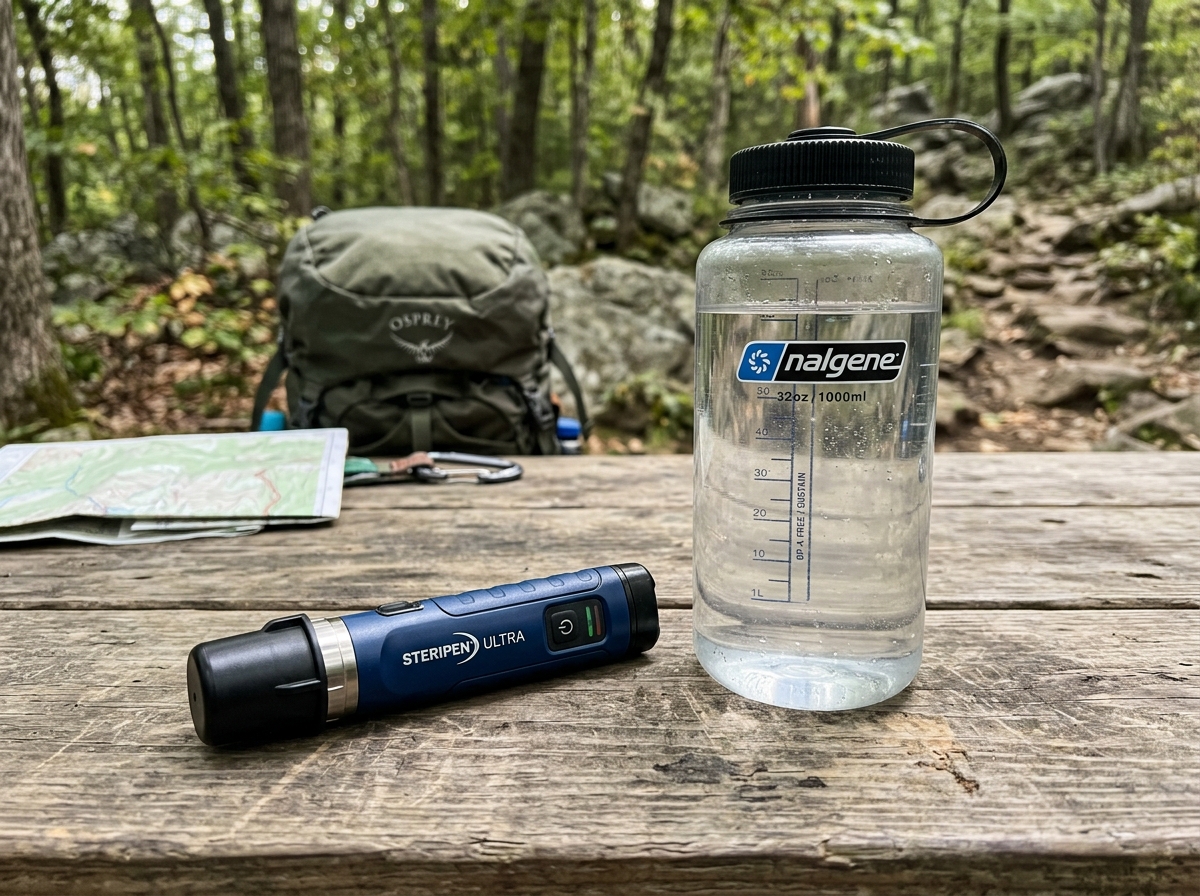
- Bottle Compatibility: Models like the Steripen Ultra are designed to fit into the neck of a wide-mouth Nalgene bottle. If you prefer narrow-mouth bottles like SmartWater, ensure your specific UV model can fit inside or be used to stir the water effectively.
For more on managing these trade-offs, check out our guide on why you shouldn’t dont-drink-the-mud-a-guide-to-uv-water-purifiers-for-camping.
Maintenance and Battery Management for Long Hikes
To get the most out of your device, you need a battery strategy. For the Steripen Ultralight, which treats about 20 liters per charge, a solo hiker might need to recharge every 4-5 days. Pairing your purifier with a small solar panel or a 10,000mAh power bank is standard practice for maximizing-efficiency-using-uv-light-purifiers-for-backpacking-trips.
Cold weather is the enemy of lithium batteries. In sub-zero temperatures, battery capacity can drop by 25% or more. We recommend keeping your UV purifier in an inside jacket pocket or at the bottom of your sleeping bag at night to keep the battery warm.
For long-term storage, don’t leave the battery completely drained or fully charged at 100% for months. Aim for a 40-60% charge to maintain the health of the internal lithium-ion cells. After each trip, wipe the lamp with a soft microfiber cloth to remove any mineral deposits from the water, which can cloud the lamp over time.
Frequently Asked Questions about UV Purifiers
Does UV light kill Giardia and Cryptosporidium?
Yes! UV-C light is exceptionally effective against these protozoa. While older chemical treatments like iodine struggled with Cryptosporidium (often requiring a 4-hour wait time), UV light neutralizes them in seconds. Steripen models are tested to kill 99.9% of these cysts.
Can I use a UV purifier in cloudy or muddy water?
You can, but its effectiveness is significantly reduced. The particles in cloudy water physically block the UV rays from hitting the microorganisms. If you must use a UV purifier in murky water, you must pre-filter with a cloth or a mechanical filter first. If the water looks like chocolate milk, UV is not the right tool for the job.
How long does the battery last on a typical hiking trip?
For the Steripen Ultralight, you can expect about 20 liters of treatment. For a solo hiker drinking 3-4 liters a day, that’s about 5 to 6 days of use. The Adventurer Opti, using CR123A batteries, lasts significantly longer at 50 liters per set, which could cover a two-week trip for a solo hiker.
Conclusion
At Total Cobre, we believe that the best gear is the gear that actually gets used. The compact uv purifier hiking category has transformed how we think about water safety by making purification fast, effortless, and comprehensive. By protecting against viruses that standard filters miss, these devices offer a level of security that is hard to beat, especially for international adventurers.
However, reliability in the backcountry means having a Plan B. No matter how much we trust our electronics, we always carry a few AquaTabs as a fail-safe. Whether you choose the featherweight Adventurer Opti or the rechargeable Ultralight, these “small lights” deliver big results, ensuring every sip you take on the trail is a safe one.
For more in-depth reviews on the latest trail tech, Visit Total Cobre for more outdoor gear reviews. Safe hiking!
