
Clean Water on the Trail: Which Filter Style Actually Delivers?
A backpacking water filter pump is one of the most reliable ways to get safe drinking water from streams, lakes, and rivers in the backcountry. But it’s not the only option — and depending on your trip, it might not even be the best one.
Here’s a quick breakdown to help you decide:
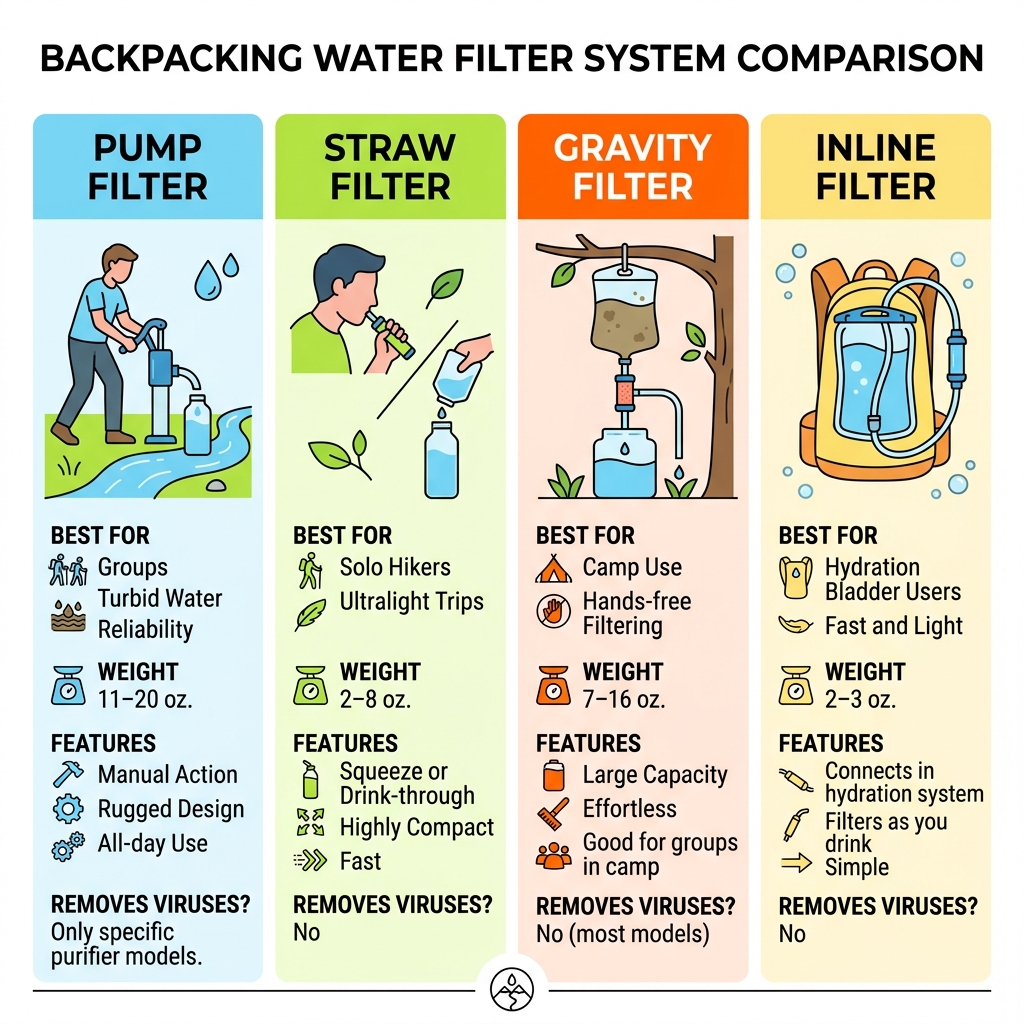
| Filter Style | Best For | Weight | Removes Viruses? |
|---|---|---|---|
| Pump filter | Groups, turbid water, all-day reliability | 11–20 oz | Only purifier models (e.g., MSR Guardian) |
| Straw/squeeze | Solo hikers, ultralight trips | 2–8 oz | No |
| Gravity filter | Camp use, hands-free filtering | 7–16 oz | No (most models) |
| Inline filter | Hydration bladder users, fast and light | 2–3 oz | No |
Think of water treatment like footwear — when it’s working well, you don’t think about it at all. But a filter that clogs halfway through a multi-day trip? That turns into a frustrating, time-consuming problem fast.
Pump filters have been a go-to backcountry tool for decades. They’re rugged, they work on demand, and the best models handle everything from glacial silt to virus-contaminated water in developing countries. But they’re also heavier and have more moving parts than newer alternatives.
This guide compares pump, straw, and inline filter systems so you can pick the right one for your next adventure.
The Mechanics of a Backpacking Water Filter Pump
When we talk about a backpacking water filter pump, we are looking at a mechanical powerhouse. Unlike a squeeze filter that relies on your grip strength or a gravity bag that relies on physics and patience, a pump uses manual action to force water through a filtration medium.
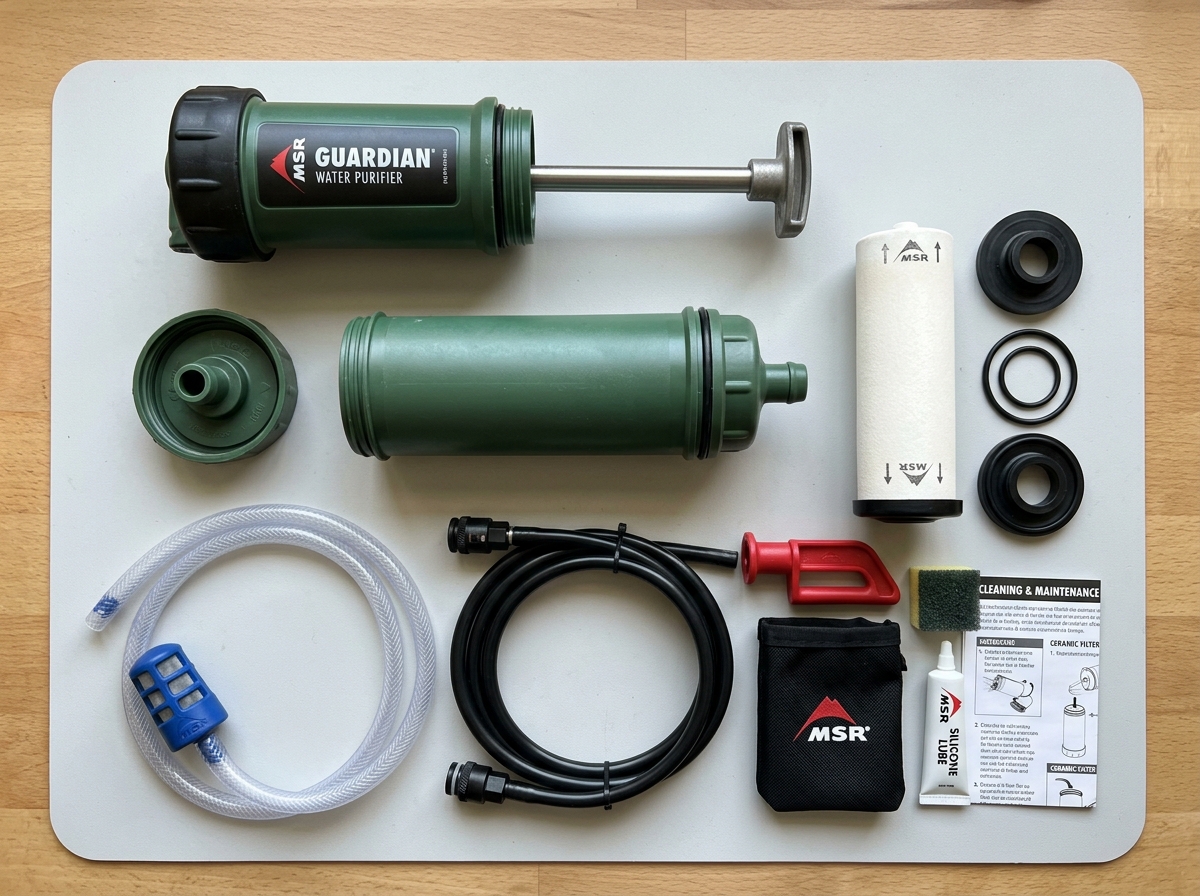
The typical setup includes an intake hose with a pre-filter (to keep the big chunks out), a pump body containing the filter element, and an outlet port that often threads directly onto a wide-mouth water bottle. Inside that pump body, you’ll usually find one of two things: a ceramic element or a hollow fiber membrane.
Ceramic elements, like those found in the MSR MiniWorks EX, are made from diatomaceous earth. They are incredibly hardy and can be scrubbed clean in the field dozens of times. On the other hand, high-tech hollow fiber systems, like the Guardian Purifier Pump, use tiny “straws” with microscopic pores to block pathogens.
The “magic” of the pump is the pressure. By using a handle to create suction and then compression, we can move water through much denser, more effective filter media than a simple gravity bag could handle.
Why Choose a Backpacking Water Filter Pump for Turbid Water?
If you’ve ever stood on the banks of a silty, tea-colored river after a rainstorm, you know the fear of a “clogged filter.” This is where the backpacking water filter pump truly shines. Most pumps are designed to handle turbid (cloudy or muddy) water better than any other style.
Models like the MSR Guardian actually feature a self-cleaning mechanism. On every stroke, about 10% of the water is used to flush the filter membrane and is sent back out the “dirty” side of the pump. This allows it to maintain a staggering flow rate of 2.5 liters per minute, even in “worst-case” water.
Furthermore, the intake hoses on these pumps usually have a float and a pre-filter. This allows us to drop the hose into a shallow puddle or a silty stream while keeping the intake off the bottom where the heaviest sediment lives. For more on how to manage these devices, check out our expert tips for using portable water pumps.
Weight and Packability of the Backpacking Water Filter Pump
We’ll be honest: if you’re an ultralight hiker counting every gram, a pump might feel like a “luxury” item. Most quality pumps weigh between 11 and 20 ounces.
- Lightweight Class (10–12 oz): Models like the Katadyn Hiker Pro offer a great balance of speed and weight.
- Standard Class (14–17 oz): The MSR MiniWorks EX or the MSR Guardian fall here. They are built for durability and long-term field use.
- Expedition Class (20 oz+): The Katadyn Pocket is a tank, weighing over a pound but lasting for up to 50,000 liters.
While they take up more space in a pack than a rolled-up squeeze bag, they are often shared among a group. If one person carries a 17-ounce pump for a group of three, the “per-person” weight is actually lower than if everyone carried their own individual squeeze filter.
Performance Metrics: Pore Size and Pathogen Removal
When we evaluate any filter, we look at the “pore size,” measured in microns. To give you an idea of scale, a human hair is about 70 microns wide.
- 0.2 Microns: This is the standard for most “filters.” It is small enough to catch 99.9999% of bacteria (like E. coli) and 99.9% of protozoa (like Giardia and Cryptosporidium).
- 0.02 Microns: This is the threshold for a “purifier.” Pores this small can actually block viruses, which are significantly smaller than bacteria.
The MSR Guardian and the LifeStraw Max High Flow Water Purifier research show that ultrafiltration (0.02 microns) is the gold standard for international travel or areas where human waste might contaminate the water. These devices meet the rigorous NSF protocol P248, which is the military standard for water purification.
Chemical and Taste Enhancements
Standard hollow fiber filters are great at stopping “bugs,” but they don’t do much for taste. If you’re filtering water from a stagnant pond or a source near a cow pasture, you might want a pump with an activated carbon core.
Carbon elements, found in models like the Katadyn Hiker Pro or MSR MiniWorks EX, reduce chlorine, pesticides, and organic compounds that cause “swampy” tastes. It’s a game-changer for palatability, though keep in mind that carbon filters have a shorter lifespan than the main ceramic or hollow fiber element and will need to be replaced more frequently.
Comparing Pump, Straw, and Inline Systems
Choosing the right style depends entirely on your “hiking personality.” We’ve put together a comparison to show how these styles stack up in the real world. For a deeper dive into making this choice, see our guide on choosing the right purification pump.
| Feature | Pump Filter | Straw/Squeeze | Inline Filter |
|---|---|---|---|
| Flow Rate | Fast (1-2.5 L/min) | Moderate (0.5-1 L/min) | Slow (Sip-dependent) |
| Effort | Manual Pumping | Squeezing/Sucking | None (Sucking only) |
| Lifespan | 2,000 – 50,000 L | 1,000 – 100,000 L | 1,000 – 2,000 L |
| Best Use | Turbid water, groups | Ultralight, solo | Hydration bladders |
Squeeze and Gravity Alternatives
Squeeze filters (like the Sawyer Squeeze) and gravity systems (like the Platypus GravityWorks) have exploded in popularity. They usually use 0.1-micron hollow fiber membranes.
The benefit of gravity is “set it and forget it.” You fill a bag, hang it from a tree, and let gravity do the work while you set up camp. However, gravity systems can be painfully slow in silty water and are difficult to use in very shallow water sources where you can’t easily submerge a large bag.
Use a Pump if: You need water now, the source is a shallow puddle, or the water is full of sediment. Use Gravity if: You have a large group in camp and plenty of time to let the bags hang.
Inline and Straw Systems for Solo Hikers
For the “fast and light” crowd, inline filters and straws are the ultimate weight-savers. An inline filter, such as the MSR Thru-Link, connects directly into your hydration bladder’s hose. You fill the bladder with “dirty” water and the filter cleans it as you drink.
Straws, like the original LifeStraw or the Peak Series Solo, allow you to drink directly from the source. While these are incredibly light (often under 3 ounces), they are best used as emergency backups or for short day hikes where you know water is plentiful. They aren’t great for filling pots for cooking or sharing with friends. If you’re planning a long-distance trek, you might want to look at water purification pumps for long hikes as a more versatile primary option.
Maintenance and Durability in the Field
A backpacking water filter pump is a mechanical device, and like all tools, it needs a little love. The most common maintenance task is backflushing (for hollow fiber) or scrubbing (for ceramic).
- Backflushing: Using a syringe to force clean water backward through the filter to pop out trapped sediment.
- Scrubbing: Taking a Scotch-Brite pad to a ceramic element to remove the outer layer of “clog.”
- Lubrication: Most pumps have an O-ring on the piston. If the handle becomes hard to push, a tiny dab of silicone lubricant (or even lip balm in a pinch) will make it move like new again.
Handling Freezing and Physical Impacts
Freezing is the “silent killer” of modern water filters. Most filters use hollow fibers that contain water. If that water freezes, it expands and cracks the tiny tubes, rendering the filter useless. Since you can’t see the cracks, the filter looks fine but allows pathogens through.
If you suspect your filter has frozen, you must perform an “integrity test” if the manufacturer provides one. If not, the filter should be replaced. The MSR Guardian is one of the few purifiers engineered to withstand freezing temperatures without damage.
When it comes to drops, most pumps are rugged, but ceramic elements are brittle. A drop onto a rock can crack a ceramic cartridge. High-end models like the Guardian are tested to withstand 6-foot drops onto concrete, making them the “Best for the Apocalypse” choice for many hikers.
Frequently Asked Questions about Backpacking Water Filters
What is the difference between a water filter and a water purifier?
In the outdoor world, these terms aren’t interchangeable. A filter removes bacteria and protozoa (the big stuff). A purifier removes bacteria, protozoa, and viruses. You generally only need a purifier if you are traveling internationally, hiking in areas with high human traffic, or if you have a compromised immune system.
How do I know if my filter is still safe to use after a drop?
If it’s a ceramic filter, open it up and look for cracks. If it’s hollow fiber, you usually can’t tell by looking. Some filters, like those from MSR, have a specific “integrity test” (like a blow test) described in the manual. If you can’t test it and it took a hard fall, it’s safer to use a backup method like chemical tablets.
Can pump filters remove heavy metals or chemicals?
Most standard backpacking filters do not remove heavy metals like lead or arsenic. Some models with activated carbon can reduce the concentration of certain chemicals and pesticides, but they aren’t designed for industrial-scale contamination. If you’re hiking near old mining sites, it’s best to find a different water source entirely.
Conclusion
At Total Cobre, we believe that clean water is the foundation of every successful outdoor adventure. Whether you choose a high-speed backpacking water filter pump for a group trek or a feather-light inline system for a solo thru-hike, the goal is the same: trail safety and gear reliability.
Pump filters remain the “gold standard” for versatility. They handle the muddiest water, fill bottles the fastest, and—in the case of purifiers—offer the highest level of protection available to the modern hiker. While they require a bit more maintenance and weigh more than a straw, the peace of mind they provide when you’re miles from the nearest tap is priceless.
Stay hydrated, stay safe, and we’ll see you on the trail.
