
Clean Water on the Trail: Finding the Best Portable Water Filter Hikers Can Trust
The best portable water filter hikers can rely on comes down to a few standout options, depending on your trip style and group size:
- Sawyer Squeeze – Best overall for solo hikers (3 oz, 1.7 L/min, 378,000 L lifetime)
- Katadyn BeFree – Best for fast-flowing, clear water sources (2.3 oz, 2 L/min)
- LifeStraw Peak Squeeze – Best budget pick (3.8 oz, 2,000 L lifetime)
- Platypus GravityWorks – Best for groups and basecamps (4L capacity, hands-free)
- MSR Guardian – Best for international travel or virus-prone sources (0.02 micron, 2.5 L/min)
Drinking untreated water in the backcountry is a real risk. Streams and lakes that look clean can carry harmful bacteria, protozoa like Giardia, and in some regions, viruses. Getting sick miles from a trailhead is more than an inconvenience – it can be dangerous.
The good news: modern portable water filters are lighter, faster, and more reliable than ever before.
But with so many options on the market – squeeze filters, gravity systems, UV purifiers, pump filters, chemical treatments – choosing the right one isn’t always obvious. The wrong pick can mean slow flow rates in the field, a filter that clogs in silty water, or one that simply doesn’t protect against the threats in your specific destination.
This guide cuts through the noise so you can make a confident choice before your next trip.
Essential Features of the Best Portable Water Filter Hikers Trust
When we are out on the trail, we don’t want to spend our precious sunset hours wrestling with a clogged filter or nursing numb fingers from squeezing a stubborn bag. The best portable water filter hikers choose is one that balances several technical factors without making the process feel like a chore.
Pore Size and Micron Ratings
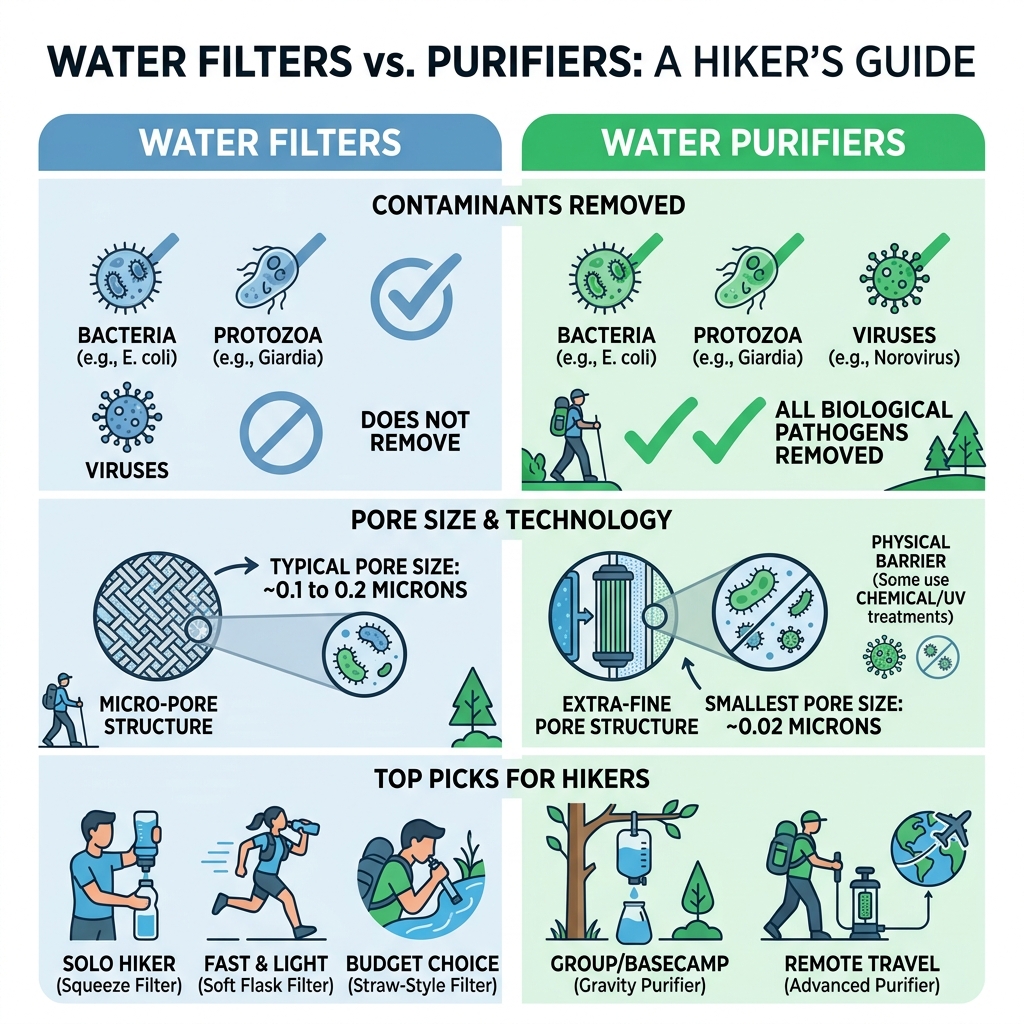
The heart of any mechanical filter is its membrane. Most backcountry filters use hollow fiber technology with a pore size of 0.1 to 0.2 microns. To put that in perspective, a human hair is about 70 microns wide. At 0.1 microns, a filter can physically block 99.9999% of bacteria (like E. coli and Salmonella) and 99.9% of protozoa (like Giardia and Cryptosporidium).
However, if you are traveling to areas where viruses are a concern—often due to human waste contamination or in developing nations—you need a “purifier.” Purifiers, like the MSR Guardian, have much smaller pore sizes, typically around 0.02 microns, which are small enough to snag tiny viruses that would slip right through a standard filter.
Flow Rate: The Need for Speed
Flow rate is measured in liters per minute (L/min). There is a massive difference between the Katadyn BeFree’s 2 L/min and a clogged Sawyer Mini that might take five minutes just to fill a single bottle. We’ve found that a flow rate of at least 1.5 L/min is the “sweet spot” for most hikers. If you’re filtering for a group, you’ll want something even faster, or a gravity system that does the work while you set up your tent.
Weight and Durability
In thru-hiking, “ounces equal pounds, and pounds equal pain.” The Sawyer Squeeze weighs a measly 3 ounces, making it a favorite for those counting every gram. But weight isn’t everything. We also have to consider durability. A filter that breaks mid-trip is just 3 ounces of dead weight. We look for robust housings and bags that won’t puncture the moment they touch a granite rock.
If you find yourself overwhelmed by the technical jargon, don’t worry. You can learn How to choose hiking water filtration systems without losing your mind by focusing on your specific trip needs rather than just the biggest numbers on the box.

Comparing Filtration Technologies for Backcountry Safety
Not all filters work the same way. Depending on whether you’re dipping a bottle into a deep lake or trying to suck water out of a shallow muddy puddle, the technology you choose matters.
| System Type | Best For | Pros | Cons |
|---|---|---|---|
| Squeeze | Solo Hikers / Thru-hiking | Lightweight, versatile, affordable | Requires manual effort, bags can leak |
| Gravity | Groups / Basecamps | Hands-free, high volume | Heavier, requires a place to hang the bag |
| Pump | Shallow/Silty Water | Can reach tiny seeps, very durable | Heavy, mechanical parts can fail |
| UV Light | Clear Water / Viruses | Kills viruses, no chemical taste | Doesn’t remove dirt/silt, needs batteries |
| Chemical | Emergency Backup | Lightest option, kills viruses | Long wait times (up to 4 hours), chemical taste |
Hollow Fiber vs. Activated Carbon
Most of the best portable water filter hikers use today rely on hollow fiber membranes. These are essentially bundles of tiny straws with microscopic holes. They are fantastic for removing biological threats but don’t do much for taste or chemicals.
Some filters, like the MSR MiniWorks EX, include an activated carbon core. This is a game-changer if you’re filtering water that tastes like “swamp juice” or contains pesticides from nearby agricultural runoff. Carbon absorbs chemicals and neutralizes odors, making your water actually taste like water.
The Virus Question
It is a common misconception that all filters remove everything. Standard mechanical filters do not remove viruses because viruses are simply too small. If you are hiking in the deep backcountry of the US or Canada, a filter is usually enough. However, if you are in high-traffic areas or traveling internationally, you need to look into Scientific research on virus removal technology to ensure your device meets the NSF P248 military standard.
Top Categories for the Best Portable Water Filter Hikers
We’ve categorized our top picks based on how you actually spend your time outdoors. A solo hiker on the Appalachian Trail has very different needs than a family of four camping in a national park.
When we are Evaluating the best lightweight water purifiers for hiking, we look at the “system” as a whole—not just the filter, but the bags, hoses, and cleaning tools required to keep it running.
Selecting the Best Portable Water Filter Hikers for Solo Trips
For the lone wolf or the thru-hiker, the Sawyer Squeeze remains the undisputed king. It has been tested over 8,000 miles of hiking on the PCT and CDT and continues to perform. With a lifetime rating of 100,000 gallons, you’ll likely lose it before you ever wear it out. It’s versatile, too; you can screw it onto a standard plastic water bottle or use it inline with a hydration bladder.
If you prefer a faster flow and a “softer” feel, the Katadyn BeFree is a fantastic alternative. It features a wide-mouth collapsible flask that is incredibly easy to fill. The flow rate is blistering—up to 2 liters per minute—making it the fastest “squeeze” on the market. The downside? The filter element is a bit more delicate and can clog faster in silty water compared to the Sawyer.
For those on a budget, the LifeStraw Peak Squeeze is a rugged, reliable choice. It weighs 3.8 oz and is designed to handle a bit more abuse. While its lifetime is “only” 2,000 liters, that is more than enough for years of casual weekend adventures. If you are interested in more solo options, check out our guide on Reviewing compact water filters for long-distance hikers.
High-Capacity Gravity Systems for Groups
There is nothing quite as satisfying as hanging a bag of “dirty” water on a tree and watching clean water trickle into your reservoir while you enjoy a snack. The Platypus GravityWorks is our top recommendation for groups. With a 4-liter capacity and a flow rate that can fill a bottle in under a minute, it takes the “work” out of water treatment.
Gravity systems are also incredibly efficient for basecamps. Instead of everyone bringing their own individual filters, one person can manage the water for the entire group. This reduces the weight carried by the team and ensures that everyone is drinking from a high-quality source. We’ve found that Gravity-fed water filters: the perfect solution for group camping trips are also easier to maintain in the field because they are less prone to the “pressure clogs” that plague squeeze filters.
Maintenance for the Best Portable Water Filter Hikers
Even the best portable water filter hikers buy will eventually fail if it isn’t maintained. We’ve seen $400 purifiers reduced to paperweights because someone forgot to clean them after a silty trip.
Backflushing: The Lifeline
Backflushing is the process of forcing clean water backward through the filter to dislodge trapped sediment. For the Sawyer Squeeze, this involves a large plastic syringe. We recommend backflushing every time you return from a trip, or even daily if you are filtering particularly turbid water.
Pro Tip: If you are using the Katadyn BeFree, don’t use a syringe! You simply “swish” the filter in clean water to dislodge the gunk.
The Silent Killer: Freezing
This is the most important rule of hollow fiber filters: Never let them freeze. If water is inside the tiny fibers and it freezes, the ice expands and ruptures the membrane. This creates microscopic holes that allow bacteria to pass through. The scary part? You won’t know it’s broken just by looking at it. If you are camping in freezing temperatures, sleep with your filter in your sleeping bag to keep it warm.
Preventing Cross-Contamination
It is easy to get “dirty” water on the “clean” side of your gear. We always carry hand sanitizer and use it after handling our dirty water bags before we touch our clean water bottles. Following Preventing cross-contamination in your water filters: tips for hikers is essential to ensure that your filtration efforts aren’t wasted by a single drop of contaminated water on your bottle’s rim.
Frequently Asked Questions
What is the difference between a water filter and a water purifier?
A water filter (like the Sawyer Squeeze or Katadyn BeFree) removes bacteria and protozoa. A water purifier (like the MSR Guardian or Grayl GeoPress) goes a step further by removing or inactivating viruses.
You should choose a purifier if:
- You are traveling to a country with poor water infrastructure.
- You are hiking in an area heavily impacted by human or animal waste.
- You want the absolute highest level of protection.
For more technical details, you can view the LifeStraw Peak Series 3-in-1 technical specifications, which highlight how different stages of filtration target different contaminants.
How do I prevent my water filter from freezing?
As mentioned, freezing is the enemy of hollow fiber filters. If you suspect temperatures will drop below 32°F (0°C), keep the filter in a zip-lock bag and tuck it into your pocket or sleeping bag. Some filters, like the MSR Guardian, are specifically designed to be more freeze-resistant, but for 99% of filters, body heat is your best protection. For a deep dive into winter safety, read our guide on Protecting water filters from freezing during winter hikes.
Why should I carry a backup water treatment method?
Mechanical things break. Bags leak, O-rings get lost, and filters clog beyond repair. We always carry a small strip of chemical treatment tablets (like Chlorine Dioxide) as a “just in case.” They weigh almost nothing and can save your trip if your primary filter fails.
When Assembling a practical portable water purification kit, we recommend a “primary” (filter) and a “secondary” (chemical) approach for total peace of mind.
Conclusion
Finding the best portable water filter hikers can trust is about more than just reading a spec sheet—it’s about matching the tool to the trail. Whether you are an ultralight thru-hiker relying on the legendary Sawyer Squeeze, a group leader setting up a Platypus GravityWorks at basecamp, or an international adventurer carrying the military-grade MSR Guardian, your safety depends on reliable gear.
At Total Cobre, we are dedicated to providing adventurous hikers with clean water solutions that work in the real world. We’ve seen filters fail in the Cascades and thrive in the Appalachians, and we use that experience to help you choose the right gear for your journey.
Stay hydrated, stay safe, and we’ll see you on the trail!
For More info about outdoor gear reviews, visit our homepage and explore our specialized guides for all your backcountry needs.
