
Clean Water Anywhere: What You Need to Know About UV Pen Water Purifiers
A uv pen water purifier is one of the fastest, lightest ways to make backcountry water safe to drink. No pumping. No chemical taste. Just clean water in under 90 seconds.
Quick answer — best UV pen water purifiers for hikers:
| Model | Best For | Treatment Time | Weight |
|---|---|---|---|
| Katadyn SteriPEN Ultra | Most hikers, rechargeable | 48s (0.5L) / 90s (1L) | 140g |
| SteriPEN Adventurer Opti | Battery-powered backup | 48s (0.5L) / 90s (1L) | ~90g |
| Generic rechargeable UV pen | Budget option | ~90s (1L) | ~137g |
All three eliminate 99.9% of bacteria, viruses, and protozoa — including Giardia and Cryptosporidium — using UV-C light at 254nm.
Picture this: you’re miles from the trailhead, your water bottle is almost empty, and the only source nearby is a mountain stream. Do you risk it, haul a heavy filter, or drop a chemical tablet and wait — and taste — the result?
That’s the exact problem UV pen purifiers solve. They’re pocket-sized, fast, and chemical-free. One experienced hiker documented nearly a decade of field use across Nepal, the Pacific Northwest Trail, and dozens of canoe trips — all without a single waterborne illness using a UV pen.
This roundup breaks down the top models, how they compare, and which one belongs in your pack.
How a UV Pen Water Purifier Works
At Total Cobre, we often get asked: “How can a little light bulb actually make water safe?” It sounds like science fiction, but the technology has been used by municipal water districts and bottling companies for decades.
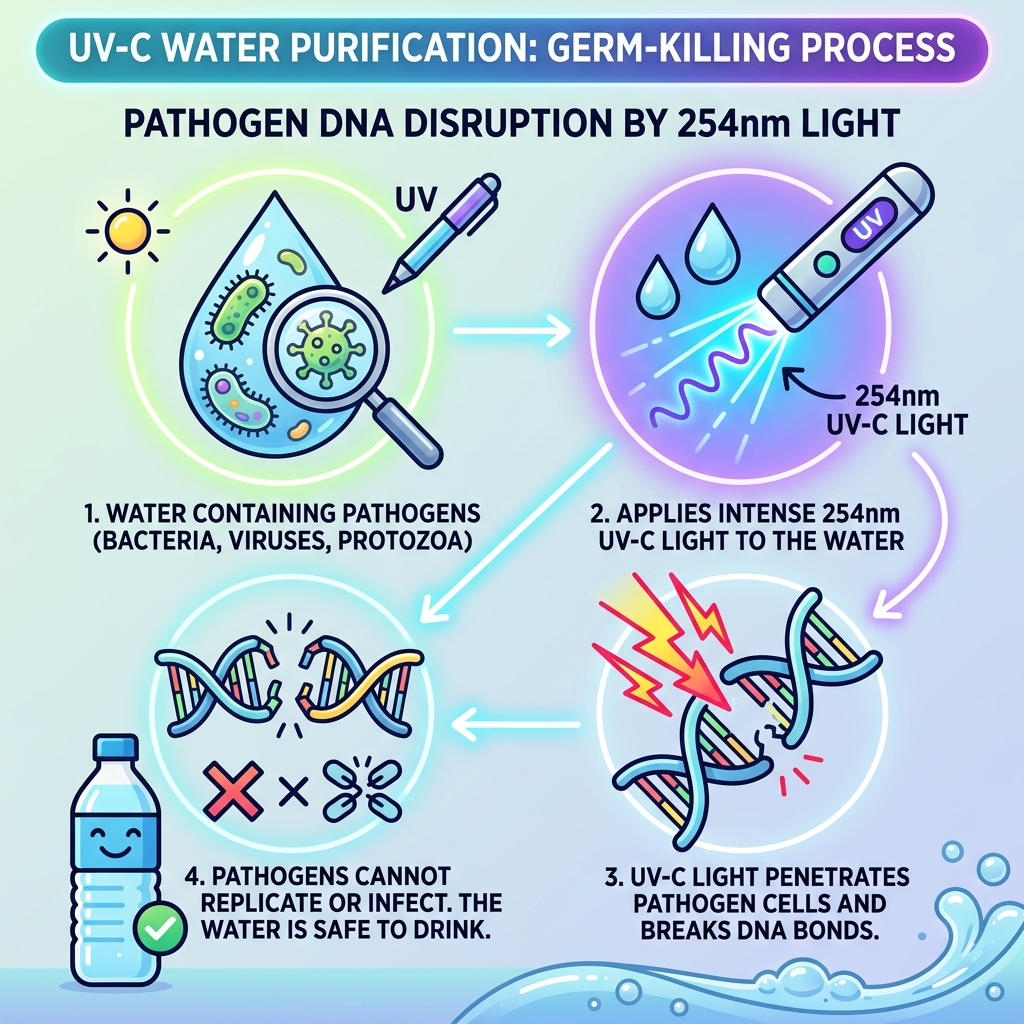
A uv pen water purifier utilizes UV-C light, which is a short-wave light falling between X-rays and visible light on the electromagnetic spectrum. Specifically, these devices emit a 254nm wavelength. This is the “sweet spot” for germicidal effectiveness.
When you stir the pen in your water, the UV-C rays penetrate the cells of microorganisms. Instead of physically “filtering” them out like a mesh screen, the light disrupts the DNA and RNA of the pathogens. This process essentially “scrambles” their genetic code, making it impossible for them to reproduce. Since they can’t reproduce, they can’t cause infection in your gut.
This method is incredibly effective against a wide range of nasties. According to Scientific research on UV-C effectiveness, these devices eliminate 99.99% of protozoa (including Giardia and Cryptosporidium), bacteria, and viruses. This is a major advantage over many mechanical filters, which are often too “holey” to catch tiny viruses. You can learn more about how-uv-purification-systems-enhance-your-health-on-hikes to see why this virus protection is a game-changer for international travelers.
UV vs. The Alternatives
To help you decide if a uv pen water purifier is right for your kit, we’ve put together this comparison table:
| Feature | UV Pen Purifier | Mechanical Filter | Chemical Tablets | Boiling |
|---|---|---|---|---|
| Speed | 90 seconds | 1-3 minutes (pumping) | 30 min – 4 hours | 10+ minutes (heat time) |
| Taste | No change | No change | Often “swimming pool” taste | Flat taste |
| Viruses | Highly Effective | Often ineffective | Effective | Highly Effective |
| Clarity | Requires clear water | Clears cloudy water | Works in cloudy water | Works in cloudy water |
| Effort | Low (stirring) | High (pumping/squeezing) | Low (drop and wait) | High (setup/fuel) |
Top Models: The Katadyn SteriPEN Ultra and Beyond
When discussing the uv pen water purifier category, one name stands above the rest: the Katadyn SteriPEN Ultra. This is the flagship model for a reason. It features an intuitive OLED display that tells you exactly what’s happening—no guessing if the treatment worked.
One of the biggest advantages-of-using-uv-light-purifiers-for-backpacking-trips is the move away from disposable batteries. The SteriPEN Ultra features an internal, rechargeable lithium-ion battery. You can treat up to 50 liters on a single charge and recharge it via a standard USB cable—meaning your solar panel or power bank can keep your water safe indefinitely.
The Ultra is rated for 8,000 activations. To put that in perspective, if you drink 2 liters of purified water every single day, the lamp will last you over 10 years! It weighs in at a modest 140g (4.94 oz), making it a favorite for weight-conscious hikers.
For those who prefer a backup that doesn’t rely on a built-in battery, the SteriPen Adventurer Opti UV Water Purifier is a fantastic alternative. It uses CR123 batteries, which are great for cold-weather performance and long-term storage in an emergency kit.
There are also newer, multi-functional models appearing on the market. Some Steripen Ultra UV variants and generic competitors now offer surface sanitization modes. These allow you to wave the pen over a keyboard, a baby bottle, or a hotel TV remote to kill germs—a nice bonus for the germaphobes among us (we don’t judge!).
Performance and Field Reliability
In our experience at Total Cobre, “lab specs” are one thing, but “trail reality” is another. A uv pen water purifier is a piece of electronics, which means it requires a bit more care than a hollow-fiber squeeze filter. However, their reliability in the field is impressive when handled correctly.
One user review we analyzed showed a SteriPEN lasting nearly a decade with 185+ days of field use across multiple international expeditions. The key to this longevity is proper battery management and sensor care. We’ve found that merging-convenience-and-efficiency-uv-light-water-purifiers-for-hikers often comes down to understanding the device’s limits.
Speed and Efficiency of a UV Pen Water Purifier
The efficiency of these pens is hard to beat. While your friends are still setting up their pump filters and hoses, you’ve already finished your liter and are back on the trail.
- 0.5 Liters (16 oz): 48 seconds
- 1.0 Liter (32 oz): 90 seconds
The process is simple: remove the cap, press the button (once for a liter, twice for half a liter), and submerge the lamp. The most important step is agitation. You must stir the water or swirl the bottle to ensure every drop of water is exposed to the UV-C light. If a pathogen is hiding in the “shadow” of a floating particle or stuck to the side of the bottle, it might survive.
Check out our guide on maximizing-efficiency-using-uv-light-purifiers-for-backpacking-trips for tips on how to integrate this speed into your hiking routine.
Water Clarity and the UV Pen Water Purifier
This is the “Achilles’ heel” of UV technology. UV light needs to pass through the water to work. If the water is “turbid” (cloudy, silty, or full of “floaties”), those particles can act as tiny shields for bacteria.
If you encounter cloudy water, you have a few options:
- The Bandana Method: Strain the water through a tightly woven cloth or bandana to remove large sediment.
- Settling: Let the water sit in a container for 30 minutes until the silt settles to the bottom, then carefully pour the clear water into your treatment bottle.
- Pre-filtration: Use a dedicated tool like the Katadyn FitsAll 4-micron filter. This adapter fits on top of most wide-mouth bottles and removes the bulk of particulates before you use your uv pen water purifier.
For more on managing tricky water sources, read our article on harnessing-uv-light-purifiers-for-safe-backpacking-trips.
Essential Maintenance and Accessories
To keep your uv pen water purifier running for its full 8,000-liter lifespan, you need to treat it like the precision instrument it is.
- Sensor Cleaning: The metal sensors on the side of the lamp tell the device when it’s submerged. Over time, minerals from “hard” water can build up on these sensors, leading to “frowning face” error messages. A quick wipe with a cloth dampened with diluted vinegar will dissolve these deposits.
- Storage: If you aren’t planning a trip for a few months, store your rechargeable pen with about a 50% charge. Lithium-ion batteries hate being stored completely empty or at 100% for long periods.
- Protection: Always use the included neoprene carrying case. The UV lamp is made of high-quality glass, but it can still crack if dropped onto a granite slab.
- Bottle Choice: UV pens work best in wide-mouth bottles (like a Nalgene). They are difficult to use with narrow-mouth “disposable” plastic bottles because the lamp won’t fit through the opening.
Frequently Asked Questions about UV Purification
Does it work in freezing temperatures?
Yes, but with caveats. Batteries (especially the rechargeable ones in the Ultra) lose capacity in the cold. If you’re winter camping, keep the pen in an inside jacket pocket close to your body heat. Also, if the lamp itself is freezing cold, it may take an extra minute to “warm up” before it starts the germicidal cycle. The SteriPEN Ultra is smart enough to handle this automatically, but it will eat more battery life.
Can it be used for international tap water?
Absolutely. In fact, this is where a uv pen water purifier shines brightest. In many countries, the tap water is chemically treated but may still contain viruses or chlorine-resistant cysts like Cryptosporidium. Using a UV pen in your hotel room or at a restaurant ensures you won’t spend your vacation in the bathroom. It’s much more eco-friendly than buying dozens of plastic water bottles.
How do I know when the treatment is finished?
On models like the SteriPEN Ultra, the OLED screen will show a countdown timer and then a clear “smiley face” once the treatment is successful. If the sensors lose contact with the water or the bulb fails, you’ll see a “frowning face” error. It’s a very “fail-safe” system.
Conclusion
At Total Cobre, we believe the best gear is the gear that actually gets used. While traditional pumps have their place, the sheer convenience of a uv pen water purifier makes it a top recommendation for most backpackers, day hikers, and international travelers.
By choosing a UV pen, you’re not just saving weight in your pack; you’re also doing the environment a favor. A single SteriPEN Ultra can prevent up to 16,000 disposable plastic bottles from ending up in landfills over its lifetime.
Whether you’re planning a thru-hike of the Appalachian Trail or just want peace of mind while traveling abroad, a UV pen is a lightweight, high-tech insurance policy for your health.
For more expert gear reviews and trail-tested recommendations, visit us at Total Cobre. Safe travels and happy hydrating!
