
Why Finding the Best Filter for Deserts Can Make or Break Your Adventure
The best filter for deserts depends on what you’re filtering — here’s a quick breakdown:
| Need | Best Option | Key Spec |
|---|---|---|
| Drinking water on a hike | Sawyer Squeeze / Micro Squeeze | 0.1 micron, 100,000 gal lifespan |
| Ultralight backpacking | HydroBlu Versa Inline | 0.1 micron, 1.5 oz |
| Clear, flowing water | Katadyn BeFree | Fast flow, lightweight |
| Virus protection | Aquamira chemical drops | Kills bacteria, viruses, and cysts |
| Off-road vehicle engine | OEM paper or dry media filter | Fine silt protection, consistent pore size |
Deserts are brutal. The heat is relentless, water sources are scarce, and when you do find water, it’s often silty, stagnant, or worse.
Here’s a sobering fact: unsafe drinking water causes over two million preventable deaths every year. And you can only survive three days without water — desert or not.
For hikers tackling arid trails like the Arizona Trail or similar remote routes, the challenge is double-edged. You need a filter that can handle turbid, sediment-heavy water without clogging after the first use. And it has to be light enough that you’ll actually carry it.
Off-road riders face a completely different problem. Desert dust — especially fine silt — can destroy an engine fast. The wrong air filter (or a poorly sealed one) lets abrasive particles slip through and cause serious damage.
This guide covers both worlds: portable water filters for desert hikers and air filters for desert vehicles. Whether you’re on foot or behind the wheel, we’ll help you find the right protection.
Top-Rated Gear: Finding the Best Filter for Deserts
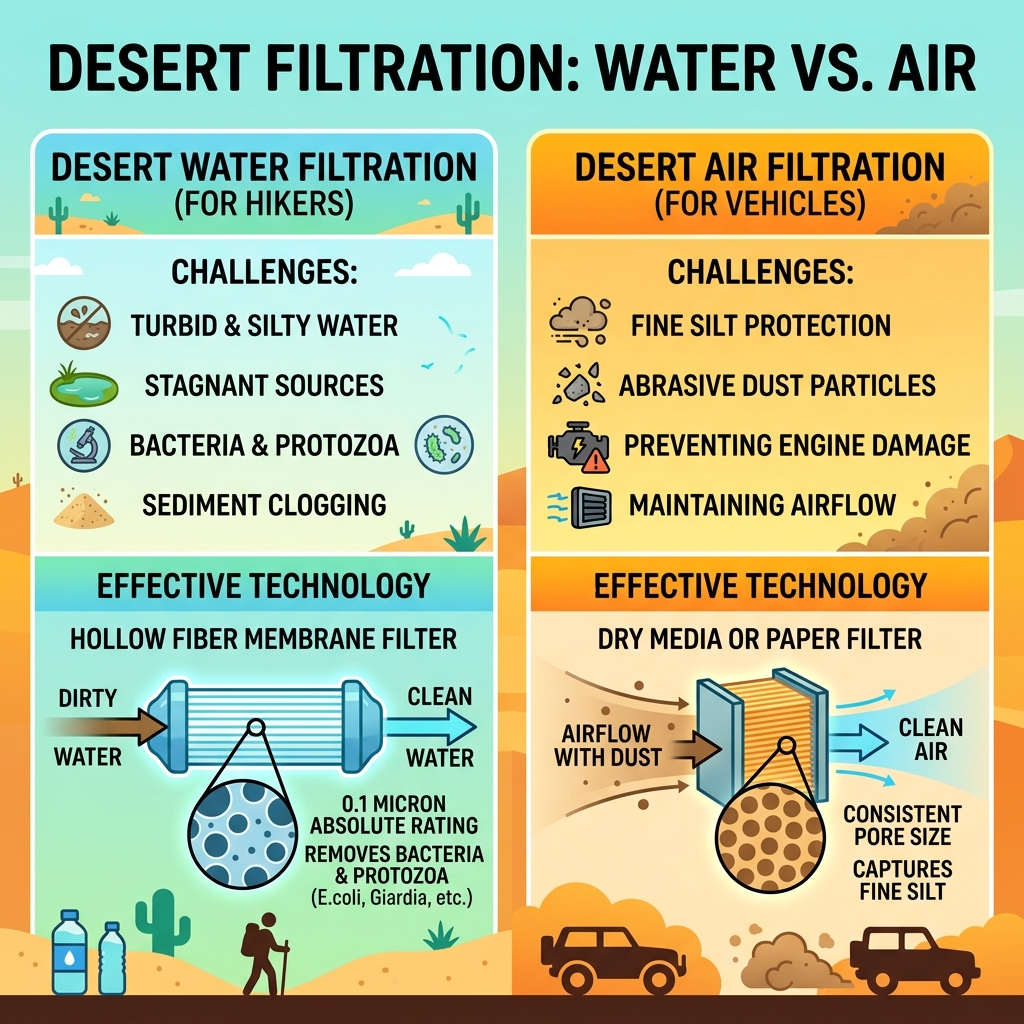
When we talk about the best filter for deserts, we have to address the “micron” in the room. In water filtration, a micron is a unit of measurement that determines what can pass through the filter’s physical mesh. For most desert hiking scenarios, a 0.1-micron absolute rating is the gold standard. This level of filtration is capable of removing 99.99% of bacteria (like E. coli and Salmonella) and protozoa (like Giardia and Cryptosporidium).
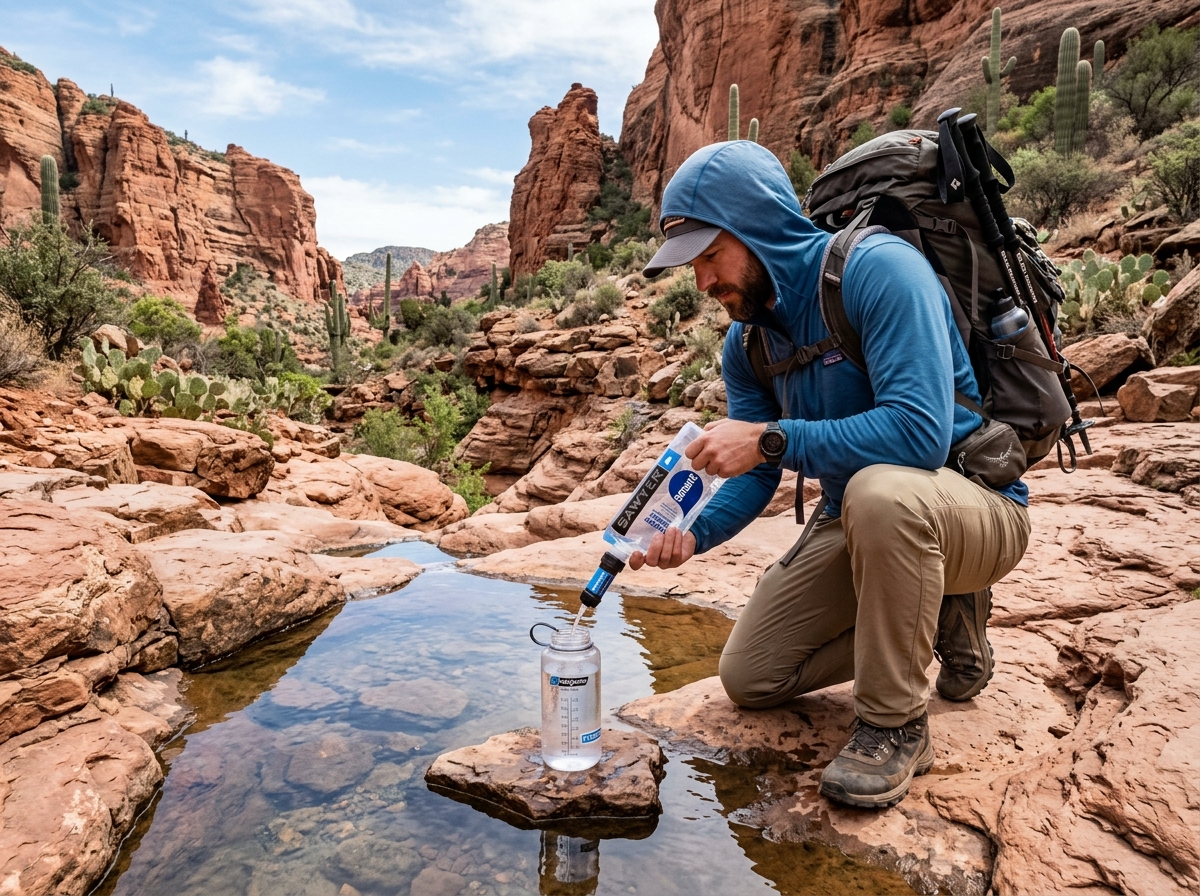
Weight is the next major factor. When you’re carrying several liters of water because the next source is twenty miles away, every ounce in your pack feels like a pound. This is why many thru-hikers on the Arizona Trail swear by ultralight options.
The Best Filter for Deserts: Portable Water Solutions
Desert water isn’t just scarce; it’s often “chewy.” High turbidity—a fancy word for cloudiness caused by suspended silt and sediment—is the primary enemy of a water filter. If you try to run silty desert puddle water through a standard filter without a plan, you’ll find the flow rate slowing to a drip within minutes.
- Sawyer Squeeze and Micro Squeeze: These are legends for a reason. They utilize hollow fiber membrane technology. The Squeeze is slightly larger (3.0 oz) but offers a faster flow rate, while the Micro Squeeze (2.5 oz) is the choice for those counting grams. Both feature 28mm threading, meaning they can screw directly onto standard smartwater bottles—a favorite hack for desert travelers.
- HydroBlu Versa Inline: This is a versatile powerhouse. Weighing only 1.5 oz, it can be used as a straw, attached to a hydration bladder hose, or used in a gravity setup. It boasts a massive 100,000-gallon lifespan, though in silty desert conditions, that “practical” life will depend heavily on how often you backflush.
- Katadyn BeFree: While it has a fantastic flow rate and is incredibly lightweight, it’s best reserved for clear, flowing water. In the desert, the BeFree’s filter element can clog quickly with “floaties,” making it less ideal for the stagnant tanks often found in arid regions.
To manage turbidity, we recommend the “settling” method: let your collected water sit in a container for an hour to let the heavy silt sink to the bottom before filtering the clearer water from the top.
Chemical and UV Backups
While mechanical filters handle the big stuff, they often miss viruses. In most US desert environments, viruses aren’t a primary concern, but in high-use areas or extreme survival scenarios, a secondary treatment is wise.
- Aquamira: These chlorine dioxide drops kill bacteria, viruses, and cysts. They take about 30 minutes to fully purify water (longer if the water is cold), but they don’t leave the harsh iodine taste of older tablets.
- UV Purifiers (SteriPen): These use ultraviolet light to scramble the DNA of pathogens. They are fast but require clear water to be effective—if the water is too silty, the UV rays can’t reach the “bugs” hiding behind the dirt particles.
Cross-contamination is the silent hiker-killer. Never let the “dirty” end of your filter touch the “clean” cap of your water bottle.
Engine Protection: High-Performance Air Filtration for Sand and Silt
Switching gears to the mechanical side of the desert, we encounter a different beast: fine silica dust. If you’ve ever driven a Polaris RZR XP 1000 through the dunes, you know about “dust swirl.” The design of many UTV intakes actually creates a vacuum that sucks dust directly toward the airbox.
Without the best filter for deserts, that dust enters the combustion chamber, acting like sandpaper on your cylinder walls. This leads to lost compression and, eventually, a very expensive paperweight where your engine used to be.
Why Paper is the Best Filter for Deserts in Off-Roading
It might sound counterintuitive to use “old-fashioned” paper when high-tech oiled cotton filters exist, but in the desert, paper is king. Traditional OEM (Original Equipment Manufacturer) paper filters are designed with a very tight, consistent pore size.
- Fine Silt Protection: Paper excels at trapping the microscopic silt that can pass through the larger openings of a cotton gauze filter.
- The Light Test: A simple way to check your paper filter is to hold a bright flashlight inside the filter element in a dark room. If you see pinpricks of light, the filter is “dusted” and needs replacement immediately.
- Maintenance: While you shouldn’t “clean” paper filters indefinitely, you can gently blow them out with compressed air from the inside out to extend their life for a ride or two.
For professional-grade racing, many Trophy Truck teams rely on specialized High-Performance Off-Road Desert Racing Tapered Air Filters that prioritize engine safety over raw horsepower gains.
Sealing and Intake Solutions
The best filter in the world won’t save you if the seal is leaking. Many desert riders use a thin bead of grease around the filter’s lip to ensure an airtight connection to the airbox.
Furthermore, advanced solutions like the S&B Particle Separator use the same technology found in military helicopters. These systems use a fan to eject 94% of dust before it even reaches your primary filter, dramatically extending the life of your engine.
Comparing Filter Media: Paper, Foam, and Dry Synthetic
Choosing the right media is a balance of airflow and filtration efficiency.
| Media Type | Efficiency | Airflow | Maintenance |
|---|---|---|---|
| Paper (OEM) | Excellent | Moderate | Disposable |
| Foam | Good | High | Washable/Oiled |
| Dry Synthetic | Excellent | High | Washable (Limited) |
- Foam Filters: Popular in dirt bikes, brands like Funnel Web Filter use a “pyramid profile” to double the surface area. While great for airflow, they require meticulous oiling. If the oil dries out in the desert heat, dust will pass right through.
- Dry Synthetic Media: These are the modern gold standard for high-performance desert rigs. Products like Universal Fit High Efficiency Dry Media Filters offer the protection of paper with the improved airflow of a performance filter, without the messy oil that can attract and “cake” dust.
The Role of Pre-Filters
Think of a pre-filter as a “sacrificial layer.” Brands like Outerwears produce hydrophobic (water-repelling) mesh covers that slide over your main filter. For a small investment, these pre-filters trap the large “floaties” and heavy sand, allowing your main filter to focus on the microscopic silt. It’s the cheapest engine insurance you can buy.
Maintenance and Longevity in Extreme Dust
The desert is not a “set it and forget it” environment.
For Water Filters: Backflush frequently! If you are filtering from a silty source, backflush your Sawyer or HydroBlu every 2-4 liters. This forces clean water backward through the fibers to pop out the lodged sediment. In the desert, a clogged filter isn’t just an inconvenience; it’s a hydration crisis.
For Air Filters: Check your airbox after every ride. If you see a layer of fine dust on the “clean” side of the intake, your filtration system has failed. Dry media filters can often be cleaned up to five times before they lose their structural integrity. For industrial-scale protection, companies like Desert Engineering provide pressurized cabin filtration for heavy machinery operating in these same harsh conditions.
Frequently Asked Questions about Desert Filtration
What are the specific challenges of air filtration in dusty desert environments?
The primary challenge is the size and quantity of the particles. Desert “silt” is much finer than standard dirt. Combined with high-speed air intakes and “dust swirl” patterns around the vehicle, filters can become saturated in a matter of hours. Extreme heat can also cause filter seals to warp or oil to thin out and migrate, leaving the engine vulnerable.
Why are traditional OEM paper filters often recommended for extreme dust?
Paper filters use a physical barrier with a very small, consistent pore size. Unlike oiled filters, which rely on the “stickiness” of the oil to catch dust, paper simply doesn’t let the particles through. In extreme silt, an oiled filter can become “loaded” and actually pull dirt through the media as the vacuum pressure increases.
How do pre-filters extend the life of a main filter?
Pre-filters act as a primary stage of separation. They catch the large sand grains and debris that would otherwise fill up the deep pleats of your main filter. Because they are usually made of a smooth mesh, you can often “tap” the dust off them in the field, keeping your engine breathing clearly for much longer.
Conclusion
Surviving and thriving in the desert requires a respect for the elements and the right gear to combat them. Whether you are an adventurous hiker looking for the best filter for deserts to keep your water clean, or an off-roader protecting a high-performance engine, filtration is your first line of defense.
At Total Cobre, we specialize in providing specialized guides for adventurous hikers and outdoor enthusiasts who refuse to let harsh environments slow them down. From 1.5 oz water filters to heavy-duty off-road intake solutions, the right choice ensures that you spend more time exploring and less time dealing with equipment failure or illness.
Stay hydrated, stay protected, and we’ll see you on the trail. For more expert reviews and clean water solutions, visit Total Cobre.
