
The Best UV Purifiers for Hiking in 2025-2026
The top uv purifiers hiking enthusiasts rely on can mean the difference between a great trip and a week of misery from waterborne illness. Whether you’re day hiking or pushing through a multi-day backcountry route, UV purification offers a fast, chemical-free way to make water safe to drink.
Here are the top UV purifiers for hiking, at a glance:
- SteriPEN Ultra – Best overall; USB rechargeable, OLED display, 8,000L bulb life, 6.7 oz
- SteriPEN Adventurer Opti – Best for off-grid trips; CR123 battery-powered, 3.6 oz, built-in flashlight
- Innest 3L – Best inline option; USB-C powered, 3L/min flow rate, ultra-lightweight aluminum build
UV purifiers work differently from squeeze or gravity filters. Instead of physically straining pathogens out of water, they use UV-C light to scramble the DNA of bacteria, viruses, and protozoa — rendering them harmless in as little as 90 seconds per liter.
That includes nasty bugs like Giardia, Cryptosporidium, and viruses such as norovirus that most standard backpacking filters simply cannot touch.
But UV purifiers aren’t perfect for every situation. They struggle with murky or silty water, depend on battery power, and don’t remove particulates, metals, or odors. Knowing when to use one — and when to pair it with a pre-filter — is the key to staying hydrated and healthy on the trail.

How UV Technology Eliminates Pathogens on the Trail
To understand why these devices are so effective, we have to look at the science of UV-C light. Most of us are familiar with UV rays from the sun that cause sunburns, but UV-C is a specific wavelength (around 254nm) that is germicidal. In the municipal world, this technology has been used for decades to treat city water. Portable units bring that same “medical-grade” power to your backpack.
When we submerge a UV lamp into a bottle of water, the light penetrates the cells of microorganisms. It doesn’t “kill” them in the traditional sense; instead, it causes a photochemical reaction that disrupts their DNA and RNA. This “scrambling” makes it impossible for the pathogens to reproduce. If a germ can’t replicate in your gut, it can’t make you sick.
One of the primary advantages-of-using-uv-light-purifiers-for-backpacking-trips is their effectiveness against viruses. While standard hollow-fiber filters (like many popular squeeze systems) are great at stopping bacteria and protozoa, they often have pore sizes too large to catch tiny viruses. According to the CDC, viruses such as rotavirus and norovirus are the smallest of all waterborne disease-causing microorganisms. UV purifiers neutralize 99.99% of these, along with Giardia and Cryptosporidium.
The treatment time is another major perk. Most units operate on a 90-second cycle for one liter of water. Compare that to chemical drops that might take 30 minutes for bacteria or up to four hours for Cryptosporidium, and you can see why we love the speed of UV for quick trail breaks.
Top UV Purifiers Hiking: The Best Models for 2025-2026
When we evaluate the top uv purifiers hiking market offers, we look for a balance of weight, battery reliability, and ease of use. The tech has come a long way, moving from finicky glass tubes to ruggedized designs with clear digital interfaces.
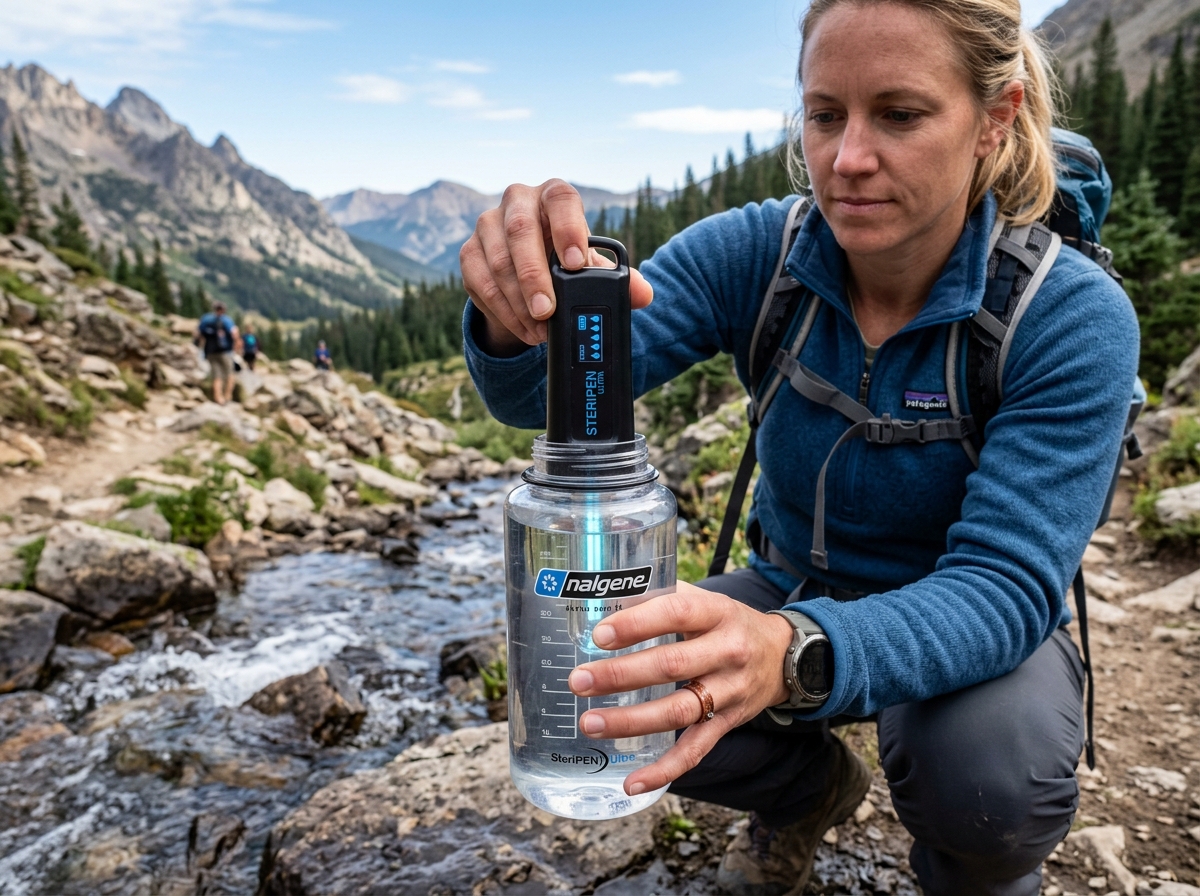
SteriPEN Ultra
The Katadyn Steripen Ultra remains the gold standard for many thru-hikers. Weighing in at 6.7 oz, it’s light enough for most kits and features a high-contrast OLED display. This screen tells you exactly how much time is left in your treatment cycle and shows a friendly “smiley face” when the water is safe to drink.
The internal lithium-ion battery is USB-rechargeable, which is a massive plus for modern hikers carrying power banks. On a full charge, you can treat roughly 50 liters of water. With a bulb life rated for 8,000 liters, this is a tool that will last for years of heavy trail use.
SteriPEN Adventurer Opti
If you are heading deep into the wilderness where you won’t have any way to recharge, the Adventurer Opti is our go-to. Instead of an internal battery, it uses two CR123 lithium batteries. These are incredibly stable in cold weather and are light to carry as spares. It also includes an integrated LED flashlight, which helps save a little extra weight by serving as a backup light source in camp.
Innest 3L
For those who prefer an inline setup, the Innest 3L is a newer, ultra-lightweight contender. It’s an aluminum-built UV-C LED sterilizer that can be powered directly by your smartphone or a power bank via USB-C. It boasts a 3L/min flow rate, making it one of the faster options for those who want to integrate UV into a hydration bladder system.
Comparison of Top UV Models
| Model | Weight | Power Source | Bulb Life | Treatments per Charge/Set |
|---|---|---|---|---|
| SteriPEN Ultra | 6.7 oz | USB Rechargeable | 8,000L | ~50 Liters |
| SteriPEN Adventurer Opti | 3.6 oz | 2x CR123 Batteries | 8,000L | ~50 Liters |
| Innest 3L | ~2.0 oz | USB-C (External) | LED (Long Life) | Variable |
Top UV Purifiers Hiking for Solo Ultralight Treks
For the solo hiker, every ounce counts. When we talk about harnessing-uv-light-purifiers-for-safe-backpacking-trips, the main draw for soloists is the lack of physical labor. After a 20-mile day, the last thing you want to do is spend 15 minutes aggressively squeezing a clogged filter bag.
UV pens allow you to simply “stir and go.” Because solo hikers are only treating water for one, the 90-second cycle is perfectly efficient. Units like the Adventurer Opti are particularly popular in the ultralight community because they strip away the weight of OLED screens and internal batteries in favor of a minimalist, reliable design.
Top UV Purifiers Hiking for Small Group Efficiency
When hiking in a small group (2-4 people), merging-convenience-and-efficiency-uv-light-water-purifiers-for-hikers becomes a team effort. While one person sets up the stove, another can be the “water officer,” treating bottles one by one.
For groups, we often recommend using UV as a secondary treatment or as a specific “virus-killer” in high-traffic areas where human waste might contaminate water sources (like near popular shelters or established campsites). If your group is using a gravity filter for the bulk of your water, having a UV pen as a backup is a smart, lightweight insurance policy. It ensures that even if your primary filter fails or freezes, the group still has access to safe water.
UV vs. Traditional Filtration: Pros and Cons
Choosing the top uv purifiers hiking setup requires understanding the trade-offs. No single water treatment method is perfect for every trail.
The Pros:
- Zero Effort: No pumping, no squeezing, and no waiting hours for chemicals to work.
- Better Taste: Unlike chlorine or iodine, UV light doesn’t change the flavor of your water.
- Virus Protection: As mentioned, UV handles viruses that standard 0.1 or 0.2-micron filters miss.
- Longevity: A single bulb can treat thousands of liters without “clogging” like a mechanical filter.
The Cons:
- Turbidity Issues: UV light needs to reach the pathogens to work. If the water is “chunky,” silty, or very cloudy, the particles can act as tiny shields for the germs.
- No Particulate Removal: A UV pen won’t remove the “floaties,” dirt, or sand from your water. You’ll still be drinking whatever was in the stream, it’ll just be “safe” dirt.
- Battery Dependency: If your batteries die or your electronics fail, you’re out of luck. We always recommend carrying AquaTabs as backup for this very reason. They weigh almost nothing and can save your trip if your tech glitches.
For a deeper dive into the limitations, check out our guide: dont-drink-the-mud-a-guide-to-uv-water-purifiers-for-camping.
Field Maintenance and Battery Management
To keep your UV purifier running smoothly across hundreds of miles, you need to be proactive about maintenance.
Power Management
If you’re using a rechargeable model like the SteriPEN Ultra, maximizing-efficiency-using-uv-light-purifiers-for-backpacking-trips means keeping your power bank topped up. Cold weather is the enemy of lithium batteries. In freezing temperatures, the voltage can drop, causing the device to signal a “low battery” error even if it’s mostly full. Pro Tip: Sleep with your UV purifier inside your sleeping bag on cold nights. Keeping the electronics warm ensures they’ll work when you stop for water the next morning.
Protecting the Bulb
The UV lamp is made of glass. While most are housed in rugged plastic sheaths, they can still break if dropped onto a rock. Always store your device in its protective case when not in use.
Dealing with Sediment
Since UV requires clear water, what do you do with a silty stream? Pre-filtering is the answer. You can use a dedicated pre-filter attachment, but a simple piece of pantyhose or a bandana stretched over the mouth of your bottle works wonders. This removes the large debris and silt that could otherwise shield bacteria from the UV rays.
Frequently Asked Questions about UV Hiking Purifiers
How do UV purifiers handle cloudy or silty water?
As we’ve noted, UV light needs clarity to be effective. In very turbid water, the “shadowing” effect allows pathogens to hide behind suspended solids. If the water looks like chocolate milk, the UV rays won’t reach the center of the bottle.
The solution is a two-step process:
- Settle and Strain: Let the water sit in a container for 30 minutes to allow sediment to fall to the bottom. Then, pour the clearer top layer through a fine mesh (like a bandana) into your treatment bottle.
- Agitate: When treating, stir the water continuously. This ensures that all the water is exposed to the lamp. To learn more about how this impacts your long-term health, see how-uv-purification-systems-enhance-your-health-on-hikes.
What is the lifespan of a typical UV purifier bulb?
Most high-quality UV purifiers, like the SteriPEN line, have a lamp life of 8,000 treatments. If you treat 2 liters of water every single day, that bulb would technically last you nearly 11 years. In terms of long-term value, UV is actually very cost-effective compared to buying replacement cartridges for hollow-fiber filters every season.
Do UV purifiers work in freezing temperatures?
The UV light itself works fine in the cold, but the batteries and the glass bulb are vulnerable.
- Batteries: Lithium batteries (like CR123s) perform better in the cold than alkaline, but they still lose efficiency.
- Glass: If water is left on the bulb and freezes, it could theoretically crack the glass. Always wipe your lamp dry before storing it in sub-zero temps.
Conclusion
At Total Cobre, we believe that your water strategy should be as robust as your hiking boots. While squeeze filters are the current trend on the PCT, the top uv purifiers hiking experts recommend offer a level of speed, ease, and virus protection that is hard to beat — especially for international travel or high-traffic trails.
By choosing a reliable unit like the SteriPEN Ultra or the Adventurer Opti, and pairing it with a simple pre-filter and a backup set of chemical tablets, you create a fail-safe system. You’ll spend less time hovering over a stream and more time enjoying the view.
Ready to upgrade your backcountry kit? More info about clean water solutions can be found throughout our specialized guides. Stay hydrated, stay safe, and we’ll see you on the trail!
