
Clean Water Is Non-Negotiable — Here’s What Actually Works
The top uv water purifiers available today can eliminate up to 99.99% of harmful microorganisms — including bacteria, viruses, Cryptosporidium, and Giardia — without chemicals or altering your water’s taste.
Here’s a quick look at the standout options across different use cases:
| System | Best For | Flow Rate | Price Range |
|---|---|---|---|
| Viqua VH200 | Small homes (1-3 bath) | 7 GPM | ~$684 |
| iSpring UVF55FS | Budget whole-house | 12 GPM | ~$272 |
| SpringWell UVC5-15 | Large homes (1-7 bath) | 15 GPM | ~$968 |
| Viqua VH410 | Medium-large homes | 14 GPM | ~$859 |
| Aquasure AS-UV18HO | High-flow residential | 18 GPM | ~$450 |
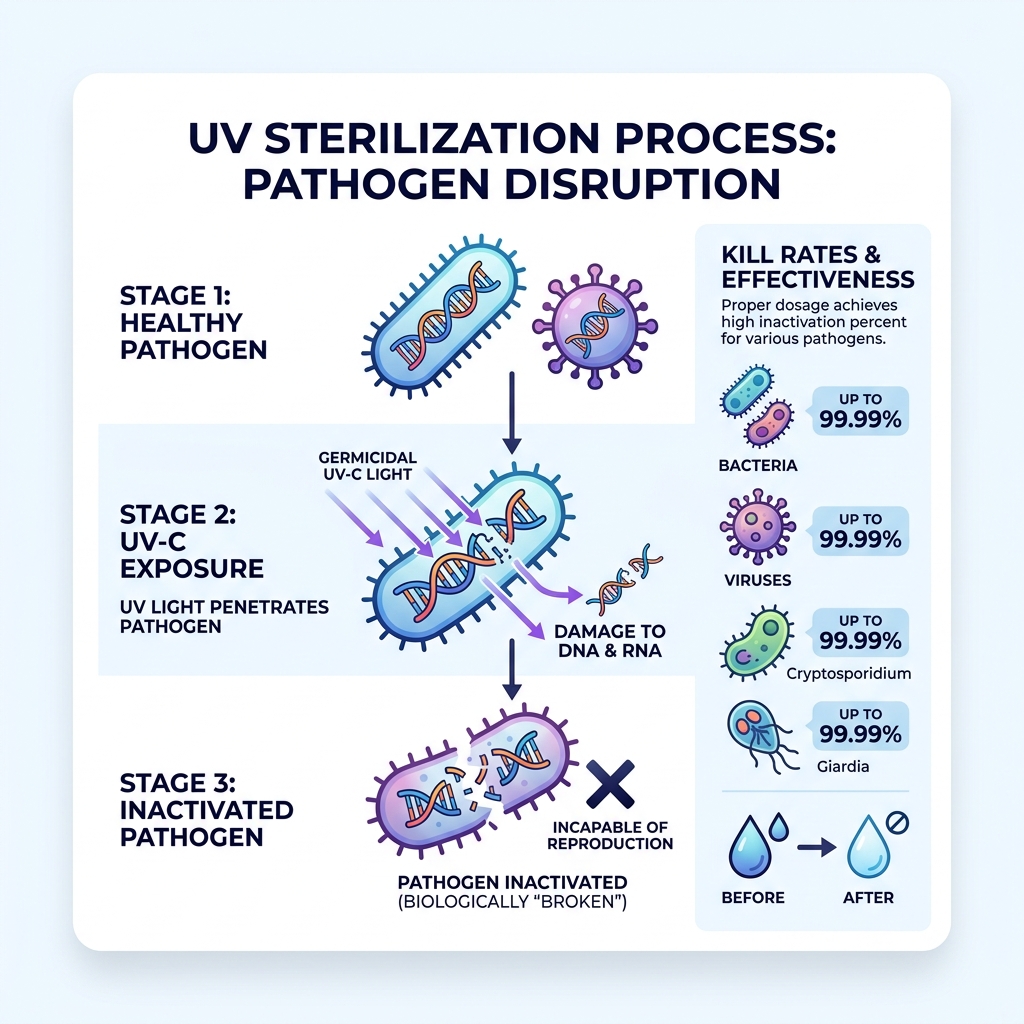
UV purification works by exposing water to germicidal UV-C light. This damages the DNA of pathogens so they can’t reproduce — and it does it fast, with no chemicals added.
For hikers and outdoor adventurers, this matters a lot. Backcountry water sources — even clear-looking streams — can carry invisible threats like Giardia and Cryptosporidium. UV systems neutralize these threats in seconds.
The challenge? Choosing the right system. Flow rate, UV dosage, pre-treatment needs, and portability all vary widely across products. The wrong choice can mean inadequate protection or gear that weighs you down.
This guide cuts through the noise and shows you exactly which systems deliver — and for whom.
Understanding How UV Technology Disinfects Water
When we talk about the top uv water purifiers, we are really talking about the power of UV-C light. This specific wavelength of light, often called germicidal radiation, is a powerhouse for safety. Unlike filters that physically trap dirt, UV systems work at a molecular level.
When water flows through a UV chamber, it is blasted with light. This light penetrates the cell walls of microscopic pathogens. Once inside, it wreaks havoc on their DNA and RNA. By disrupting their genetic code, the pathogens become “inactivated.” They aren’t technically dead in the way a bug is squashed, but they are biologically “broken”—they can no longer reproduce or cause infection.
This process is incredibly effective. Most of the top uv water purifiers boast a 99.99% kill rate against:
- Bacteria: Such as E. coli and Salmonella.
- Viruses: Including Hepatitis A and Rotavirus.
- Protozoa: Specifically Cryptosporidium and Giardia, which are notoriously resistant to chlorine.
The beauty of this technology is that it is entirely chemical-free. You aren’t adding chlorine or iodine to your water, so the taste and smell remain exactly as nature intended. This is why UV is a cornerstone of the EPA Ground Water Rule, which aims to reduce the risk of illness from microbial contamination in ground water. Furthermore, high-end systems like the Viqua PRO series are designed to meet LT2 regulations for virus reduction, providing up to a 4-Log (99.99%) reduction in viruses for high-flow applications.

Choosing the top uv water purifiers for Residential Use
Selecting a system for your home requires a bit of math and a look at your plumbing. We usually categorize these systems by their flow rate, measured in Gallons Per Minute (GPM). If you pick a system with a flow rate that is too low, the water will move through the chamber too quickly, and the pathogens won’t receive a high enough “dose” of UV light to be neutralized.
Here is a comparison of how different household sizes typically match up with the top uv water purifiers:
| Household Size | Recommended Flow Rate | Recommended Models | Price Range |
|---|---|---|---|
| 1-3 Bathrooms | 7 – 10 GPM | Viqua VH200, ecoPLUS EP-600-UV | $650 – $1,400 |
| 3-5 Bathrooms | 12 – 15 GPM | iSpring UVF55FS, Viqua VH410 | $270 – $860 |
| 5+ Bathrooms | 15 – 24 GPM | SpringWell UVC5-15, Viqua PRO24 | $960 – $2,300 |
For those of us who spend our weekends on the trail, it’s worth noting that the principles of residential UV systems are the same as those for portable units. If you are interested in how this tech scales down, check out our guide on maximizing efficiency using uv light purifiers for backpacking trips.
High-Capacity top uv water purifiers for Large Families
For large families or homes with high-flow fixtures (like rainfall showerheads or large soaking tubs), a 15 GPM system is the gold standard. A prime example is the SpringWell UVC5-15. This unit is designed to provide a UV dosage of at least 30 mJ/cm², which is the industry benchmark for effective disinfection at high speeds.
Some premium systems use high-output lamps and 316L stainless steel reactors. This type of steel is highly resistant to corrosion, ensuring the chamber stays reflective and effective for decades. When looking at these high-capacity units, it’s also wise to look for NSF 58 certification standards or similar IAPMO validations, which prove the system can handle the contaminants it claims to remove.
Essential Features of top uv water purifiers for Well Water
If you are on well water, your needs are slightly different. Well water can be unpredictable, especially after heavy rains when runoff can introduce bacteria into the aquifer. For these scenarios, we recommend systems with:
- UV Sensors: These monitor the actual intensity of the light. If the light dims or the water becomes too cloudy for the light to penetrate, an alarm sounds.
- Solenoid Shut-off Valves: This is a “fail-safe” feature. If the power goes out or the UV lamp fails, the valve automatically closes, preventing any untreated water from entering your home.
- Audible Alarms: These ensure you know the moment maintenance is required.
Using these advanced features is one of the ways how UV purification enhances health on hikes and in homes alike—it provides a “safety net” that physical filters alone cannot offer.
Critical Factors: Flow Rate, UVT, and Pre-Treatment
One of the most common mistakes we see is homeowners installing a UV system without proper pre-treatment. UV light is a “line-of-sight” technology. If there is a piece of floating sediment (like sand or silt) in the water, a bacteria cell can “hide” in the shadow of that particle and pass through the system completely unharmed. This is called “shadowing.”
To prevent this, every UV system should be preceded by a sediment filter. We recommend a 5-micron sediment filter as the bare minimum. This ensures the water is clear enough for the UV light to do its job.
Another technical term you’ll encounter is UV Transmittance (UVT). This is a measure of how much light can pass through the water. Most of the top uv water purifiers are rated based on a 95% UVT. If your water is “hard” (high in minerals like calcium) or contains high levels of iron and manganese, these can coat the UV lamp’s protective sleeve, effectively blocking the light.
Before installing a UV system, we suggest testing for:
- Iron: Should be < 0.3 ppm.
- Manganese: Should be < 0.05 ppm.
- Hardness: Should be < 7 gpg.
- Turbidity: Should be < 1 NTU.
If your water exceeds these levels, you may need a water softener or an iron filter alongside your UV unit. Understanding these requirements is just as important as knowing the advantages of using uv light purifiers for backpacking trips, where water clarity can vary from one stream to the next.
Installation, Maintenance, and Ongoing Costs
While the top uv water purifiers are generally “set it and forget it” systems, they do require annual attention.
The Annual Lamp Change
UV lamps are not like the lightbulbs in your ceiling; they don’t just “burn out.” Instead, they undergo “solarization.” Over time, the glass of the lamp becomes less transparent to the UV-C wavelength. Even if the lamp is still glowing blue, it may not be emitting enough germicidal radiation to protect you after 9,000 hours (roughly one year) of continuous use. We recommend changing the lamp every 365 days.
Quartz Sleeve Maintenance
The lamp sits inside a glass tube called a quartz sleeve. This sleeve protects the lamp from the water. Over time, minerals can “bake” onto the sleeve, creating a cloudy film. Every time you change the lamp, you should inspect and clean the sleeve with a mild acid (like vinegar or Citric Acid). If the sleeve is etched or cannot be cleaned, it must be replaced.
Costs to Consider
- Lamps: Usually cost between $80 and $150 depending on the brand.
- Electricity: Most residential UV systems use about the same amount of power as a 40-watt lightbulb.
- Warranties: Look for brands like Viqua or SpringWell that offer 10-year warranties on the stainless steel chamber and 3-year warranties on the electronics.
For a deeper dive into maintaining your gear in the wild, see our guide to uv water purifiers for camping.
Specialized UV Solutions for RVs and Outdoor Use
Not every UV system needs to be a giant 15 GPM beast. For our fellow adventurers, there are compact, portable UV systems designed for RVs, vans, and even tiny homes. These typically range from 1 to 3 GPM and can often run on 12V DC power, making them perfect for off-grid living.
In an RV setting, a UV system provides peace of mind when filling up at unfamiliar campgrounds. You never know the quality of the well at a remote site, and a small UV sterilizer acts as a final barrier against pathogens.
For those who prefer a more “active” outdoor lifestyle, harnessing uv light purifiers for safe backpacking trips involves using handheld devices or integrated bottle systems. These use the same germicidal principles but are powered by rechargeable batteries and designed to treat one liter of water at a time.
Frequently Asked Questions about UV Purification
What contaminants does a UV system effectively remove?
A UV system is highly effective against biological threats. It neutralizes 99.99% of bacteria (E. coli, coliform), viruses (Norovirus, Hepatitis), and protozoan cysts (Cryptosporidium, Giardia). However, it does not remove chemicals like chlorine, heavy metals like lead, or physical sediments. For those, you need a carbon or sediment filter.
How often do UV lamps and sleeves need to be replaced?
UV lamps must be replaced every 12 months (365 days) of continuous use. Quartz sleeves should be cleaned annually and typically replaced every 2 to 3 years, or sooner if they become cracked or permanently clouded.
Is a sediment filter required before a UV water purifier?
Yes, absolutely. A sediment filter (usually 5 microns or smaller) is essential to prevent “shadowing,” where pathogens hide behind dirt particles and escape the UV light. Without a sediment filter, the effectiveness of even the top uv water purifiers is significantly compromised.
Conclusion
At Total Cobre, we believe that access to clean water shouldn’t be a luxury, whether you’re in your kitchen or five miles deep into a mountain trail. Our outdoor gear expertise and specialized hiking guides are designed to help you find the most reliable solutions for your lifestyle.
UV technology is one of the few “perfect” solutions in water treatment—it’s fast, chemical-free, and incredibly effective against the things that make us the sickest. By choosing one of the top uv water purifiers and pairing it with the right pre-filtration, you can ensure that every drop of water your family drinks is safe.
Ready to gear up for your next adventure or home upgrade? View our full equipment reviews to find the perfect fit for your needs.
