
Clean Water in the Wild: What Every Off-Grid Hiker Needs to Know
A portable water purification device is one of the most critical pieces of gear you can carry into the backcountry. Whether you’re filtering from a mountain stream or a murky lake, the right device keeps you safe from bacteria, parasites, viruses, and chemicals that you simply can’t see.
Here are the main types of portable water purification devices:
| Type | Best For | Removes Viruses? |
|---|---|---|
| Straw filter | Solo day hikes | No (most models) |
| Squeeze bottle filter | Solo/duo backpacking | No (most models) |
| Pump filter/purifier | Versatile field use | Yes (purifier models) |
| Gravity-fed system | Groups and base camps | No (most models) |
| UV purifier | Travel, virus-prone areas | Yes |
| Chemical treatment | Backup/emergency | Yes |
| Electrolysis device | Long-term/emergency | Yes |
Waterborne illness is a real risk on multi-day trips. Streams and lakes that look clean can carry Giardia, Cryptosporidium, and harmful bacteria. In areas with livestock, viruses become a concern too.
The good news? Today’s portable purifiers are lighter, faster, and more capable than ever. Some weigh under 3 ounces. Others can serve a group of four for years on a single device.
This guide breaks down every major technology and system type so you can choose the right option for your needs — without carrying more weight than necessary.
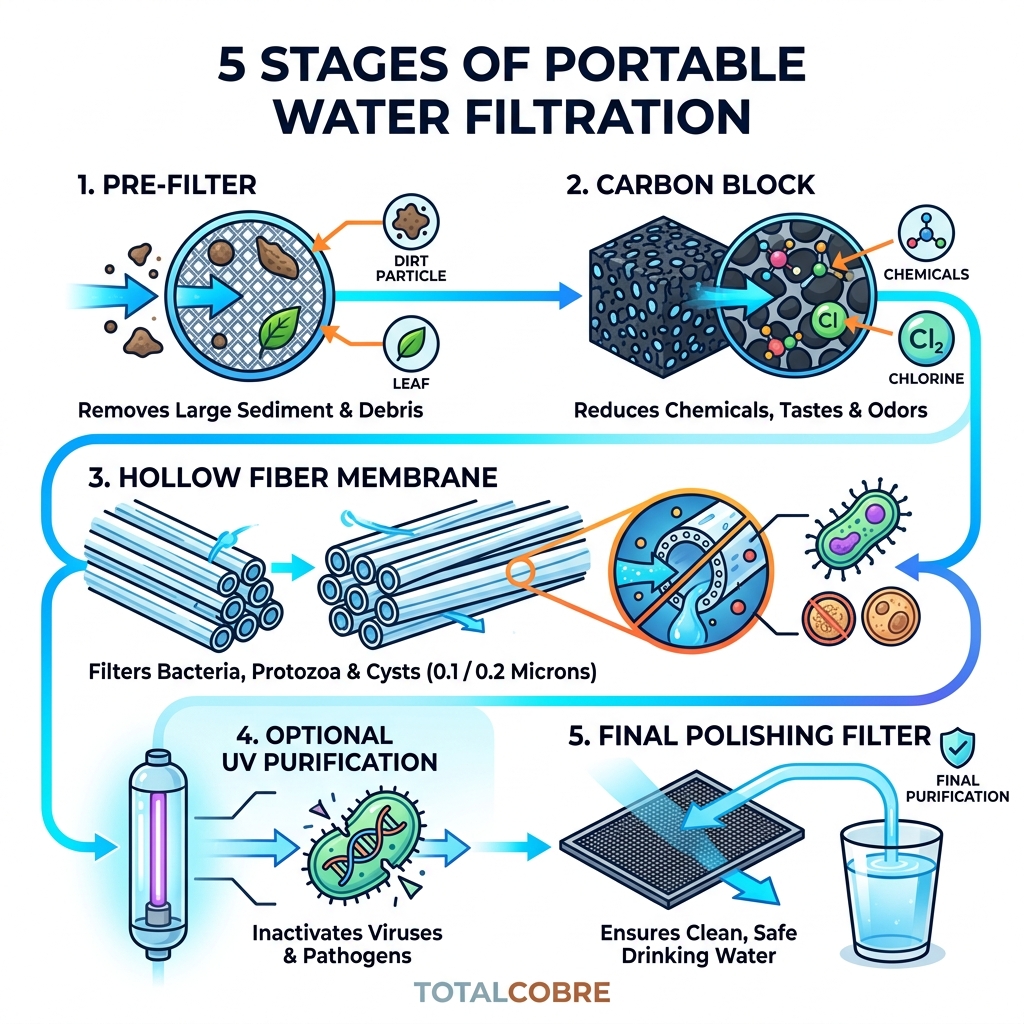
Core Technologies in a Portable Water Purification Device
When we talk about a portable water purification device, we are actually looking at several different technologies working together (or solo) to make your water drinkable. Understanding these is the first step in choosing the best portable water filter for your hiking needs.
Membrane Microfilters
The most common technology in the backcountry is the hollow fiber membrane. Think of it like a bundle of microscopic straws with tiny holes in the sides. These holes are usually 0.1 microns in size. They physically block bacteria and protozoa because those “bugs” are simply too big to fit through the holes.
Carbon Blocks
Many systems include an activated carbon stage. While membranes handle the biological “nasties,” carbon is the hero of taste. It adsorbs chemicals like chlorine, pesticides, and herbicides. If you’ve ever drank water that tasted like a “wet dog” despite being filtered, you probably needed a carbon block.
UV-C Light
UV purifiers don’t actually “remove” anything. Instead, they use ultraviolet light to scramble the DNA of bacteria, viruses, and protozoa. This makes them unable to reproduce, rendering them harmless. The catch? The water must be clear; if it’s turbid (cloudy), the light can’t reach the pathogens hiding behind dirt particles.
Chemical Disinfection
Tablets or drops using chlorine dioxide or iodine are the ultimate lightweight backup. They are effective against viruses and bacteria, but they usually require a “wait time” of 30 minutes to 4 hours to be fully effective against tough cysts like Cryptosporidium.
Electrolysis Devices
A newer player in the off-grid world involves using common salt and electricity to create a disinfectant solution. These devices, like the H2gO Purifier, can treat thousands of liters of water using just a few grains of salt and a USB charge.
To help you visualize the differences, check out our top features to look for in portable water filters for hiking.
| Technology | Removes Bacteria/Protozoa | Removes Viruses | Improves Taste |
|---|---|---|---|
| 0.1 Micron Filter | Yes | No | No |
| 0.02 Micron Purifier | Yes | Yes | No |
| Activated Carbon | No | No | Yes |
| UV Light | Yes | Yes | No |
| Chemical Tabs | Yes | Yes | No (can worsen) |
Mechanical Filtration and Pore Size
Pore size is the “gatekeeper” of your portable water purification device. Most standard filters use a 0.1-micron pore size. This is more than enough to stop 99.9999% of bacteria (like E. coli and Salmonella) and 99.9% of protozoan cysts (like Giardia and Cryptosporidium).

However, if you are traveling to areas with poor sanitation or where human/animal waste is prevalent, 0.1 micron isn’t small enough. Viruses are significantly smaller than bacteria, which is why we look toward ultrafiltration.
Advanced Purification for Virus Removal
To tackle viruses, a portable water purification device needs a pore size of roughly 0.02 microns. This is often referred to as “Log 5” reduction, meaning it removes 99.999% of tested viruses.
Some high-end purifiers, such as the LifeStraw Escape High-Flow Pressurized Purifier, use this advanced ultrafiltration. Beyond just biological threats, these advanced systems are often designed to handle heavy metals like lead and mercury, as well as modern “forever chemicals” like PFAS. This makes them excellent for emergency filtered water bottles where the water source might be chemically contaminated.
Comparing System Types for Off-Grid Living
Not all systems are built the same. A solo thru-hiker has very different needs than a family living off-grid in a cabin. We’ve spent years testing these in the field, and here is how they stack up.
Straw Filters
The “straw” style is the ultimate in simplicity. You stick one end in the water and sip from the other. They are incredibly lightweight (often around 2 ounces) and affordable. However, they can be tiring to use if you need to drink a lot of water, and you can’t easily use them to fill a pot for cooking.
Pump-Action Systems
The classic pump filter uses a hose that you drop into the water source. You then manually pump the water through the filter into your bottle. These are great for shallow puddles where a “squeeze” bag wouldn’t work. Some pump systems, like the Survivor Filter PRO, offer 0.01-micron filtration, which is the highest level available in a portable unit.
Gravity-Fed Reservoirs
If you are at a base camp or living off-grid, gravity is your best friend. You fill a large bag with “dirty” water, hang it from a tree, and let gravity push the water through a filter into a “clean” bag. It’s hands-free and perfect for groups. For more on this, see our guide on camping water filtration 101 from straws to systems.
Pressurized and Electrolysis Systems
For those who want high flow rates without the arm workout of a pump, pressurized tanks are an option. Systems like those from Guzzle H2O can pump and purify water from natural sources at high speeds, making them ideal for overlanders or van-lifers. Meanwhile, the H2gO PRIME Water Purifier uses electrolysis to create a disinfectant that can treat up to 10 liters at a time, making it a sustainable choice with a massive 60,000-liter lifetime capacity.
Choosing a Portable Water Purification Device for Solo Use
If you’re a solo adventurer, weight and packability are king. You likely want a “squeeze” system or a compact hiking water filter system.
Squeeze bottles allow you to scoop water and drink on the go. Many solo hikers prefer the Sawyer Squeeze because of its incredible 100,000-gallon lifetime. It’s a “buy it once and forget it” piece of gear. For those on a strict budget, there are plenty of top-rated portable water filters for budget-conscious adventurers that perform exceptionally well.
High-Capacity Portable Water Purification Device for Groups
When you’re providing water for a family or a group, small straws won’t cut it. You need a high flow rate. A good group system should deliver at least 1 liter per minute.
Gravity systems with 4-liter to 10-liter reservoirs are the standard here. For extreme off-grid scenarios or humanitarian needs, systems like the LifeStraw Max can serve hundreds of people a day without needing electricity. These high-capacity water purification bottles and systems are designed to be durable and handle the heavy lifting of base camp life.
Maintenance and Longevity Factors
A portable water purification device is only as good as its last cleaning. If you don’t maintain your filter, it will clog, the flow rate will drop to a trickle, and you’ll be left thirsty and frustrated.
Backwashing: The Key to Life
Most hollow fiber filters require “backwashing.” This involves using a syringe to force clean water backward through the filter. This pops out the silt and sediment trapped in the membranes.
Dealing with Turbid Water
If you are filtering from a silty river (like the Colorado River), your filter will clog almost instantly. In these cases, pre-filtration is a must. You can use a simple bandana or a coffee filter to strain out the big chunks of “muck” before it hits your expensive filter. This is a vital part of knowing how to assemble your own portable water purification kit.
Lifespan and Replacement Costs
Filter lifespans vary wildly:
- Replacement cartridges: Some filters last for 1,000 to 2,000 liters before the cartridge needs to be swapped.
- Lifetime filters: Devices like the Sawyer Squeeze or Survivor Filter PRO have ultra-filters that can last up to 100,000 liters if properly backwashed.
- Carbon filters: These usually have the shortest lifespan, often needing replacement every 100 to 500 liters to remain effective at removing chemicals.
Always factor in the long-term cost of replacement filters when buying. A “cheap” filter that needs a $20 replacement every month is much more expensive than a $50 filter that lasts a lifetime. For those looking for deals, we’ve rounded up the top-rated portable water filters under 50.
Frequently Asked Questions about Portable Water Purifiers
How do I know when to replace my filter?
Most modern filters are designed with a “fail-safe” mechanism. As the pores fill up with contaminants, the flow rate will naturally slow down. When you can no longer push water through the filter even after a thorough backwash, the filter has reached the end of its life. For more tips on maintenance, check out our guide on personal-water-filtration-devices-for-trails/.
Can these devices remove chemicals and microplastics?
Yes, but it depends on the model. To remove microplastics, you need a filter with a pore size of at least 0.1 microns. To remove chemicals like PFAS, lead, or chlorine, you need a system that includes an activated carbon stage or a specialized ion-exchange filter. We highly recommend eco-friendly-portable-water-filtration-gear/ for those concerned about long-term environmental contaminants.
What is the difference between a filter and a purifier?
This is a common point of confusion.
- Water Filter: Removes bacteria and protozoa (like Giardia).
- Water Purifier: Removes bacteria, protozoa, and viruses.
In the United States and Canada, a filter is usually sufficient for most backcountry trails. However, if you are traveling internationally or hiking in areas with heavy agricultural runoff, a purifier is a safer bet. Look for certifications like NSF/ANSI P231, which is the gold standard for microbiological purifiers. You can read more in our emergency water filter reviews for hikers.
Conclusion
Choosing the right portable water purification device doesn’t have to be a headache. Whether you’re looking for a lightweight water purifier for backpacking or a robust system for a remote off-grid cabin, the key is matching the technology to your environment.
At Total Cobre, we are dedicated to helping you find the gear that keeps you safe and hydrated on every adventure. From the highest-rated portable survival water filters that actually work in a crisis to durable camping water purifiers, our mission is to ensure you never have to worry about the quality of your water.
Ready to gear up for your next trip? Explore our ultimate guide to portable water filters for outdoor adventures and find your perfect match today. Stay safe, stay hydrated, and we’ll see you on the trail!
For more expert reviews and specialized guides for adventurous hikers, visit us at Total Cobre.
