
Why Solar UV Water Purification Could Save Your Life on the Trail
Solar UV water purification is the process of using sunlight — specifically ultraviolet radiation — to destroy the DNA and RNA of harmful pathogens in water, making it safe to drink without chemicals or boiling.
Here’s how it works at a glance:
- Sunlight exposes water to UV-A (and UV-B where possible) radiation
- UV radiation damages pathogen DNA/RNA, preventing bacteria, viruses, and protozoa from reproducing
- Heat from the sun can boost the effect, especially above 50°C
- Result: biologically safe drinking water using nothing but sunlight
The two main approaches are:
| Method | How It Works | Best For |
|---|---|---|
| SODIS (passive) | Fill clear PET bottles, expose to sun 6+ hours | Low-cost, no-gear situations |
| Solar-powered UV systems (active) | PV panels power a UV-C lamp to treat flowing water | Higher volume, faster, more reliable |
The stakes are real. Around 844 million people worldwide lack access to safe drinking water. Roughly 1,000 children die every single day from diseases linked to contaminated water. Even for hikers in remote wilderness, a single sip from a contaminated stream can mean days of illness far from help.
The good news? The sun is a surprisingly powerful disinfection tool — and it’s free.
This guide breaks down exactly how solar UV purification works, what it kills, what it can’t do, and how to use it reliably whether you’re crossing a mountain range or preparing for an emergency.
The Science of Solar UV Water Purification
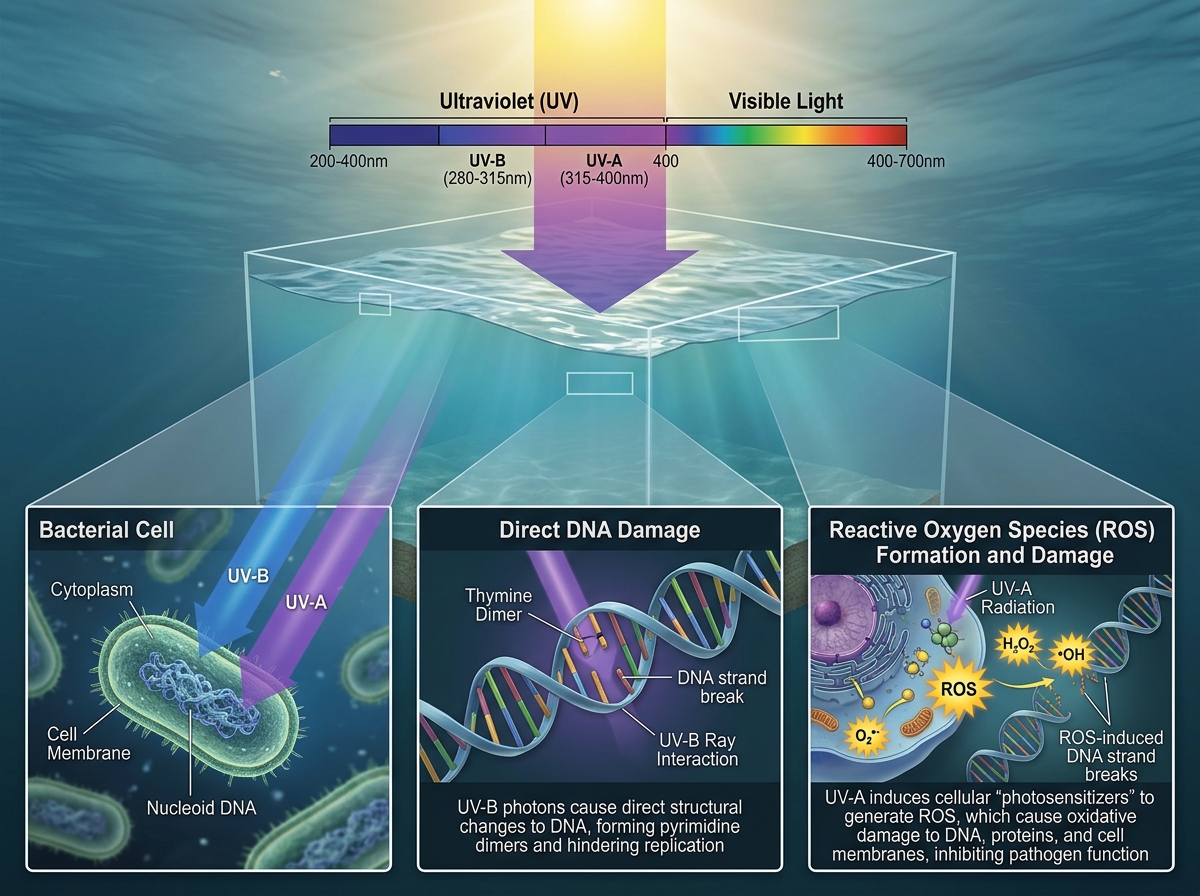
To understand how solar UV water purification works, we have to look at the invisible parts of the light spectrum. While we enjoy the sun for its warmth and light, it is also bombarding the Earth with ultraviolet (UV) radiation. In the context of water treatment, we are primarily interested in three mechanisms: UV-A radiation, photo-oxidation, and thermal pasteurization.
According to Solar water disinfection – Wikipedia, the process relies on the synergistic effect of these forces. UV-A radiation (wavelength 320–400 nm) reacts with dissolved oxygen in the water to produce highly reactive forms of oxygen, such as free radicals and hydrogen peroxide. These reactive oxygen species (ROS) are like microscopic wrecking balls; they attack the cell membranes and internal structures of pathogens.
Furthermore, UV radiation directly causes DNA damage and RNA destruction. When a microorganism’s genetic material is scrambled by UV light, it can no longer reproduce. In microbiology, a pathogen that cannot reproduce is effectively “dead” because it cannot cause infection in a human host.
Pathogens Inactivated by Solar UV Water Purification
The effectiveness of sunlight against waterborne “nasties” is well-documented in Scientific research on solar disinfection systems. Most common bacteria, including E. coli, Vibrio cholerae (the cause of cholera), and Salmonella, are highly susceptible to solar UV.
However, not all pathogens are created equal:
- Bacteria: Generally the easiest to kill. A standard 6-hour exposure usually achieves a 99.9% to 99.99% reduction.
- Viruses: These can be more stubborn. While Rotavirus is often inactivated within a day of full sun, some viruses require longer exposure because they are smaller and sometimes more resistant to UV-A.
- Protozoa: This is where things get tricky. Cryptosporidium parvum and Giardia are notorious for having hard outer shells (cysts). Cryptosporidium is responsible for 30–50% of childhood mortality in low-income countries, and while solar UV can inactivate them, it often requires the added “punch” of higher temperatures (above 50°C) to be truly effective.
Water Chemistry and Radiation Attenuation
The “cleanness” of your water before you start treatment matters immensely. This is known as turbidity — essentially, how cloudy the water is. If water is murky, suspended solids (dirt, silt, or algae) act as tiny shields for bacteria, blocking the UV rays from reaching them.
A common rule of thumb is the “newspaper test.” If you can read the headline of a newspaper through a filled 2-liter bottle, the turbidity is likely below 30 NTU (Nephelometric Turbidity Units), which is the threshold for effective SODIS. If it’s cloudier than that, you must pre-filter the water.
Beyond dirt, dissolved organic matter (DOM) and nitrates can also impact the process. In some cases, these act as “sensitizers,” helping to create more hydroxyl radicals that kill bacteria. In other cases, they absorb the radiation themselves, acting as a “sunscreen” for the pathogens. For more on how environmental factors like thin air and intense sunshine play a role, check out our guide on pure water from thin air and thick sunshine.
Primary Methods: SODIS vs. Solar-Powered UV Systems
There are two main ways to harness the sun for water safety: the “wait and see” passive approach and the “high-tech” active approach.
| Feature | SODIS (Passive) | Solar-Powered UV (Active) |
|---|---|---|
| Equipment | PET bottles | PV panels + UV-C lamp + Pump |
| Treatment Time | 6 hours to 2 days | Instantaneous (Continuous flow) |
| Volume | Limited to bottle size | Up to 10 liters per minute |
| Pathogen Kill | UV-A + Heat | Intense UV-C (254 nm) |
| Cost | Negligible ($0.63/year) | Moderate ($150 – $500+) |
| Reliability | Weather dependent | High (often includes batteries) |
SODIS (Solar Water Disinfection) is the most accessible household water treatment. It’s a batch process: you fill a bottle, shake it to add oxygen (which helps create those reactive oxygen species), and leave it on a roof.
Solar-powered UV systems are a different beast entirely. These use photovoltaic (PV) energy to power a dedicated UV-C lamp. UV-C is much more powerful than UV-A but is normally filtered out by the Earth’s atmosphere. By generating it locally with a bulb, these systems can provide a standard 40J/m² dose, which is the international benchmark for drinkable water. Many of these systems, like the Wyckomar Solar Tote, also include zeolite filters and carbon pre-filtration to handle taste and sediment simultaneously.
Optimizing Solar UV Water Purification with Container Materials
The container you choose is essentially the “lens” for your purification. Most people use PET bottles (polyethylene terephthalate) because they are ubiquitous and cheap. However, PET has a secret: it blocks most UV-B radiation.
Research into new technology research on solar UV suggests that alternative materials like polypropylene (PP), PMMA (acrylic), or even specialized UV-transparent glass can significantly speed up the process by allowing UV-B rays to pass through.
One thing to watch out for is aging. Over time, plastic bottles get scratched or “yellowed” by the sun. This reduces their transparency and makes them less effective at letting UV light through. We recommend replacing SODIS bottles every 6 to 12 months to ensure you’re getting the best protection.
Enhancements for Faster Disinfection
If you’re in a hurry, you can “supercharge” the sun. One common method is using a black backing or placing bottles on a black corrugated iron roof. This increases the water temperature, leading to a synergistic effect where heat and UV work together to kill pathogens much faster than either could alone.
For more advanced setups, Compound Parabolic Concentrators (CPC) or simple parabolic reflectors made of aluminum foil can reflect extra sunlight into the water container. This can reduce the required exposure time from 6 hours to just 90 minutes in some conditions. SODIS bags are another innovation; they have a larger surface-to-volume ratio than bottles, allowing them to heat up and disinfect more efficiently.
Practical Considerations for Off-Grid and Emergency Use of Solar UV Systems
When we’re out on the trail or dealing with a power outage, we need methods that actually work. Here are our best practices for safe implementation:
- Pre-filtration is Mandatory: If your water looks like chocolate milk, the UV won’t work. Use a cloth, a sand filter, or a dedicated sediment filter first.
- Oxygenation Matters: For SODIS, fill the bottle three-quarters full, shake it for 20 seconds, and then fill it the rest of the way. This increases dissolved oxygen, which makes the UV-A more lethal to bacteria.
- Know Your Weather: 6 hours of bright sun is the gold standard. If it’s 50% cloudy, you need the full day. If it’s 100% cloudy or raining, you need two full days.
- Avoid Recontamination: Once the water is treated, keep it in the same container until you drink it. Pouring it into an unwashed cup is the fastest way to get sick again.
- Maintenance of Active Systems: If you’re using a solar-powered UV device, UV-C lamps have a lifespan (usually about 1 year of continuous use). Even if the bulb is glowing blue, it might not be emitting enough UV-C to kill pathogens.
Advantages and Disadvantages Compared to Traditional Methods
Why choose solar UV over boiling or chlorine?
The Pros:
- Cost: SODIS is estimated to cost just $0.63 per person per year. Compare that to the $10.56 per year it costs to boil water using wood or gas.
- Taste: Unlike chlorination, UV doesn’t change the taste of the water.
- Simplicity: No moving parts (in passive systems) and no chemicals to refill.
- Sustainability: It uses a 100% renewable resource.
The Cons:
- Speed: Passive methods are slow.
- No Residual Protection: Unlike chlorine, which stays in the water to kill any new bacteria that might fall in, UV-treated water can be recontaminated easily.
- Chemicals: UV does not remove lead, arsenic, or pesticides.
For those looking for the best gear for their next adventure, we’ve reviewed the top solar-powered water solutions for the trail to help you find a balance between weight, speed, and reliability.
Frequently Asked Questions about Solar UV Water Purification
How long does solar UV water purification take in cloudy weather?
In perfectly sunny conditions, 6 hours is sufficient. However, UV intensity drops significantly with cloud cover. If it is more than 50% cloudy, you should leave the bottles out for two consecutive days. Active systems with photovoltaic panels are less affected by minor cloud cover because they use stored battery power to maintain a consistent UV-C dose, but their “autonomy” (how long they can run without sun) is usually limited to 2–3 days.
Does solar UV purification remove chemical contaminants?
No. This is a critical distinction. Solar UV water purification is a biological treatment. It is incredibly effective at killing living organisms like bacteria and viruses. However, it will not remove heavy metals like lead or arsenic, nor will it neutralize chemical pesticides. If you suspect chemical contamination, you need an integrated system that includes Reverse Osmosis (RO) or a high-quality activated carbon block.
What are the material considerations for solar UV water purification?
For passive SODIS, use only clear PET bottles (look for the #1 recycling symbol). Avoid PVC bottles, which can leach harmful plasticizers, and avoid colored bottles (like green or brown), which block the very UV rays you need. For active systems, ensure the “sleeve” surrounding the UV lamp is made of high-quality quartz glass, as standard glass blocks UV-C radiation.
Conclusion
At Total Cobre, we believe that access to clean water shouldn’t be a luxury reserved for those on the grid. Whether you are a hiker exploring the deep backcountry or someone looking to secure your family’s water supply during an emergency, understanding solar UV water purification is an essential skill.
While SODIS offers a nearly free, life-saving solution for those with no other options, active solar-powered UV systems provide the speed and reliability that modern adventurers demand. By combining the ancient power of the sun with modern filtration technology, we can ensure that every drop of water we consume is safe, sustainable, and life-sustaining.
Ready to gear up for your next trek? Explore top solar-powered water purification solutions for the trail and stay hydrated out there!
