
Why Your Ultralight Water Purifier Choice Can Make or Break Your Trip
An ultralight water purifier is a compact filtration or purification device weighing under 4 ounces that removes harmful pathogens from backcountry water sources. Here are the top options for 2026:
| System | Weight | Best For |
|---|---|---|
| Sawyer Squeeze + Cnoc VectoX 2L | 6.3 oz | Thru-hiking, most reliable overall |
| HydraPak UltraFlask + Filter Cap | 2.3 oz | Front-mounting, on-the-go drinking |
| Katadyn BeFree AC .5L | 2.3 oz | Short trips, easy field cleaning |
| LifeStraw Peak Squeeze 1L | 3.8 oz | Versatile solo use, long filter life |
| Aquamira Drops | ~3 oz | Chemical backup, ultralight simplicity |
Walk any long-distance trail this summer and you’ll notice something: almost every experienced thru-hiker is carrying a squeeze filter, not a bulky pump. The gear has gotten that good.
But picking the wrong system still causes real problems. Filters freeze and crack overnight. Flow rates drop to a trickle after one silty creek. Some filters handle bacteria and protozoa just fine — but leave viruses completely untreated.
Your hydration strategy is only as strong as the system you trust it to. A bad choice means stopping constantly to filter, drinking questionable water when your filter clogs, or carrying more weight than you need to.
The good news? A handful of well-tested systems solve all of this — and the lightest setups weigh less than a granola bar.
Top-Rated Ultralight Water Purifier Systems for 2026
When we talk about the “best” systems, we aren’t just looking at the weight on a scale. We’re looking at the “trail weight”—how much effort it takes to get water from a muddy puddle into your parched throat. For 2026, the market has split into two main camps: the ultra-reliable hollow fiber filters and the newer, sunken-head 42mm systems.
The Sawyer Squeeze + Cnoc VectoX 2L remains our gold standard for a reason. It uses a 0.1-micron hollow fiber membrane that is virtually impossible to “wear out” if you treat it right. While some competitors tap out after 500 gallons, the Sawyer Squeeze is famously rated for 100,000 gallons. We’ve seen these filters survive entire thru-hikes of the PCT and CDT with nothing more than a daily backflush.
If you prefer a softer, more integrated feel, the LifeStraw Peak Squeeze is a formidable challenger. It’s rated for 2,000 liters (500 gallons), which is double the lifespan of many other collapsible systems. It filters 1L in about 40 seconds, making it one of the faster “squeeze-and-drink” options on the market.
For those who prioritize speed and front-pocket access, the HydraPak UltraFlask + Filter Cap .5L is the new king of the mountain. Weighing just 2.3 oz, it’s designed specifically to sit in your shoulder strap pockets. You don’t even have to stop walking; just squeeze the flask and drink through the bite valve.
The Ideal Ultralight Water Purifier Setup for Thru-Hiking
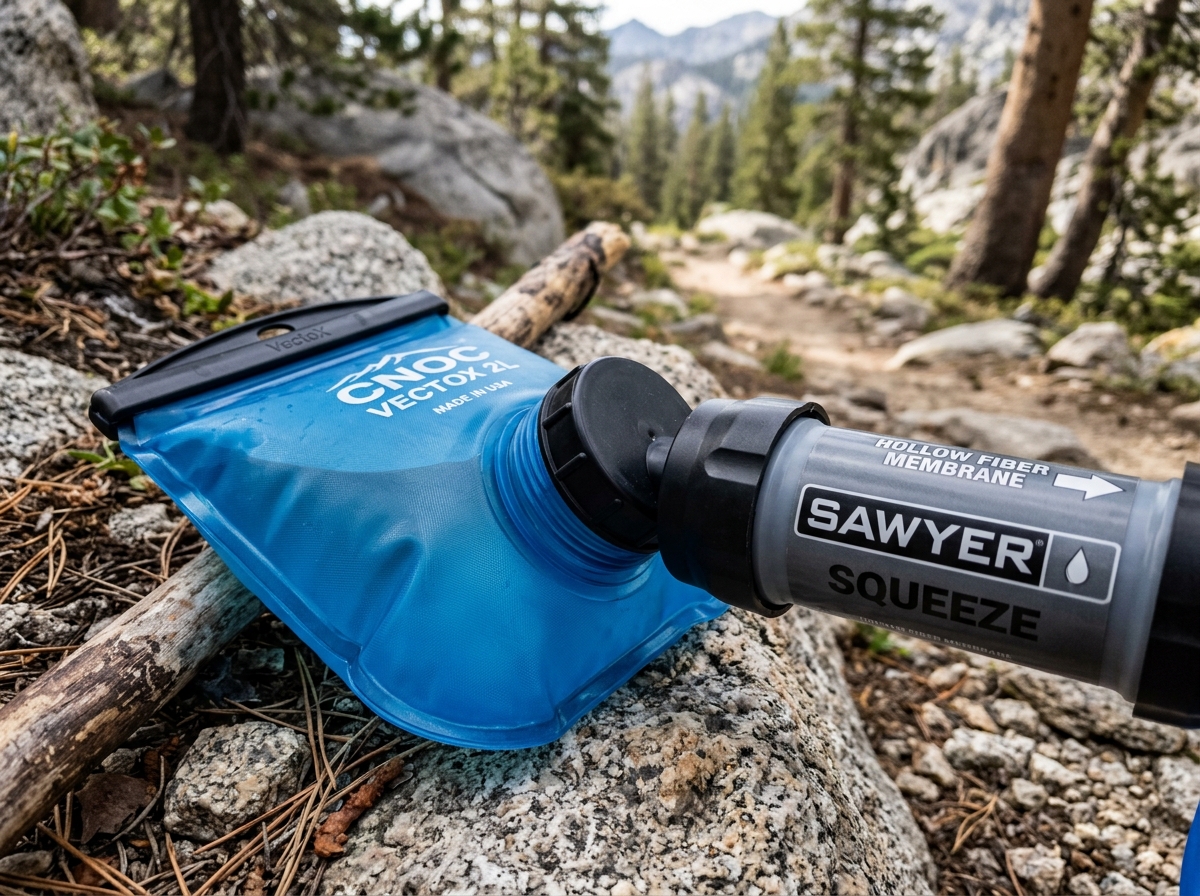
For a 2,000-mile journey, reliability is the only metric that truly matters. This is why 85% of PCT thru-hikers stick with the Sawyer Squeeze. But the filter is only half the story. The “dirty bag” that comes in the box with most filters is, frankly, prone to failure.
We recommend pairing the Sawyer with a Cnoc VectoX. This reservoir uses a 28mm threading that matches the Sawyer perfectly but adds a wide-mouth rear opening. This makes collecting water from shallow pools or slow-moving seeps infinitely easier. The VectoX is built from a much tougher TPU than standard bags, meaning you won’t be dealing with pinhole leaks three weeks into your trip.
When evaluating the best lightweight water purifiers for hiking, we found that the most successful hikers follow a simple maintenance rhythm: backflush every morning. By using the included syringe to force clean water backward through the filter, you clear out the “cake” of silt that slows down your flow rate.
Choosing an Ultralight Water Purifier for International Travel
Standard hollow fiber filters (like the Sawyer or BeFree) are “microfilters.” They excel at removing bacteria (like E. coli) and protozoa (like Giardia), but they are often too porous to catch tiny viruses. If your travels take you to areas where water sources are contaminated by human waste or in international regions with less developed infrastructure, you need a true ultralight water purifier.
The MSR Guardian is the heavy hitter here. With a 0.02-micron pore size, it physically blocks viruses. However, at over a pound, it’s a stretch to call it “ultralight.” For a more packable option, the Grayl GeoPress is a favorite for travelers. While it weighs about 15.9 oz (not exactly “featherweight”), its “OnePress” system removes heavy metals, chemicals, and viruses in seconds.
For the true minimalist traveling abroad, we suggest checking out our guide on lightweight-water-purifiers-for-backpacking to see how to layer chemical treatments with physical filters for 100% protection.
Comparing Squeeze Filters vs. Chemical Treatments
Before filters became so light, chemical treatment was the only way to go. Today, it remains the ultimate backup. AquaMira and other chlorine dioxide treatments are ultra-reliable because they have no moving parts to break and no fibers to clog.
Here is how the two methods stack up:
- Weight: Chemicals win. A set of drops or a pack of tablets weighs about 1-3 oz and can treat 30+ gallons.
- Effectiveness: Filters remove particulates (dirt, sand, bug parts). Chemicals do not. If you use chemicals, you’re drinking “clean” dirt.
- Wait Time: Filters are instant. Chemicals require “contact time.” Most bacteria are dead in 30 minutes, but Cryptosporidium can require up to 4 hours of waiting, especially in cold water.
- Reliability: Chemicals don’t freeze and break. If you drop a bottle of AquaTabs, they still work. If you drop a Sawyer Squeeze and the internal fibers crack, it’s useless.
We always suggest carrying AquaTabs as a backup. A 10-pack weighs a mere 0.1 oz. If your filter fails, clogs, or freezes, these tiny tablets are your insurance policy. For more on how to balance these for long trips, see our lightweight water gear recommendations for multi-day hikes.
Best Filter and Bottle Combinations for Every Hiker
The “best” filter is often defined by what you screw it onto. The industry has moved toward two main thread sizes: 28mm (standard soda bottle) and 42mm (wide-mouth soft flask).
| Combination | Best Use Case | Weight |
|---|---|---|
| Sawyer Squeeze + Igneous NOBO | Sustainable Hard-Sided | 6.7 oz |
| HydraPak 42mm + Cnoc VectoX 2L | Fast Gravity Setup | 6.0 oz |
| Platypus QuickDraw + Smartwater | Budget Ultralight | 3.5 oz |
| Katadyn BeFree + HydraPak Flux | Hybrid Soft/Hard Bottle | 5.5 oz |
The Sawyer Squeeze + Igneous NOBO is our top pick for those who hate single-use plastics. The NOBO bottle is a durable, ethical alternative to the classic Smartwater bottle, offering a better grip and longer lifespan.
If you prefer a “sunken” filter design, look at the HydraPak 42mm Filter Cap + Cnoc VectoX 2L 42mm. Unlike the Sawyer, which sticks out like a chimney, 42mm filters sit inside the neck of the bottle. This makes the whole system much more compact and less likely to snag on branches. For a deeper dive into these setups, check out our compact hiking water filter systems guide.
Front-Mounting Solutions for On-the-Go Hydration
Modern backpacking packs often feature large mesh pockets on the shoulder straps. Using these for water is a game-changer because it keeps your weight centered and encourages you to sip more often.
The Katadyn BeFree AC .5 Filter was the pioneer here, but the new 2025/2026 models have improved durability. The “AC” version features a much tougher flip-top cap that won’t snap off in your pack. When paired with a soft flask, you have a system that disappears as you drink. This is widely considered the best portable water filter for hiking when you’re moving fast and light.
Maintenance and Reliability: Ensuring Your System Lasts
A water filter is a precision instrument. If you treat it like a piece of iron, it will fail you. The most common pitfall is turbid water. If you’re filtering from a silty glacial stream or a stagnant pond, the tiny pores in your filter will clog almost instantly.
Pro Tip: Use a pre-filter. A simple bandana or a piece of pantyhose rubber-banded over the mouth of your dirty bag will catch the big stuff (algae, sand, silt) before it ever hits your expensive filter fibers.
The Platypus QuickDraw + Cnoc VectoX 2L 28mm is excellent for this because the QuickDraw allows for a “shake-to-clean” method. If the flow slows down, you just shake the filter to dislodge debris. However, for most filters, the syringe backflush is the only way to truly restore flow.
Another critical reliability factor is the O-ring. This is the small rubber gasket inside the filter that creates a seal with your bottle. If you lose this, the dirty water will leak out the sides and contaminate your clean water. Always carry a spare, or choose a filter like the QuickDraw that has an integrated gasket. For more maintenance hacks, see our guide for must-have portable water filters for frequent backpackers.
Frequently Asked Questions about Water Treatment
Can ultralight filters remove viruses?
Most cannot. Standard hollow fiber filters (Sawyer, Katadyn, Platypus) have a pore size of 0.1 to 0.2 microns. Viruses are much smaller, often around 0.02 microns. To remove viruses, you need a “purifier” like the MSR Guardian or a chemical treatment like chlorine dioxide. In the US and Canada, viruses are rarely a concern in the backcountry, but they are a major risk in international travel or areas with high human impact.
How do I prevent my filter from freezing at night?
This is the “Golden Rule” of ultralight filtering: If it freezes, it’s garbage. When water inside the hollow fibers freezes, it expands and cracks the tubes. You won’t be able to see the cracks, but pathogens will swim right through them. If the temperature is going to drop below 32°F (0°C), put your filter in a Ziploc bag and sleep with it in your sleeping bag. Your body heat will keep it safe.
What is the best budget option for small groups?
If you’re hiking with friends and don’t want to spend $60+ per person, the Waterdrop Filter Straw and Gravity Bag is an incredible value. It’s a fraction of the cost of high-end systems and works perfectly as a gravity camp filter. Just fill the bag, hang it from a tree, and let gravity do the work while you set up your tent.
Conclusion
At Total Cobre, we believe that your gear should disappear into your experience. You shouldn’t be thinking about your water filter—you should be thinking about the view. By choosing a high-quality ultralight water purifier and pairing it with the right vessel, you ensure that clean hydration is never a chore.
Whether you choose the time-tested Sawyer Squeeze or a modern front-mounting HydraPak, maintenance is the key to gear longevity. Keep it clean, keep it from freezing, and always carry a backup.
For more deep dives into trail safety and gear, check out our ultimate guide to portable water filters for outdoor adventures or Visit Total Cobre for more gear reviews. Happy trails!
