
Clean Water in the Backcountry: What Every Hiker Needs to Know
A water filtration system backpacking setup is one of the most critical pieces of gear you can carry — right alongside your shelter and navigation tools.
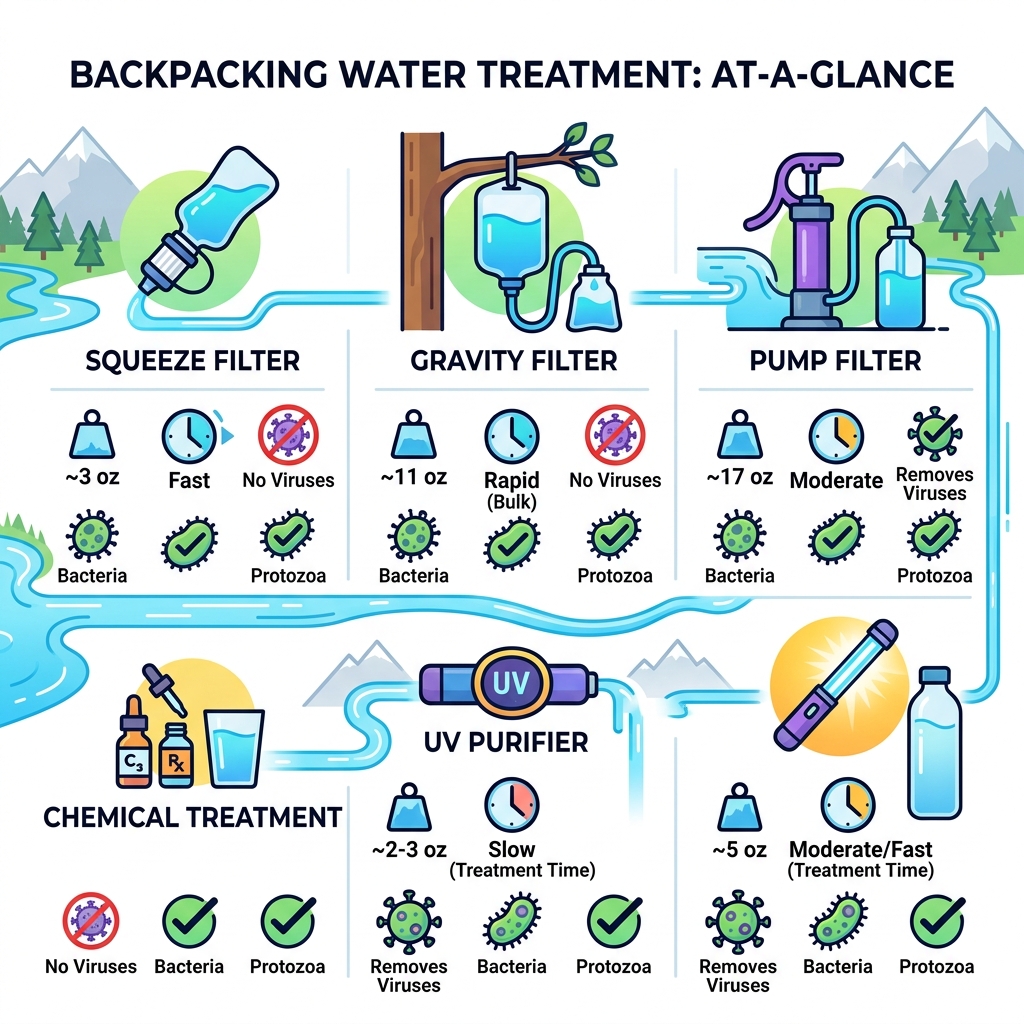
Here’s a quick overview of your main options:
| System Type | Best For | Weight | Removes Viruses? |
|---|---|---|---|
| Squeeze filter (e.g., Sawyer Squeeze) | Solo hikers, thru-hikers | ~3 oz | No |
| Gravity filter (e.g., Platypus GravityWorks) | Groups, base camps | ~11 oz | No |
| Pump filter (e.g., MSR Guardian) | Challenging sources, international travel | ~17 oz | Yes |
| Chemical treatment (e.g., Aquamira drops) | Backup, ultralight travel | ~2–3 oz | Yes (chlorine dioxide) |
| UV purifier (e.g., SteriPEN Ultra) | Clear water, international travel | ~5 oz | Yes |
The short answer: For most backpacking trips in North America, a lightweight hollow fiber squeeze or gravity filter is all you need. For international travel or areas with high human traffic, upgrade to a purifier that also kills viruses.
Every stream, lake, and spring in the backcountry looks clean. Most aren’t.
Giardia, Cryptosporidium, and bacteria like E. coli are invisible — and according to the Centers for Disease Control and Prevention (CDC), they can turn a dream trip into a miserable week of stomach cramps. The risk is real, and the solution is straightforward: treat every water source, every time.
The good news? Modern gear has made this easier, lighter, and faster than ever. A filter like the Sawyer Squeeze weighs just 3 ounces and can process water at 1.7 liters per minute. A gravity system can filter a full 4 liters in under three minutes while you set up camp. There’s a solution for every trip style and group size.
This guide breaks down every major type of water filtration system for backpacking — how they work, who they’re best for, and how to keep them running mile after mile.
Key terms for water filtration system backpacking:
Understanding Your water filtration system backpacking Options
When we look at a water filtration system backpacking setup, we are essentially looking at how water is forced through a physical barrier to trap contaminants. Most modern systems use one of three primary filter media:
- Hollow Fiber: These are tiny, U-shaped bundles of “straws” with microscopic pores in their walls. They are incredibly lightweight and offer a massive surface area, allowing for fast flow rates.
- Ceramic Media: These use a porous ceramic stone. They are heavy-duty and can be cleaned in the field by scrubbing the surface, making them excellent for very turbid or silty water.
- Activated Carbon: Usually found as a secondary stage, carbon doesn’t remove bacteria but excels at absorbing chemicals, pesticides, and improving the “pond water” taste.
Squeeze and Straw Filters for Solo Hikers
For the ultralight crowd and thru-hikers, squeeze filters are the gold standard. These systems involve a collapsible pouch that you fill with “dirty” water and then squeeze through a hollow fiber filter directly into your mouth or a clean bottle.
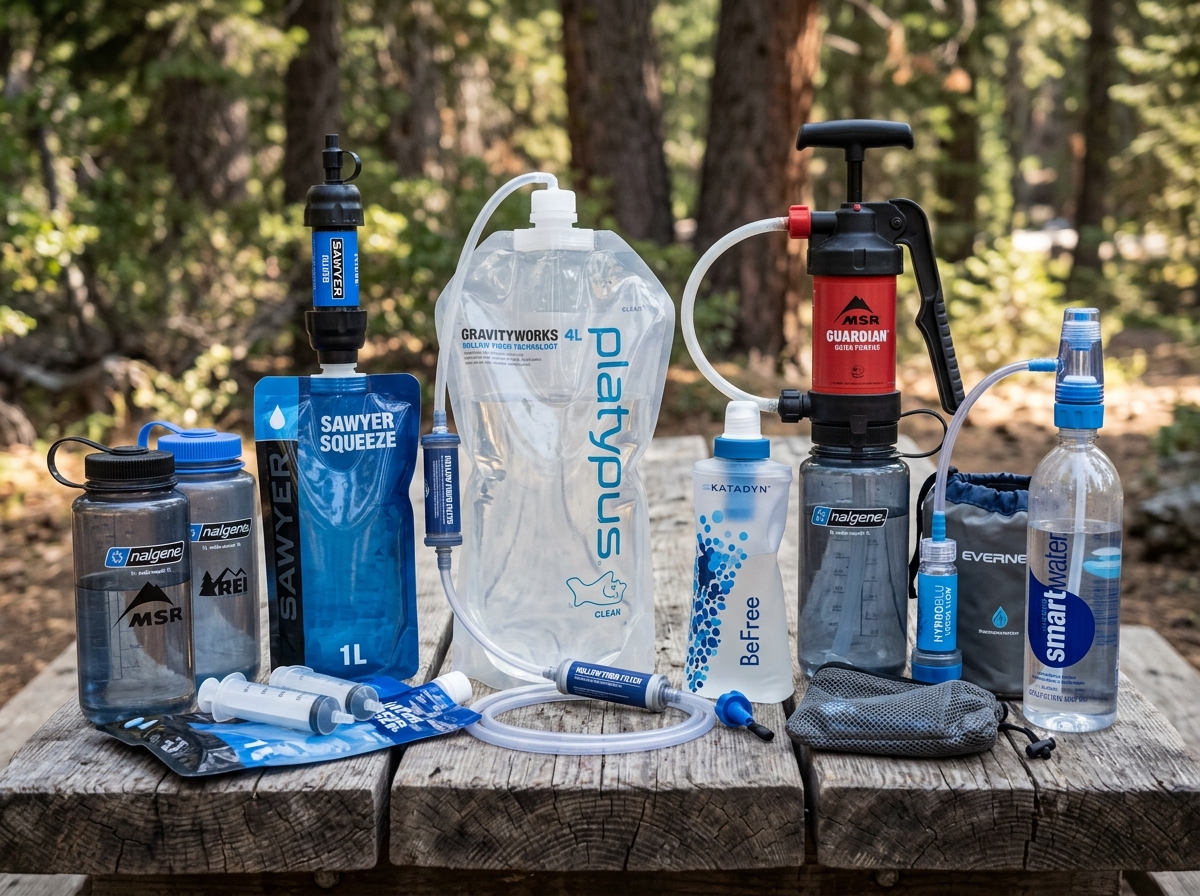
The Sawyer Squeeze is perhaps the most famous example, boasting a lifetime volume of 378,000 liters (100,000 gallons). Another popular choice is the Katadyn BeFree, which features a wider mouth for easier filling and a flow rate of up to 2 liters per minute. These filters typically have a 0.1-micron pore size, which is small enough to catch 99.9999% of bacteria and protozoa. If you’re looking for the most efficient setup, check out our guide on the best-portable-water-filters-for-backpackers.
Gravity Systems for Group Basecamps
If you’ve ever spent 20 minutes hunched over a stream squeezing bags for a group of four, you’ll understand why gravity systems are a revelation. These systems use two bags (a “dirty” and a “clean” reservoir) connected by a hose with an inline filter.
You simply fill the dirty bag, hang it from a tree branch, and let gravity do the work. The Platypus GravityWorks, for instance, can filter 4 liters of water in under three minutes with a flow rate of 1.75 L/min. It’s hands-free hydration that allows you to set up your tent or start dinner while your water purifies itself. For more on these high-capacity options, see our review of top-hiking-hydration-systems-with-filters.
Manual Pump Filters for Challenging Sources
While squeeze and gravity filters are popular, manual pump filters like the MSR MiniWorks EX or the Katadyn Hiker remain viable for specific scenarios. Pumps are the best tool for “sketchy” water sources—think shallow seeps or puddles where you can’t easily submerge a bag.
Pumps allow you to drop an intake hose into a tiny pool of water and pump directly into a wide-mouth bottle. They are often field-maintainable; for example, the MiniWorks EX uses a ceramic element that you can scrub clean when the flow slows down. While they weigh more (often around 1 lb), their durability in silty water is hard to beat.
Water Filter vs. Water Purifier: Which Do You Need?
This is the most important technical distinction you’ll make.
- Water Filters: Use mechanical straining (usually 0.1 to 0.2 microns) to remove protozoa (Giardia, Cryptosporidium) and bacteria (E. coli, Salmonella). They do not remove viruses because viruses are simply too small.
- Water Purifiers: These must meet higher standards, removing or inactivating 99.99% of viruses in addition to bacteria and protozoa. They achieve this through smaller pore sizes (0.02 microns), UV light, or chemical treatment.
In most of the U.S. and Canada, a filter is sufficient because waterborne viruses are rarely found in the backcountry. However, if you are purifying-water-in-remote-areas-strategies-for-backpackers, the math changes.
When to Use a Purifier for International Travel
If your adventures take you to developing nations or areas with poor sanitation and high human traffic, a purifier is non-negotiable. Viruses like Hepatitis A and Norovirus are a significant risk in these regions.
The MSR Guardian is a top-tier mechanical purifier, using hollow fibers so small (0.02 microns) that they physically block viruses. It was originally designed for the military and can handle extremely turbid water. For a lighter approach, we recommend looking into lightweight-water-purifiers-for-backpacking.
Chemical and UV Light Purification Methods
If you want to avoid the bulk of a mechanical filter, chemicals and UV light are excellent alternatives.
- Chemicals: Chlorine dioxide (like Aquamira drops or Katadyn Micropur tablets) is the gold standard for chemical treatment. It kills viruses and bacteria quickly (15-30 minutes), though it takes up to 4 hours to kill Cryptosporidium. It leaves very little aftertaste compared to old-school iodine.
- UV Light: Devices like the SteriPEN Ultra use ultraviolet light to scramble the DNA of pathogens, preventing them from reproducing. It takes about 90 seconds per liter. The limitation? It only works in clear water—silt and floaties can “shield” pathogens from the light. Learn more about advantages-of-using-uv-light-purifiers-for-backpacking-trips.
Choosing the Right water filtration system backpacking for Your Trip
Choosing the “best” system depends entirely on your specific trip. We recommend asking yourself these four questions:
- How many people? Solo hikers should stick to squeeze filters. Groups of 3+ will be much happier with a gravity system.
- What is the water quality? If you’re in the Pacific Northwest with clear, rushing streams, a hollow fiber filter is perfect. If you’re in the desert filtering from silty “cow tanks,” a pump filter or a pre-filter system is better.
- Does weight matter? If you’re counting grams, a 2-ounce chemical treatment or a 3-ounce squeeze filter is the way to go.
- What is the temperature? Hollow fiber filters are destroyed if they freeze while wet. If you’re winter camping, chemicals or boiling might be safer.
Evaluating Flow Rate and Capacity
Flow rate is often overlooked until you’re tired and thirsty at the end of a 15-mile day. The Sawyer Squeeze offers a respectable 1.7 L/min, while the Platypus QuickDraw can claim up to 3 L/min when new.
That “advertised” flow rates are based on clean lab water. In the field, that 2 L/min might drop to 0.5 L/min if the water is silty. For more details on performance metrics, see our ultimate-guide-to-portable-water-filters-for-outdoor-adventures.
Maintaining Your water filtration system backpacking for Longevity
Maintenance is the difference between a filter that lasts ten years and one that fails on your second trip.
- Backflushing: Most hollow fiber filters require backflushing with a syringe to push clean water backward through the filter, dislodging trapped sediment.
- Cleaning the BeFree: Unlike the Sawyer, the Katadyn BeFree is cleaned by “swishing” the filter in clean water.
- Decalcifying: If you have hard water at home, soaking your filter in a vinegar solution after a trip can help remove calcium buildup that slows flow rates.
Regular care is vital for must-have-portable-water-filters-for-frequent-backpackers.
Best Practices for Backcountry Water Safety
Even the best water filtration system backpacking setup can struggle if you don’t use good judgment.
Assess the Source: Always look for flowing water over stagnant water. Avoid areas with obvious animal or human activity upstream. Pre-Filtering: If you must use a silty source, use a bandana or coffee filter to strain out the “big chunks” before using your main filter. This will dramatically extend the life of your cartridge. For more tips, read about safe-hydration-practices-every-backpacker-should-adopt.
Hygiene and Leave No Trace Principles
Water safety isn’t just about what’s in the stream; it’s about what you put there.
- The 200-Foot Rule: Following Leave No Trace principles, always collect water and perform any washing (even with biodegradable soap) at least 200 feet away from the source.
- Catholes: Ensure you are digging your 6-8 inch deep catholes at least 200 feet from water to prevent runoff contamination.
- Hand Hygiene: Many “waterborne” illnesses are actually spread by poor hand hygiene. Use sanitizer after every bathroom break and before handling food. Check out safe-hydration-practices-every-backpacker-should-adopt-2 for more.
Protecting Your Gear from Freezing
This is a critical “pro tip” for shoulder-season hikers. If the water inside a hollow fiber filter freezes, it expands and cracks the microscopic tubes. This damage is invisible, but it means the filter will now let bacteria through.
If you expect temperatures to drop below freezing, sleep with your filter in your sleeping bag. The warmth from your body will keep it safe. If you suspect your filter has frozen, it’s time to replace it. For more on gear protection, see our backpackers-guide-to-using-water-bottles-with-built-in-filters.
Frequently Asked Questions about Backpacking Water Treatment
How often should I backflush my filter?
You should backflush whenever you notice a significant drop in flow rate. On a typical trip with clear water, once every few days is usually enough. If you are filtering silty or “tea-colored” water, you might need to backflush after every 8-10 liters.
Do I really need a backup treatment method?
Yes! We always recommend carrying a small pack of chemical tablets (like Katadyn Micropur) as a backup. Filters can break, freeze, or clog beyond repair. Having a few tablets that weigh almost nothing can save your trip in an emergency. Compare your options here: comparison-of-water-purification-tablets-for-backpackers.
Can filters remove heavy metals or chemicals?
Most standard backpacking filters do not remove heavy metals (like lead or arsenic) or dissolved chemicals. If you are hiking in an area with a history of mining or heavy agriculture, look for a filter with an activated carbon stage, like the Grayl GeoPress or the MSR MiniWorks EX, which can reduce these contaminants.
Conclusion
At Total Cobre, we believe that choosing the right water filtration system backpacking setup shouldn’t be a headache. Whether you opt for the ultralight simplicity of a Sawyer Squeeze, the hands-free convenience of a Platypus GravityWorks, or the heavy-duty protection of an MSR Guardian, the goal remains the same: staying hydrated and healthy so you can enjoy the trail.
Remember to maintain your gear, protect it from the cold, and always carry a backup. For more expert reviews and deep dives into the latest trail tech, More info about outdoor gear reviews. Happy hiking!
