
Clean Water in the Wild: What Every Camper Needs to Know
A portable water filtration system for camping is one of the most important pieces of gear you can carry into the backcountry. Whether you’re on a weekend trip or a multi-week thru-hike, drinking untreated water — even from a crystal-clear mountain stream — can make you seriously ill.
Quick answer: Best portable water filtration options for camping
| Type | Best For | Example | Removes Viruses? |
|---|---|---|---|
| Squeeze filter | Solo hikers | LifeStraw Peak Squeeze | No |
| Gravity filter | Groups/basecamps | Platypus GravityWorks | No |
| Pump purifier | All-around/travel | MSR Guardian Purifier | Yes |
| Chemical drops | Backup/lightweight | Aquamira Drops | Yes (with wait time) |
| Straw filter | Ultralight/emergency | LifeStraw | No |
Here’s the hard truth: even pristine-looking water can carry invisible threats. Protozoa like Giardia and Cryptosporidium, bacteria like E. coli, and in some regions, viruses, are all found in backcountry water sources. Contamination often comes from wildlife, livestock, or other hikers — none of which you can see or smell.
The good news? There are more options than ever to treat water safely in the field — from ultralight squeeze filters under 3 oz to gravity systems that handle water for your entire group hands-free.
This guide walks you through everything: how filtration works, which system fits your trip, and how to keep your filter running reliably for miles to come.
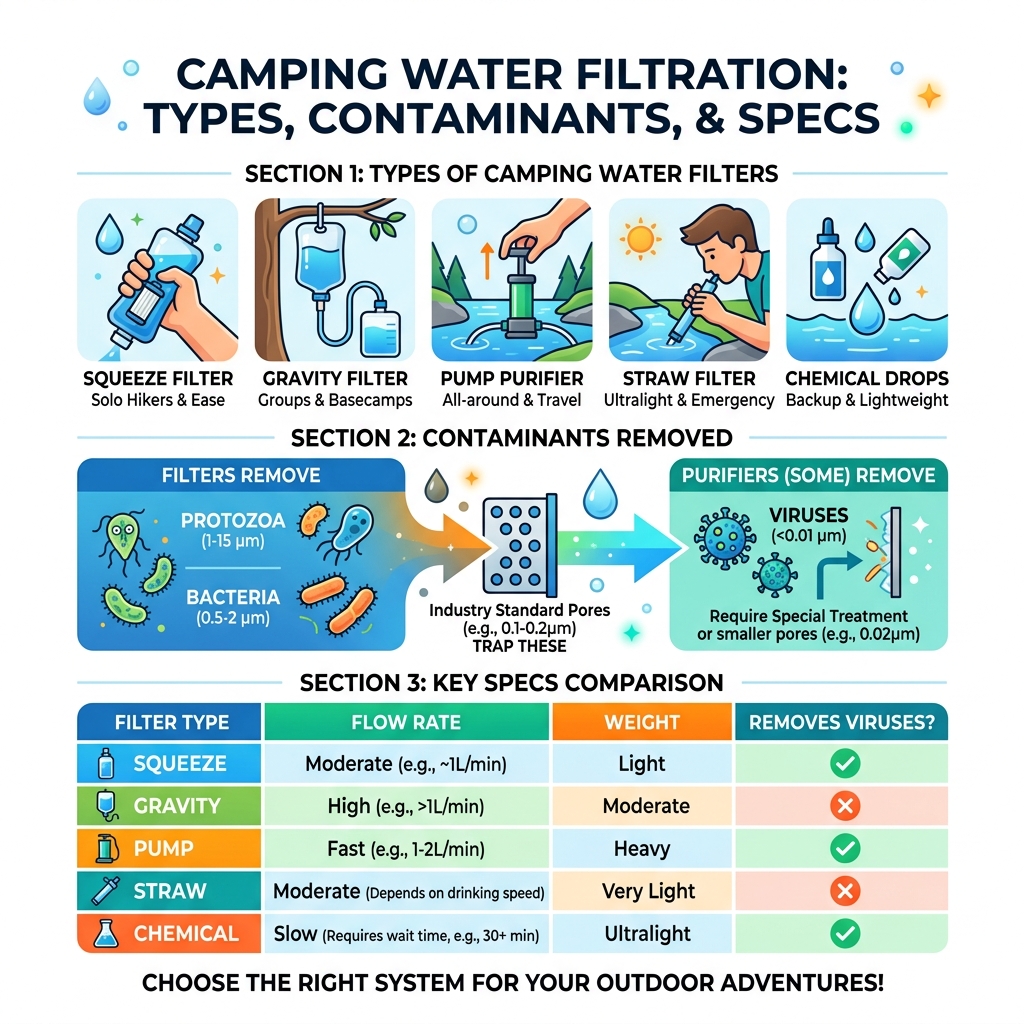
Understanding Contaminants and Pore Sizes
To choose the right portable water filtration system for camping, we first need to understand what we are trying to keep out of our bodies. Backcountry water contaminants generally fall into three biological categories: protozoa, bacteria, and viruses.
Protozoa, such as Cryptosporidium and Giardia, are relatively large (about 1 to 15 microns). Bacteria like E. coli and Salmonella are smaller (0.5 to 2 microns). Most standard backpacking filters use a “micron rating” to tell you what they can catch. A filter with a 0.1μm (0.1 micron) or 0.2μm pore size is the industry standard. These tiny holes act like a microscopic spaghetti strainer; water passes through, but the nasties get stuck.
While a 0.1 micron filter is technically “tighter” than a 0.2 micron filter, both are highly effective against 99.999% of bacteria and protozoa. However, neither will stop a virus. Scientific research on viruses shows they are significantly smaller (0.02 to 0.3 microns), meaning they can slip right through standard filters.

Filter vs. Purifier: What’s the Difference?
This is a distinction that trips up many campers. A filter removes protozoa and bacteria. This is usually sufficient for most camping in the United States and Canada, where viruses aren’t a primary concern in the backcountry.
A purifier, however, goes a step further by removing or inactivating viruses. Systems like the MSR Guardian use ultrafiltration with 0.02 micron pores to physically block viruses. Other purifiers might use UV light or chemicals to neutralize them. If you are traveling internationally to regions with poor sanitation or hiking in areas with heavy human or livestock waste, a purifier is a safer bet. For more on this, check out our guide on Essential Water Filtration Systems for Trekking Enthusiasts.
The Role of Activated Carbon
Some systems include an activated carbon core. While hollow fiber membranes handle the biology, carbon handles the chemistry. Carbon helps reduce pesticides, herbicides, and industrial chemicals. Perhaps more importantly for the casual camper, it significantly improves the taste of your water by removing odors and the “swampy” flavor caused by tannins (organic matter like decaying leaves).
Selecting the Right Portable Water Filtration System for Camping
When we’re out on the trail, we have to balance several factors: how fast the water flows (flow rate), how much the unit weighs, how much space it takes up in the pack (packability), and how many liters it can treat before it dies (lifespan).
For a deeper dive into these metrics, see our article on How to Choose the Best Portable Water Filter for Your Hiking Needs.
The Best Portable Water Filtration System for Camping for Solo Hikers
If you’re trekking alone, you want something fast and light. Squeeze filters and straw-style filters are the gold standard here.
- Squeeze Filters: Models like the Sawyer Squeeze or LifeStraw Peak Squeeze allow you to fill a pouch with “dirty” water and squeeze it through the filter into your bottle. The Sawyer Squeeze is legendary, claiming a 100,000-gallon lifetime capacity.
- Straw Filters: These are the ultimate in simplicity. You stick the straw directly into the stream and sip. While they are great for emergencies or trail runners, they don’t allow you to easily carry extra water or cook meals.
Solo systems typically offer a lifespan of 2,000L to over 378,000L (like the Sawyer). You can learn more about these in our review of Personal Water Filtration Devices for Trails.
Gravity Systems for Group Campsites
There is nothing quite as frustrating as finishing a long hike and having to spend 30 minutes pumping water for four people. For groups, we highly recommend gravity systems. These consist of a large “dirty” bag (often 4L to 10L) and a “clean” bag connected by a hose with an inline filter.
You simply fill the dirty bag, hang it from a tree, and let gravity do the work. It’s hands-free filtration that lets you set up camp or start dinner while the water processes. The Platypus GravityWorks is a fan favorite for its 1.75 L/min flow rate. For setup tips, see Setting Up Gravity Water Filters at Campsites: A Comprehensive Guide.
Comparing Mechanical Filters vs. Chemical Treatments
Mechanical filters (hollow fiber) are the most popular because they provide instant results and don’t change the taste of the water. However, they aren’t the only tool in the shed.
| Method | Pros | Cons |
|---|---|---|
| Mechanical Filter | Instant, no taste change, removes sediment | Can freeze/break, requires cleaning |
| Chemical (Chlorine Dioxide) | Lightweight, kills viruses, foolproof | 30m – 4hr wait time, slight chemical taste |
| UV Light (SteriPEN) | Fast (60s), kills viruses | Requires batteries, doesn’t remove sediment |
| Boiling | 100% effective | Uses fuel, takes time to cool |
Budget-Friendly Portable Water Filtration System for Camping Options
You don’t need to spend $400 on a military-grade purifier for a casual weekend at a state park. There are excellent options under $50, such as the Sawyer Mini or the LifeStraw Peak Straw. These “survival straws” and compact squeeze filters offer incredible value for money, though they may have slightly slower flow rates than their more expensive siblings. For a list of the best deals, check out Top Rated Portable Water Filters Under $50.
Speed and Effectiveness Comparison
In water treatment, “speed” is relative. A high-efficiency hand pump like the LACUCINO can move 1400ml per minute, which is blazingly fast. In contrast, chemical drops like Aquamira require a two-step activation process and a 30-minute wait for most bacteria. If you’re worried about Cryptosporidium, that wait time jumps to 4 hours. If you’re thirsty now, a mechanical filter is your best friend.
Maintaining Your Portable Water Filtration System for Camping in the Field
A filter is only as good as its maintenance. Over time, the microscopic pores in a hollow fiber filter get clogged with silt and organic matter. To fix this, we use a process called “backflushing.”
Most squeeze and gravity filters come with a large plastic syringe. You fill the syringe with clean water and force it backward through the filter. This blasts out the gunk and restores your flow rate. If you’re filtering from a turbid (murky) source, you might need to backflush every few liters. For a step-by-step guide, see How to Effectively Use a Portable Water Filter on Your Next Trail Adventure.
Preventing Damage and Clogging
The biggest “filter killer” is ice. Because hollow fiber filters work by trapping water inside tiny tubes, if that water freezes, it expands and cracks the tubes. This creates a hole that pathogens can swim through, and the worst part is you can’t see the damage. If your filter freezes, it is compromised and should be replaced.
Pro Tip: If you’re camping in sub-freezing temperatures, keep your filter in a waterproof bag and sleep with it inside your sleeping bag. Your body heat will keep it from freezing.
To prevent clogging in the first place, use a “pre-filter.” A simple bandana or even a piece of pantyhose wrapped around the intake hose can strain out the big stuff (leaves, sticks, sand) before it reaches the delicate filter membrane.
Long-Term Storage Best Practices
When you get home from your trip, don’t just throw your filter in the closet. Bacteria can grow inside a damp filter, leading to mold and bad smells.
- Sanitize: Run a weak bleach solution (one capful per liter) or a manufacturer-recommended cleaning tablet through the filter.
- Dry Completely: Allow the filter to air dry for several days before sealing it in a bag.
- Replace Carbon: Activated carbon filters have a much shorter lifespan than the main membrane—usually only 60 to 100 liters. Replace these regularly to maintain water quality.
Frequently Asked Questions about Camping Water Purification
How do I handle turbid or silty water?
If the water looks like chocolate milk, your filter will clog almost instantly. First, try to find a better source. If you can’t, use the “settling” method: fill a large container with the murky water and let it sit for an hour. The heavy sediment will sink to the bottom. Carefully scoop the clearer water from the top to filter. Some advanced pumps, like the MSR Guardian, are “self-cleaning” and can handle silt better than others.
Can I use these filters for international travel?
Standard filters are generally not enough for international travel in developing nations. You need a purifier that handles viruses. Look for the 0.02 micron pore size or use a combination of a mechanical filter (to remove sediment and bacteria) followed by chemical drops or UV light to kill the viruses. Scientific research on bacteria shows that while bacteria are easy to catch, viruses require that extra layer of protection.
How do I know when to replace my filter?
Most modern filters are designed to “fail safe.” This means that as they reach the end of their life, the flow rate will slow down until it eventually stops completely. If you’ve backflushed your filter several times and the water is still barely trickling through, it’s time for a new one. Some high-end models also have “integrity tests” you can perform to ensure the membrane hasn’t been damaged by a drop or freezing.
Conclusion
At Total Cobre, we believe that having a reliable portable water filtration system for camping is the key to a successful adventure. Not only does it keep you safe from nasty intestinal stowaways, but it also allows you to travel lighter and stay hydrated longer.
Remember to always follow Leave No Trace principles by filtering water at least 200 feet away from the source and disposing of “gray water” (the water used for backflushing) away from the stream.
Ready to find your perfect match? Check out our Ultimate Guide to Portable Water Filters for Outdoor Adventures for more reviews and trail-tested recommendations. Stay hydrated and happy trails!
