
Why Clean Water Is the Most Important Thing to Get Right in Your RV
A portable water filtration system for RV travel is the single most effective way to protect your health on the road — whether you’re hooking up at a campground or pulling water from a remote lake.
Here are the best types of RV water filtration systems at a glance:
| System Type | Best For | Filtration Level |
|---|---|---|
| Inline filter | Simple campground use | 1–5 micron (sediment, chlorine) |
| Multi-stage canister | Full-time RVers, most hookups | 0.2–5 micron (bacteria, VOCs, heavy metals) |
| Reverse osmosis (RO) | Maximum purity, dissolved solids | 99.99% contaminant removal |
| Pump-powered off-grid | Boondocking, lakes, streams | Varies; bacteria and virus capable |
Campground water isn’t always safe to drink straight from the spigot. It can carry sediment, chlorine, bacteria, heavy metals, and even PFAS chemicals. And if you’re camping off-grid, natural water sources like lakes and streams add bacteria, viruses, and microorganisms to that list.
The good news? The right filtration system solves all of this — without adding much bulk or complexity to your setup.
This guide walks you through everything you need to choose, install, and maintain the right system for how you camp.
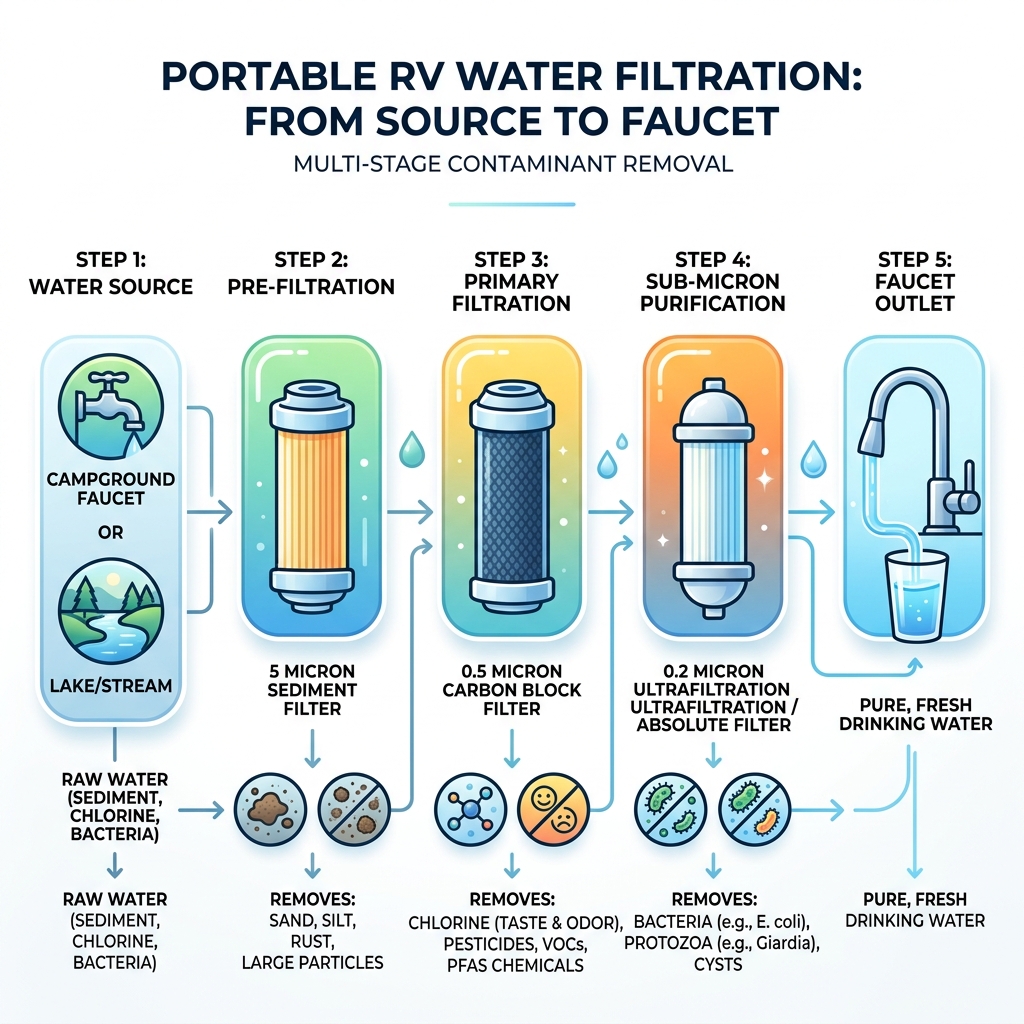
Contaminants, Micron Ratings, and Water Quality
When we talk about water quality on the road, we aren’t just talking about a bit of sand in the pipes. RVers face a cocktail of potential issues. Sediment like rust and silt can clog your fixtures, while chlorine makes your morning coffee taste like a swimming pool. More concerning are “forever chemicals” like PFAS, heavy metals, and biological threats like bacteria (E. coli, Legionella) and viruses.
To understand how a portable water filtration system for RV handles these, we have to look at micron ratings. A micron is one-millionth of a meter. For perspective, a human hair is about 70 microns wide.
- 5 Micron Filters: These are standard for sediment removal. They catch the “big stuff” like dirt and rust.
- 0.5 to 1 Micron Filters: These are often carbon blocks that excel at removing chlorine, lead, and cysts like Giardia.
- 0.2 Micron Filters: This is where things get serious. A 0.2-micron filter can remove 99.99% of pollutants, including bacteria. These are roughly 100 times more effective than a standard 5-micron filter.
There is also a difference between nominal and absolute ratings. A “nominal” 0.2-micron filter might let some larger particles through, while an “absolute” rating means the filter is guaranteed to stop everything larger than that size. For those of us who prioritize safety, absolute ratings are the gold standard.
Beyond particles, sulfur odors (that “rotten egg” smell) are a common campground complaint. High-quality solid carbon blocks are the best defense here, as they provide maximum contact time to neutralize odors. For a deeper dive into how these technologies translate to the trail, check out our Ultimate Guide to Portable Water Filters for Outdoor Adventures.
Choosing the Best Portable Water Filtration System for RV
Selecting the right system feels like a balancing act between water purity, flow rate, and portability. You don’t want a system so restrictive that your shower feels like a leaky faucet, but you also don’t want to drink “mystery water” from an aging RV park.

Common System Types
- Inline Filters: These are the most basic. They screw directly onto your hose. While convenient, they often have lower capacities and less specialized filtration. However, advanced models like the Clear2O CRV1005 offer a 5-micron solid carbon block that provides a 50% better flow rate than standard cheap inlines.
- Multi-Stage Canister Systems: These are the workhorses of the RV world. They typically use two or three large canisters. The first stage might be a 5-micron sediment filter to protect the more expensive filters downstream. The second and third stages handle chemicals, bacteria, and even viruses. Systems like the Clearsource Ultra™ use NASA-developed VirusGuard™ technology to provide hospital-grade protection.
- Reverse Osmosis (RO): For those who want bottled-water quality at every tap, RO is the answer. These systems, like the GlacierFresh RV RO, remove up to 99.99% of all contaminants, including dissolved salts and fluoride. They do produce “waste water” (usually a 1:1 ratio), but the purity is unmatched.
- Pump-Powered Systems: If you are drawing from a lake, you need a pump. These systems are “bullet-proof” and can draw water from up to 100 feet away and 20 feet in elevation.
When choosing, look for NSF Certifications (like NSF 42 for taste and 53 for health effects) and check the Flow Rate (GPM). A flow rate of 4.5 to 4.9 GPM is ideal for maintaining strong pressure in your RV. For more on maximizing your setup, see our guide on Using Portable Water Purifiers Efficiently.
Selecting a Portable Water Filtration System for RV Boondocking
If your “campsite” doesn’t have a zip code, your filtration needs change. Boondocking often requires drawing water from non-pressurized sources like streams or lakes.
A dedicated off-grid system, such as the Clearsource NOMAD™, is essential here. These systems run on a 12V battery connection, allowing you to use your RV’s power to pull and purify water simultaneously. Because natural water is often “turbid” (cloudy with dirt), these systems rely heavily on high-capacity sediment pre-filters to prevent the fine 0.2-micron filters from clogging instantly.
User Experiences and System Reliability
Real-world feedback shows that durability matters as much as filtration. Systems with powder-coated steel or aluminum chassis and stainless steel fittings tend to survive the bumps and bruises of travel much better than plastic-only setups.
Filter Lifespan Statistics:
- Standard Canisters: Usually last about 2,000 gallons or 3 months.
- iSpring 3-Stage: Can last 6-12 months depending on water quality.
- GlacierFresh RO: The main filter can last up to 2 years (approx. 25,000 water bottles worth of water).
Most users find that 2,000 gallons is plenty for a season of travel, but if you are a full-timer, you’ll want to keep a “replacement kit” on hand.
Matching Filtration to Your Camping Style and Flow Needs
How you camp dictates what you need. If you only stay at high-end resorts with treated city water, a heavy-duty virus filter might be overkill. But if you’re exploring the backcountry, it’s a necessity.
| Feature | Inline Filter | Multi-Stage Canister | Reverse Osmosis |
|---|---|---|---|
| Installation | 1 minute (Hose-end) | 5 minutes (Stand-alone) | 30–60 minutes (Semi-permanent) |
| Best Use | Weekend Trips | Full-timing / Boondocking | Health-conscious / Hard water |
| Flow Rate | Medium | High (4.5+ GPM) | Low (12 oz/min) |
| Off-Grid Capable | No | Yes (with pump) | Yes (with power bank) |
Maintaining water pressure is a common concern. High-quality systems are designed to minimize “pressure drop.” For instance, the Clearsource Ultra™ maintains a 4.5 GPM flow rate, which is enough to run a shower and a sink simultaneously without a noticeable dip in performance. To learn more about tailoring your gear, read about Optimizing Portable Water Purifiers for Outdoor Use.
Installation, Maintenance, and Performance Tips
Installation should be tool-free and painless. Most modern systems use 3/4″ lead-free brass quick connectors.
Pro Tips for Peak Performance:
- Use a Pressure Regulator: Always place a regulator before your filter. High pressure at some campgrounds can burst filter housings or cause leaks.
- Flush the Spigot: Before connecting your hose, let the campground faucet run for a minute to clear out any sitting rust or debris.
- Sanitize Your Hoses: Even the best filter can’t save you if your hose is full of algae. Use an RV-safe hose sanitizer regularly.
- Winterization: If temperatures drop, water inside the canisters can freeze and crack the housings. Always “shake out” the water or bring the unit inside during freezing weather. Some systems, like the Clearsource Weather Guard, offer heated covers for protection down to 10°F.
The Cost-Effectiveness of a Portable Water Filtration System for RV Travel
Is it worth the investment? Let’s look at the numbers. A high-end RO system can purify the equivalent of 25,000 water bottles. At an average price of $1.00 per bottle, that’s a massive saving. Even a standard $200 canister system pays for itself within a single season if you stop buying plastic jugs. Plus, you’re significantly reducing plastic waste—a win for the environment we love to explore.
Frequently Asked Questions about RV Water Filtration
How do I know when to replace my RV water filter?
The most obvious sign is a drop in water pressure. As the filter captures contaminants, the “pores” clog, slowing the flow. You might also notice a change in taste or smell. As a rule of thumb, replace most filters every 3 months or 2,000 gallons.
Can I use a portable RV filter to draw water from a lake?
Only if it has a pump and biological filtration. Standard inline filters are for pressurized, treated water only. To source from a lake, you need a system like the Clearsource NOMAD™ or Guzzle H2O Stream, which are designed to handle the bacteria and viruses found in raw water.
Do I need a water softener in addition to a filtration system?
Filters remove contaminants; softeners remove minerals (calcium/magnesium) that cause scale buildup. If you travel in the Southwest or areas with “hard water,” a portable 8,000 or 16,000-grain softener will protect your RV’s plumbing and make your soap lather better.
Conclusion
At Total Cobre, we believe that the right gear shouldn’t just work—it should give you peace of mind. Whether you are an adventurous hiker using a portable water filter on the trail or an RVer crossing the country, clean water is the foundation of a safe trip.
Investing in a portable water filtration system for RV travel ensures that no matter where the road leads, you have a reliable source of hydration. From 0.2-micron absolute protection to high-flow RO systems, there is a solution for every camping style. Stay safe, stay hydrated, and enjoy the journey!
For more expert reviews and guides on clean water solutions, visit Total Cobre.
