
Why Every Hiker Needs a Portable Water Filter
Portable water filters are compact devices that remove harmful bacteria, protozoa, and other contaminants from natural water sources — making them safe to drink without boiling or buying bottled water.
Quick answer: the most common types of portable water filters are:
| Type | Best For | Removes Viruses? |
|---|---|---|
| Squeeze/Straw | Solo hikers, ultralight travel | No (most models) |
| Gravity filter | Groups, base camp | No (most models) |
| UV purifier | City travel, clear water | Yes |
| Pump purifier | All conditions, murky water | Depends on model |
| Press purifier (e.g. Grayl) | International travel | Yes |
You’re deep in the backcountry. You’re thirsty. There’s a stream right in front of you.
But can you drink it?
That question matters more than most hikers realize. Around 2.2 billion people worldwide lack access to safe drinking water — and wild streams, however clear they look, can carry invisible threats like giardia, E. coli, and viruses that cause serious illness.
The good news? A quality portable water filter solves this problem without adding much weight to your pack.
There’s just one catch: not all filters work the same way. Some remove bacteria but miss viruses. Others are perfect for backcountry streams but useless in a city. Choosing the wrong one could leave you sick on day two of a five-day trip.
This guide breaks down every major type of portable filtration system — how they work, what they remove, who they’re for, and which scenarios each one handles best.
Understanding the Portable Water Filter: Filters vs. Purifiers
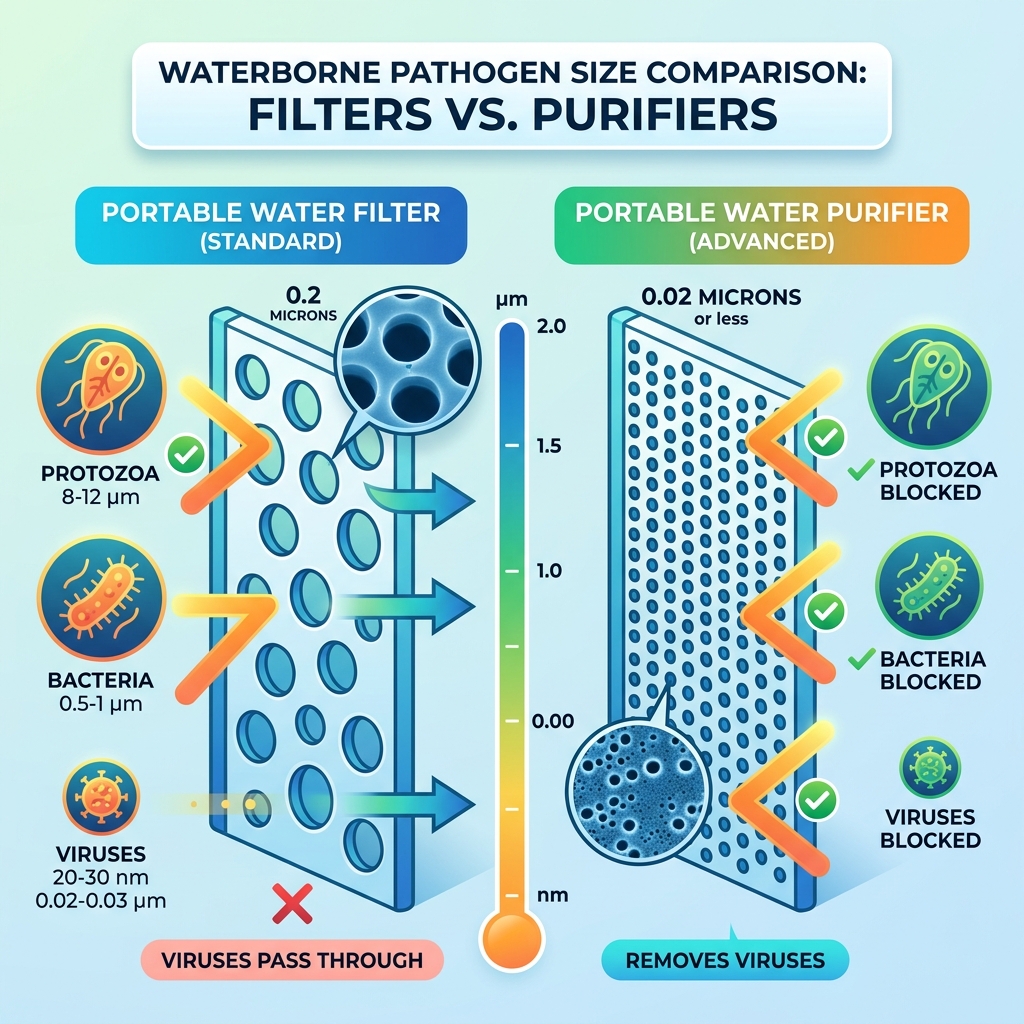
When we talk about a portable water filter, we often use the terms “filter” and “purifier” interchangeably. However, in water science, they mean very different things. Knowing the difference can be the deciding factor in whether you stay healthy or spend your vacation in a bathroom.
The Microscopic Battle
Most standard water filters use a physical barrier — often a hollow fiber membrane — to strain out contaminants. These membranes typically have a pore size of about 0.1 microns. This is small enough to catch:
- Bacteria: Such as E. coli, Salmonella, and Cholera.
- Protozoa (Cysts): Such as Giardia and Cryptosporidium.
However, viruses are significantly smaller than bacteria. According to the CDC, viruses such as rotavirus and norovirus are the smallest of all waterborne disease-causing microorganisms and can pass right through a 0.1-micron filter. Diseases like and typhoid can be transmitted through contaminated water, making it vital to know what your device can handle.
Enter the Purifier
A water purifier goes a step further. To be classified as a purifier, a device must remove or deactivate viruses in addition to bacteria and protozoa. This is usually achieved through:
- Chemicals: Iodine or chlorine dioxide tablets.
- UV Light: Disrupting the DNA of the microbes.
- Ultra-filtration: Using membranes with pores as small as 0.02 microns (like the MSR Guardian or LifeStraw Mission).
- Adsorption: Using electro-adhesion or carbon to “trap” the tiny viruses.
If you are how-to-choose-the-best-portable-water-filter-for-your-hiking-needs, you must first identify your “enemy.” If you’re in the high Sierras of the USA, a filter is usually enough. If you’re in a region with poor sanitation, you need a purifier.
Choosing a Portable Water Filter for International Travel
For those of us venturing into developing countries or urban areas with aging infrastructure, the risk shifts from “cow pasture runoff” to “human waste contamination.” In these scenarios, viruses are a real threat.
When we travel through South America or Southeast Asia, we prioritize “purifiers” over “filters.” A simple straw filter might remove the grit, but it won’t stop a virus. For city travel, we often recommend UV purifiers or “press” style bottles. These allow you to take tap water from a hotel sink and make it drinkable in seconds, saving you from the endless cycle of buying expensive (and plastic-heavy) bottled water.
If you’re looking for the best-portable-water-filters-for-backpackers, consider where your feet will land. International travel requires a higher level of “microbiological defense” than a weekend trip to a local state park.
The Best Portable Water Filter for Backcountry Hiking
In the backcountry, our priorities shift to weight, flow rate, and durability. When we are searching-for-the-best-water-filters-to-keep-you-hydrated-on-trails, we want something that won’t break when dropped and won’t take thirty minutes to fill a single bottle.
A good backcountry portable water filter should have a high “gallon rating.” For example, the Sawyer Mini is rated for up to 100,000 gallons. While you’ll likely never drink that much water in a lifetime, that high rating means the filter is robust enough to handle many “backflushes” (cleaning the filter by pushing water backward through it) to keep the flow rate high.
Main Types of Portable Filtration Systems
Choosing the right system is like choosing the right pair of boots — it depends on the terrain. Here is how the most popular categories of portable water filter units stack up against each other:
| System Type | Technology | Weight | Pros | Cons |
|---|---|---|---|---|
| Squeeze | Hollow Fiber | 2-3 oz | Ultralight, fast | Bags can leak/break |
| Gravity | Hollow Fiber | 8-12 oz | Hands-free, group use | Requires a place to hang |
| UV Light | Ultraviolet | 4-5 oz | Fast, kills viruses | Requires batteries, fails in murky water |
| Pump | Mechanical | 12-20 oz | Handles shallow/murky water | Heavy, requires physical effort |
| Press | Adsorption/Carbon | 10-15 oz | Purifies everything, easy | Requires “muscle,” filter life is shorter |
Squeeze and Straw Filters
These are the darlings of the ultralight hiking community. A squeeze filter like the Sawyer Squeeze or Katadyn BeFree weighs next to nothing (often under 3 ounces) and allows you to drink almost instantly. You simply fill a pouch with “dirty” water, screw the filter onto the top, and squeeze the water into your clean bottle or directly into your mouth.
Straw filters, like the original LifeStraw, are even simpler. You drink directly from the source like a giant milkshake. While incredibly light and affordable, straws are less versatile because you can’t easily filter water to use for cooking or to share with a friend. These are top-features-to-look-for-in-portable-water-filters-for-hiking if you are a solo hiker on a well-watered trail.
Gravity and Pump Purifiers
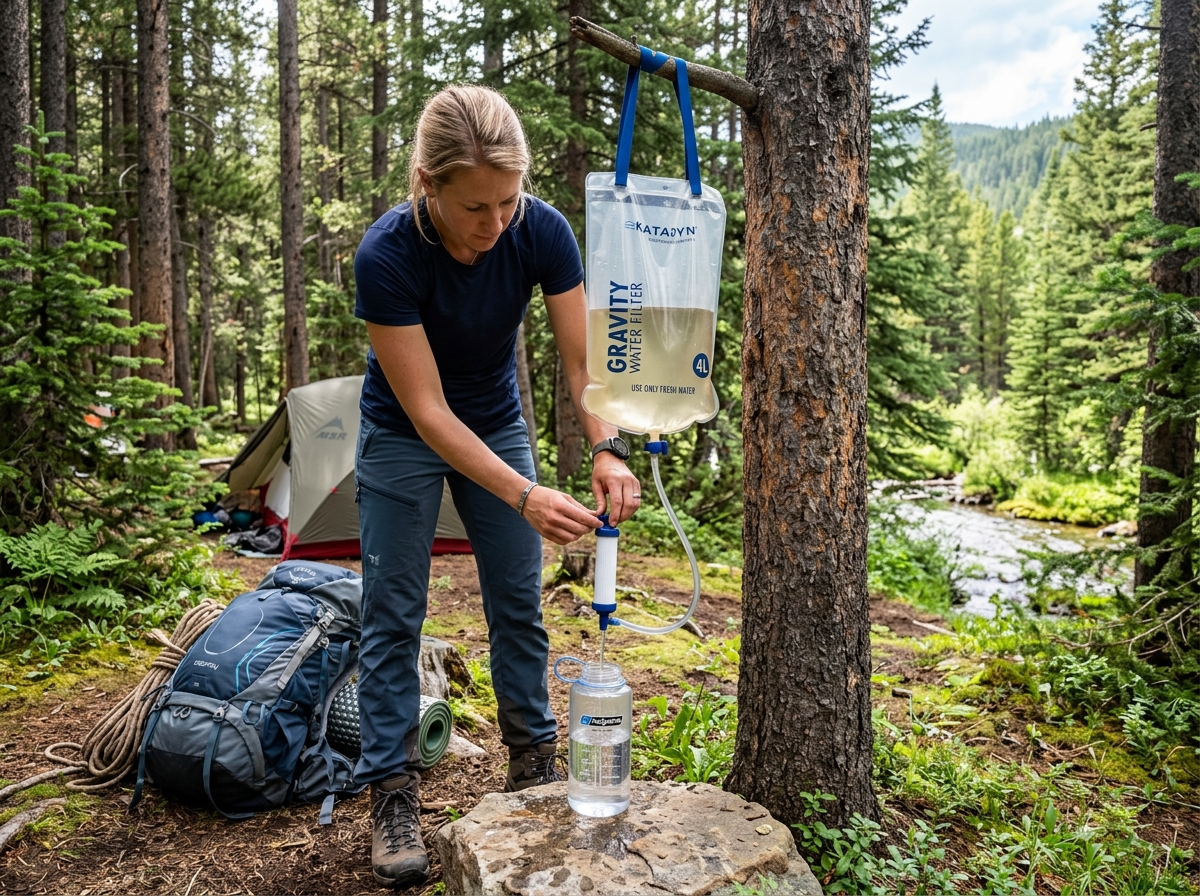
If you are hiking with a group or setting up a base camp, you don’t want to spend your evening squeezing individual bags of water. This is where gravity systems shine. You fill a large bag (usually 3L to 10L), hang it from a tree, and let physics do the work. High-volume systems like the LifeStraw Mission can provide up to 12 liters of purified water per hour.
Pump purifiers, while heavier, are the “tanks” of the water world. They allow you to draw water from very shallow puddles or silty sources that would clog a squeeze filter instantly. When assembling-a-practical-portable-water-purification-kit, a pump is often the choice for “worst-case scenario” preparedness.
Performance Standards and Maintenance
You wouldn’t drive a car for 100,000 miles without an oil change, and you shouldn’t expect a portable water filter to work forever without maintenance.
Understanding Certifications
When shopping, look for independent lab tests and certifications. The most common are:
- NSF/ANSI 42: Covers aesthetic effects (taste and odor).
- NSF/ANSI 53: Covers health effects (lead, heavy metals).
- NSF P231: The gold standard for microbiological purifiers (bacteria, viruses, and cysts).
The Art of the Backflush
Most hollow fiber filters will eventually slow down as sediment gets trapped in the fibers. To fix this, we use a process called “backflushing.” Most filters come with a large syringe. You fill the syringe with clean, filtered water and force it backward through the filter. This “blows out” the gunk and restores your flow rate.
Storage and Cleaning
If you’re using a system like the BOROUX Legacy Compact at home or in a cabin, maintenance involves scrubbing the filters every few months. For travel filters, the most important rule is: Never let them freeze. If water is inside the hollow fibers and it freezes, the ice will expand and crack the microscopic tubes. This ruins the filter, and you won’t even be able to see the damage. If you’re hiking in freezing weather, we recommend keeping your filter in your pocket or inside your sleeping bag at night.
For more tips, check out our backpackers-guide-to-using-water-bottles-with-built-in-filters.
Environmental Impact and Cost Savings
Beyond personal safety, using a portable water filter is one of the best things you can do for the planet.
The Plastic Problem
The statistics are staggering. Every single minute, 1 million single-use plastic water bottles are purchased worldwide. That adds up to 1.3 billion bottles per day. Reuters produced graphics to illustrate the scale of the problem, showing how our reliance on “convenience” water is choking our oceans.
Most of these bottles take at least 450 years to degrade in a landfill. By using a single Sawyer Mini, which can filter 100,000 gallons, you could theoretically replace hundreds of thousands of plastic bottles over the course of a decade.
The Financial Incentive
Buying bottled water while traveling is a “hidden tax.” If you’re on a two-week trip and drinking the recommended two liters a day, you could easily spend $50-$100 just on water. A high-quality portable water filter or purifier often pays for itself within the first week of a trip. We’ve found that top-rated-portable-water-filters-for-budget-conscious-adventurers are some of the best investments you can make for your travel gear kit.
Frequently Asked Questions about Portable Filtration
Can these filters handle murky or silty water?
Yes, but with a caveat. Silt and glacial flour (very fine rock dust) will clog a 0.1-micron filter very quickly. If you have to pull water from a muddy puddle, we recommend “pre-filtering.” Use a bandana, coffee filter, or even a piece of pantyhose to strain out the large chunks before putting the water through your main filter. This will significantly extend the life expectancy of your device.
How do I know when to replace the cartridge?
Most modern filters are designed to “fail-safe.” This means that as they reach the end of their life, the flow rate will slow down until it eventually stops completely. If you’ve backflushed your filter and the water still barely trickles out, it’s time for a replacement. For bottle-style filters like the Grayl, the cartridge usually lasts about 350 presses (250L). For countertop units like the BOROUX Legacy, the filters typically last about 12 months or 1,000 gallons.
Do portable systems remove heavy metals and PFAS?
Standard hollow fiber filters do not remove heavy metals, PFAS, or chemicals. To remove these, you need a filter with activated carbon or specialized ion-exchange technology. The BOROUX Foundation filters, for example, are tested to remove up to 99.97% of contaminants like lead, PFAS, and chlorine. If you are concerned about chemical runoff from nearby farms or industrial areas, always choose a system that includes a carbon stage.
Conclusion
At Total Cobre, we believe that clean water shouldn’t be a luxury reserved for those near a grocery store. Whether you’re a thru-hiker tackling the PCT, a family camping in the woods, or a traveler exploring the streets of a new city, having a reliable portable water filter is your ticket to freedom.
By choosing the right unit, you aren’t just protecting your health — you’re saving money and helping reduce the 481.6 billion plastic bottles produced every year. So, before your next adventure, take a look at your water plan. Don’t settle for “probably safe.” Use a filter, stay hydrated, and keep exploring.
