
Clean Water in the Backcountry: What Every Hiker Needs to Know
Water purification systems for camping hiking backpacking come in six main types, each suited to different needs:
| System Type | Best For | Example |
|---|---|---|
| Squeeze filter | Solo hikers, ultralight | Sawyer Squeeze |
| Straw filter | Day hikes, minimalist | LifeStraw Peak Squeeze |
| Gravity filter | Groups, basecamp | Platypus GravityWorks |
| Pump filter | Any source, reliability | MSR Guardian |
| UV purifier | International travel | SteriPEN Ultra |
| Chemical treatment | Backup, ultralight | AquaTabs, Aquamira |
Even crystal-clear mountain streams can carry Giardia, Cryptosporidium, bacteria, and viruses. You can’t see them. You won’t taste them. But they can put you flat on your back for days — or worse.
The good news? Modern water purification gear is lighter, faster, and more reliable than ever. A solid setup can weigh under 3 ounces and filter hundreds of liters before needing maintenance.
The tricky part is picking the right system. The wrong choice can mean a filter that clogs in silty water, a UV device that dies in the cold, or a straw you can’t use to fill your cook pot.
This guide breaks down every major system type, what each one actually removes, and how to choose the best setup for your specific trip — whether you’re a solo thru-hiker covering 20 miles a day or setting up a basecamp for a group.
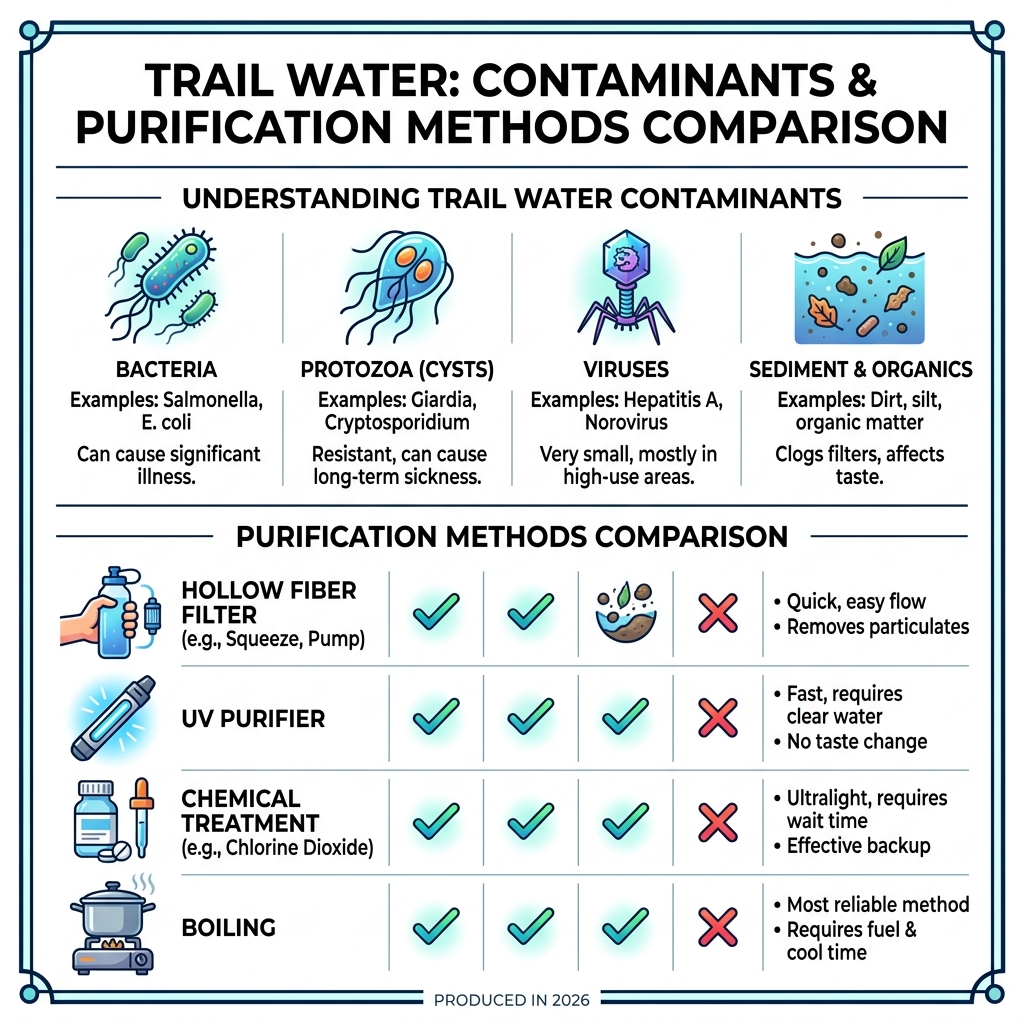
Types of Water Purification Systems for Camping Hiking Backpacking
Choosing the right way to treat your water is one of the most important gear decisions you’ll make. It’s not just about weight; it’s about the “user experience” at the stream bank. If you’re exhausted after a 15-mile day, the last thing you want is a complicated system that takes twenty minutes to produce a single liter of water.
To help you navigate the options, we’ve broken down the primary technologies used in water purification systems for camping hiking backpacking. For a deeper dive into the basics, check out our guide on Camping Water Filtration 101: From Straws to Systems.
Comparison of Popular Backcountry Filtration Stats
| System Name | Weight | Flow Rate | Lifetime Capacity | Pore Size |
|---|---|---|---|---|
| Sawyer Squeeze | 3.0 oz | 1.7 L/min | 100,000+ gal | 0.1 micron |
| LifeStraw Peak Squeeze | 3.8 oz | 1.0 L/min | 500 gal | 0.2 micron |
| Platypus GravityWorks 4L | 11.5 oz | 1.5 L/min | 396 gal | 0.2 micron |
| MSR Guardian Purifier | 17.3 oz | 2.5 L/min | 2,600+ gal | 0.02 micron |
| HydraPak Flux+ 1.5L | 5.0 oz | >1 L/min | 396 gal | 0.2 micron |
Hollow-Fiber Membrane Filters
This is the most common technology in modern backpacking. Think of thousands of tiny straw-like tubes with microscopic holes. Water is pushed through the tubes, but bacteria and protozoa are too large to pass. Systems like the Sawyer Squeeze and LifeStraw Peak Series All in One Filter use this tech. They are lightweight and offer an incredible “instant” flow rate.
Ceramic Filters
Ceramic filters, like the MSR MiniWorks EX Microfilter, are the “workhorses” of the trail. They use a porous ceramic element that can be scrubbed clean in the field when it clogs. While heavier than hollow-fiber, they are incredibly durable and often include a carbon core to improve taste and remove chemicals.
UV Light Purifiers
UV systems, such as the SteriPEN, don’t actually “remove” anything. Instead, they use ultraviolet light to scramble the DNA of bacteria, protozoa, and viruses, making them unable to reproduce (and therefore unable to make you sick). They are fast—usually 60 to 90 seconds per liter—but they require clear water to work effectively and depend entirely on battery life.
Chemical Drops and Tablets
Chemicals like Aquamira (chlorine dioxide) or AquaTabs are the ultimate ultralight choice. They kill everything, including viruses, but they require a “wait time” (usually 15 to 30 minutes, sometimes up to 4 hours for Cryptosporidium). Many hikers carry these as a lightweight backup in case their primary mechanical filter fails.
Portable Water Purification Systems for Camping Hiking Backpacking
When we talk about “portable” or “on-the-go” systems, we’re usually referring to squeeze filters and straw-style units. These are the darlings of the thru-hiking community because they allow for effortless hydration without long stops.
Squeeze filters, like the Sawyer Squeeze or the Flux™+ 1.5L, involve filling a soft-sided reservoir with “dirty” water and then squeezing it through the filter into a clean bottle or directly into your mouth. This is a synergistic approach: the soft vessel is best for filtering from because it collapses as you squeeze, while a hard-sided bottle is best for filtering into for stability.
Straw-style filters allow you to drink directly from the source. While minimalist, they can be a bit awkward if you need to collect water for cooking at camp. However, modern versions like the LifeStraw Peak Series All in One Filter have become modular, allowing them to be used as a straw, a squeeze filter, or even part of a gravity setup.
Gravity-Fed Water Purification Systems for Camping Hiking Backpacking
If you’re traveling with a partner, a family, or a larger group, “pumping” or “squeezing” 10 liters of water a day becomes a grueling chore. This is where gravity systems shine.
A gravity system consists of a large “dirty” bag that you fill and hang from a tree. Gravity pulls the water through a filter and into a “clean” bag or bottle. It’s a passive process—you hang it up, go set up your tent, and come back to 4 liters of pristine water. The Platypus GravityWorks is the gold standard here, filtering 1 liter in under a minute.
For those looking to optimize their camp setup, we recommend reading our comprehensive guide on setting up gravity water filters at campsites. These systems are not just for basecamps; many duos find that the slight weight penalty is worth the luxury of “hands-free” water at the end of the day.
Understanding Pathogens: What Your System Actually Removes
To choose the right water purification systems for camping hiking backpacking, you need to understand what you’re up against. Not all “clean” water is created equal.

Bacteria and Protozoa (The “Big” Stuff)
Most standard filters have a pore size of 0.1 to 0.2 microns. This is small enough to catch:
- Protozoa: Giardia and Cryptosporidium. These are relatively large (1–10 microns) and are the most common cause of “hiker’s revenge.”
- Bacteria: E. coli, Salmonella, and Campylobacter. These are smaller (0.5–2 microns) but still easily caught by a 0.1-micron filter.
Viruses (The “Tiny” Stuff)
Viruses (like Norovirus or Hepatitis A) are incredibly small—down to 0.02 microns. Most standard “filters” will not catch them. To remove viruses, you need a purifier.
The MSR Guardian Purifier is one of the few mechanical devices that can physically strain out viruses. Others, like the LifeStraw Escape Pressurized Water Purifier, use advanced ultrafiltration to achieve this. If you are traveling internationally or hiking in areas with high human impact and poor sanitation, a purifier is a must.
Chemicals, Heavy Metals, and Microplastics
Standard hollow-fiber filters don’t remove dissolved chemicals or heavy metals. For that, you need a system with activated carbon. Carbon helps reduce pesticides, herbicides, and that “swampy” taste often found in stagnant water. Most modern filters are now also rated to remove microplastics, which is becoming an increasing concern even in remote wilderness areas.
Maintenance, Backflushing, and Field Reliability
The most common reason for a filter “failing” on the trail isn’t a broken part—it’s a clog. As you filter, silt, algae, and minerals build up in the membrane, slowing your flow rate to a maddening drip.
The Art of the Backflush
Backflushing is the process of forcing clean water backward through the filter to push out trapped debris.
- Sawyer Squeeze: Comes with a large syringe for backflushing. We recommend doing this daily if the water is murky.
- LifeStraw Peak: Can be backflushed with a syringe or by simply blowing air back through the mouthpiece.
- Katadyn BeFree: This filter cannot be traditionally backflushed. Instead, you “shake” the filter in clean water to dislodge debris.
Field Reliability and Failure Points
Every system has a “weak link.”
- Hollow-fiber filters: Their biggest enemy is freezing. If water stays inside the fibers and freezes, it expands and cracks the membrane. The filter will still “work” (water will flow), but it will no longer be removing pathogens. You must sleep with your filter in your sleeping bag if temperatures drop! See our tips on protecting water filters from freezing during winter hikes.
- Pump filters: O-rings can dry out or tear. Always carry a small tube of silicone lubricant.
- Squeeze bags: The bags included with many filters are prone to leaking at the seams. We often recommend replacing them with a more durable reservoir like the Cnoc Vecto.
Essential Maintenance Tools for Your Kit:
- Backflushing syringe (if applicable)
- Spare O-rings/gaskets (especially for Sawyer filters)
- Silicone lubricant (for pumps)
- A small piece of scouring pad (for ceramic elements)
Advanced Strategies for Challenging Environments
Not every water source is a bubbling alpine brook. Sometimes, you’re looking at a cow pond that looks like chocolate milk.
Dealing with Turbid (Silty) Water
Silt and glacial flour will kill a filter faster than anything else.
- Settling: Fill a large bag with water and let it sit for an hour. The heavy sediment will sink to the bottom. Filter from the top.
- Pre-filtration: Use a bandana, coffee filter, or a dedicated pre-filter to strain out the “big chunks” before they hit your expensive main filter.
- The MSR Guardian Advantage: The Guardian Purifier Backpacking Water Purifier actually uses a self-cleaning mechanism that pumps a portion of the water back through the filter with every stroke, making it the best choice for consistently muddy water.
Redundancy and Backups
We never head into the backcountry without a “Plan B.” If your pump breaks or your hollow-fiber membrane freezes, you need a way to stay hydrated.
- The 10-Tab Rule: Always carry at least 10 AquaTabs or a small bottle of Aquamira Water Treatment Drops. They weigh virtually nothing and can save your trip.
- Boiling: The ultimate backup. Boiling water for 1 minute (3 minutes at high altitude) kills everything. It just costs you fuel and time.
International Travel and High-Risk Areas
If you are traveling to regions where waterborne viruses like Norovirus or Rotavirus are common, standard filtration isn’t enough. You need a 3-stage system or a dedicated purifier. The LifeStraw Escape is a pressurized system that handles high volumes while removing 99.99% of viruses, making it ideal for remote job sites or international expeditions.
Frequently Asked Questions
Do water filters remove viruses?
Generally, no. Most backpacking “filters” (pore size 0.1–0.2 microns) remove bacteria and protozoa but are too “porous” to catch tiny viruses. To eliminate viruses, you need a purifier (pore size 0.02 microns) or chemical/UV treatment.
How do I prevent my filter from freezing?
If there is a risk of frost, keep your filter in a sealed Ziploc bag and tuck it inside your sleeping bag at night. During the day, keep it in an internal jacket pocket. If you suspect your filter has frozen, do not trust it—the microscopic cracks in the membrane are invisible but deadly.
What is the difference between a filter and a purifier?
The difference is the level of protection. A filter removes bacteria and protozoa (like Giardia). A purifier removes those plus viruses. In the US and Canada, a filter is usually sufficient. For international travel or high-human-traffic areas, go with a purifier.
Conclusion
At Total Cobre, we believe that choosing the right water purification systems for camping hiking backpacking is about more than just avoiding a stomach ache—it’s about the freedom to explore further and stay out longer.
Whether you choose the ultralight efficiency of a Sawyer Squeeze, the group convenience of a Platypus GravityWorks, or the bombproof protection of an MSR Guardian, the key is understanding your gear. Practice backflushing at home, protect your membrane from the cold, and always carry a chemical backup.
Safe hydration is the foundation of every successful adventure. By matching your system to your environment and group size, you can stop worrying about what’s in the water and start enjoying the view.
Visit Total Cobre for more expert gear reviews to find the perfect setup for your next trail adventure. Happy hiking and stay hydrated!
