
Water on the Trail: Why Every Thru-Hiker Needs a Reliable Solution
A reliable thru hiking water solution can be the difference between finishing your trail and getting sidelined by illness miles from the nearest road.
Quick answer: The best thru hiking water solutions in 2026
| Method | Best For | Weight | Removes Viruses? |
|---|---|---|---|
| Hollow fiber squeeze filter (e.g., Sawyer Squeeze) | Most thru-hikers | ~3 oz | No |
| Compact personal straw filter | Solo, ultralight hikers | ~3.8 oz kit | No |
| Chemical treatment (e.g., Aquamira drops) | Backup or hiking | ~1 oz | Yes |
| UV purifier (e.g., SteriPen) | International travel | ~5 oz | Yes |
| Gravity filter | Groups or camp use | ~11 oz | No |
For most thru-hikers on trails like the PCT or AT, a lightweight squeeze filter paired with a chemical backup is the most practical, proven setup.
Backcountry water looks clean. A crystal-clear mountain stream can still carry Giardia, Cryptosporidium, bacteria, and other pathogens that will stop your hike cold. Water-borne illness is not a minor inconvenience out there — it can mean evacuation.
At the same time, bulky gear slows you down. When you’re covering 20+ miles a day, every ounce matters and every minute spent fumbling with equipment adds up.
The good news: modern filter straws and squeeze filters have made safe hydration on the trail faster and lighter than ever. The right pick fits in your palm, weighs almost nothing, and keeps you moving without missing a beat.
Below, we break down the top fast-acting filter straw options to help you find the one that fits your pack, your pace, and your trail.
Understanding Filtration Technologies for Thru Hiking
When we talk about a thru hiking water solution, we are usually talking about mechanical filtration. This is the “bouncer at the door” approach to water safety. Instead of using chemicals to kill bugs or UV light to scramble their DNA, we use physical barriers to simply stop them from entering our bodies.
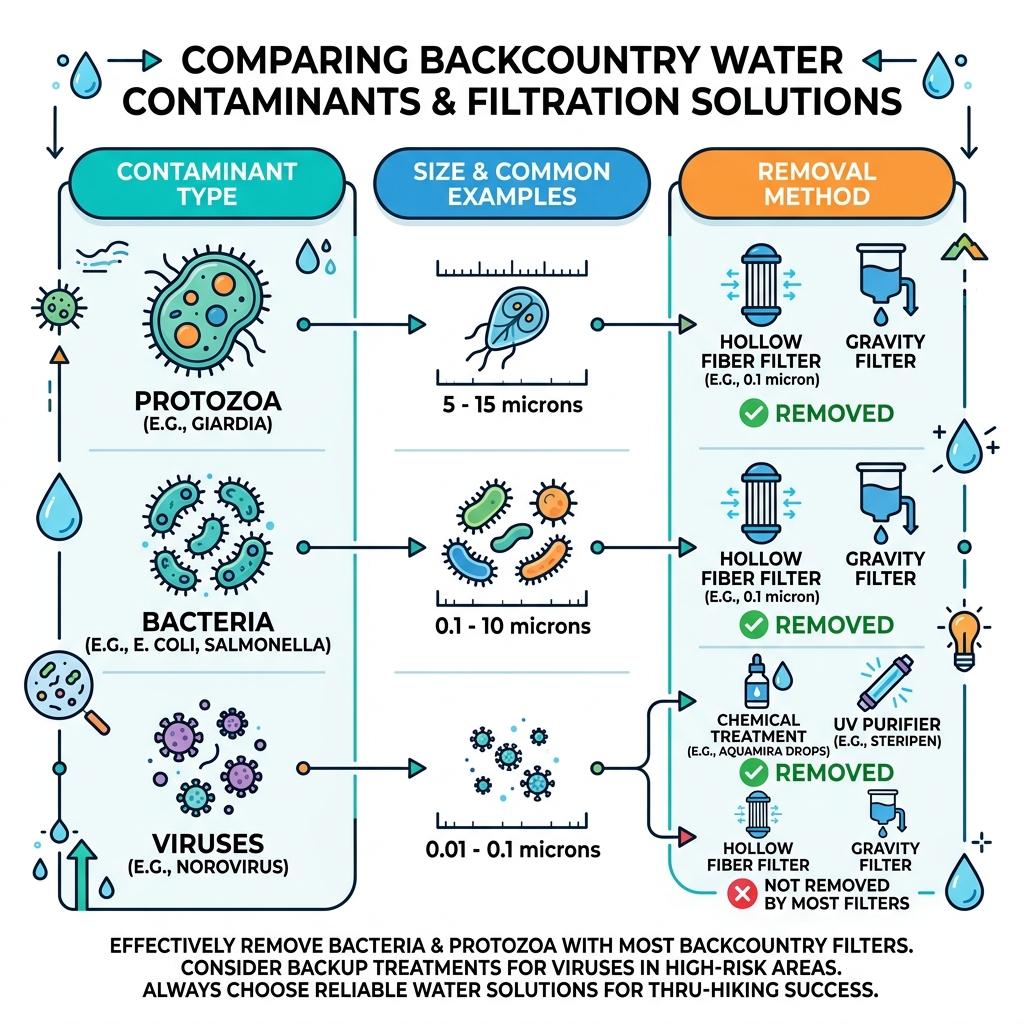
Most modern portable filters utilize hollow fiber membrane technology. Imagine a bundle of microscopic straws with tiny holes in the sides. These holes are typically 0.1 microns in size. To put that in perspective, a human hair is about 70 microns wide. Bacteria and protozoa (like the dreaded Giardia) are too large to fit through these 0.1-micron holes, so they get trapped while the clean water passes through.

Mechanical filtration is the gold standard for long-distance trails because it provides instant gratification. You don’t have to wait 30 minutes for a chemical reaction to occur, and you don’t have to carry heavy fuel to boil your water. According to the American Hiking Society, choosing one method and using it faithfully is the best way to avoid “the back-country cooties.”
Lightweight Squeeze Filters as a Thru Hiking Water Solution
The “Squeeze” style filter has revolutionized how we hike. These filters are designed to be versatile; you can screw them onto a collapsible bladder and squeeze the water into a clean bottle, or you can screw them directly onto a standard water bottle and drink through the filter like a straw.
For many of us at Total Cobre, the hollow fiber squeeze filter is the ultimate thru hiking water solution. Why? Because it’s fast. A high-quality squeeze filter can process a liter of water in about 40 seconds. When you’re trying to crush 25 miles on the PCT, you don’t want to spend twenty minutes pumping water by a mosquito-infested pond. You want to scoop, squeeze, and move.
Key Considerations for Squeeze and Straw Filters in 2026
Choosing the right filter isn’t just about weight; it’s about how that gear integrates into your daily rhythm. In 2026, the market has split into ultra-durable “workhorse” filters and highly compact “personal” straws.
| Filter Type | Typical Weight | Rated Lifespan | Flow Rate (Approx.) | Best Use Case |
|---|---|---|---|---|
| Standard Hollow Fiber Squeeze | 3.0 oz | 100,000 gal | 1.5 – 2.0 L/min | Primary thru-hiking filter |
| Compact Personal Straw | 2.0 oz | 1,000 – 4,000 L | 1.0 L/min | Emergency backup or ultralight |
| High-Flow Squeeze Kit | 3.8 oz | 500 – 2,000 L | 2.0 – 3.0 L/min | Fast-paced solo hiking |
Understanding Standard Squeeze Filter Features
The most popular filters on the trail today, like the Sawyer Squeeze, have earned their reputation through “bombproof” reliability. A standard squeeze filter typically weighs around 3 ounces—roughly the weight of a deck of cards.
One of the most critical features to look for is 28mm threading. This is the standard thread size for most disposable soda and water bottles (like the ubiquitous Smartwater bottle). This compatibility allows you to ditch the flimsy pouches that often come with filters and use a sturdier bottle or a high-quality collapsible bladder like a CNOC Vecto.
Furthermore, these filters are designed for field maintenance. If the flow rate slows down because you had to filter some “cow-pond special” water, you can use a syringe or a cleaning coupler to “backflush” the filter, pushing clean water through the exit port to dislodge sediment.
Exploring Innovative Personal Filter Designs
While the squeeze filter is the king of the trail, personal filter straws have seen massive upgrades. Modern designs, such as the LifeStraw Peak Series, have moved away from the “just a straw” limitation. These newer models often feature threading that allows them to be used as a squeeze filter or a gravity system.
These personal filters are ideal for solo hikers who want a minimalist setup. Some kits weigh as little as 3.8 ounces for the entire system, including a collapsible bottle. While their total liter lifespan is often lower than the massive 100,000-gallon rating of the Sawyer Squeeze, they are more than sufficient for a 2,600-mile hike. For example, the LifeStraw Peak Squeeze is rated for 2,000 liters—plenty for a full PCT trek.
Critical Factors for Long-Distance Hydration
When you are out for five months, your water system becomes your “cockpit.” You need to be able to access it without thinking. We’ve seen many hikers struggle because they chose a system that was too fiddly to use while wearing their pack.
As Tom Shields notes in his analysis of the perfect thru-hiker’s hydration system, the goal is to minimize “friction.” If it’s hard to get to your water, you’ll drink less. If you drink less, you’ll get tired faster. It’s a simple, albeit thirsty, equation.
Optimizing Flow Rate and Weight
Flow rate is the unsung hero of the thru hiking water solution. A filter that starts with a flow rate of 1 liter per 40 seconds might slow down to 1 liter per 2 minutes after a few weeks of silty water. This is why we prioritize filters that are easy to clean in the field.
Weight is equally important, but don’t be a “gram-weenie” at the expense of your health. A Sawyer Micro Squeeze is lighter than the Original Squeeze (2.5 oz vs 3 oz), but many hikers find the slower flow rate of the Micro to be a dealbreaker. Sometimes, carrying an extra half-ounce is worth the 30 seconds you save at every stream crossing.
Accessories to Enhance Your System
A filter is rarely used in isolation. To build a truly efficient system, we recommend a few specific accessories:
- Collapsible Bladders: The pouches that come with most filters are notoriously prone to popping. Investing in a durable soft bottle like a CNOC Vecto or an Evernew bladder is a game-changer. They feature wide openings that make scooping water from shallow pools much easier.
- Cleaning Couplers: Instead of carrying a bulky plastic syringe, a small blue coupler allows you to screw a clean water bottle onto the “out” port of your filter to backflush it using the pressure of the bottle.
- Sport Caps: Using a flip-top sport cap on your clean water bottle allows you to drink on the move and doubles as a way to squirt water into your filter for a quick backflush.
Maintenance and Field Reliability
The most common reason for filter failure isn’t a manufacturing defect; it’s user error. If you don’t take care of your filter, it won’t take care of you.
Handling Clogs and Freezing in the Field
Clogging is inevitable if you are filtering turbid (cloudy) water. To prevent this, we suggest “pre-filtering” your water. Using a bandana or a coffee filter to strain out the big chunks of sediment before they hit your filter will significantly extend the time between backflushes. If you’re dealing with extremely silty water, let the water sit in your bladder for 15 minutes to allow the sediment to settle at the bottom before you start squeezing.
The Golden Rule of Hollow Fiber Filters: Do Not Let Them Freeze. Because these filters work by trapping water inside tiny tubes, if that water freezes, it expands and shatters the fibers. Once the fibers are broken, the filter is useless—and there is no way to tell it’s broken just by looking at it. If you are hiking in freezing temperatures, you must sleep with your filter in your sleeping bag and keep it in an inside jacket pocket during the day. If you think your filter might have frozen, replace it immediately. Your health is worth more than the $40 replacement cost.
Long-Term Value and Durability
When looking for a thru hiking water solution, consider the cost per liter. A Sawyer Squeeze costs under $40 and can theoretically last for 100,000 gallons. That is essentially a lifetime of hiking. Even if you only get 10% of that lifespan due to heavy sediment, it is still an incredible value.
Compare this to chemical treatments. Aquamira drops cost about $15 and treat roughly 30 gallons. On a 2,600-mile hike, you would need dozens of packages, making it much more expensive and logistically difficult (due to resupply needs) than a single, well-maintained filter.
Frequently Asked Questions about Thru Hiking Water Solutions
Do thru-hikers need to treat water on the PCT?
Yes, absolutely. While some “old school” hikers claim the high-altitude springs are safe, the risk is simply too high. Between grazing cattle, marmots, and other hikers, almost every water source has the potential for contamination. We’ve seen entire “bubbles” of hikers get sick because they shared a contaminated source or neglected their hygiene. Treatment is a small price to pay for peace of mind.
How do I prevent my water filter from freezing?
As mentioned, keep it close to your body. During the day, an interior pocket is best. At night, tuck it into the bottom of your sleeping bag or inside a clean sock near your chest. Some hikers even put their filter in a waterproof baggie and keep it in their pocket while they sleep to ensure it stays warm.
Which filter is best for removing viruses?
Most standard hollow fiber filters (0.1 micron) do not remove viruses, which are much smaller than bacteria. However, viruses are generally not a major concern in the North American backcountry. If you are hiking internationally or in areas with high human waste contamination, you need a “purifier” like the MSR Guardian (which has 0.02-micron pores) or a secondary chemical treatment like chlorine dioxide tablets.
Conclusion
At Total Cobre, our mission is to help you find the gear that gets you to the terminus safely and happily. A thru hiking water solution isn’t just a piece of plastic; it’s your lifeline. Whether you choose the tried-and-true Sawyer Squeeze or a modern personal straw, the key is consistency and maintenance.
Keep your filter clean, keep it from freezing, and always have a backup (like a few Aquatabs) in your repair kit. The trail is long, and the water is waiting—make sure you’re ready to drink it in.
For more deep dives into the gear that makes or breaks a thru-hike, check out our latest outdoor gear reviews. Happy trails!
