
What Is a Gravity Water Filter and How Does It Work for Camping?
Gravity water filter camping is one of the simplest, most hands-free ways to get safe drinking water in the backcountry. Here’s a quick breakdown:
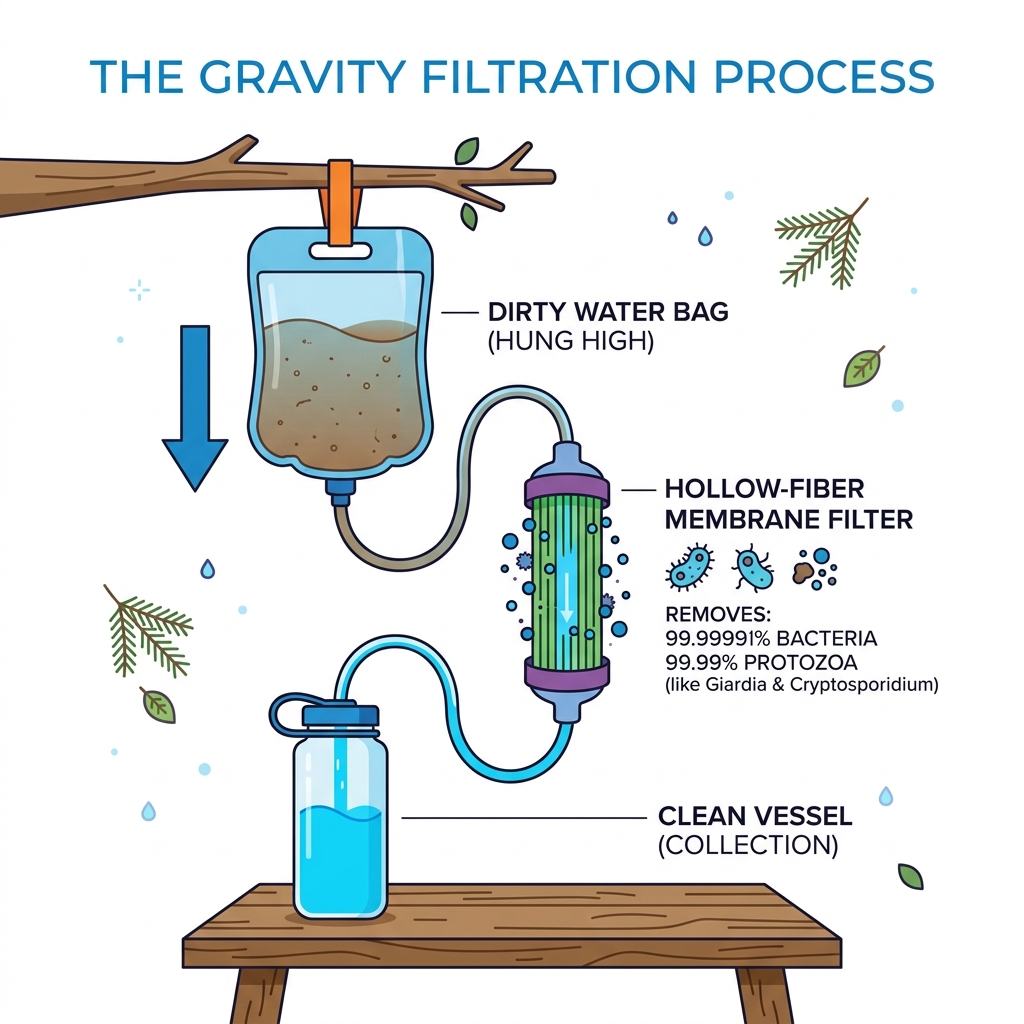
- How it works: Fill a dirty-water bag from a stream or lake, hang it up high, and let gravity push water through a hollow-fiber membrane filter into a clean container below
- What it removes: 99.9999% of bacteria and 99.99% of protozoa (like Giardia and Cryptosporidium) — but not viruses in most standard models
- Who it’s best for: Groups of 2 or more people, multi-day trips, and anyone who wants clean water without pumping or squeezing
- Flow rates: Anywhere from 750 ml/min (budget systems) to 1.75 L/min (premium systems like the Platypus GravityWorks)
- Weight: Most complete systems weigh between 8 and 12 ounces
Hauling water in the backcountry is hard enough without fighting a pump filter at the end of a long day. That’s the quiet appeal of gravity filters — you do the work once (filling the bag), hang it from a tree branch, and walk away.
While your camp gets set up, dinner gets started, or your boots finally come off, the filter does its job on its own.
For solo ultralight hikers, a squeeze filter might be lighter. But for groups of two or more — especially on multi-day trips where everyone needs water for drinking, cooking, and washing — gravity systems offer a level of convenience that’s hard to match.
The key is knowing which system fits your group size, your water sources, and how much weight you can carry. That’s exactly what this guide covers.
Why Choose a Gravity Water Filter for Camping?

When we talk about gravity water filter camping, the biggest “sell” isn’t just the clean water—it’s the time you get back. Traditional methods like pumping require you to crouch by a muddy bank for fifteen minutes, getting a forearm workout you didn’t ask for. Squeeze filters are great for solo hikers, but try squeezing enough water for a four-person pasta dinner, and you’ll quickly realize why “group efficiency” is a buzzword in the camping world.
Gravity systems are the ultimate “set-it-and-forget-it” tool. Because they are pump-free, there are fewer moving mechanical parts to break. You simply fill a reservoir, hang it from a sturdy branch, and let physics do the heavy lifting. This hands-free operation allows you to multitask: you can pitch your tent, gather firewood, or finally take those sweaty socks off while your hydration needs are being met.
According to Scientific research on backcountry water treatment, proper filtration is essential because even the most pristine-looking mountain stream can harbor pathogens. For those planning group excursions, choosing the right system is the first step toward a stress-free trip. You can find More info about group camping solutions to see how these systems integrate into a larger camp kitchen setup.
Understanding the Gravity Mechanism
At the heart of most modern gravity filters is a hollow-fiber membrane. Imagine thousands of tiny, microscopic straws bundled together. These “straws” have 0.1 to 0.2-micron pores. To put that in perspective, a human hair is about 70 microns wide. These tiny holes are small enough to trap 99.9999% of bacteria (like E. coli and Salmonella) and 99.99% of protozoa (like Giardia), but large enough to let water molecules pass through freely.
The “engine” of this system is hydrostatic pressure. By hanging the dirty bag higher than the clean vessel, the weight of the water creates pressure that forces the liquid through the membrane. The higher you hang the bag, the more pressure you create, and the faster your water filters. It’s a simple, elegant solution that provides robust protozoa protection without the need for batteries or bicep curls.
Advantages Over Pump and Squeeze Filters
If you’ve ever used a pump filter in silty water, you know the frustration of the handle becoming nearly impossible to move. Gravity filters offer significant energy conservation. On a high-mileage backpacking trip, saving that physical effort for the trail is a game-changer.
Furthermore, gravity systems offer a superior weight-to-volume ratio for groups. While a pump might weigh 15 ounces and filter 1 liter per minute, a 10-ounce gravity system can process 4 to 10 liters in one go. This high-volume output is essential for basecamps.
There’s also the health aspect to consider. Beyond biological threats, Research on heavy metal accumulation in water sources shows that while biological pathogens are the immediate concern for hikers, long-term exposure to contaminants is a broader environmental issue. While standard hollow-fiber filters don’t typically remove heavy metals, some gravity systems (like those from MSR or LifeStraw) offer optional activated carbon stages to improve taste and reduce certain chemicals, providing a more comprehensive clean than a basic straw filter.
Selecting the Best System for Your Group Size
Choosing the right gravity water filter camping setup depends entirely on how many mouths you have to feed (and hydrate). A system that is “overkill” for a solo hiker becomes a “lifesaver” for a scout troop.
Small Groups and Solo Backpackers
For 2-4 people, a 2-liter to 4-liter capacity is the sweet spot. You want something that balances weight and speed.
- Ultralight Components: Many hikers now use “DIY” setups. For example, you can pair a Sawyer Squeeze filter with a 2L or 3L CNOC Vecto bag. This creates a versatile system that weighs as little as 8 ounces.
- Performance: A standard Sawyer Squeeze in gravity mode can filter roughly 1 liter in a minute or two, depending on the height of the hang.
- The Budget Pick: Options like the Paria 6L Gravity Filter offer a massive capacity for a fraction of the weight (minimum weight around 7.9 ounces) and can filter a full 6L bladder in about 10 minutes (roughly 750ml per minute).
Large Groups and Basecamps
When you have 5 or more people, or you’re setting up a basecamp for a week, you need 6-liter to 10-liter reservoirs.
- Speed is King: Premium systems like the Platypus GravityWorks 4L or 6L are rated for high flow rates of up to 1.75 liters per minute. That means you can have 4 liters of potable water ready in about 2.5 minutes.
- Dual-Bag Systems: These often come with two color-coded bags (Dirty and Clean). You hang the dirty one, connect the hose, and the clean water collects in the second bag, which often has a convenient dispensing tap.
- Solar Shower Compatibility: Some large systems, like the MSR AutoFlow XL (10L), are robust enough to be used as a solar shower or a handwashing station once the water is filtered.
- Durability: Large-group systems use “beefier” materials to handle the weight of 10kg (22 lbs) of water hanging from a tree.
Setup and Maintenance for Maximum Flow
Setting up your filter correctly is the difference between a 2-minute wait and a 20-minute frustration. If you want to dive deep into the logistics, we have a Detailed guide on campsite setup that covers the “pro” tips.
Optimizing Your Gravity Water Filter Camping Setup
To get the fastest flow, follow these steps:
- Vertical Distance: Gravity works better with more “head pressure.” Hang your dirty bag as high as your reach allows. A distance of 4-6 feet between the bag and the filter is ideal.
- Air Purging: This is the #1 reason for slow flow. Air bubbles get trapped in the filter fibers (an “air lock”). To fix this, start the flow, then lift the clean hose/vessel above the dirty bag for a second to let the air bubbles float up and out.
- Hose Management: Ensure there are no kinks. If your hose is stiff from being packed, run some warm water over it (if available) or simply work it with your hands to soften the plastic.
- Quick-Connects and Clamps: Use the shutoff clamp to stop the flow while you switch bottles. This prevents wasting water and keeps your campsite dry.
Field Maintenance and Longevity
Most gravity filters are rated for a long life—some, like the Sawyer Squeeze, claim up to 100,000 gallons, while others like the Platypus are rated for 1,500 liters. However, you’ll only reach those numbers with proper care.
- Backflushing: This is the act of forcing clean water backward through the filter to push out trapped sediment. For systems like the GravityWorks, you simply hold the clean bag above the dirty bag for a few seconds. For others, you might use a provided syringe.
- Sediment Pre-filtration: If the water is “chunky” or muddy, wrap a bandana or coffee filter around the intake. This prevents the large stuff from ever reaching your expensive filter membrane.
- Freezing Protection: This is critical. If water inside the hollow fibers freezes, it expands and cracks the “straws,” rendered the filter useless (and dangerous). If a freeze is expected, sleep with your filter in your sleeping bag.
- Storage: Never store a wet filter in a sealed bag for months. Run a weak bleach solution through it, let it air dry completely, and store it in a cool, dry place.
Frequently Asked Questions about Gravity Water Filter Camping
How do I fix a slow flow rate?
If your “lightning-fast” filter has slowed to a drip, it’s usually one of three things:
- Air Lock: As mentioned, purge the air by inverting the system.
- Clogging: If you’ve been filtering silty water, it’s time to backwash. In very silty conditions (like glacial runoff), you might need to backwash every 2-4 liters.
- Head Pressure: Is the bag high enough? Even an extra foot of height can noticeably increase the flow rate.
Common Problems with Gravity Water Filter Camping
- Bag Leaks: Lightweight TPU bags can develop pinholes if dragged across sharp rocks. Always carry a small piece of Tenacious Tape or a dedicated patch kit.
- Hose Connectivity: Sometimes the quick-connect O-rings get dry and won’t click into place. A tiny bit of lip balm or spit can help them slide in.
- Turbid Water: In very muddy water, let the dirty bag hang for 20 minutes before connecting the filter. This allows the heavy sediment to settle at the bottom. Then, connect the hose and filter the clearer water from the top.
Do gravity filters remove viruses and chemicals?
Most standard gravity water filter camping systems are filters, not purifiers.
- Pore Size: Filters (0.1 to 0.2 microns) remove bacteria and protozoa. Viruses are much smaller (0.02 microns) and pass right through most hollow-fiber membranes.
- When to Purify: If you are camping in areas with high human impact or traveling internationally, you need a purifier (like the MSR Guardian Gravity) or a secondary treatment.
- Secondary Treatments: You can add purification tablets (like Aquatabs or Katadyn Micropur) to your clean water bag to kill viruses.
- Chemicals: Standard filters don’t remove chemicals or heavy metals. If your water source is near industrial runoff, look for a system with an activated carbon stage, which helps reduce chemicals and improves the “earthy” taste of pond water.
Conclusion
At Total Cobre, we believe that the best gear is the gear that disappears into the background of your adventure. A reliable gravity water filter camping system does exactly that—it works quietly in the corner of your campsite while you focus on the sunset and the company of your fellow hikers.
Whether you’re a solo gram-counter building a DIY ultralight setup or a trip leader responsible for a dozen hungry backpackers, there is a gravity system designed for your needs. Remember to prioritize flow rate for large groups, weight for long treks, and always, always backflush your filter to keep the water flowing.
Safe trails and clean water are the foundation of every great trip. Visit Total Cobre for more gear reviews and specialized guides to help you find the perfect solutions for your next outdoor adventure.
