
Clean Water in the Wild: What Every Hiker Needs to Know About Portable Water Filtration
Portable water filtration is the process of removing harmful contaminants — bacteria, protozoa, viruses, and more — from natural water sources using a compact, carry-anywhere device.
Here’s a quick look at the most important things to know before you choose a system:
| Factor | What to Know |
|---|---|
| Filter vs. Purifier | Filters remove bacteria and protozoa. Purifiers also remove viruses. |
| Best for backcountry hiking | Sawyer Squeeze, Katadyn BeFree, LifeStraw Peak |
| Best for international travel | Grayl Geopress, MSR Guardian, SteriPen Ultra |
| Budget pick (under $50) | Sawyer Mini, Aquamira drops |
| Best for groups | Platypus GravityWorks, LifeStraw Mission |
| Virus protection needed? | Only purifiers with 0.02 micron pores (or UV) kill viruses |
| Murky/silty water? | MSR Guardian handles it best; UV purifiers need clear water |
Drinking untreated water from a backcountry stream might look harmless. But a single sip can expose you to Giardia, Cryptosporidium, or bacteria like E. coli — and ruin a multi-day trip fast.
The problem? Not all portable filtration systems protect against the same threats. A lightweight squeeze filter might be perfect for a solo PCT thru-hike but completely inadequate for travel through parts of Southeast Asia or South America where waterborne viruses are a real risk.
Add to that the gear-weight battle every backpacker faces, and the choice becomes genuinely complicated. A heavy-duty purifier that removes everything is great — until it’s slowing you down on a 20-mile day.
According to field testing across thousands of trail miles, the right system depends on where you’re going, how long you’ll be out, and what’s actually in the water you’ll be drinking.
This guide breaks it all down — from filter types and contaminant removal to top-rated systems, maintenance, and budget picks — so you can make a confident, informed choice before your next adventure.
Portable water filtration glossary:
Understanding Portable Water Filtration Technologies
When we head into the backcountry, we aren’t just looking for water that tastes good; we’re looking for water that won’t send us home early with a stomach bug. The technology behind portable water filtration has evolved significantly, moving from heavy, clunky pumps to ultralight hollow fiber membranes that can fit in your pocket.

Most modern filters use hollow fiber membrane technology. Imagine thousands of tiny “straws” with microscopic holes (pores) in their walls. These holes are so small that water can pass through, but bacteria and protozoa are physically blocked. Other systems, like UV purifiers, don’t “remove” anything but instead use light to scramble the DNA of microbes so they can’t reproduce and make you sick.
Understanding these compact hiking water filter systems is the first step in building a reliable gear kit.
Main Types of Portable Water Filtration
- Squeeze Filters: These are the darlings of the thru-hiking world. You fill a soft pouch with “dirty” water and squeeze it through the filter into your mouth or a clean bottle. They are lightweight, fast, and incredibly simple.
- Pump Systems: These involve a hose you drop into the water source and a hand-operated pump. They are excellent for shallow puddles where you can’t easily dip a bag, and many include carbon cores to improve taste.
- UV Purifiers: Devices like the Steripen use ultraviolet light to neutralize pathogens. They are the fastest method—often 90 seconds per liter—but require clear water to be effective.
- Gravity Bags: Perfect for groups or basecamps. You hang a large bag of dirty water from a tree and let gravity pull it through a filter into a clean reservoir. No pumping or squeezing required!
- Bottle Filters: These integrate the filter directly into a reusable bottle. You simply scoop and drink through a straw or press the water through a plunger.
- Chemical Treatment: Using chlorine dioxide tablets or drops. While they take time (up to 4 hours for some cysts), they are the ultimate ultralight backup.
- Straw Filters: The most basic form, allowing you to drink directly from the source like a straw.
For those interested in the science, there is extensive Scientific research on water disinfection methods that validates how these technologies protect human health in the wild.
The Future of Portable Water Filtration Technology
As we look toward 2026, the focus is on reducing pore size while maintaining high flow rates. The “standard” pore size for a microfilter is 0.1 to 0.2 microns, which stops 99.9999% of bacteria. However, the next generation of personal water filtration devices for trails is pushing toward 0.02 microns—the threshold needed to stop viruses physically. Durability is also a major focus; manufacturers are moving away from fragile squeeze bags toward more rugged, puncture-resistant materials that can survive the rigors of an 800-mile trek.
Water Filters vs. Purifiers: Contaminant Removal Explained
The terms “filter” and “purifier” are often used interchangeably, but in portable water filtration, they mean very different things.
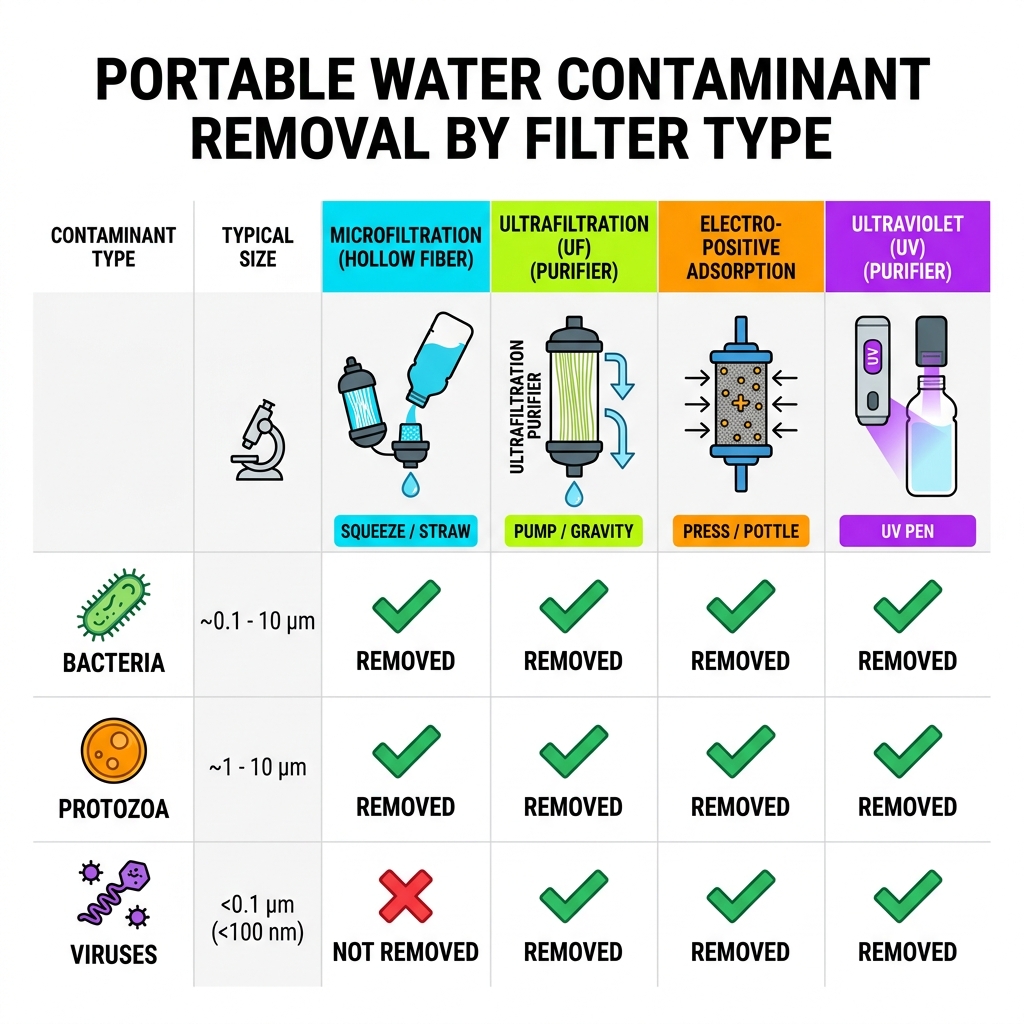
| Contaminant | Water Filter (0.1 – 0.2 microns) | Water Purifier (0.02 microns or UV/Chemical) |
|---|---|---|
| Bacteria (E. coli, Salmonella) | Yes | Yes |
| Protozoa (Giardia, Crypto) | Yes | Yes |
| Viruses (Hepatitis A, Norovirus) | No | Yes |
| Microplastics | Yes | Yes |
| Chemicals/Heavy Metals | Limited (requires carbon) | Limited (requires carbon) |
A standard filter is usually sufficient for North American backcountry use, where the primary threats are bacteria and protozoa from animal feces. However, if you are traveling internationally or hiking in areas with heavy human impact, a purifier is essential. Viruses are significantly smaller than bacteria and can slip through the 0.1-micron pores of a standard filter. For more details on these microscopic threats, see the Scientific research on waterborne pathogens.
Key Factors in Portable Water Filtration Performance
When we evaluate a system, we look at more than just what it removes.
- Pore Size: This determines the “filter grade.” A 0.1-micron rating is standard for bacteria, while 0.02 is required for viruses.
- Flow Rate: Nobody wants to spend an hour squeezing a bag for one liter of water. Top-tier filters like the Katadyn BeFree can move 2 liters per minute.
- Turbidity Handling: “Turbid” water is just a fancy way of saying murky or silty. Some filters clog instantly in muddy water, while others, like the MSR Guardian, are designed to self-backflush with every stroke.
- Log Reduction: This is a mathematical way of showing effectiveness. A “7-log reduction” means 99.99999% of bacteria are removed.
Learning how to choose the best portable water filter for your hiking needs involves balancing these technical specs with your specific destination.
Virus Protection for International Travel
According to the World Health Organization, 1 in 3 people globally lack access to safe drinking water. In many developing countries, tap water is rife with viruses like rotavirus and norovirus. These are the smallest microorganisms and can easily pass through standard filters. If your 2026 travel plans include South America, Southeast Asia, or Africa, you must use a purifier. Check the latest Scientific research on drinking water safety for region-specific risks.
Top-Rated Portable Water Filtration Systems for 2026
We have spent years testing these systems across thousands of miles. Here are the standouts for the current year.
- Sawyer Squeeze: The gold standard for thru-hikers. It’s lightweight (3 oz), has a lifetime volume of 378,000 liters, and is incredibly versatile. It can be used as a squeeze filter, a gravity system, or an inline filter for a hydration bladder.
- Grayl Geopress: The ultimate travel companion. It looks like a standard water bottle but acts as a powerful purifier. You fill the outer sleeve, press the inner filter down (like a French press), and in 20 seconds, you have 710ml of safe, virus-free water.
- SteriPen Ultra: A UV purifier that is perfect for urban travel. It’s fast and easy, though it does require batteries and clear water to work correctly.
- Katadyn BeFree: This filter features a soft, collapsible bottle and a high-flow nozzle. It’s popular because it’s so easy to clean—just swish it in the water to unclog the membrane.
If you are on a budget, there are several top-rated portable water filters under 50 that still offer excellent protection.
Best Systems for Backcountry Hiking
For those of us counting every ounce in our packs, the Sawyer Squeeze and the Katadyn BeFree remain the top choices. The Platypus QuickDraw is also a strong contender, offering a slightly more durable housing and a faster flow rate than many other squeeze models. When weight is the primary concern, these lightweight water purifiers for backpacking provide the best “bang for your buck.”
High-End Solutions for Virus Protection
When the stakes are high—such as in areas with known viral outbreaks or for group expeditions—investing in a 0.02-micron purifier is non-negotiable. The MSR Guardian is a military-grade pump that is virtually indestructible and removes viruses physically. For larger groups, the LifeStraw Mission gravity bag can purify up to 12 liters per hour, making it ideal for basecamps. These high-capacity water purification bottles and systems are worth the extra weight for the peace of mind they provide.
Choosing the Right System for Your Adventure
The “best” filter doesn’t exist in a vacuum; it depends entirely on the scenario.
- Solo Thru-Hiking: Stick to a squeeze filter like the Sawyer Squeeze or Platypus QuickDraw. They are light, fast, and compatible with standard “SmartWater” style bottles.
- Group Camping: A gravity system like the Platypus GravityWorks is a game-changer. Fill the 4L bag, hang it up, and go set up your tent while the water filters itself.
- Shallow/Drought Areas: If you’re filtering out of a tiny puddle or a shallow seep, a pump filter like the MSR TrailShot is best. It can draw water from sources only an inch deep.
- Murky Water: Avoid UV and small squeeze filters. Use a pump with a pre-filter or a system like the MSR Guardian that handles silt without clogging.
Finding the best portable water filters for backpackers means matching these features to your specific trail conditions.
Budget Options and Value Picks
You don’t need to spend $400 to get safe water. The Sawyer Mini is often available for under $25 and provides the same 0.1-micron protection as its larger sibling (though with a slower flow rate). The LifeStraw Peak Straw is another excellent, low-cost option for emergency kits or day hikes. We’ve found that even some top-rated portable water filters for budget-conscious adventurers like the Waterdrop Filter Straw provide great value if you’re willing to do a little more maintenance.
Specialized Systems for RV and Van Life
For those living on the road, portable water filtration takes a different form. Systems like the Guzzle H2O Stream are designed to pump and purify water from a lake or river directly into your vehicle’s tank. The Eddy inline filter uses a 0.5-micron carbon block that is 40 times more effective than standard RV filters, removing lead, chemicals, and sediment. These durable camping water purifiers ensure that your “home on wheels” always has a clean supply.
Maintenance, Cleaning, and Emergency Backup Methods
A filter is only as good as its last cleaning. Over time, sediment and minerals from the water will clog the microscopic pores, slowing your flow rate to a crawl.
- Backflushing: Most hollow fiber filters come with a large syringe. You fill it with clean water and force it backwards through the filter to blast out trapped debris. Do this regularly!
- Field Cleaning: For the Katadyn BeFree, simply “shake and swish” the filter in a body of water to loosen clogs.
- Freezing: This is the “silent killer” of water filters. If water inside the hollow fibers freezes, it expands and cracks the tubes, rendering the filter useless. In cold weather, keep your filter in your pocket or inside your sleeping bag at night.
When assembling a portable water purification kit for outdoor use, always include the cleaning tools provided by the manufacturer.
Effective Backup Treatment Options
Every mechanical system can fail. Bags can pop, O-rings can leak, and UV batteries can die. We always carry a backup. Katadyn Micropur tablets or Aquamira chlorine dioxide drops are the gold standard. They are lightweight and effective against viruses and bacteria. Boiling is another foolproof method; according to the CDC, you should boil water for one full minute (three minutes at high altitudes) to ensure safety. Check the Scientific research on boiling water for safety for more details.
Extending Your Filter Lifespan
The “pre-filter” is your best friend. If you have to pull water from a silty or leaf-filled source, wrap a bandana or a piece of pantyhose around the intake. This catches the big stuff before it ever hits your expensive filter membrane. Proper storage is also key; before putting your filter away for the season, flush it with a weak bleach solution to prevent mold growth. We have found that optimizing portable water purifiers for outdoor use starts with these simple, proactive steps.
Frequently Asked Questions about Portable Water Filtration
What is the difference between a water filter and a water purifier?
A water filter removes bacteria and protozoa (like Giardia). A water purifier goes a step further by also removing or neutralizing viruses. Filters typically have 0.1-micron pores, while purifiers have 0.02-micron pores or use UV/chemicals.
Can portable filters remove microplastics and heavy metals?
Most hollow fiber filters (like Sawyer or LifeStraw) are excellent at removing 99.9% of microplastics. However, they do not remove heavy metals or chemicals unless they have an activated carbon stage. Filters like the Grayl Geopress or Katadyn Hiker are better suited for chemical removal.
How do I prevent my water filter from freezing in winter?
If a hollow fiber filter freezes while it contains water, it is ruined. During winter hikes, keep the filter in an interior jacket pocket during the day and sleep with it in your sleeping bag at night to keep it above freezing.
Conclusion
At Total Cobre, we believe that clean water should be accessible to every adventurer, whether you’re on a weekend camping trip or a months-long international expedition. Switching to a high-quality portable water filtration system isn’t just about your health—it’s also about the planet.
Every minute, one million single-use plastic bottles are purchased worldwide. Most of these end up in landfills where they take at least 450 years to degrade. By using a reusable filter, you can save hundreds of bottles on a single trip. The Environmental impact of plastic bottles is staggering, but a single Sawyer Squeeze can provide enough water for a lifetime of adventures.
Ready to find your perfect match? Explore our portable water filtration services and specialized guides to ensure your next sip is a safe one. Happy trails!
