
Clean Air and Water on the Trail: Why Portable UV Light Purifiers Matter
Portable UV light purifiers are compact devices that use ultraviolet light to destroy the DNA and RNA of harmful microorganisms — killing bacteria, viruses, and other pathogens without chemicals.
For hikers, that matters a lot. Remote trails mean unpredictable water sources, shared shelters, and no easy way to stay clean. Getting sick three days from the nearest trailhead is a serious problem.
Here’s a quick look at the top portable UV purifier types for hikers:
| Type | Best For | Key Stat |
|---|---|---|
| UV-C air purifier | Tents, shelters, small enclosed spaces | Removes 99.97%+ of airborne particles |
| UV-C wand / surface sanitizer | Gear, food prep surfaces, sleeping areas | Kills 99.9% of bacteria and viruses in 10 seconds |
| UV-C water purifier | Drinking water from streams and lakes | Inactivates pathogens without chemicals or filters |
The core technology is the same across all three: UV-C light (typically around 253–265 nm) damages the genetic material of microorganisms so they can’t reproduce or cause infection. It’s fast, it’s chemical-free, and it’s been used in hospitals, water treatment plants, and food processing since the 1930s.
The challenge for hikers is finding a device that’s actually portable — lightweight, durable, battery-powered, and tough enough for backcountry conditions.
This guide breaks down what to look for, compares the best options, and helps you pick the right UV purifier for your next trip.
How Portable UV Technology Works for Outdoor Use
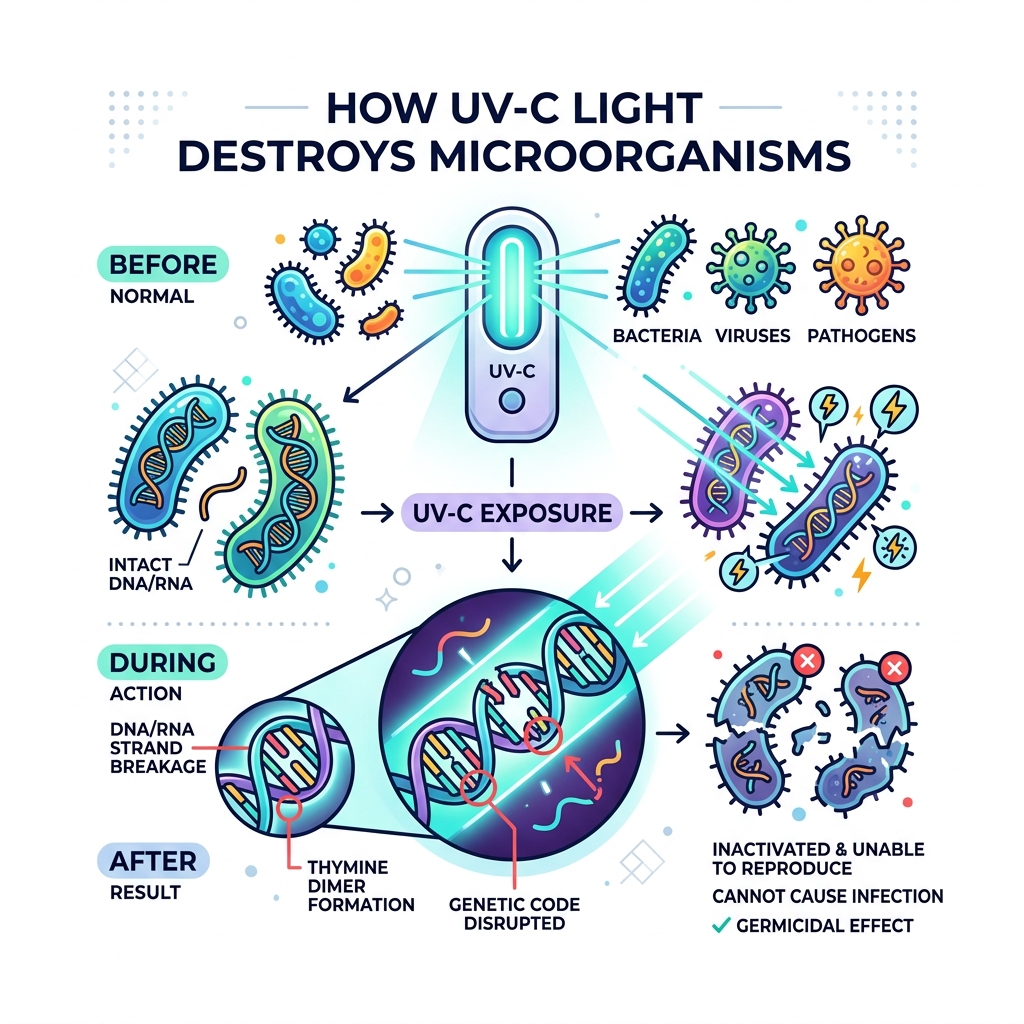
When we talk about a portable uv light purifier, we are specifically looking at the UV-C spectrum. Ultraviolet light is divided into three types: A, B, and C. While UV-A and UV-B reach us from the sun, UV-C is almost entirely absorbed by the Earth’s atmosphere. This is lucky for us, because UV-C is “germicidal”—meaning it is incredibly effective at killing microscopic life.
The science is fascinatingly simple. The most effective wavelengths for disinfection are generally between 253.7nm and 265nm. At these frequencies, the light penetrates the thin cell walls of bacteria and the protein coats of viruses. Once inside, it wreaks havoc on the organism’s DNA and RNA. Specifically, it causes “thymine dimers,” which are essentially kinks in the genetic code that prevent the pathogen from replicating. If a virus can’t replicate, it can’t make you sick.
In professional air purification, this technology is so respected that organizations like ASHRAE (the American Society of Heating, Refrigerating and Air-Conditioning Engineers) recognize it as a primary tool for air disinfection. Independent testing by labs like MRI Global has shown that high-quality UV-C systems can achieve a 99.99% sanitization rate against airborne pathogens.
For hikers, this technology offers significant advantages of using uv light purifiers for backpacking trips. Unlike chemical treatments that can leave a funky aftertaste in your water or take 30 minutes to work, a Industry leading portable Air Purifier or water device works in seconds or minutes. It’s a clean, dry, and highly technical solution to the age-old problem of trail hygiene.
Essential Features of a High-Quality portable uv light purifier
If you are looking to invest in a portable uv light purifier, you shouldn’t just grab the cheapest one on the shelf. Backcountry gear needs to be “trail-tough” and highly efficient. When we evaluate these devices, we look for a multi-stage approach.

The Filtration Powerhouse
For air-focused units used in vans or cabins, a UV lamp alone isn’t enough. The best units incorporate a Medical Grade H13 HEPA filter. These filters are rated to trap 99.97% of all particles as small as 0.1 to 0.3 microns. To put that in perspective, a human hair is about 70 microns wide.
Performance Metrics
When comparing air units, keep an eye on the CADR (Clean Air Delivery Rate). A solid portable unit might offer a CADR of 25 m³/h, which is perfect for a tent or a small camper van. You also want to check the coverage area; most portable units are designed for spaces around 7 to 10 square meters (roughly 75 to 100 square feet).
Portability and Power
For harnessing-uv-light-purifiers-for-safe-backpacking-trips, weight is king. A good portable unit should weigh less than a pound. Furthermore, look for USB-rechargeable lithium-ion batteries. Being able to juice up your purifier using the same power bank you use for your phone is a huge logistical win on long treks.
| Feature | Air Purifier | Surface Wand | Water Purifier |
|---|---|---|---|
| Primary Goal | Remove dust/pollen/viruses | Sanitize gear/surfaces | Neutralize water pathogens |
| Key Tech | HEPA + UV-C + Carbon | High-intensity UV-C LED | Submersible UV-C Lamp |
| Best Use | Tent / Cabin / Car | Sleeping bags / Cookware | Streams / Lakes / Springs |
| Maintenance | Filter & Lamp change | Lamp cleaning | Lamp cleaning |
Comparing Air, Surface, and Water Purification for Hikers
Hikers face three different types of “invisible enemies” on the trail: airborne pollutants, surface contaminants, and waterborne pathogens.
Airborne Protection
While the “great outdoors” usually has great air, shared spaces like AT shelters, hostels, or even a crowded four-season tent can become breeding grounds for respiratory irritants. A portable air unit helps remove odors, smoke from the campfire, and allergens that might keep you sneezing all night.
Surface Sanitization
This is where the Portable UV-Sanitizer LP-UVS100 and similar wands shine. Think about the surfaces you touch: your cell phone, your shared bear canister, or the questionable mattress at a trail hostel. A quick 10-second pass with a UV-C wand can eliminate 99.9% of bacteria and viruses, preventing cross-contamination.
Water Purification
This is perhaps the most critical application for hikers. Using uv-purification-systems-to-enhance-your-health-on-hikes allows you to drink from clear mountain streams with confidence. While a filter physically removes sediment, the UV light tackles the stuff that’s too small for some filters to catch, like certain viruses. It’s a 99.99% sanitization rate that gives you peace of mind when the nearest tap is 40 miles away.
Safety and Maintenance Requirements
As much as we love this technology, a portable uv light purifier isn’t a toy. UV-C light is powerful enough to damage human cells just as easily as it damages bacteria.
Safety First
Most high-quality wands now include a gravity sensor. This is a brilliant safety feature that automatically shuts off the UV lamp if it is tilted upward toward your eyes. Never look directly at a UV-C bulb while it is active, and keep these devices away from children and pets.
Maintenance and Longevity
To keep your gear running through a thru-hike, you need to know the numbers:
- Bulb Lifetime: Most UV-C LED bulbs are rated for about 8,000 hours of use. For most hikers, that’s a lifetime of trips.
- Filter Replacement: If your unit uses a HEPA filter, it generally needs to be replaced every 2,880 hours of operation (roughly every 4 months of heavy use).
- Battery Life: Expect about 70 minutes of continuous sanitization for a wand, or 8–12 hours for an air purifier on a single charge.
- Noise Levels: If you’re using an air purifier in a tent, you’ll want it quiet. Look for units that operate around 38 dB to 50 dB—roughly the sound of a quiet library or moderate rainfall.
Frequently Asked Questions about Portable UV Technology
Are portable uv light purifiers effective against viruses?
Yes. UV-C light is highly effective at inactivating viruses by destroying their protein coats and genetic material. This includes common cold and flu viruses, as well as more complex airborne pathogens.
Can a portable uv light purifier be used for both air and water?
Generally, no. These devices are specialized. An air purifier uses fans to pull air through a filter past a light. A water purifier is either a submersible “pen” or a bottle cap designed to treat liquids. A surface wand is designed for “line-of-sight” sanitization of physical objects. You’ll need the right tool for the specific job.
What is the difference between HEPA and UV-C in a portable uv light purifier?
Think of HEPA as a net and UV-C as a bug zapper. The HEPA filter physically catches particles like dust, pollen, and large bacteria. The UV-C light provides a germicidal “kill” step for the tiny viruses and bacteria that might be small enough to slip through or that are trapped on the filter’s surface.
Conclusion
At Total Cobre, we know that the right gear can make or break an adventure. A portable uv light purifier might seem like a luxury, but when you consider the risks of trail-borne illness, it quickly becomes an essential part of a modern hiker’s kit. Whether you’re purifying a liter of water from a glacial stream or sanitizing a shared shelter space, this “small but mighty” technology offers a chemical-free, highly effective shield against the invisible threats of the backcountry.
Stay safe, stay hydrated, and we’ll see you on the trail!
Explore more clean water solutions and gear guides at Total Cobre
