
Why Every Backpacker Needs a Reliable Water Filter
Water filter for backpackers is one of the most important pieces of gear you’ll ever choose — get it wrong and you could spend your trip hugging a tree for the wrong reasons.
Here’s a quick look at the top water filter options for backpackers:
| Filter Type | Best For | Weight | Removes Viruses? |
|---|---|---|---|
| Squeeze filter (e.g., Sawyer Squeeze) | Most trips, murky water | ~3 oz | No |
| Soft flask filter (e.g., Katadyn BeFree) | Fast-paced hikes, clear water | ~2.3 oz | No |
| Pump filter (e.g., MSR Guardian) | International travel, groups | ~17 oz | Yes |
| Chemical drops (e.g., Aquamira) | Backup, virus protection | ~2 oz | Yes |
| UV purifier (e.g., SteriPen) | International travel | ~5 oz | Yes |
| Gravity filter (e.g., Platypus GravityWorks) | Groups, basecamp | ~11.5 oz | No |
Backcountry water looks clean. It often isn’t.
Streams, lakes, and even fast-moving mountain springs can carry Giardia, Cryptosporidium, bacteria like E. coli, and in some regions, viruses. Any one of these can cause severe cramps, diarrhea, and fatigue — the last thing you want miles from the trailhead.
One backpacker on the Appalachian Trail ditched his filter to save weight, confident he knew which sources were safe. He got sick. It’s a common and very avoidable mistake.
The good news? Modern water filters are lighter, faster, and more reliable than ever. Whether you’re thru-hiking a 500-mile trail or heading out for a weekend trip, there’s a system that fits your pack and your pace.
This guide breaks down every major option so you can pick the right one for your trip.
Understanding Your Options: Water Filter vs. Purifier
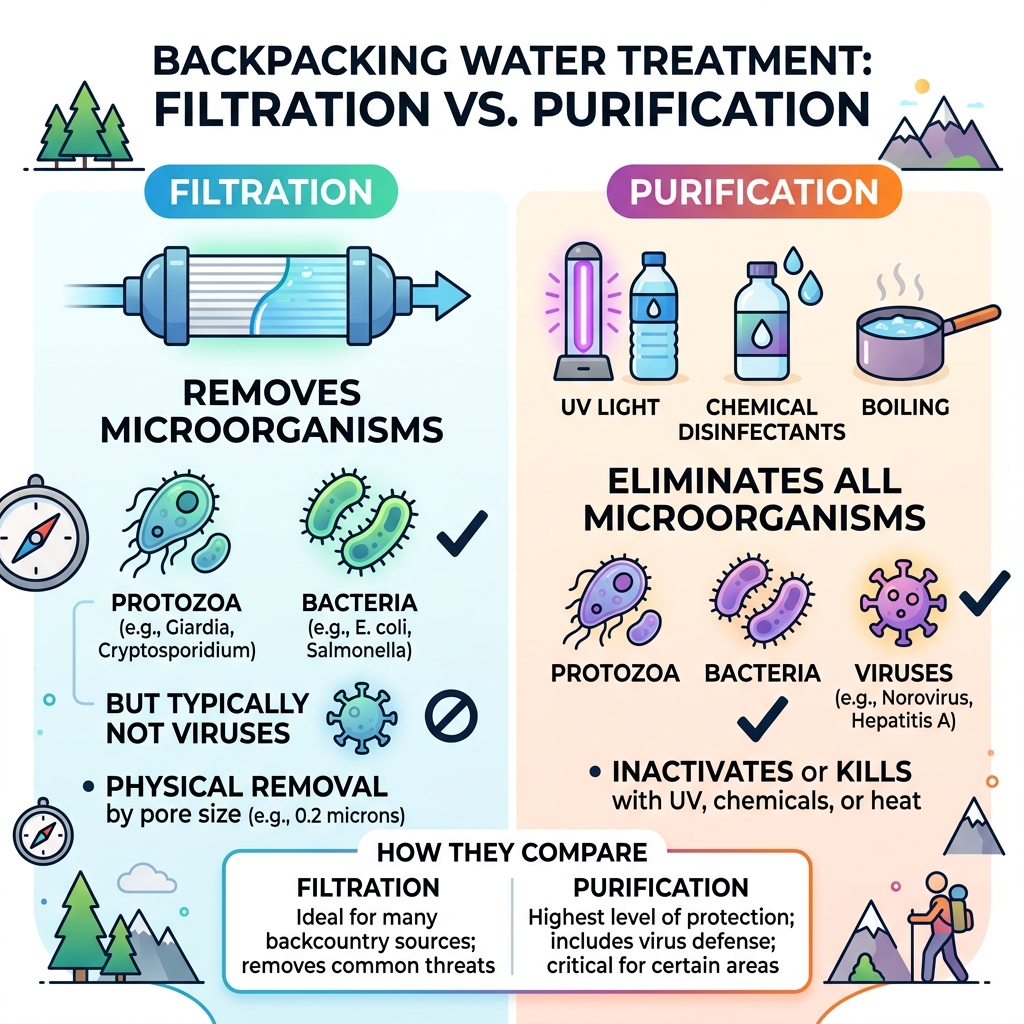
When we talk about a water filter for backpackers, we are usually referring to mechanical strainers. Most standard microfilters use hollow-fiber technology with a pore size of 0.2 microns. This is small enough to catch 99.999% of bacteria (like Salmonella and E. coli) and protozoa (like Giardia and Cryptosporidium).
However, there is a distinct difference between a filter and a purifier. Viruses—such as Norovirus or Hepatitis A—are significantly smaller than bacteria, often measuring around 0.02 microns. A standard 0.2-micron filter will not catch them. This is where lightweight water purifiers for backpacking come into play.
Purifiers use either much smaller pore sizes (like the MSR Guardian’s 0.02-micron membrane), UV light, or chemical treatments to neutralize these tiny threats. While filters are generally sufficient for the backcountry of the United States and Canada, purifiers are highly recommended for international travel or areas where water is heavily contaminated by human or animal feces.
Chemical treatments like Aquamira or Micropur tablets are effective purifiers but require “dwell time.” For example, chlorine dioxide tablets might kill bacteria in 15 minutes, but they often require up to 4 hours to kill hard-shelled Cryptosporidium in cold water. Knowing these timelines is essential for safe hydration practices every backpacker should adopt.
How to Choose the Best Water Filter for Backpackers
Choosing a water filter for backpackers isn’t just about what it removes; it’s about how it fits into your daily trail routine. If you have to spend two hours every evening pumping water, you’re going to be a very grumpy hiker.
Weight vs. Flow Rate
There is almost always a trade-off between weight and speed. A tiny filter like the Sawyer Mini weighs next to nothing but can be frustratingly slow to use. On the other hand, the Sawyer Squeeze weighs about 3 ounces and offers a much faster flow rate, making it the “Goldilocks” choice for many.
| Filter Model | Weight | Flow Rate (Approx) | Lifespan |
|---|---|---|---|
| Sawyer Squeeze | 3.0 oz | 1.7 L/min | 378,000 Liters |
| Katadyn BeFree | 2.3 oz | 2.0 L/min | 1,000 Liters |
| MSR MiniWorks EX | 16.0 oz | 1.0 L/min | 2,000 Liters |
| LifeSaver Wayfarer | 11.4 oz | 1.4 L/min | 5,000 Liters |
Durability and Maintenance
Field maintainability is a huge factor. Can you fix it if it clogs in the middle of the High Sierra? Systems like the MSR MiniWorks EX allow you to scrub the ceramic element to restore flow, while hollow-fiber filters like the Sawyer series require “backflushing” with a syringe. Balancing hydration and weight for backpackers means choosing a system that won’t fail when you’re miles from civilization.
Initial Cost vs. Lifetime Value
Some filters are cheap up front but require expensive replacement cartridges every few hundred liters. The Sawyer Squeeze is famous for its nearly infinite 378,000-liter lifespan, whereas a bottle-press filter like the Grayl GeoPress requires a new cartridge every 250 liters. If you’re a frequent hiker, the lifetime value of a long-lasting filter far outweighs the initial savings of a disposable one.
Top-Rated Systems for Every Trail Scenario
No single water filter for backpackers is perfect for every trip. We’ve found that matching the tool to the environment is the key to success. You can explore our full list of best-portable-water-filters-for-backpackers to see which models are currently leading the market.
Best Water Filter for Backpackers on Ultralight Trips
For the “grams-count” crowd, squeeze filters and inline systems are king. The Sawyer Squeeze or Micro Squeeze are staples because they weigh roughly 3 ounces and can screw directly onto standard 28mm threaded disposable bottles (like Smartwater).
Another top contender is the HydraPak 28mm Filter Kit. It weighs only 1.6 ounces and integrates perfectly with soft flasks. These hollow-fiber systems allow you to filter as you drink or squeeze water into a secondary container. They are compact, efficient, and take up almost zero space in your pack.
High-Volume Solutions for Group Camping
If you are hiking with a group of four or more, squeezing individual bottles becomes a chore. This is where gravity-fed systems, like the Platypus GravityWorks, shine. You fill a “dirty” bag, hang it from a tree, and let gravity do the work. These systems can provide 4 liters of clean water in just a few minutes with zero effort. It’s hands-free hydration that lets you focus on setting up camp or cooking dinner.
Choosing a Water Filter for Backpackers in International Travel
When viruses are a concern, you need a purifier. The MSR Guardian is the gold standard here; it is a pump-style purifier with a 0.02-micron pore size that physically removes viruses. It even has an auto-backflush feature, making it ideal for the turbid, silty water often found in developing regions.
Alternatively, many travelers prefer maximizing efficiency using UV light purifiers for backpacking trips. A device like the Katadyn Steripen Ultra can treat a liter of water in just 90 seconds using ultraviolet rays to scramble the DNA of pathogens. Just remember that UV light doesn’t remove dirt or “floaties,” so you may want to pre-filter murky water through a bandana first.
Maintenance, Freezing, and Best Practices
A water filter for backpackers is a precision instrument. If you don’t take care of it, it won’t take care of you.
Backwashing Techniques
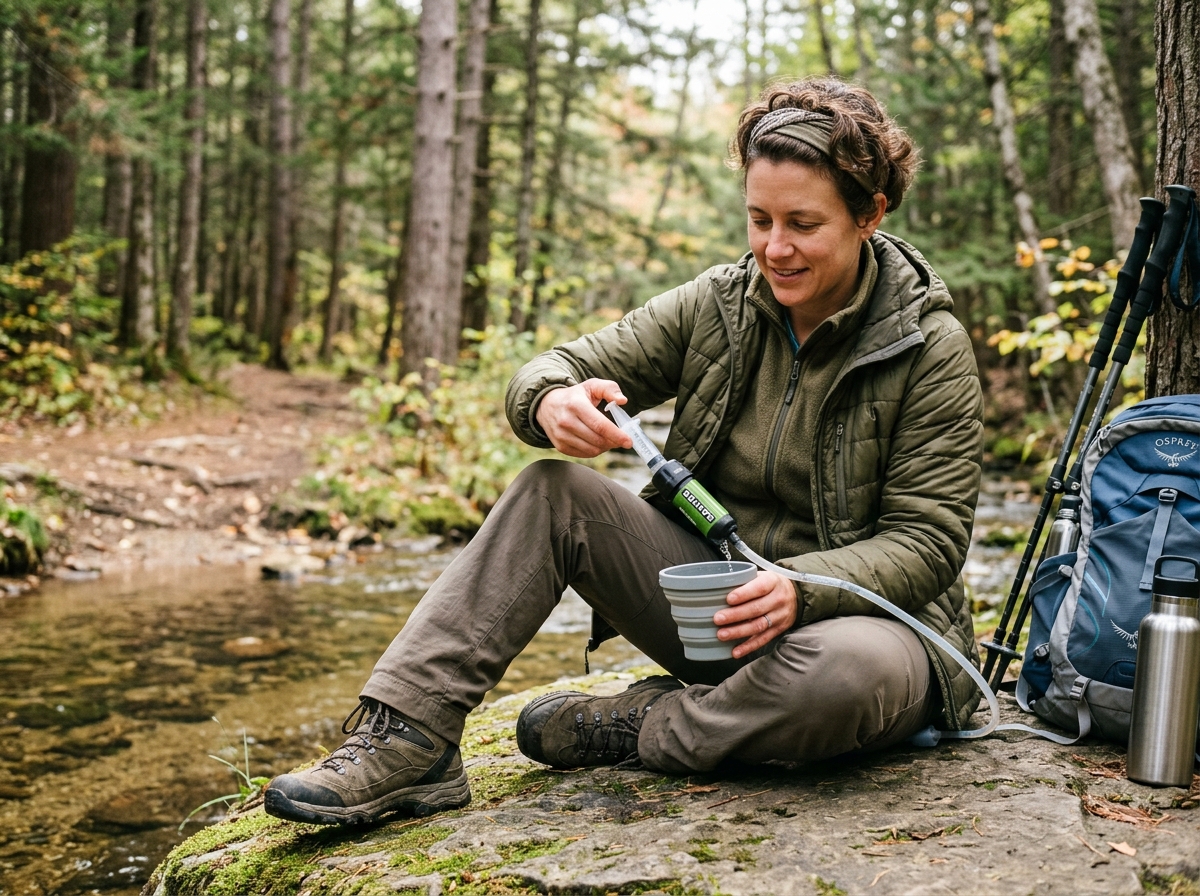
As you filter water, particulates like silt and algae get trapped in the fibers. This slows the flow rate. For Sawyer-style filters, you must backflush regularly using the provided syringe. For the Katadyn BeFree, a simple “swish and shake” in clean water usually does the trick. Regular maintenance ensures your filter lasts for years rather than one single muddy trip.
How do I prevent my filter from freezing?
This is the most critical rule for hollow-fiber filters: Never let them freeze.
Because these filters work by trapping water inside tiny tubes, that water will expand if it freezes. This expansion creates microscopic cracks in the fibers. The filter will still look fine and water will still flow, but it will no longer be straining out bacteria.
- Pro Tip: If the temperature drops below freezing, keep your filter in a sealed bag inside your sleeping bag at night. During the day, keep it in an internal jacket pocket where your body heat can protect it.
Why do I need a backup method?
Mechanical things break. Filters clog beyond repair, O-rings leak, and electronics (in the case of UV pens) fail. Always carry a secondary method.
Chemical treatments are the perfect backup because they are virtually weightless. Comparison of water purification tablets for backpackers shows that chlorine dioxide tablets are the most effective choice. If all else fails, remember the 1-minute boil rule (3 minutes if you are above 6,500 feet). Boiling is the only 100% foolproof way to kill every type of pathogen.
Best Practices for Sourcing Water
To keep your filter running smoothly, follow these “source-to-sip” best practices:
- Seek Flowing Water: Always prefer clear, cold, moving streams over stagnant ponds.
- Pre-Filter Murky Water: If you must use a silty source, let it settle in a bucket or pre-filter it through a coffee filter or bandana. This prevents your main filter from clogging instantly.
- Mind Your Hygiene: Many “waterborne” illnesses are actually caused by poor hand hygiene. Use hand sanitizer after going to the bathroom and before handling your clean water bottles.
- Avoid Cross-Contamination: Never let the “dirty” cap or hose touch the “clean” side of your system. Even a single drop of untreated water can contain enough pathogens to make you sick.
Conclusion
At Total Cobre, we believe that choosing the right water filter for backpackers is about more than just avoiding a stomach ache—it’s about the freedom to explore further and stay out longer. Whether you choose a high-speed squeeze filter for a solo thru-hike or a robust pump purifier for an international expedition, understanding your gear is the first step toward a successful adventure.
By following Leave No Trace principles and practicing proper filter maintenance, you ensure that both you and the trails remain healthy for years to come. For more specialized guides and gear reviews, check out our Safe hydration practices every backpacker should adopt 2 or visit our homepage for Must-have portable water filters for frequent backpackers.
Stay hydrated, stay safe, and we’ll see you on the trail!
