
Stop the Squirts: Why the Best Water Purifier Backpacking Gear Can Save Your Trip
The best water purifier backpacking options in 2025 are:
| Rank | Product | Best For | Weight | Removes Viruses? |
|---|---|---|---|---|
| 1 | MSR Guardian Purifier | Overall/International | 17 oz | Yes |
| 2 | Katadyn BeFree | Ultralight/Clear Water | 2.3 oz | No |
| 3 | Sawyer Squeeze | Thru-hiking/Durability | 3 oz | No |
| 4 | Platypus GravityWorks | Groups/Hands-free | 11.5 oz | No |
| 5 | Aquamira Drops | Ultralight Backup/Viruses | 3 oz | Yes |
Every stream looks clean. Most aren’t.
Giardia, E. coli, cryptosporidium — these microscopic threats live in backcountry water sources across North America and beyond. Drinking untreated water doesn’t just mean a rough night. It can mean days of cramps, fever, and diarrhea, potentially far from help.
The good news? The right water treatment system makes this a non-issue. Experienced thru-hikers routinely cover thousands of miles — some over 6,500 miles — without a single waterborne illness, simply by treating every water source, every time.
But with so many options — squeeze filters, gravity systems, UV pens, chemical drops, pump purifiers — picking the right one for your trip takes a little know-how.
This guide cuts through the noise so you can choose with confidence.
Filter vs. Purifier: Understanding the Difference
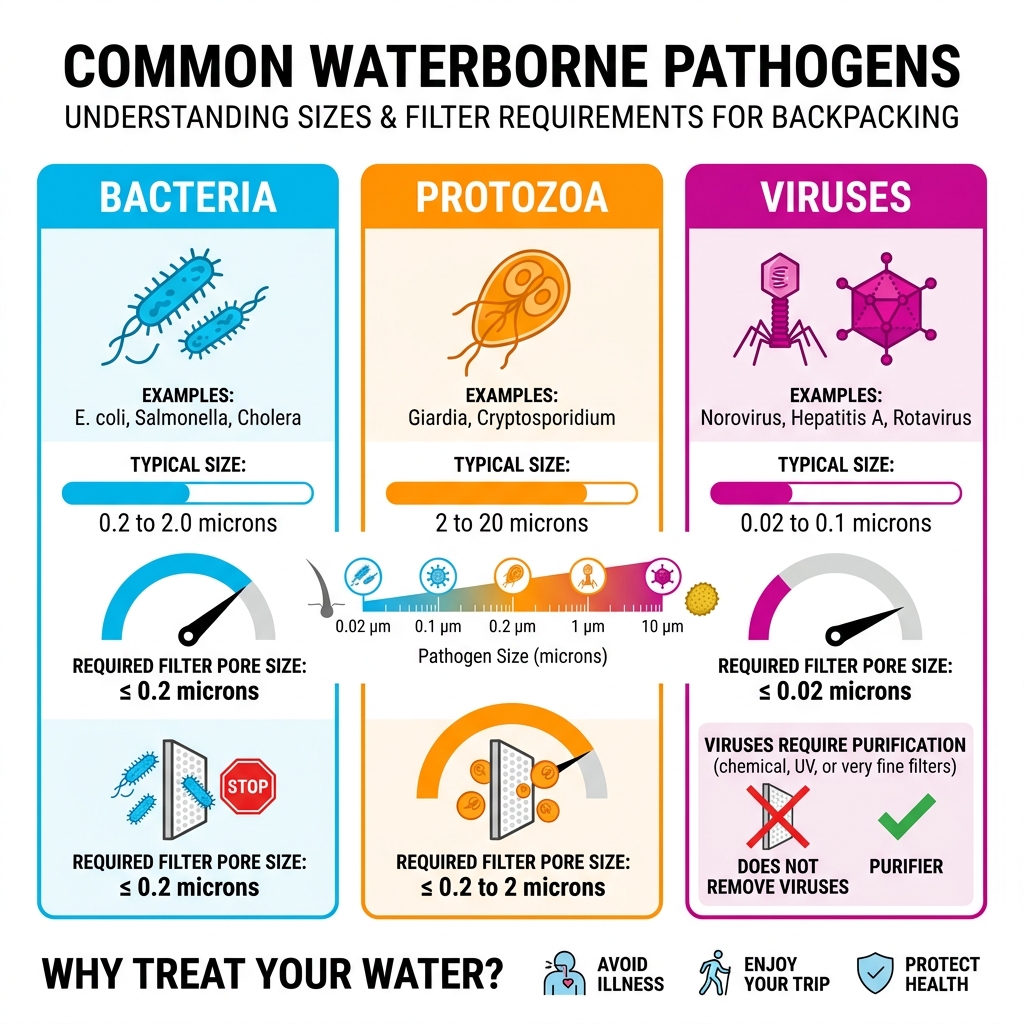
In backcountry hydration, the terms “filter” and “purifier” are often used interchangeably, but they represent two very different levels of protection. Understanding this distinction is the first step in finding the best water purifier backpacking setup for your specific destination.
What is a Water Filter?
Most backpackers in North America use a water filter. These devices typically use a hollow-fiber membrane (which looks like a bundle of tiny straws) to physically strain out contaminants.
- What they remove: Bacteria (like E. coli and Salmonella) and Protozoa (like Giardia and Cryptosporidium).
- The Size Factor: Standard filters usually have a pore size of 0.1 to 0.2 microns. Since bacteria are roughly 0.5 to 2 microns and protozoa are even larger, they get trapped easily.
- The Gap: Filters do not remove viruses. Viruses are incredibly small—down to 0.02 microns—and they slip right through the “large” holes of a standard filter.
What is a Water Purifier?
A water purifier goes a step further. To be classified as a purifier by EPA standards, a device must remove or inactivate 99.99% of viruses in addition to bacteria and protozoa.
- How they work: Some use much tighter physical membranes (0.02 microns), while others use UV light or chemical treatments to “inactivate” the DNA of the pathogens so they can’t make you sick.
- When you need one: If you are traveling internationally to regions with poor sewage infrastructure, or if you are hiking in high-traffic areas where human or animal waste is a significant concern, a purifier is a must.
For more details on maximizing your gear’s performance, check out our guide on the Effective Use of Portable Water Purifiers.
Top-Rated Systems for the Best Water Purifier Backpacking
When we look for the best water purifier backpacking systems, we evaluate them based on weight, flow rate, and how well they handle different water types (clear vs. murky).
The Gold Standard: MSR Guardian Purifier
If you want the ultimate “peace of mind” tool, the Guardian Purifier Backpacking Water Purifier | MSR is in a league of its own. Originally designed for military use, this pump system uses advanced hollow-fiber technology to block viruses without chemicals or batteries.
- Key Stats: It pumps at a staggering 2.5 liters per minute and has a cartridge life of over 10,000 liters.
- Durability: It is one of the few mechanical systems that can withstand freezing and drops of up to 6 feet onto concrete.
- Self-Cleaning: It uses a portion of the pumped water to backflush the filter continuously, meaning the flow rate stays high even in “chocolate milk” glacial silt.
| Feature | MSR Guardian | Katadyn BeFree | Sawyer Squeeze |
|---|---|---|---|
| Type | Pump Purifier | Squeeze Filter | Squeeze Filter |
| Weight | 17 oz | 2.3 oz | 3 oz |
| Flow Rate | 2.5 L/min | 2.0 L/min | 1.7 L/min |
| Lifespan | 10,000+ L | 1,000 L | 378,000 L |
| Virus Protection | Yes | No | No |
Ultralight Designs for the Best Water Purifier Backpacking
For the ounce-counters and thru-hikers, weight is everything. You don’t want a pound of metal and plastic hanging off your pack if you’re trying to crush 20-mile days.
Katadyn BeFree The BeFree is a fan favorite for a reason. At just 2.3 ounces (including the 1L soft bottle), it is incredibly light. The wide-mouth design makes it easy to fill, and the flow rate is so fast you can drink almost as quickly as you would from a tap at home. However, it is best for clear water; silty water can clog the 0.1-micron filter relatively quickly. You can learn more about similar setups in our review of Sip-ly: The Best Top Portable Water Purifying Systems.
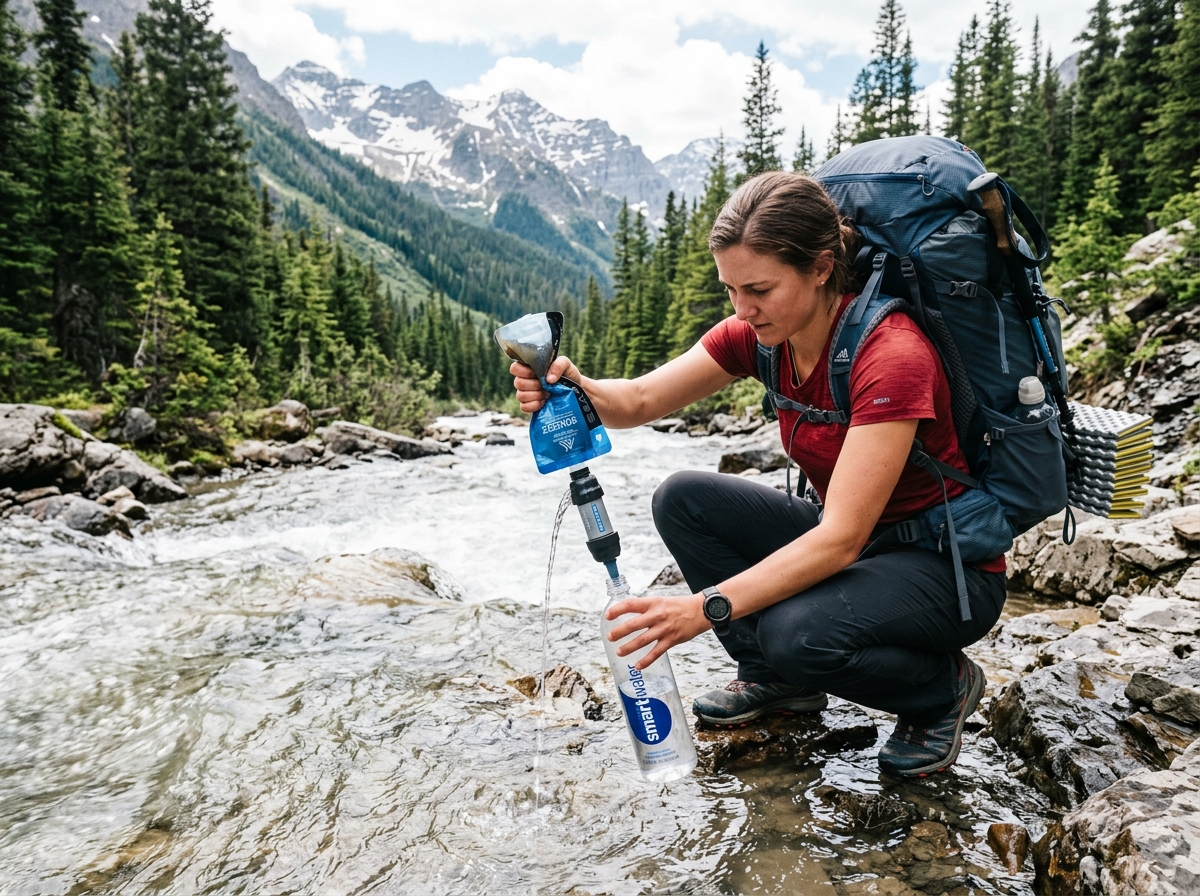
Sawyer Squeeze The Sawyer Squeeze is the “indestructible” workhorse of the PCT and AT. While it’s a hair heavier than the BeFree, its lifetime volume of 378,000 liters means you will likely never need to buy another filter. It uses a standard 28mm thread, allowing you to screw it directly onto lightweight Smartwater bottles, which is a common “pro” hack among experienced hikers.
High-Capacity Systems for the Best Water Purifier Backpacking
If you are hiking with a partner, a family, or a group of friends, “squeezing” or “pumping” for everyone becomes a chore. This is where gravity systems shine.
Platypus GravityWorks This system uses gravity to do the work for you. You fill a “dirty” bag, hang it from a tree, and let the water flow through a filter into a “clean” bag.
- Group Benefit: With a 4L capacity and a flow rate of 1.75 L/min, you can have enough water for everyone’s dinner and morning coffee in just a few minutes of passive filtering.
- Hands-Free: It allows you to set up your tent or start a fire while your water treats itself.
Katadyn Explorer Pro Purifier For those needing a rugged, modular pump for groups of 2-5 people, the Katadyn Explorer Pro Purifier offers a three-stage system. It combines a ceramic pre-filter for murky water, an activated carbon core to improve taste, and a hollow-fiber membrane for virus protection. It’s a powerhouse for basecamps and remote expeditions.
Specialized Methods: UV, Chemical, and Mechanical Systems
Sometimes, a physical filter isn’t the best tool for the job. Depending on the environment—whether it’s freezing cold or you’re dealing with clear but virus-prone water—you might look toward UV or chemical solutions.
UV Light: The High-Tech Approach
The Katadyn Steripen Ultra is the most popular UV option. It works by swirling a glass lamp in your water bottle for about 48 to 90 seconds. The UV light destroys the DNA of bacteria, protozoa, and viruses.
- Pros: It’s fast and very effective against viruses.
- Cons: It requires batteries and does not remove particulates. If your water is murky, the UV light can’t “see” through the dirt to kill the bugs. You’ll want to pre-filter through a bandana or coffee filter first. For a deeper dive, see our article on Harnessing UV Light Purifiers for Safe Backpacking Trips.
Chemical Treatment: The Ultralight Backup
Chemicals like Aquamira (chlorine dioxide) or Katadyn Micropur tablets are the ultimate “just in case” items.
- Aquamira: This two-part liquid treats about 114 liters per 3 oz bottle set. It kills 99.9% of bacteria, viruses, and cysts like Giardia.
- Pros: No moving parts to break and it kills viruses.
- Cons: You have to wait. Typically, it takes 15–30 minutes for bacteria and viruses, and up to 4 hours to kill the ultra-resilient Cryptosporidium.
We’ve compared these in detail in our guide Comparing Chemical and Mechanical Water Purification Methods for Outdoor Use.
Maintenance, Backups, and Hygiene Best Practices
Even the best water purifier backpacking gear will fail if you don’t take care of it. Maintenance in the field is just as important as the gear you buy.
The Art of the Backflush
Hollow-fiber filters (Sawyer, BeFree, Platypus) eventually clog with sediment. Most come with a syringe or a “shake-to-clean” protocol.
- Pro Tip: If your flow rate drops, backflush your filter with clean water. Doing it with dirty water will just jam more gunk into the fibers.
The Winter Danger: Freezing
This is the “silent killer” of water filters. If water stays inside the hollow fibers and freezes, it expands and cracks the microscopic tubes. You won’t see the damage, but the filter is now useless, allowing pathogens to pass through.
- Best Practice: On cold nights, keep your filter in a sealed bag inside your sleeping bag. Your body heat will keep it from freezing. If you suspect your filter has frozen, it’s time to retire it.
Why You Need a Backup
Mechanical things break. Bags pop, O-rings dry out, and ceramic elements can crack if dropped. Always carry a secondary method. A few Aquatabs or a small bottle of iodine weigh almost nothing but can save your trip if your primary filter fails. Check out our Emergency Water Filter Reviews for Hikers for reliable backup ideas.
Hygiene and “Leave No Trace”
Clean water starts with a clean source.
- Collect Upstream: Always scoop water from upstream of where people are wading or washing.
- Hand Hygiene: Many “waterborne” illnesses are actually “hand-to-mouth” illnesses. Use hand sanitizer after using the bathroom and before handling your water bottles.
- The 200-Foot Rule: Always dig your catholes at least 200 feet away from any water source to prevent contamination.
For more on staying safe in the wilds, see our strategies for Purifying Water in Remote Areas: Strategies for Backpackers.
Frequently Asked Questions about the Best Water Purifier Backpacking
What is the fundamental difference between a water filter and a water purifier?
A water filter physically removes bacteria and protozoa but is generally ineffective against viruses because they are too small. A water purifier is designed to remove or inactivate all three classes of microbes: bacteria, protozoa, and viruses. Purifiers are essential for international travel or areas with high human fecal contamination.
Can I use a water filter if it has been exposed to freezing temperatures?
Generally, no. Most modern filters use hollow-fiber membranes. When the water inside these fibers freezes, it expands and creates microscopic tears in the membrane. Since you cannot see this damage, the filter is no longer safe to use. If you think your filter froze, replace it.
Why is carrying a backup water purification method crucial for backpacking?
Equipment failure is a reality of the trail. Squeeze bags can leak, pump handles can break, and filters can clog beyond repair in silty water. Carrying a lightweight backup, like chemical tablets or drops, ensures you can still safely hydrate even if your primary device fails.
Conclusion
Finding the best water purifier backpacking setup depends entirely on where you’re going and how you like to travel. If you’re a solo ultralight hiker on the Appalachian Trail, a Sawyer Squeeze or Katadyn BeFree is likely your best bet. If you’re heading to the high Andes or a remote village in Southeast Asia, the virus-killing power of the MSR Guardian is worth every ounce.
At Total Cobre, we believe that gear reliability is the foundation of trail health. Our specialized guides are designed to help adventurous hikers find clean water solutions that work every time, so you can focus on the view, not the nearest bush.
Ready to gear up? Visit us at https://www.totalcobre.com/ for more expert reviews and trail-tested recommendations. Stay hydrated, stay healthy, and we’ll see you on the trail!
