
Clean Water Can Be the Difference Between Life and Death on the Trail
The best survival water purifier for most hikers is the MSR Guardian for full virus protection, the LifeStraw Peak Squeeze for ultralight personal use, or the Platypus GravityWorks for group trips.
Here’s a quick comparison to match your situation:
| Scenario | Best Pick | Why |
|---|---|---|
| Solo hiking, personal use | LifeStraw Peak Squeeze | 108g, filters 1L in 35 seconds, 2,000L lifespan |
| Group camping | Platypus GravityWorks | 4L hands-free gravity system, 52 seconds per liter |
| International travel or virus risk | MSR Guardian | 0.02-micron pores, removes viruses, self-cleaning |
| All-in-one with chemical/heavy metal removal | Grayl GeoPress | Removes viruses, heavy metals, pesticides, and chemicals |
| Budget backup | Sawyer Squeeze | 100,000-gallon lifespan, under $40 |
Every backcountry water source looks clean. Most aren’t.
Bacteria, protozoa like Giardia and Cryptosporidium, and viruses can all hide in crystal-clear mountain streams. Drinking unfiltered water in the wild — even from fast-moving sources — is one of the fastest ways to end a trip early or land in serious medical trouble.
The problem most hikers run into isn’t knowing they need clean water. It’s picking the right tool for the job.
Not all purifiers work the same way. Some only stop bacteria and parasites. Others also block viruses. A few can even pull out heavy metals and chemical contaminants. The difference matters — especially when you’re far from help.
The gear you carry has to match the threats you’ll actually face.
This guide breaks down exactly how to choose the right survival water purifier for your kit, your trip type, and your risk level.
Water Filter vs. Water Purifier: The Survival Difference
When we talk about the best survival water purifier, the first thing we need to clarify is the technical difference between a “filter” and a “purifier.” In a casual conversation at the trailhead, people use these terms interchangeably. In a survival situation, that mistake could be dangerous.
The fundamental difference lies in pore size and the types of pathogens they can stop.
The 0.2 Micron Standard (Filters)
Most standard backpacking filters use hollow fiber membranes with a pore size of roughly 0.2 microns (some go down to 0.1). These are incredibly effective at removing:
- Bacteria: Such as E. coli, Salmonella, and Cholera.
- Protozoa/Cysts: Such as Giardia and Cryptosporidium.
However, these pores are too large to catch viruses. If you are hiking in the high Sierras or the Rockies, a filter is usually sufficient because viral contamination in North American wilderness areas is statistically low.
The 0.02 Micron Standard (Purifiers)
A true water purifier goes a step further. These devices typically have a pore size of 0.02 microns—ten times smaller than a standard filter. This allows them to physically block viruses like Hepatitis A, Norovirus, and Rotavirus.
In survival terms, we look for a Log 5 reduction, which means the device removes 99.999% of viruses. While viruses are less common in pristine wilderness, they are a major threat in international travel, flood zones, or areas with high human or livestock density. For a deeper look at how these mechanical systems hold up when things go south, check out our guide on Portable Survival Water Filters That Actually Work In A Crisis.
Choosing the Best Survival Water Purifier for Your Kit
Selecting the best survival water purifier isn’t just about the smallest pore size; it’s about balancing performance metrics like flow rate, durability, and weight. If a purifier is too heavy, you’ll leave it at home. If the flow rate is too slow, you might get impatient and take a risky sip of untreated water.
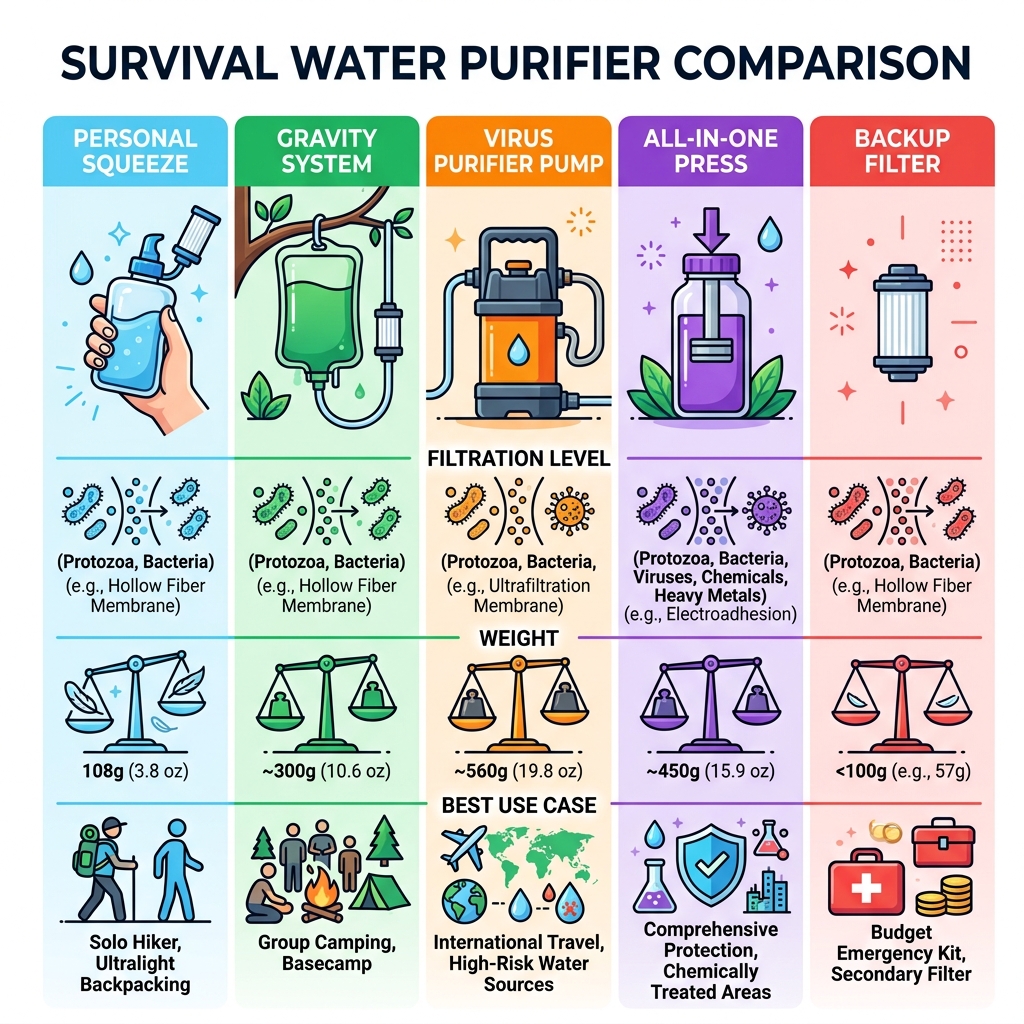
| System Type | Best For | Pros | Cons |
|---|---|---|---|
| Pump | Turbid/Dirty Water | Fast flow, self-cleaning options | Heavier, more moving parts |
| Gravity | Groups/Basecamp | Hands-free, high volume | Needs elevation to work |
| Squeeze | Solo/Ultralight | Lightweight, versatile | Can be tiring to squeeze |
| Press | Polluted Water | Removes chemicals/metals | Lower filter lifespan |
Best Survival Water Purifier for Group Use
If you’re traveling with a family or a crew of friends, pumping water for four people after an 18-mile day feels like a second job. This is where gravity systems shine.
Systems like the Platypus GravityWorks or the LifeStraw Peak Series Gravity Purifier allow you to fill a “dirty” reservoir, hang it from a tree, and let physics do the work. The LifeStraw Peak Series Gravity Purifier With Virus Removal is a standout here because it provides that critical 0.02-micron protection for the whole group.

Best Survival Water Purifier for International Travel
When you’re traveling to regions where water infrastructure is compromised or nonexistent, you need more than just pathogen removal. You need protection against heavy metals (like lead and mercury) and chemicals (like pesticides or chlorine).
The Grayl GeoPress or UltraPress systems are often considered the best survival water purifier for these scenarios. They use an electroadsorptive media and activated carbon to pull out contaminants that a standard hollow fiber filter would miss. For those who prefer the convenience of a bottle-integrated system, we’ve reviewed The Best Emergency Filtered Water Bottles For Outdoor Safety to help you narrow down your choices.
Maintenance and Managing Highly Turbid Water
One of the quickest ways to ruin the best survival water purifier is to feed it “sludge.” Highly turbid (silty or muddy) water acts like sandpaper on delicate filter membranes.
Pre-filtration and Settling
If your only water source is a silty river or a stagnant pond, don’t just stick your filter in and start pumping.
- Settling: Fill a bucket or bag and let it sit for an hour. The heavy sediment will sink to the bottom.
- Pre-filter: Use a bandana, coffee filter, or a dedicated pre-filter basket (like the one found on the LifeStraw Peak Series All in One Filter) to catch the “big stuff” before it hits your main filter.
The Power of Backflushing
Most survival purifiers require regular backflushing—the process of forcing clean water backward through the filter to dislodge trapped particles. The Sawyer Squeeze is famous for its 100,000-gallon lifespan, but that’s only achievable if you use the included syringe to backflush regularly.
The MSR Guardian takes a different approach; it is a self-cleaning pump. With every stroke, it uses 10% of the water to automatically backflush the system. This makes it arguably the most durable choice for “worst-case” water. To ensure your gear lasts for years of expeditions, read our expert tips on How To Maintain Your Filters For Longevity And Performance.
Backup Methods and Chemical Treatments
In survival, “one is none, and two is one.” Even the best survival water purifier can break, freeze, or clog. We always recommend carrying a secondary method of purification.
Chemical Treatments
Chemicals like Chlorine Dioxide (Aquamira Drops) or Iodine are ultralight and fail-proof.
- Pros: They treat the entire volume of water, including the threads of your bottle.
- Cons: They often have a “waiting period” (up to 4 hours for Cryptosporidium) and can leave a chemical aftertaste.
UV Light
Devices like the SteriPEN use UV-C light to scramble the DNA of bacteria and viruses, preventing them from reproducing. These are great for clear water but lose effectiveness in turbid water because the silt “shields” the pathogens from the light.
Boiling
The old-school gold standard. Boiling water for one minute (three minutes at high altitudes) kills everything. However, it requires fuel and time for the water to cool. Understanding the trade-offs between these methods is vital; you can learn more in our comparison of Chemical Versus Mechanical Methods Of Water Purification For Hikers.
Frequently Asked Questions about Survival Water Purifiers
Can survival water purifiers remove heavy metals and chemicals?
It depends on the technology. Standard hollow fiber filters (like the Sawyer Squeeze) do not remove chemicals or heavy metals. To remove things like lead, mercury, or pesticides, you need a purifier with an activated carbon or ion exchange stage. The LifeStraw Escape and the Grayl series are designed specifically for this purpose.
How do I know when it is time to replace my filter?
Most modern filters are designed to “fail safe.” This means that as they reach the end of their life, the flow rate will slow down until it eventually stops completely. If you find yourself pumping or squeezing for five minutes just to get a cup of water, your filter is likely clogged beyond repair and needs to be replaced.
Is it safe to let a water filter freeze?
No. This is a critical safety point. Most survival purifiers use hollow fiber membranes that contain residual water. When that water freezes, it expands into ice crystals, which can rupture the microscopic fibers.
Once a fiber is cracked, pathogens can pass through freely. If you suspect your filter has frozen, it is no longer safe to use. In cold weather, we recommend keeping your filter in a sealed bag inside your sleeping bag at night to keep it warm with your body heat.
Conclusion
Finding the best survival water purifier is about more than just reading a spec sheet—it’s about matching the tool to your environment. Whether you need the military-grade protection of an MSR Guardian, the group-friendly flow of a Platypus GravityWorks, or the “just-in-case” portability of a Sawyer Squeeze, the right choice ensures you never have to worry about what’s lurking in your bottle.
At Total Cobre, we believe that every person should have access to clean water, no matter how far off the grid they go. By understanding the difference between filters and purifiers, maintaining your gear, and always carrying a backup, you can explore the backcountry with total confidence.
