
The Fastest Way to Find the Right Portable Camping Water Filter
A portable camping water filter can be the difference between a great backcountry trip and a week spent sick from contaminated stream water. Giardia, cryptosporidium, and bacteria are invisible — and common — in even the clearest mountain streams.
Here’s a quick look at the best options by use case:
| Use Case | Best Filter Type | Top Pick |
|---|---|---|
| Solo backpacking | Squeeze filter | Sawyer Squeeze |
| Ultralight hiking | Straw filter | LifeStraw Peak Straw |
| Group camping | Gravity filter | Platypus GravityWorks |
| International travel | Purifier (0.02 micron) | MSR Guardian |
| Budget pick | Squeeze filter | Sawyer Mini |
| Emergency backup | Chemical treatment | Aquamira Drops |
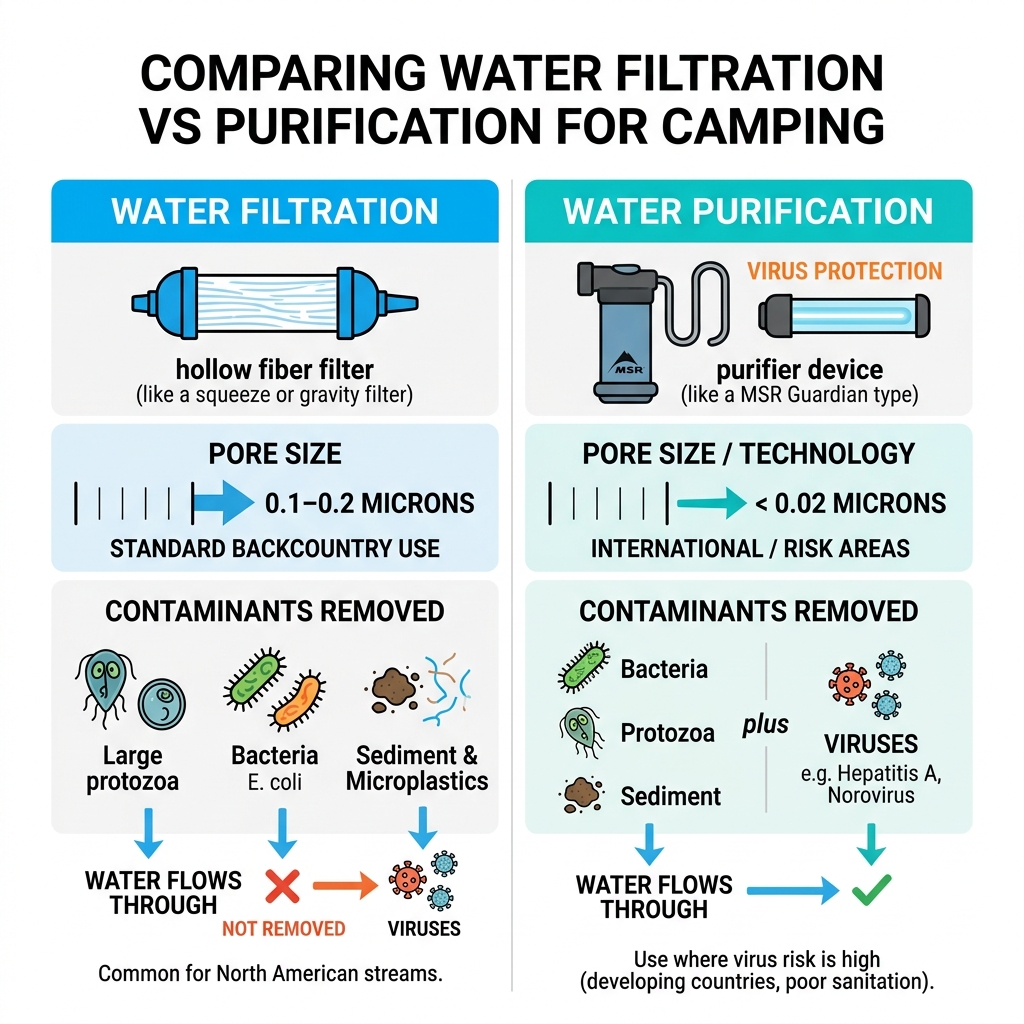
Most hikers in North America do fine with a standard hollow fiber filter (0.1–0.2 micron), which removes bacteria and protozoa. If you’re heading to developing countries or areas with poor sanitation, you’ll need a purifier that also removes viruses.
The six main filter technologies are:
- Squeeze/straw — ultralight, personal use
- Gravity — hands-free, great for groups
- Pump — reliable, works in any conditions
- UV light — fast, kills viruses, needs batteries
- Chemical treatment — lightest backup option
- Bottle filters — convenient all-in-one design
Weight, flow rate, filter lifespan, and whether you need virus protection are the four factors that matter most. The sections below break down every major option so you can pick the right one for your trip.
Understanding Different Portable Camping Water Filter Technologies
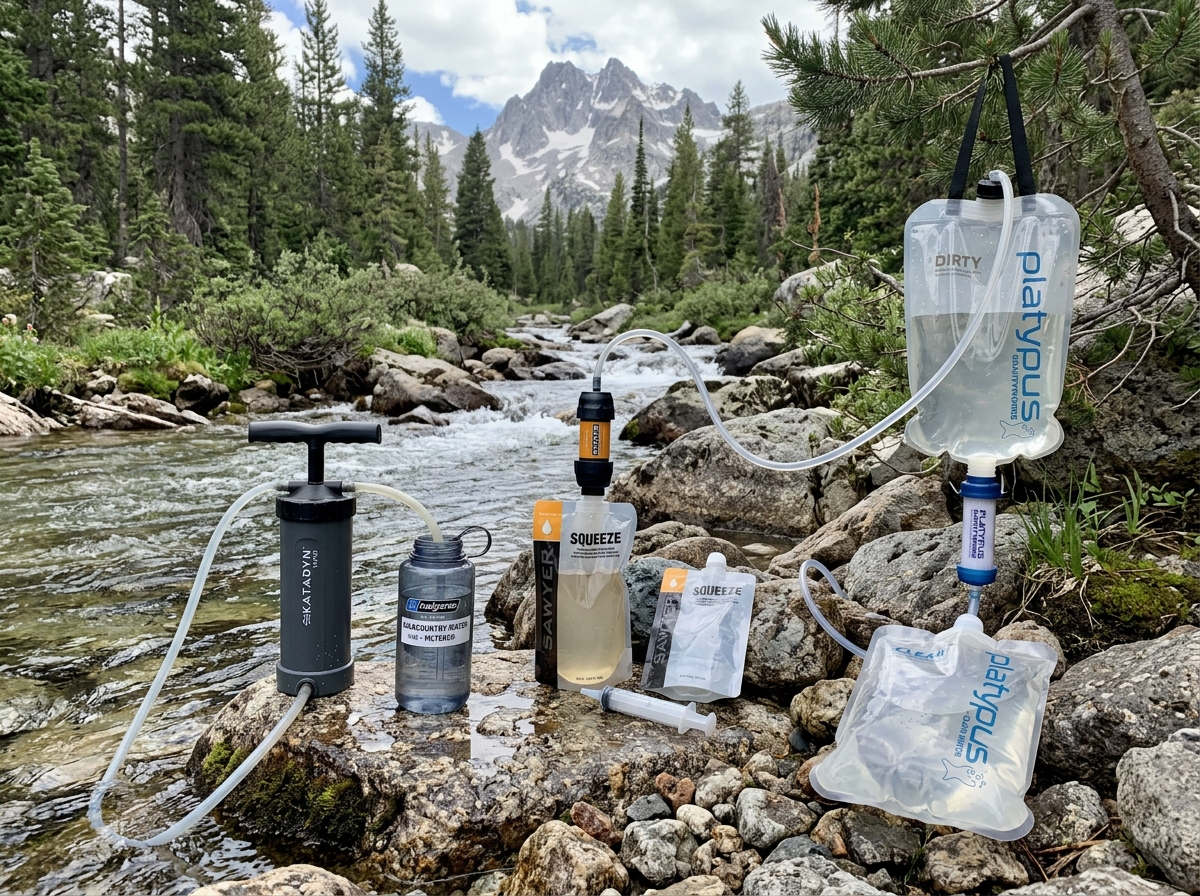
When we head into the backcountry, we aren’t just looking for water that looks clear; we are looking for water that is biologically safe. The technology inside a portable camping water filter determines exactly what gets left behind in the mud.
Most modern filters use hollow fiber membrane technology. Imagine thousands of tiny, microscopic straws bundled together. These straws have walls filled with pores so small (often 0.1 to 0.2 microns) that bacteria and protozoa simply cannot fit through. Water is pushed through the center of these fibers, leaving the “nasties” trapped on the outside.
Here is a breakdown of how these technologies vary in the field:
- Squeeze Systems: These are favorites for thru-hikers. You fill a soft pouch with “dirty” water, screw the filter onto the top, and squeeze the water into your clean bottle or directly into your mouth.
- Gravity Bags: Perfect for those of us who prefer to relax at camp rather than labor over a pump. You hang a bag of dirty water from a tree and let gravity pull it through a filter into a clean reservoir.
- Pump Filters: These use a manual hand pump to draw water through a hose and push it through a filter element. They are excellent for drawing water from shallow puddles where a bag might be hard to fill.
- UV Light: Devices like the Steripen use ultraviolet rays to scramble the DNA of pathogens, making them harmless. They don’t remove sediment, so they work best with clear water.
- Chemical Treatment: Drops or tablets (like chlorine dioxide) kill pathogens over time. They are the lightest option but often require a waiting period of 30 minutes to 4 hours.
| Filter Type | Avg. Flow Rate | Weight | Best For |
|---|---|---|---|
| Squeeze (Sawyer) | 1.7 L/min | 3 oz | Solo Hikers |
| Gravity (Platypus) | 1.75 L/min | 11.5 oz | Groups/Basecamp |
| Pump (MSR) | 2.5 L/min | 17-20 oz | Murky/Silty Water |
| Straw (LifeStraw) | 1.5 L/min | 2.3 oz | Trail Running/Emergency |
Squeeze and Straw Methods
Squeeze and straw filters have revolutionized ultralight backpacking. The Sawyer Squeeze is a legendary example, weighing just 3 ounces and offering a lifetime volume of 378,000 liters. We love these because they are versatile; you can use them as a straw, attach them to a standard water bottle, or use them inline with a hydration bladder.
The LifeStraw Peak Straw is another fantastic personal device. It’s ideal for trail runners or those hiking in water-abundant areas who don’t want to carry heavy liters on their backs. With a 0.2-micron pore size and a 4,000-liter lifespan, it’s a reliable companion for quick sips from a stream. For more details on these compact tools, check out our guide on personal water filtration devices for trails.
Gravity and Pump Systems
If you are traveling with a partner or a group, squeezing a bag 20 times a day gets old fast. This is where gravity systems like the Platypus GravityWorks shine. By simply hanging the 4L “dirty” bag above the “clean” bag, you can filter 4 liters of water in under three minutes without lifting a finger.
For those facing truly murky conditions, a pump system is often more durable. The Katadyn Hiker is a classic choice, featuring an activated carbon core that improves water taste by reducing chemicals. If you need a high-volume solution for camp, the Platypus GravityWorks performance data shows it remains one of the most efficient ways to handle group hydration.
Top portable camping water filter Models for 2026
Choosing the right model depends on where you are going and how much weight you are willing to carry. Based on our extensive testing and real-world performance data, these are the standout performers for the coming year.
Sawyer Squeeze
The Sawyer Squeeze remains the “Goldilocks” of filters. It’s light enough for solo treks but fast enough to support a small group. We’ve found that even after hundreds of miles, a simple backflush with the included syringe restores the flow rate to near-new levels. You can see the full Sawyer Squeeze field testing results to understand why it’s our top overall pick.
Katadyn BeFree
If you value speed and ease of cleaning, the Katadyn BeFree is hard to beat. It features a 0.1-micron filter integrated into a soft-sided 1L bottle. Instead of backflushing with a syringe, you simply swish the filter in clean water to dislodge debris. It boasts an incredible 2 L/min flow rate, though the filter lifespan (1,000L) is shorter than the Sawyer.
MSR Guardian
For those of us heading into truly remote or international territory, the MSR Guardian is the ultimate insurance policy. It is a purifier, not just a filter, meaning its 0.02-micron pores physically block viruses. It’s also self-cleaning, using a portion of the pumped water to flush the filter element with every stroke.
LifeStraw Peak Series
LifeStraw has updated their lineup with the Peak Series, which includes a highly durable squeeze bottle. The 1L Squeeze system is designed to be tear-resistant, addressing a common complaint with older collapsible bottles. It removes 99.999999% of bacteria and 99.999% of parasites, making it a robust choice for any trail.
Best for Solo Backpackers
For the solo hiker, every ounce counts. We typically recommend the Sawyer Squeeze or the Katadyn BeFree. The BeFree is slightly lighter at 2.3 oz, while the Sawyer offers more versatility and a longer lifespan. If you’re looking for the absolute lightest setup, the Sawyer Mini (2 oz) is an option, though we find its slower flow rate can be frustrating after a long day on the trail. Explore more options in our list of the best portable water filters for backpackers.
Best for International Travel
When traveling to areas where viral contamination is a concern (like parts of South America, Africa, or Asia), a standard microfilter isn’t enough. You need a purifier. The Grayl GeoPress is a favorite for travel because it works like a French press—simply fill the outer sleeve, press the inner bottle down, and you have clean water in seconds. It also removes heavy metals and chemicals. However, for sheer ruggedness, the MSR Guardian purifier specifications make it the gold standard for military-grade protection.
Key Factors for Choosing a portable camping water filter
Selecting a portable camping water filter isn’t just about picking the most popular brand; it’s about matching the tool to your environment. For a deeper dive, read our guide on how to choose the best portable water filter for your hiking needs.
Pore Size
Pore size is the most critical safety metric.
- 0.1 to 0.2 Microns: Standard for most backpacking filters. Effectively removes bacteria (like E. coli) and protozoa (like Giardia).
- 0.02 Microns: The standard for purifiers. This is small enough to stop viruses, which are significantly smaller than bacteria.
Flow Rate and Lifespan
There is nothing worse than being thirsty and having to wait ten minutes for a single liter of water. Look for a flow rate of at least 1.5 L/min. Additionally, consider the “lifetime” of the filter. While Sawyer claims 100,000 gallons, other high-performance filters like the BeFree may only last 1,000 liters before needing a replacement element.
Weight and Portability
For a day hike, a 1-pound pump filter is fine. For a 2,000-mile thru-hike, you’ll want something under 4 ounces. Always factor in the weight of the accessories, such as hoses, syringes, and storage bags.
Filtration Accuracy and Safety
Safety is non-negotiable. Most high-quality filters will remove 99.9999% of harmful substances. If you are filtering from sources near agricultural runoff, you may also want a filter with an activated carbon stage to reduce pesticides and improve the “earthy” taste of pond water. You can review the scientific research on membrane microfilter performance to see how these devices hold up under lab conditions.
Durability and Long-Term Value
A cheap filter that breaks on day three is the most expensive gear you’ll ever buy. Rugged designs like the Katadyn Pocket (made of heavy-duty materials) are built to last for decades. For those on a budget, look for systems with replaceable cartridges, which save money over time. We have compiled a list of top rated portable water filters for budget conscious adventurers that balance cost with reliability.
Maintenance and Backup Treatment Methods
A portable camping water filter is a precision instrument. If you don’t take care of it, it will stop taking care of you. Proper maintenance is the secret to getting that “100,000 gallon” lifespan. For more maintenance tips, see our ultimate guide to portable water filters for outdoor adventures.
Maintaining Your portable camping water filter
The biggest enemy of your filter is “bio-fouling” and sediment.
- Backflushing: Use the provided syringe to force clean water backward through the filter. This dislodges the “gunk” trapped in the fibers. We recommend doing this after every trip, or even daily if you are filtering silty water.
- Pre-filtering: If the water looks like chocolate milk, don’t put it straight into your filter. Use a bandana or a piece of pantyhose to strain out the large chunks of sand and organic matter first.
- Freezing Prevention: This is vital! If water inside the hollow fibers freezes, it expands and cracks the microscopic tubes, rendering the filter useless. If temperatures drop below freezing, keep your filter in your pocket or at the bottom of your sleeping bag.
- Replacement Parts: Always check your O-rings and hoses before a trip. For those using the Hiker series, Katadyn Hiker maintenance kits are essential for keeping your pump in top shape.
Essential Backup Purification
Even the best gear can fail. A bag can rip, or a filter can clog beyond repair. We always carry a backup chemical treatment.
- Aquamira: A two-part chlorine dioxide liquid that is highly effective and leaves very little aftertaste.
- Katadyn Micropur Tablets: These are the lightest backup possible—just a few tablets in your first aid kit. They take 4 hours to kill Cryptosporidium but are foolproof. For more on these “plan B” options, check the Aquamira water treatment details.
Frequently Asked Questions about Backcountry Filtration
Does a standard filter remove viruses?
No. Most standard backpacking filters have a pore size of 0.1 to 0.2 microns. Viruses are much smaller (0.02 to 0.3 microns). In North America, the risk of waterborne viruses in the backcountry is generally low, but if you are traveling internationally or hiking in areas with high human feces contamination, you should use a purifier like the MSR Guardian or Grayl GeoPress.
How do I prevent my filter from freezing?
The best way is to keep it against your body. During the day, keep the filter in a jacket pocket. At night, tuck it into a small dry bag and put it inside your sleeping bag. If you suspect your filter has frozen, it is no longer safe to use, as you cannot visually inspect the internal fibers for cracks.
When should I replace my filter cartridge?
Most filters will tell you when they are done by simply stopping. As the pores become permanently clogged with minerals and fine silt, the flow rate will drop until you can no longer push water through it. For filters with a set lifespan (like the Katadyn BeFree’s 1,000L), it’s a good idea to track your usage or replace it once the flow significantly slows down even after cleaning.
Conclusion
At Total Cobre, we believe that clean water is the foundation of every successful adventure. Whether you are a solo thru-hiker looking for the ultralight efficiency of a Sawyer Squeeze or a group leader relying on a Platypus GravityWorks system, choosing the right portable camping water filter is about understanding your needs and the environment you’re exploring.
Don’t let a microscopic pathogen cut your trip short. Invest in a quality filtration system, maintain it with care, and always carry a backup. Ready to gear up for your next trek? Explore more at Total Cobre for the latest reviews and specialized guides for adventurous hikers. Stay hydrated and see you on the trail!
