
Introduction
When we talk about an “epic” journey, we usually picture sun-drenched ridgelines and triumphant summit photos. We rarely picture the less-glamorous reality: crouching over a silty puddle at dusk, praying your filter doesn’t clog before you finish your second liter. This is where your thru-hike water filter choice becomes the most important gear decision you’ll make.
The primary goal of any filtration system is Giardia prevention and protozoa removal. Most modern filters utilize hollow fiber technology. Imagine thousands of tiny, straw-like tubes with microscopic pores. These pores are typically 0.1 to 0.2 microns in size—small enough to allow water molecules through while trapping bacteria and protozoa like a microscopic bouncer at a club.

Essential Factors for Your Thru-Hike Water Filter Choice
Choosing a filter for a weekend is easy; choosing one for a 2,000-mile trek requires a deeper look at the mechanics of trail life. You need to balance the physical effort of filtration against the weight you’re carrying on your back.
| Filter Type | Best Use Case | Flow Rate | Weight | Pros | Cons |
|---|---|---|---|---|---|
| Squeeze | Solo/Duo Thru-hike | Fast (1.7L/min) | 2-3 oz | Ultralight, versatile | Requires hand strength |
| Gravity | Groups/Basecamp | Medium (1.5L/min) | 10-12 oz | Hands-free, easy | Bulkier, heavier |
| Pump | Silty/Cold Water | Fast (2.5L/min) | 16-20 oz | Durable, handles silt | Heavy, mechanical parts |
In PNW conditions, the challenges shift. You aren’t just dealing with clear springs; you’re often facing silty water or “glacial flour”-fine rock particles suspended in meltwater that can cement a filter shut in seconds. Understanding these environmental factors is vital for any best-portable-water-filters-for-hiking strategy, especially when considering CDC guidance on backcountry water treatment.
Balancing Weight and Flow in Your Thru-Hike Water Filter Choice
For the ultralight community, every ounce is a mile-killer. However, a filter that weighs one ounce but takes twenty minutes to process a liter is a different kind of burden. We generally recommend the “1L per 5 miles” rule as a baseline for carrying capacity, though this fluctuates wildly based on heat and elevation.
A squeeze filter is the gold standard for solo hikers because it allows you to filter and move. You fill a pouch, screw on the filter, and drink directly or squeeze into a clean bottle. Gravity systems, while heavier, allow you to hang a bag and perform camp chores while physics does the work. If you are looking for more details on matching a filter to your specific mileage goals, check out our guide on how-to-choose-the-best-portable-water-filter-for-your-hiking-needs.
Long-Term Durability and Thru-Hike Water Filter Choice
A filter’s “lifespan” is often a marketing figure, but for thru-hikers, it represents a real-world deadline. The Sawyer Squeeze, for instance, boasts a million-gallon lifespan. While you likely won’t drink a million gallons, that rating points to incredible clogging resistance.
Field maintainability is the true test of durability. Can you fix it when it stops flowing? Most hollow fiber filters can be backflushed-forcing clean water backward through the membrane to pop out the “gunk.” Without this ability, a filter is essentially disposable, which is the last thing you want in the middle of a wilderness section.
Top-Rated Hollow Fiber Filters for Thru-Hikers
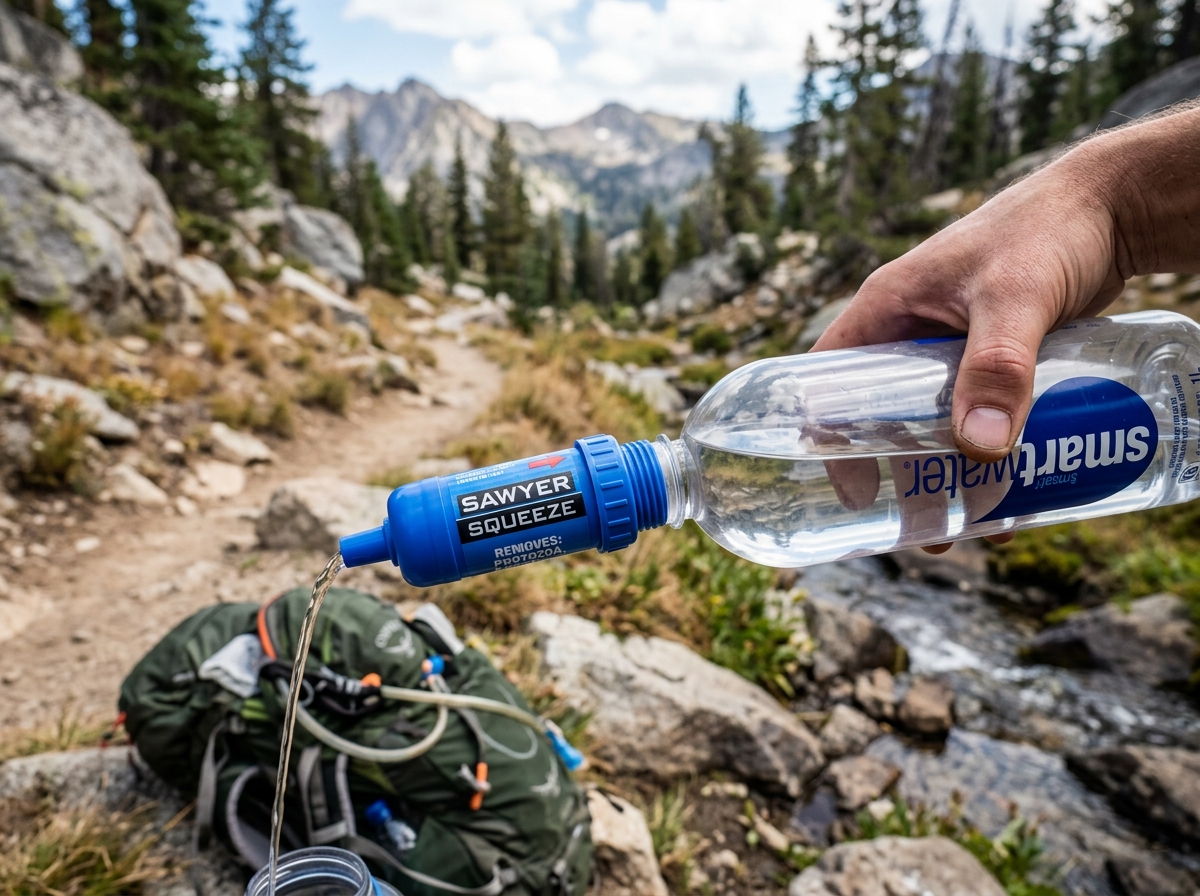
Sawyer Squeeze
The undisputed king of the trail. With a 100,000-gallon guarantee (and often cited as lasting “forever” with proper care), the Sawyer Squeeze has been used for approximately 5,000 miles by individual thru-hikers on the PCT and CDT. It is nearly indestructible. We recommend ditching the included bags and pairing it with a 28mm CNOC Vecto bladder or a standard Smartwater bottle for better durability.
Platypus QuickDraw
A newer contender that has quickly gained a following. It offers a blistering 3L/min flow rate and features a “dual-thread” design that fits both narrow-mouth and wide-mouth bottles. Thru-hikers have put over 4,000 miles on these, praising the ability to perform an “integrity test” in the field to check if the filter has been damaged by a drop or a freeze.
Katadyn BeFree
The BeFree is the “sports car” of filters—fast and sleek but a bit temperamental. It uses a 42mm thread, meaning it only works with specific Hydrapak flasks. While it offers a 2L/min flow rate initially, it is known to clog faster than the Sawyer in silty conditions. It’s a top choice for clear-water regions like the High Sierra but requires careful cleaning.
LifeStraw Peak Squeeze
The Peak series is built for those who are hard on their gear. It has a projected lifespan of 2,000 liters, which is double that of many competitors. Its soft bottle is notably tear-resistant, addressing a common complaint with collapsible systems. For more comparisons, see our list of the best-portable-water-filters-for-backpackers.
Maintenance and Reliability on Long-Distance Trails
Maintenance isn’t just a chore; it’s a survival skill. On a multi-week trek, your flow rate will drop. Backflushing frequency should be high—we suggest doing it every few days, or every time you filter from a “questionable” source.
The Deep Clean
If backflushing with a syringe doesn’t restore your flow, you might have calcium buildup. A vinegar soak—letting the filter sit in a bowl of warm water and white vinegar for 30 minutes—can decalcify the fibers and restore that “like new” flow.
Integrity and Freezing
Hollow fiber filters have one Achilles’ heel: ice. If water stays inside the fibers and freezes, it expands and cracks the tubes. This damage is invisible, meaning you could be drinking “filtered” water that is actually bypassing the membrane entirely. Always perform an integrity test (usually by trying to blow air through the wet filter) if you suspect a freeze. To learn more about keeping your gear in top shape, visit top-features-to-look-for-in-portable-water-filters-for-hiking.
Advanced Purifiers and Chemical Backups
Sometimes a standard filter isn’t enough. If you’re hiking in areas with heavy human impact, livestock, or international locations, you need to step up to a purifier.
- MSR Guardian: This is the “tank” of the water world. It utilizes 0.02-micron filtration, which is small enough to remove viruses. It is self-cleaning, meaning every pump stroke backflushes the system. It’s heavy (17.3 oz) but virtually fail-proof in the worst sludge.
- Grayl GeoPress: This “press” style bottle uses electro-adsorption to remove heavy metals, chemicals, and viruses. It’s perfect for international thru-hikes or areas with known industrial runoff.
The Power of Redundancy
No matter your primary thru-hike water filter choice, you must carry a chemical backup.
- Aquamira Drops: A two-part chlorine dioxide treatment. It’s lightweight, has no nasty iodine taste, and kills viruses that filters can’t.
- Micropur Tablets: Foolproof and lightweight. Just drop a tab in and wait.
Chemicals are your insurance policy. If your filter freezes or the housing cracks, these drops will keep you on the trail. For a deeper dive into these advanced systems, see our article on evaluating-the-best-lightweight-water-purifiers-for-hiking.
Frequently Asked Questions about Thru-Hiking Water Filters
How do I prevent my water filter from freezing?
This is the most common cause of filter failure. If the temperature is expected to drop below 32°F (0°C), you must keep your filter warm. The most effective method is “sleeping with your filter”—tuck it into a Ziploc bag and keep it at the bottom of your sleeping bag. During the day, keep it in an internal jacket pocket where your body heat can protect it. If it does freeze, do not trust it; switch to your chemical backup immediately.
What is the best water filter for silty PNW water?
Glacial silt is the enemy of the hollow fiber. If you must filter from a silty source, use a pre-filtration method. Wrap a bandana or a coffee filter around your “dirty” intake to catch the larger particles. For those who frequently encounter “liquid dirt,” a self-cleaning pump like the MSR Guardian is the gold standard, as it prevents the silt from ever settling into the membrane.
Should I choose a squeeze or gravity filter for a solo thru-hike?
For solo efficiency, the squeeze filter (like the Sawyer Squeeze) is usually the winner. It’s lighter and allows you to filter exactly what you need when you need it. However, if you prefer a “luxury” camp experience where you can set up your tent while your water filters itself, a gravity setup is worth the extra few ounces. Many squeeze filters can actually be converted into gravity systems with a few extra bits of tubing, giving you the best of both worlds.
Conclusion
At Total Cobre, we believe that gear reliability is the foundation of every great adventure. Your thru-hike water filter choice isn’t just about avoiding a stomach ache; it’s about the peace of mind that comes from knowing you can turn a muddy puddle into life-sustaining hydration.
Whether you choose the workhorse Sawyer Squeeze or the lightning-fast Platypus QuickDraw, a filter is only as good as the maintenance you provide. Clean it often, protect it from the cold, and always have a backup plan. Safe hydration is the key to finishing your journey strong. For more expert tips, check out our ultimate-guide-to-portable-water-filters-for-outdoor-adventures.
