
Clean Water on the Trail: Why Choosing the Right Purifier Could Save Your Life
The top portable water purifiers for hikers in 2026 are:
| Rank | Purifier | Best For | Weight | Virus Protection |
|---|---|---|---|---|
| 1 | Sawyer Squeeze | Best overall / backpacking | 3 oz | No |
| 2 | MSR Guardian | International travel / expeditions | 17.3 oz | Yes |
| 3 | Katadyn BeFree | Ultralight / solo hiking | 2.3 oz | No |
| 4 | LifeStraw Peak Straw | Budget / ultralight | 1.7 oz | No |
| 5 | GRAYL GeoPress | All-in-one / travel | ~10 oz | Yes |
Every minute, one million single-use plastic bottles are purchased worldwide. That’s over 480 billion per year — and each one takes at least 450 years to break down in a landfill.
For hikers, there’s a smarter way.
A good portable water purifier means you can drink safely from mountain streams, reduce plastic waste, and move lighter through the backcountry. But with dozens of options on the market, picking the right one isn’t simple.
Here’s the core problem: not all purifiers do the same job. Some only filter bacteria and parasites. Others also remove viruses — which matters a lot if you’re traveling internationally or drinking from heavily used water sources. And 2.2 billion people worldwide still lack access to safe drinking water, a reminder that the risk of contamination is very real, even in places that seem clean.
The wrong choice could leave you sick on day two of a five-day trek. The right one disappears into your pack and works every time you need it.
This guide breaks down the best options by use case — solo hikers, group campers, international travelers, and budget-conscious adventurers — so you can make a confident call before your next trip.

Understanding the Difference: Water Filters vs. Water Purifiers
When we talk about the top portable water purifier, we first need to clear up a common misconception: the difference between a “filter” and a “purifier.” In the outdoor industry, these terms aren’t interchangeable. They refer to the specific size of the “bad guys” they can stop.
Water Filters: The Bacteria and Protozoa Blockers
Most standard backpacking filters, like the Sawyer Squeeze or Katadyn BeFree, use hollow fiber technology. These fibers have tiny pores, usually around 0.1 to 0.2 microns in size. This is small enough to physically block:
- Bacteria: Such as E. coli and Salmonella.
- Protozoa (Cysts): Like Giardia and Cryptosporidium.
For the vast majority of hiking in the United States and Canada, a high-quality filter is all you need. Most backcountry water issues come from animal or human feces (yes, it’s gross), and filters handle those pathogens perfectly.
Water Purifiers: The Virus Killers
Viruses, such as Norovirus and Rotavirus, are significantly smaller than bacteria—often ranging from 0.02 to 0.4 microns. A standard 0.1-micron filter is like a chain-link fence trying to stop a mosquito; the virus just slips right through.
According to Scientific research on waterborne contaminants, a device must meet stricter EPA standards to be labeled a “purifier.” It must remove:
- 99.9999% of bacteria
- 99.9% of protozoa
- 99.99% of viruses
If you are traveling to developing countries, hiking in areas with high human traffic and poor sanitation, or dealing with floodwaters, you need a purifier. These systems use ultrafiltration (with pores as small as 0.02 microns), UV light (like the Steripen), or chemical treatments to neutralize those tiny viral threats.
Key Features of the Top Portable Water Purifier
Choosing a system isn’t just about safety; it’s about how that system fits into your hiking style. We look at four main metrics: weight, flow rate, lifespan, and ease of use.
Weight and Packability
For solo hikers and thru-hikers, every ounce matters. A system like the Katadyn BeFree weighs only 2.3 oz, while a heavy-duty pump like the MSR Guardian weighs over 17 oz. If you’re crushing 20-mile days, you’ll want the lighter option.
Flow Rate: How Fast Can You Drink?
There is nothing worse than being exhausted at a stream and having to spend 20 minutes squeezing a clogged filter. A good flow rate is typically around 1.5 to 2 liters per minute. The Katadyn BeFree is a champion here, though its flow can drop if not cleaned properly.
Lifespan: Cost Per Liter
The upfront price can be deceiving. The Sawyer Squeeze costs around $46 and is rated for 378,000 liters—essentially a lifetime of water. In contrast, some bottle-based purifiers require replacement cartridges every 250 liters, which can get expensive over time.
| Feature | Sawyer Squeeze | MSR Guardian | Katadyn BeFree |
|---|---|---|---|
| Weight | 3 oz | 17.3 oz | 2.3 oz |
| Flow Rate | 1.7 L/min | 2.5 L/min | 2.0 L/min |
| Lifespan | 378,000 L | 10,000 L | 1,000 L |
| Protection | Bacteria/Protozoa | Bacteria/Protozoa/Viruses | Bacteria/Protozoa |
For a deeper dive into how these systems integrate into your pack, check out More info about backcountry filter systems.
Best Portable Water Purifiers for Every Adventure
Different trips require different tools. A solo trail runner has very different needs than a scout leader responsible for ten hungry, thirsty teenagers.
Group Camping and Basecamps
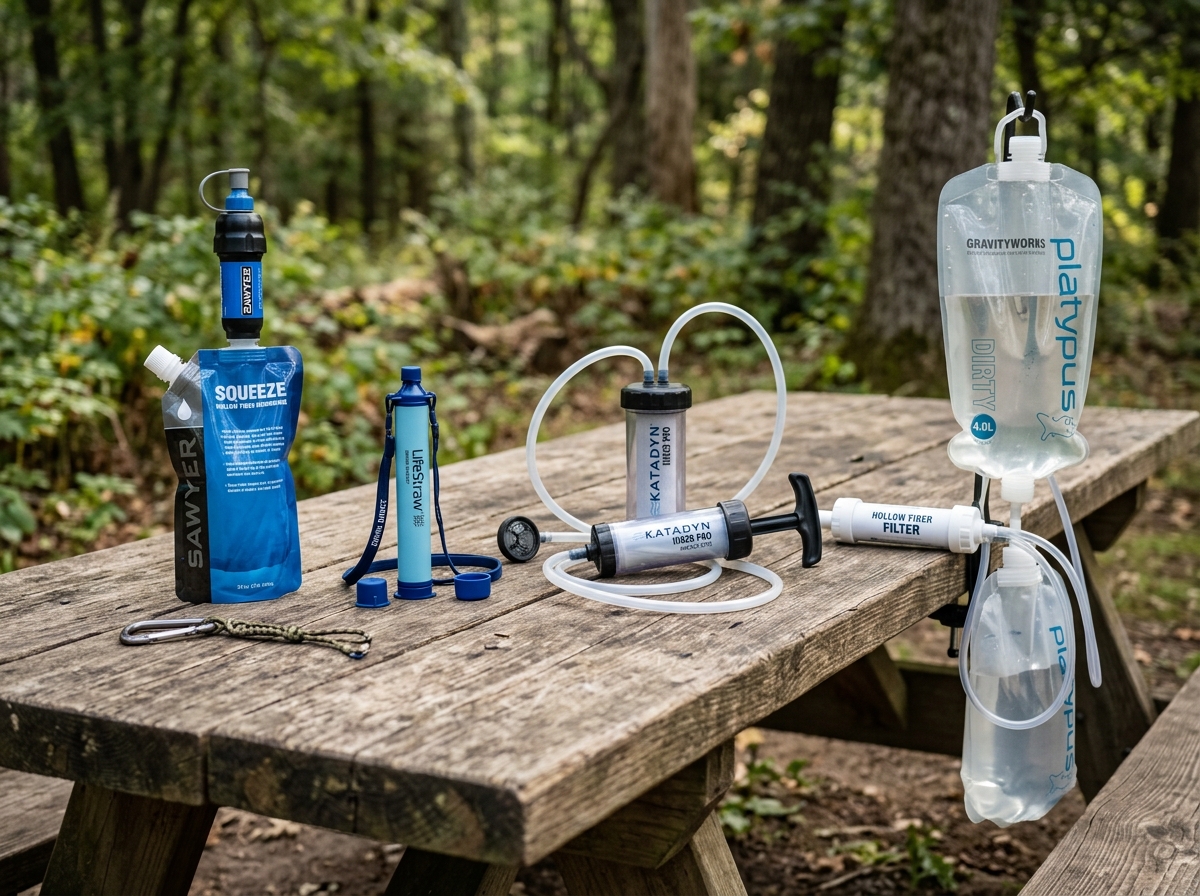
If you are stationary or traveling in a large group, gravity filters are the way to go. You fill a “dirty” bag, hang it from a tree, and let physics do the work while you set up your tent. Systems like the Platypus GravityWorks can filter 4 liters in minutes without any pumping or squeezing. You can find More info about gravity systems to see if this hands-free approach fits your next group outing.
Handling Silty or Murky Water
Murky water is the “filter killer.” Tiny particles of silt and glacial flour can clog a hollow fiber filter in seconds. The MSR Guardian is a standout here because it features a self-cleaning mechanism that backflushes the filter with every pump stroke. If you’re drinking from the Colorado River or a muddy puddle, this is the top portable water purifier for the job.
Improving Taste with Activated Carbon
Standard filters remove pathogens but don’t always remove chemicals or bad tastes. If you’re drinking from a pond that tastes like “swamp,” look for a system with an activated carbon stage. The GRAYL GeoPress and certain LifeStraw models use carbon to reduce chlorine, heavy metals, and odors, making that funky pond water taste like it came from a tap.
Best Overall Top Portable Water Purifier for Backpacking: Sawyer Squeeze
The Sawyer Squeeze has earned its legendary status on the Triple Crown trails (the PCT, AT, and CDT). We’ve seen hikers use these for over 8,000 miles of trail use with consistent results.
Why we love it:
- Versatility: You can use it as a squeeze filter with the included bags, screw it onto a standard SmartWater bottle, or even use it inline on a hydration bladder.
- Longevity: With a 378,000-liter rating and a 0.1-micron pore size, it’s a one-time purchase for most people.
- Simplicity: No moving parts to break.
The only real “con” is that the included bags can occasionally fail under high pressure, so many hikers choose to pair the filter with a more durable third-party bladder or a standard plastic soda bottle.
Best Top Portable Water Purifier for International Travel: MSR Guardian
When your health depends on removing every possible threat, including viruses, the MSR Guardian is the gold standard. Originally designed for the military, it meets the rigorous NSF P248 standard.
Key Advantages:
- Full Protection: Physically removes viruses (0.02 microns) without chemicals or batteries.
- Self-Cleaning: It never clogs, even in the “chunkiest” water.
- Speed: It pumps 2.5 liters per minute, which is incredibly fast for a purifier.
As noted in Scientific research on international water safety, tap water in many regions can be rife with viruses. The Guardian eliminates the need to buy plastic bottles in foreign cities, saving you money and protecting the environment.
Top Ultralight and Budget Options: Katadyn BeFree and LifeStraw Peak
For those who want to move fast or are watching their wallet, there are excellent options under $50.
Katadyn BeFree: This is our favorite for trail runners. It consists of a 0.1-micron filter integrated into a soft, collapsible flask. You fill the flask, screw on the cap, and drink directly from the nozzle. It is incredibly easy to clean in the field—just shake the filter in the water to dislodge debris.
LifeStraw Peak Straw: The updated Peak Series straw is a great emergency backup or budget primary tool. It’s rated for 4,000 liters and removes 99.999999% of bacteria. At only 2.3 oz, it’s a no-brainer for a day hike “just in case” kit.
Maintenance and Backup Strategies for the Trail
Even the top portable water purifier will fail if you don’t take care of it. Maintenance is the difference between a successful trip and a long, thirsty walk back to the trailhead.
The Art of the Backflush
Hollow fiber filters (Sawyer, LifeStraw, Platypus) eventually slow down as sediment builds up. Most come with a cleaning syringe. We recommend backflushing your filter after every trip—or even daily if the water is silty. For the Katadyn BeFree, you “swish” it in clean water rather than using a syringe.
The “Sleeping Bag” Rule
This is critical: Never let your hollow fiber filter freeze. If water is inside the fibers and it freezes, the ice expands and cracks the microscopic tubes. This creates a hole that pathogens can pass through, but you won’t be able to see the damage. If the temperature is going to drop below freezing, put your filter in a waterproof bag and tuck it into your sleeping bag with you at night.
Pre-Filtering and the Bandana Method
If you have to draw water from a very murky source, don’t just stick your filter in. Use a pre-filter like a bandana, coffee filter, or even a piece of pantyhose to strain out the large “floaties” like leaves, algae, and sand. This prevents your main filter from clogging prematurely.
Always Carry a Backup
Mechanical things break. Bags leak, O-rings get lost, and filters freeze. We always carry a small pack of chemical treatment tablets as a “Plan B.”
More info about purification tablets explains that chlorine dioxide is the most effective chemical option. While it takes about 30 minutes to kill bacteria and up to 4 hours for Cryptosporidium, it is lightweight and foolproof. According to Scientific research on water disinfection, boiling water for one minute is the only 100% effective way to kill all pathogens if your equipment fails.
For those who like to customize their gear, you can find More info about DIY hydration setups to see how to build a system that works for you.
Frequently Asked Questions about Water Purification
Can filters remove microplastics and improve taste?
Yes, most modern 0.1-micron filters (like the LifeStraw Peak and Sawyer Squeeze) are highly effective at removing microplastics. However, to improve taste or remove chemicals (like pesticides or chlorine), you generally need a filter that includes an activated carbon stage. Carbon adsorbs the molecules that cause bad odors and flavors.
How do I prevent my filter from breaking in freezing temperatures?
As mentioned, keeping the filter close to your body is the best method. If you suspect your filter has frozen, do not trust it. Some manufacturers, like MSR, have integrity tests you can perform, but for most “squeeze” style filters, it is safer to replace the unit if it has been exposed to a hard freeze.
What is the most effective backup if my primary filter clogs?
If backflushing doesn’t restore the flow, your best backup is chemical treatment (like Aquamira drops or Micropur tablets) or boiling. Always carry a small “emergency kit” that doesn’t rely on mechanical parts.
Conclusion
At Total Cobre, we believe that every hiker deserves access to clean, safe water without contributing to the global plastic crisis. Whether you are looking for the ultralight convenience of a Katadyn BeFree for your next trail run or the military-grade security of an MSR Guardian for an expedition through South America, choosing the top portable water purifier is about matching the tool to the terrain.
Stay safe, stay hydrated, and keep our trails beautiful by ditching the single-use bottles. For more specialized guides on clean water solutions and outdoor gear, Explore more outdoor gear guides and prepare for your next adventure with confidence.
