
The Quickest Way to Never Get Giardia on the Trail
Purifying water while backpacking is essential for staying healthy in the backcountry. Here are the four main methods you can use:
- Filtration – Push water through a hollow-fiber membrane to remove protozoa and bacteria (e.g., Sawyer Squeeze, Katadyn BeFree)
- Chemical disinfection – Use chlorine dioxide drops or tablets to kill bacteria, viruses, and most protozoa (e.g., Aquamira)
- UV light – Scramble pathogen DNA with a UV pen to prevent reproduction (e.g., SteriPen)
- Boiling – Bring water to a rolling boil for 1 minute (3 minutes above 6,500 ft) to kill all pathogens
Quick answer: For most North American trips, a hollow-fiber filter like the Sawyer Squeeze paired with chlorine dioxide drops gives you the broadest protection at a low weight penalty. For international travel, choose a method that also neutralizes viruses.
That clear, cold stream winding through the mountains looks perfect. But looks can be deceiving.
Research shows that between 1-in-5 and 1-in-10 tested backcountry water sources harbor disease-causing pathogens — even the ones that look pristine. And it doesn’t take much. Ingesting as few as 10 microorganisms is enough to trigger diarrhea, cramps, and the kind of dehydration that can turn a great trip into a miserable one.
The problem isn’t just that the water looks clean. Animals, other hikers, and even asymptomatic carriers who show no symptoms themselves can contaminate a water source upstream without you ever knowing it.
This guide cuts through the noise. You’ll learn exactly which purification methods work, what pathogens each one targets, and how to choose the right system for your trip — whether you’re a solo ultralight hiker or leading a group through the wilderness.
Why Purifying Water While Backpacking is Non-Negotiable
We have all heard the “old-timer” stories—the hikers who claim they’ve been drinking straight from mountain springs for thirty years and never felt a tickle in their tummy. While we don’t doubt their luck, the science tells a much riskier story. In the outdoor community, we call these “gut-seeking microbes,” and they don’t care how beautiful the scenery is.
The reality is that Common Waterborne Pathogens Hikers Should Know are present in almost every ecosystem where animals or humans travel. Even if a stream looks untouched, a decomposing deer a half-mile upstream or a poorly placed “cathole” from a previous camper can flood that water with invisible threats.
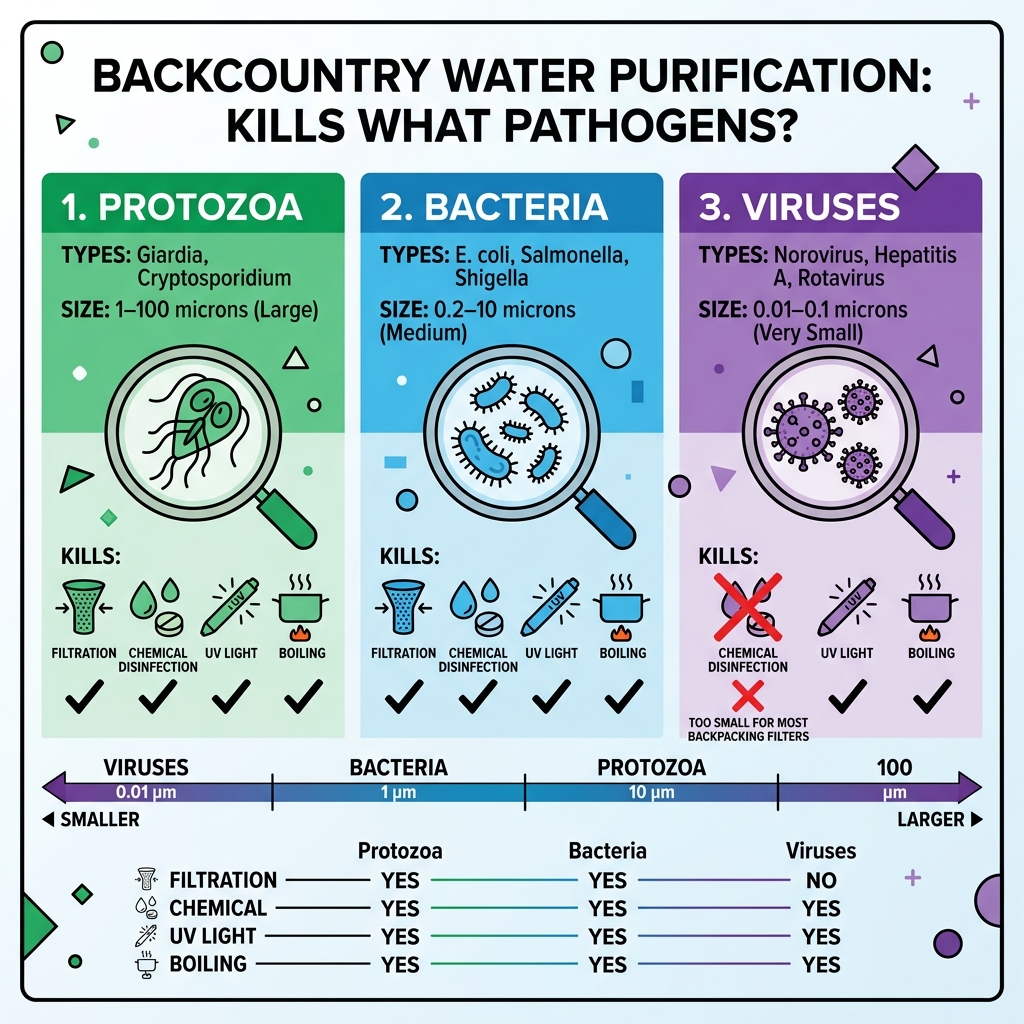
According to the CDC’s Guide to Drinking Water Treatment and Sanitation for Backcountry and Travel Use, there are three main categories of pathogens we worry about:
- Protozoa (e.g., Giardia and Cryptosporidium): These are the “big guys” of the microscopic world (about 1–10 microns). They have hard outer shells (cysts) that make them very resistant to some chemicals like chlorine or iodine.
- Bacteria (e.g., E. coli, Salmonella): These are mid-sized microbes. They are often responsible for the most immediate and violent gastrointestinal illnesses.
- Viruses (e.g., Norovirus, Hepatitis A): These are tiny—so small they pass right through most standard filters. While less common in deep North American wilderness, they are a major concern in areas with high human traffic or poor sanitation.
One of the scariest parts of backcountry hygiene is the concept of the asymptomatic carrier. Someone might feel perfectly fine but still be shedding millions of pathogens into the environment. Because the infectious dose for something like Giardia is as low as 10 cysts, a single lapse in judgment can lead to a trip-ending illness.
Comparing Primary Methods for Purifying Water While Backpacking
Choosing a method for purifying water while backpacking usually involves balancing weight, speed, and effectiveness. No single method is perfect for every scenario, which is why we often recommend Comparing Chemical and Mechanical Water Purification Methods for Outdoor Use before you buy your gear.
| Method | Targets | Wait Time | Pros | Cons |
|---|---|---|---|---|
| Filtration | Protozoa, Bacteria | Instant | Removes sediment; no taste | Doesn’t kill viruses; can freeze |
| Chemicals | All (mostly) | 15–30 min | Lightweight; kills viruses | Chemical taste; long wait for Crypto |
| UV Light | All | 90 seconds | Fast; kills viruses | Needs clear water; battery-dependent |
| Boiling | All | 1–3 mins | 100% effective | Uses fuel; water stays hot |
Mechanical Filtration and How Personal Water Filtration Actually Works
Most modern backpackers reach for a hollow-fiber filter first. But How Personal Water Filtration Actually Works is quite fascinating. Imagine thousands of tiny, hollow “straws” bundled together. These straws have microscopic pores—usually around 0.1 to 0.2 microns in size.
When you squeeze or pump water through these fibers, the water molecules pass through, but the much larger protozoa and bacteria get physically stuck on the outside. This mechanical barrier is incredibly effective at removing the “chunks” (sediment) and the most common North American pathogens. However, because viruses are often smaller than 0.1 microns, they can slip through the pores. This is why a “filter” is technically different from a “purifier.”
Chemical Disinfection and Purifying Water While Backpacking with Chlorine Dioxide
If you want to move into the “purifier” category without carrying a heavy pump, chemicals are your best friend. While iodine was the standard for decades, it has a nasty taste and isn’t effective against Cryptosporidium.
Modern hikers prefer Chlorine Dioxide. This is the same stuff used in municipal water plants. When you follow a Step-by-Step Guide to Using Water Purification Tablets or drops (like Aquamira), you are using an oxidant that kills viruses and bacteria quite quickly.
The catch? Contact time. While most bacteria die within 15 minutes, the resilient Cryptosporidium can require a dwell-time of up to four hours to be fully neutralized. For this reason, many of us use a “combo” strategy: filter the water to get the big stuff and protozoa out instantly, then add a chemical drop to kill any lingering viruses while we hike.
Advanced Strategies for Safe Water Collection and Storage
Even the best filter in the world will struggle if you feed it liquid mud. Being smart about where you get your water is the first step in purifying water while backpacking effectively.
We always suggest looking for the highest, cleanest source possible. According to Essential Tips for Finding Safe Water Sources While Hiking, you should prioritize:
- Flowing water: Streams and rivers are generally better than stagnant ponds.
- High-elevation sources: The closer you are to the headwaters (like a spring gushing from a rock), the less time there has been for contamination.
- Deep water: If you must use a lake, reach out past the shore where microorganisms tend to congregate in the warm, shallow edges.
If you are stuck with a silty or “chunky” source, use a pre-filter. Straining water through a bandana or a coffee filter removes the large grit that would otherwise clog your expensive hollow-fiber membrane in seconds. As the National Park Service notes, managing turbidity isn’t just about taste; it makes your chemical or UV treatments significantly more effective.
Preventing Cross-Contamination and Maintaining Your System
One of the most common ways hikers get sick isn’t actually from the water—it’s from their own hands. If you handle a “dirty” water bag and then touch your “clean” water bottle or your sandwich, you’ve just bypassed your expensive filter.
Learning How to Prevent Cross-Contamination in Your Water Filters is vital. We recommend:
- Labeling vessels: Mark one bottle “Dirty” and one “Clean.”
- Hand Hygiene: Use a 60% alcohol hand sanitizer after every water collection session.
- The “Clean End” Rule: Never let the output nozzle of your filter touch the ground or your dirty collection bag.
Maintenance is equally important. Over time, those tiny hollow fibers get clogged with biofilm and silt. Regular backflushing—using a syringe to push clean water backward through the filter—is the key to How to Maintain Your Filters for Longevity and Performance. A Sawyer Squeeze, for instance, can last for hundreds of thousands of liters if you backflush it faithfully.
Finally, keep your gear safe from the elements. A single night of freezing temperatures can ruin a hollow-fiber filter. When water turns to ice inside those fibers, it expands and cracks the membrane, creating invisible holes that pathogens can swim through. If it’s going to be a cold night, sleep with your filter in your sleeping bag!
Choosing the Right System for Your Trip Profile
There is no “best” filter, only the best filter for the job.
- The Solo Ultralight Hiker: You want something like the Sawyer Squeeze or Katadyn BeFree. These are light (2–3 oz) and allow you to drink directly from the source or a soft bottle. Check out our Ounce-Counting for Clean Water: The Ultimate Ultralight Comparison to see how the top models stack up.
- The Group Leader: Pumping water for four people is a workout you don’t need. Gravity-Fed Water Filters: The Perfect Solution for Group Camping Trips allow you to hang a large bag of dirty water from a tree and let physics do the work while you set up camp.
- The International Traveler: If you are heading to a region where Hepatitis A or Norovirus are prevalent, a standard filter isn’t enough. You need a purifier like the MSR Guardian or a combination of filtration and chemical treatment to ensure those tiny viruses are neutralized.
Frequently Asked Questions about Backcountry Water
Is household bleach safe for purifying water while backpacking?
Yes, in an emergency, ordinary unscented household bleach (sodium hypochlorite) can be used. The EPA recommendation is generally two drops of bleach per liter of clear water, let sit for 30 minutes. While it is excellent at killing viruses and bacteria, it is less effective against Giardia than chlorine dioxide and does nothing for Cryptosporidium. It’s a great “Plan C,” but shouldn’t be your primary method. For more on this, see our Emergency Water Safety Tips Every Hiker Should Know.
How long do I need to boil water at high altitudes?
Boiling is the “gold standard” because it kills everything. At sea level, a rolling boil for one minute is plenty. However, as you go higher, water boils at a lower temperature. If you are above 6,500 feet, you must maintain that rolling boil for three minutes to ensure all pathogens are dead. That this consumes a lot of fuel, so it’s usually best reserved for Safe Methods for Filtering River Water While Hiking when your filter fails.
Will freezing temperatures ruin my water filter?
Absolutely. This is the “silent killer” of water filters. Because the damage is microscopic, you won’t see a crack on the outside of the casing, but the filter is no longer safe. If you suspect your filter has frozen, it’s time to replace it. Always practice Protecting Water Filters from Freezing During Winter Hikes by keeping the filter in an interior jacket pocket or at the bottom of your quilt.
Conclusion
At Total Cobre, we believe that the best adventure is one where you come home healthy. Purifying water while backpacking is a skill that combines the right gear with the right habits. By choosing a reliable system, maintaining it properly, and avoiding cross-contamination, you can enjoy those mountain streams with total peace of mind.
Remember to always follow Leave No Trace principles: dispose of waste at least 200 feet from water sources to keep the wilderness pristine for the next hiker. For more Safe Hydration Practices Every Backpacker Should Adopt or to find your next piece of gear, check out our More info about outdoor gear reviews.
Happy trails, and stay hydrated!
