
Clean Water in the Wild: What Every Hiker Needs to Know About UV Purification
Ultraviolet water purifier camping is one of the smartest moves you can make for safe hydration on the trail. Streams and lakes may look crystal clear, but they can carry invisible threats — bacteria, viruses, and protozoa like Giardia and Cryptosporidium — that can sideline even the most experienced hiker.
Here’s a quick snapshot of what UV water purifiers offer campers:
- How they work: A UV-C light pen is submerged in water, disrupting the DNA of pathogens so they can’t reproduce or make you sick
- What they kill: Bacteria, viruses, protozoa, and cysts — including Giardia, E. coli, Norovirus, and Hepatitis A
- How fast: 48 seconds for 0.5 liters, or 90 seconds for 1 liter
- How light: Around 140 grams (under 5 oz) for rechargeable models
- Key limitation: Only works on clear water — turbid or silty water needs pre-filtering first
- Battery life: Approximately 50 treatments per full USB charge
UV purifiers don’t filter particles or chemicals. But for biological threats in clear backcountry water, they’re among the fastest, lightest, and most reliable tools available.
The CDC reports over 1 million Giardia cases in the US every year — and that’s just one of many waterborne risks hikers face. Getting sick miles from the trailhead isn’t just miserable, it can be dangerous.
The good news? A device weighing less than a granola bar can protect you from nearly all of them.

How an Ultraviolet Water Purifier for Camping Works
When we talk about an ultraviolet water purifier camping setup, we are essentially talking about bringing a miniature, high-tech sun into our backpack. The core technology relies on germicidal irradiation, specifically using the UV-C wavelength (around 254nm).
Unlike a traditional filter that physically strains out “the chunks” through tiny pores, a UV purifier uses light to perform microbial inactivation. When the UV-C light hits a pathogen, it penetrates the cell wall and causes photolytic damage to its DNA or RNA. Think of it as scrambling the biological “instruction manual” of the microbe. Once the DNA is disrupted, the organism can no longer reproduce. Since it can’t reproduce, it can’t colonize your gut and make you spend your entire camping trip behind a very specific bush.
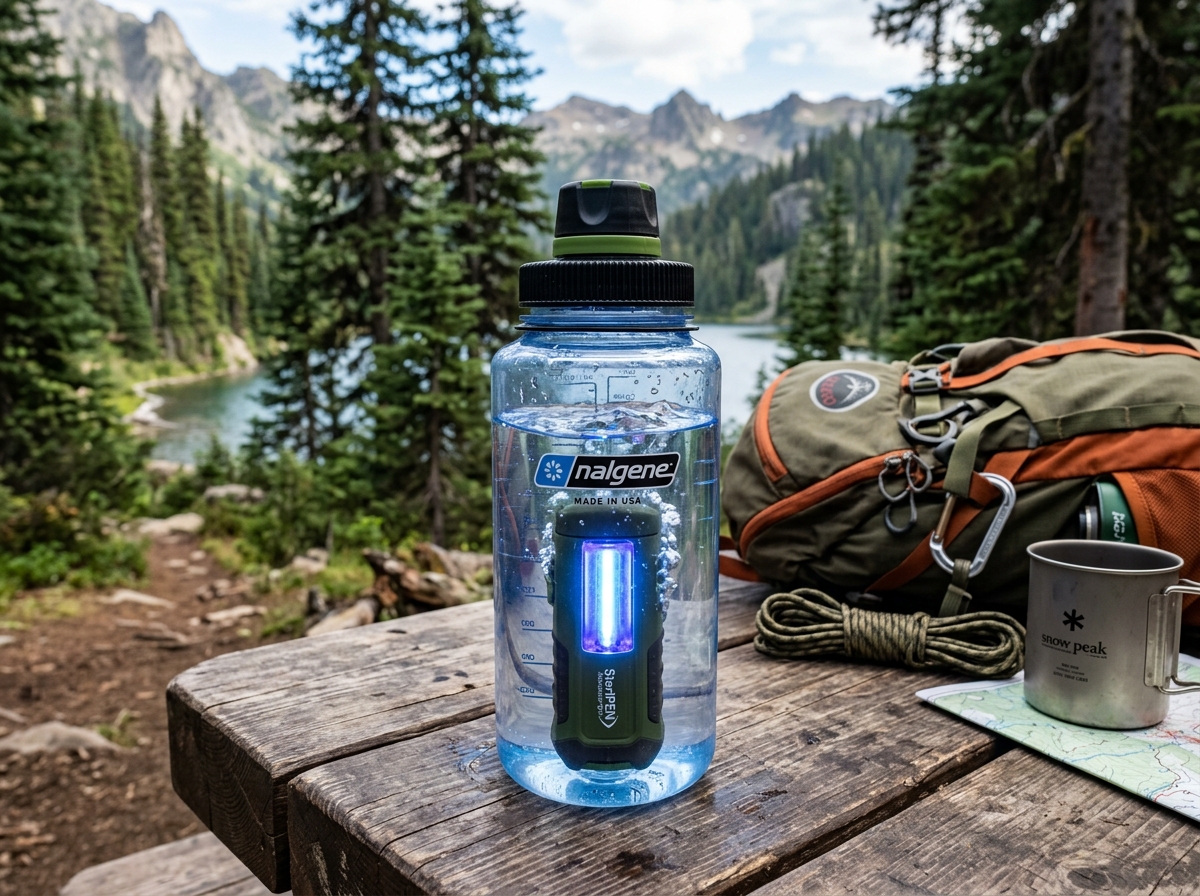
By merging convenience and efficiency: UV light water purifiers for hikers, these devices have revolutionized how we treat water. For example, the Katadyn SteriPen Ultra uses an OLED display to guide you through the process. You simply submerge the lamp, stir the water to ensure every drop gets exposed to the light, and wait for the “smile” or the countdown to finish.
This process is incredibly effective for pathogen sterilization, but it is important to remember that the light must reach the pathogen. If the water is full of “floaties” or mud, the microbes can literally hide in the shadows of those particles. This is why clarity is king when using UV.
Pathogen Effectiveness and Health Benefits
One of the biggest reasons we recommend UV purifiers is their comprehensive protection. While many popular hollow-fiber filters (like the Sawyer Squeeze) are excellent at removing bacteria and protozoa, they often struggle with viruses because viruses are simply too small to be caught in a 0.1-micron filter.
An ultraviolet water purifier camping device, however, handles viruses with ease. It is effective against:
- Bacteria: E. coli, Salmonella, and Cholera.
- Protozoa: Giardia and Cryptosporidium (the tough ones that chemical tablets often struggle to kill quickly).
- Viruses: Hepatitis A, Norovirus, and even COVID-19.
Understanding how UV purification systems enhance your health on hikes is about more than just avoiding “Beaver Fever” (Giardia). It’s about total peace of mind. Scientific research on UV pathogen reduction, such as the data provided by Katadyn, confirms that these devices provide a high level of protection against cysts and other microscopic nasties that can survive in cold mountain streams.
Why Choose an Ultraviolet Water Purifier Camping?
If you are a fan of efficiency, UV is hard to beat. Most treatments take just 90 seconds for a full liter of water. Compare that to chemical drops that might take 30 minutes to 4 hours to be fully effective against Cryptosporidium.
The advantages of using UV light purifiers for backpacking trips include:
- Zero Aftertaste: Unlike iodine or chlorine, UV adds nothing to your water. It tastes exactly like the spring you took it from.
- Lightweight Design: At roughly 140 grams (4.94 ounces), the SteriPen Ultra is lighter than most pump-style filters.
- Speed: You can treat a liter and be drinking it before your friend has even finished assembling their gravity bag.
- Ease of Use: No pumping, no squeezing, and no waiting for hours.
Limitations and Field Realities
We love UV technology, but we have to be honest about its limits. The biggest “gotcha” is water clarity. If you’ve ever tried to treat water that looks like chocolate milk, you know that UV light isn’t going to cut it.
Turbidity (cloudiness) interferes with the light’s ability to reach pathogens. If the water is silty or tannic (tea-colored), the effectiveness drops significantly. In these cases, you absolutely must use a pre-filter—even something as simple as a bandana or a coffee filter—to get the big stuff out first.
Our guide to UV water purifiers for camping emphasizes that sediment shielding is a real risk. If a microbe is tucked behind a grain of sand, the UV light won’t hit it, and it remains “live.”
Another reality is battery dependency. Most modern units like the SteriPen Ultra are USB rechargeable and provide about 50 treatments per charge. However, in cold weather, battery performance can dip. If you’re winter camping, you’ll want to keep your purifier in an inside pocket close to your body heat to ensure the electronics don’t fail when you need them most.
Challenges with Ultraviolet Water Purifier Camping
There are a few “user error” traps to watch out for. One is thread contamination. When you dip your Nalgene bottle into a stream, the water on the threads of the bottle doesn’t get treated by the UV light inside. If you drink from that bottle, those few drops of raw water could still make you sick. We recommend wiping the threads dry after treatment to stay safe.
When harnessing UV light purifiers for safe backpacking trips, power management is key. We always suggest carrying a small power bank (which you likely have for your phone anyway) as a backup. While electronic failure is rare—one user reported 185 field days over nearly a decade without a single illness—it is still a possibility. Unlike a hollow-fiber filter that might just slow down, a dead battery means zero water.
Comparison with Other Treatment Methods
How does an ultraviolet water purifier camping device stack up against the competition? It depends on your priorities.
| Method | Best For | Pros | Cons |
|---|---|---|---|
| UV Purifier | Clear water, viruses | Fast, lightweight, no taste | Needs batteries, clear water only |
| Hollow Fiber (Sawyer) | Turbid water | No batteries, removes sediment | Doesn’t kill viruses, can freeze/break |
| Chemicals (Aquamira) | Emergency backup | Ultralight, inexpensive | Chemical taste, long wait times |
| Gravity Filters | Large groups | Hands-free, high volume | Heavy, bulky, doesn’t kill viruses |
If you’re looking for the best overall filter for personal use, many hikers point to the Sawyer Squeeze because of its simplicity. However, if you are traveling internationally or in areas where human waste might contaminate the water, a UV purifier is superior because it handles viruses that the Sawyer can’t.
Maximizing efficiency: using UV light purifiers for backpacking trips often means pairing methods. Some of our team members carry a UV pen for primary use and a few chlorine dioxide tablets in their first aid kit as a “just in case” backup.
For those in RVs or camper vans, the technology scales up. Products like the Acuva Wanderer 2.0 or the WaterFixer 500 offer 12V systems that can treat 2 to 6 liters per minute, providing safe water straight from the tap. These are excellent for long-term off-grid living where you might be drawing from questionable tanks or local wells.
Maintenance and Safety Best Practices
To keep your ultraviolet water purifier camping gear in top shape, a little TLC goes a long way. Most UV lamps are rated for about 8,000 activations. That is a staggering 8,000 liters of water! For most hikers, that’s a lifetime of use.
Here are our top tips for maintenance and safety:
- Check the Sensors: Devices like the SteriPen Adventurer Opti use optical sensors to detect when they are in water. Keep these clean so the device knows when to turn on.
- Battery Storage: If you aren’t using the device for a few months, don’t store it with a completely dead battery. Give it a partial charge to maintain the battery’s health.
- The “Wipe and Swirl”: After treating, wipe the mouth of your bottle. During treatment, make sure you are stirring or swirling the water constantly to ensure even exposure.
- Solar Backups: If you’re on a long trek, look into top solar-powered water purification solutions for the trail to keep your USB devices topped up.
Frequently Asked Questions about UV Purification
Does UV light work in cloudy or turbid water?
Not effectively. The particles in cloudy water act as shields for bacteria and viruses. If your water isn’t clear enough to read a book through, you need to filter it or let the sediment settle before using your UV purifier.
How many liters can a UV purifier treat on one charge?
Most modern rechargeable units like the SteriPen Ultra provide about 50 treatments (of 1 liter each) per full charge. If you are treating 3 liters a day, a single charge should last you about two weeks.
Is UV light effective against viruses like Norovirus?
Yes! This is one of the primary reasons to choose UV over standard mechanical filters. UV-C light is highly effective at neutralizing Norovirus, Hepatitis, and other viral threats that can be found in water sources near high-traffic campsites.
Conclusion
Choosing an ultraviolet water purifier camping system is about balancing speed, weight, and protection. For the modern hiker who wants the fastest path to safe, great-tasting water without the chemical tang of tablets, UV is a game-changer. Whether you’re trekking through the high Sierras or exploring remote international trails, having a reliable way to neutralize viruses and bacteria is essential gear.
At Total Cobre, we believe that the best gear is the gear that disappears into your routine. A UV pen that sits in your pocket and provides clean water in under two minutes is the definition of “trail magic.” Just remember to keep your batteries charged, your water clear, and your bottle threads dry!
Ready to upgrade your backcountry kit? Discover more safe water solutions at Total Cobre and ensure your next adventure is memorable for the views, not the stomach bugs.
