
Clean Water Anywhere: Finding the Best Water Bottle with Filter
The best water bottle with filter is one that matches your water source, activity level, and contaminant concerns. Here’s a quick look at top options to help you decide fast:
| Bottle | Best For | Filter Type | Filter Life |
|---|---|---|---|
| GRAYL GeoPress | Hiking, international travel | Press purifier | 65 gal / 350 uses |
| LifeStraw Go Series | Hiking, backpacking, travel | Hollow fiber + carbon | 1,000 gal membrane / 26 gal carbon |
| Brita Premium | Everyday / office use | Activated carbon | 40 gal / 2 months |
| LARQ Bottle Filtered | Daily use, tap water | Nano Zero | 40 gal / 2 months |
| CamelBak Eddy+ by LifeStraw | Backcountry + daily use | Hollow fiber + ion exchange | Varies |
You’ve been there. You’re miles into a trail, you’ve found a stream, and you’re asking yourself: is this water safe to drink?
For hikers and backpackers, that question matters. A lot. Drinking untreated water from natural sources can expose you to bacteria like E. coli, parasites like Giardia, and even microplastics. Getting sick in the backcountry isn’t just uncomfortable — it can be dangerous.
That’s exactly what filtered water bottles solve. They let you drink from rivers, lakes, taps, and public fountains without hauling a bulky purification kit or relying on single-use plastic bottles.
But not all filtered bottles work the same way. Some only improve taste. Others remove bacteria and parasites. A few even eliminate viruses — which matters a lot if you’re traveling internationally or drinking from seriously questionable sources.
The right bottle depends on where you’re going and what you need to filter out.
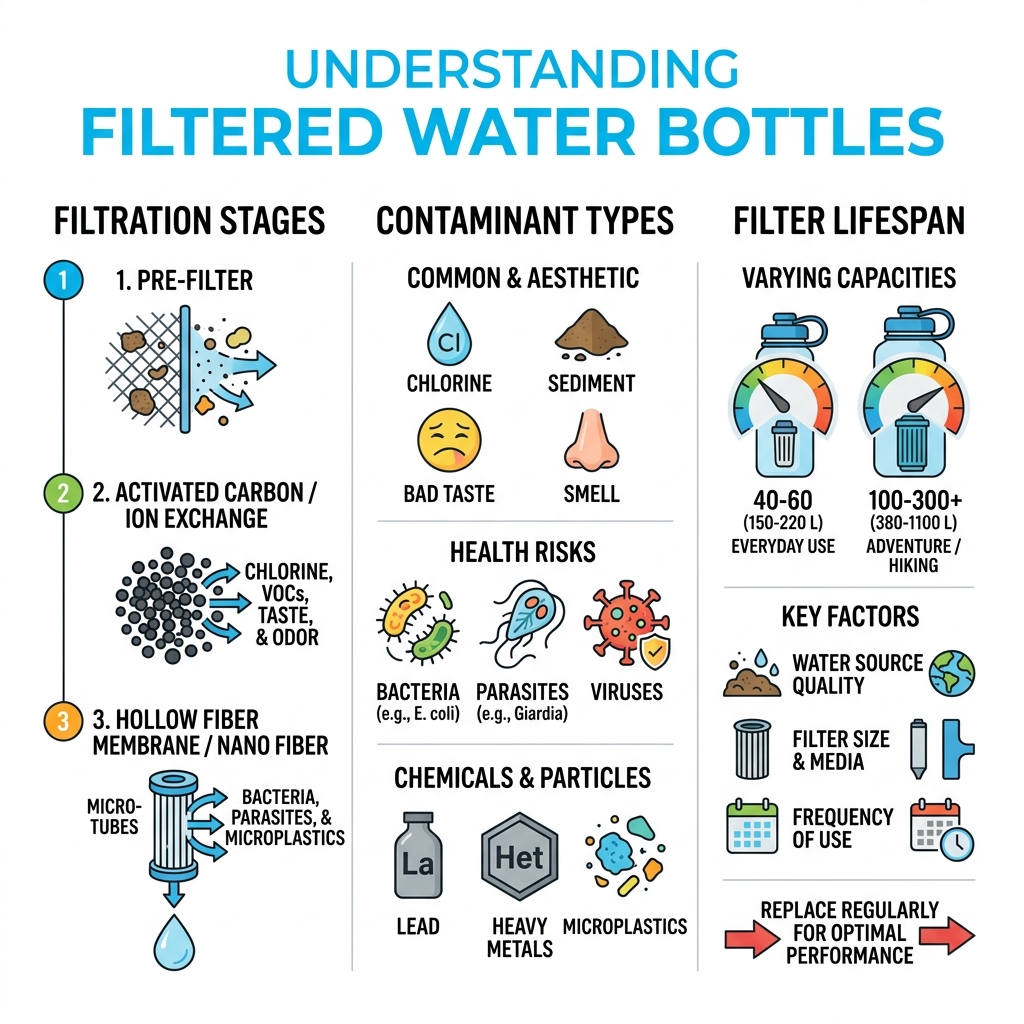
Key Features of the Best Water Bottle with Filter
When we look for the best water bottle with filter, we aren’t just looking at how much water it holds. We’re looking at how it fits into our lives—whether that’s shoved into the side pocket of a trekking pack or sitting on an office desk.
Capacity and Flow Rate
Size matters. For a quick walk, a 20 oz bottle is plenty. But for long-distance hiking, you might want something like the high-capacity water purification bottles that hold 24 to 32 oz.
However, there’s a trade-off: the more water a bottle holds, the heavier it is. Also, consider the “sip effort.” Some straw-based filters, like the original LifeStraw, can feel like drinking a thick milkshake because you have to pull the water through a dense membrane. Others, like the Epic Water Filters Nalgene OG, use a design that allows water to enter from all sides, making it feel like you aren’t using a filter at all.
Portability and Durability
If you’re a backpacker, weight is your enemy. A stainless steel bottle might be tough, but a lightweight BPA-free plastic bottle or even collapsible water bottles with filters can save you precious ounces. We also look for features like integrated carry loops or carabiners—essential for clipping your bottle to the outside of your pack for easy access.
Insulation
Do you like your water ice-cold? If so, vacuum-insulated stainless steel is the way to go. Bottles like the Brita Stainless Steel or the CamelBak Eddy+ can keep water cold for up to 24 hours. Just remember that insulation adds weight and usually reduces the internal capacity slightly because of the double-wall construction.

Best Water Bottle with Filter for International Travel
When we travel to regions where waterborne viruses (like Hepatitis A or Norovirus) are a concern, a standard filter won’t cut it. Most filters remove bacteria and parasites, but viruses are much smaller.
For these trips, we recommend a “purifier” rather than just a “filter.” The GRAYL GeoPress is a standout here. It uses electroadsorption to pull out viruses, bacteria, and protozoa in about 10 seconds of pressing. It’s a “smug factor” favorite—you can confidently fill up from a questionable bathroom tap in Tanzania or a river in Colombia and know you’re safe.
Best Water Bottle with Filter for Hiking and Backpacking
For most trails in North America or Europe, the primary threats are bacteria (like E. coli and Salmonella) and protozoa (like Giardia and Cryptosporidium). A hollow-fiber membrane filter is the gold standard here.
The LifeStraw Go Series is a classic choice for hikers. It removes 99.9999% of bacteria and parasites. If you’re looking for more tips on how to integrate these into your gear list, check out our backpackers guide to using water bottles with built-in filters.
Understanding Filtration Technologies and Contaminant Removal
Not all filters are created equal. Understanding the “guts” of your bottle helps you know exactly what you’re protected against.
Activated Carbon
This is the most common technology for “everyday” bottles like Brita. Carbon is excellent at removing chlorine, bad tastes, and odors. It’s essentially a sponge for chemicals. However, carbon alone usually does not remove bacteria or viruses. It’s great for making city tap water taste like a mountain spring, but don’t take it to a literal mountain spring.
Hollow Fiber Membrane
Imagine a bundle of tiny straws with microscopic holes (usually 0.2 microns). Water can pass through, but bacteria and parasites are too big and get stuck. This technology is what makes the LifeStraw so effective for backcountry use. It’s durable and often lasts for hundreds or even thousands of gallons.
Ion Exchange and Nano Zero
Advanced bottles like the LARQ or CamelBak Eddy+ use ion exchange or specialized “Nano Zero” technology. These are designed to tackle heavy metals like lead, as well as PFAS (the “forever chemicals”) and pharmaceuticals, often adhering to NSF/ANSI standards for contaminant reduction. These are perfect for those of us who don’t trust the aging pipes in our own cities.
| Technology | Removes Bacteria/Parasites? | Removes Viruses? | Removes Chlorine/Lead? | Best Use Case |
|---|---|---|---|---|
| Activated Carbon | No | No | Yes (Chlorine) | Office/Home Tap |
| Hollow Fiber | Yes | No | No | Backcountry Hiking |
| UV-C Light | Yes | Yes | No | Sanitizing Bottle |
| Electroadsorption | Yes | Yes | Yes | International Travel |
For a deeper dive into how these technologies work in different formats, see our article exploring collapsible water bottles with built-in filters.
Material Comparison: Stainless Steel vs. BPA-Free Plastic
Choosing the right material is a balance of weight, durability, and temperature control.
Stainless Steel
- Pros: Extremely durable, often vacuum-insulated (keeps water cold for 24 hours), doesn’t retain odors.
- Cons: Heavy. If you drop it, it might dent.
- Best for: Daily commutes, car camping, and short day-hikes.
BPA-Free Plastic (Tritan)
- Pros: Lightweight, impact-resistant, and usually transparent so you can see how much water you have left. Many brands, like LifeStraw, now use “Tritan Renew,” which is made from 50% recycled plastic.
- Cons: Doesn’t keep water cold. Can eventually develop scratches or odors if not cleaned properly.
- Best for: Backpacking, long-distance trekking, and gym use.
Borosilicate Glass
- Pros: The “purest” taste. No risk of chemicals leaching, and it looks beautiful.
- Cons: Fragile and heavy. Even with a silicone sleeve, it’s not something we’d recommend for a rugged trail.
- Best for: Wellness seekers and office environments.
If you are looking for the ultimate weight-saving option, collapsible water bottles with filters are the way to go. They take up almost no space in your pack when empty, making them perfect for emergency kits.
Maintenance, Lifespan, and Filter Replacement
A filter is only good if it’s working. Neglecting maintenance can lead to slow flow rates or, worse, bacterial growth inside the filter itself.
How Long Do Filters Last?
Filter life varies wildly. A standard Brita filter lasts about 40 gallons (roughly 2 months). On the other end of the spectrum, the LifeStraw membrane can last up to 1,000 gallons—that’s about five years of daily use! However, if your LifeStraw has a carbon stage, that part usually needs replacing every 26 gallons to keep the water tasting fresh.
Cleaning and Dishwasher Safety
Most bottle bodies (plastic or steel) are top-rack dishwasher safe, but never put the filter in the dishwasher. The heat and detergent will ruin the delicate membranes. Always remove the filter and rinse it with clean water. For the bottle itself, we recommend using a bottle brush to get into the crevices, especially around the mouthpiece.
Priming Your Filter
When you get a new bottle, you often need to “prime” the filter. For Epic Water Filters, this involves soaking the filter for five minutes and taking a few strong sips to get the air out. For GRAYL, the first few presses might be stiff until the filter media is fully saturated.
For those keeping a bottle for “just in case” scenarios, read our guide on the best emergency filtered water bottles for outdoor safety to learn how to store them long-term without the filter drying out or cracking.
Frequently Asked Questions about Filtered Water Bottles
How long do the filters typically last?
As a rule of thumb, most carbon-based filters (for taste) last 2 months or 40–60 gallons. Microbiological filters (for hiking) last much longer, often 250 to 1,000 gallons. Always check the manufacturer’s specs, as “clogging” is a sign the filter has reached its end of life.
Do filtered water bottles remove viruses?
Most do not. Only “purifiers” like the GRAYL GeoPress or specific “Everywhere” filters from Epic are rated to remove 99.99% of viruses. Standard LifeStraw and Brita models are not designed for virus removal.
Are these bottles easy to clean and maintain?
Yes, provided you follow the rules. Most require a simple hand-wash for the lid and straw. If you’re using a bottle in the backcountry, it’s a good idea to “backflush” or rinse the filter after your trip to remove any sediment or silt that could cause clogs.
Conclusion
Finding the best water bottle with filter is one of the smartest moves you can make for your health and the planet. By switching to a filtered bottle, you can replace hundreds of single-use plastic bottles a year—Brita estimates their bottles replace 300, while LifeStraw’s membrane is equivalent to a staggering 8,000 plastic bottles.
At Total Cobre, we believe clean water shouldn’t be a luxury, whether you’re on a remote trail or in a busy city. Whether you need emergency filtered water bottles for your “go-bag” or a rugged companion for your next thru-hike, choosing a high-quality filtration system ensures you stay hydrated and healthy.
Ready to gear up? Check out The Ultimate Guide to Clean Water for more expert reviews and trail-tested recommendations. Happy hiking!
