
Clean Water in the Wild: Why Your Personal Water Filter Could Save Your Life
A personal water filter is one of the most important pieces of gear you can carry on any backcountry trip. Whether you’re pulling water from a mountain stream or preparing for an emergency, the right filter keeps waterborne illness out of your body.
Quick answer — best personal water filters by use case:
| Use Case | Top Pick | Key Strength |
|---|---|---|
| Solo hiking / ultralight | Sawyer Mini | 100,000-gallon lifetime, 2 oz |
| Everyday trail use | LifeStraw Personal | 1,000 gallons, unlimited shelf life |
| Upgraded solo performance | LifeStraw Peak Squeeze | 2,000-liter capacity, fast flow |
| International travel | Grayl GeoPress | Removes viruses + heavy metals |
| UV purification | SteriPen | Fast, lightweight, battery-powered |
Here’s the thing most hikers don’t realize until it’s too late: not all filters are the same.
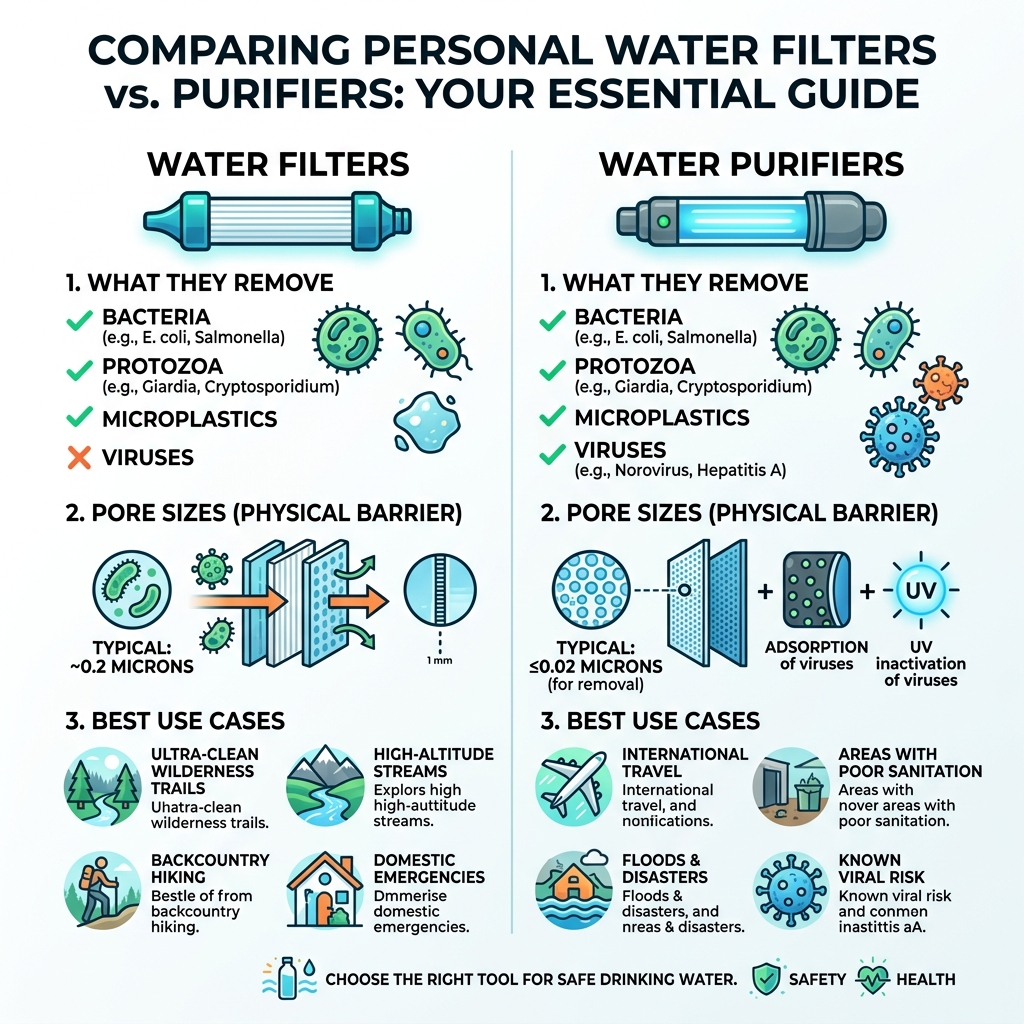
There’s a big difference between a filter and a purifier. Filters remove bacteria, parasites, and microplastics. Purifiers go further and also eliminate viruses — something that matters a lot in developing countries or disaster scenarios.
The stakes are real. Around 1 in 3 people globally lack access to safe drinking water. Even in pristine-looking wilderness streams, pathogens like Giardia and Cryptosporidium can cause serious illness days after exposure.
The good news? Modern personal water filters are lighter, faster, and more reliable than ever. Some weigh less than 2 ounces and fit in your palm.
This guide breaks down the top options so you can find the right one for your pack, your destination, and your budget.
Understanding the Personal Water Filter: Technology and Standards
When we talk about a personal water filter, we are usually referring to a device that uses mechanical “hollow fiber membrane” technology. Think of it like a bundle of microscopic straws with tiny holes in the sides. These holes are so small that water can pass through, but nasty things like bacteria and parasites are physically blocked.
The industry standard for a high-quality personal water filter is a pore size of about 0.2 microns. To give you an idea of how small that is, a human hair is about 70 microns wide. At 0.2 microns, these filters are incredibly effective. According to the Performance Data Sheet, top-tier filters remove:
- 99.999999% of bacteria (like E. coli and Salmonella)
- 99.999% of parasites (like Giardia and Cryptosporidium)
- 99.999% of microplastics, dirt, and sand
These aren’t just empty claims. Reliable brands test their products against rigorous standards set by the US EPA and NSF International (specifically NSF P231). When we are unveiling personal water filtration devices for hiking, we always look for these certifications to ensure our community stays safe on the trails.
It is important to remember that a standard microfilter (0.1 to 0.2 microns) does not typically remove viruses, which are much smaller than bacteria. For that, you need an “ultrafilter” or a purifier with a pore size of approximately 0.02 microns.

Essential Specifications for Outdoor Filtration
Choosing the right personal water filter involves balancing three main factors: weight, flow rate, and lifespan. If you’re an ultralight hiker, every ounce counts. If you’re filtering for a group, flow rate is king.
Here is how the top contenders stack up:
| Model | Weight | Filter Lifespan | Pore Size |
|---|---|---|---|
| LifeStraw Personal | 1.6 oz | 1,000 Gallons | 0.2 Micron |
| Sawyer Mini | 2.0 oz | 100,000 Gallons | 0.1 Micron (Absolute) |
| LifeStraw Peak Solo | 1.7 oz | 500 Gallons | 0.2 Micron |
| Grayl GeoPress | 15.9 oz | 65 Gallons (250L) | 0.02 Micron (Purifier) |
Flow Rate and Ease of Use
Flow rate refers to how fast you can get clean water into your mouth or bottle. A “straw” style filter requires you to suck water through the device, which can be tiring after a long day of hiking. “Squeeze” filters allow you to fill a pouch and force water through the filter into a clean container, which is generally much faster. For instance, the LifeStraw Peak Solo can fill a 1-liter bottle in about 20 seconds.
Filter Lifespan and Value
The lifespan of a personal water filter varies wildly. A LifeStraw Personal lasts for about 1,000 gallons (4,000 liters), which is enough for one person to drink for five years. However, the Sawyer Mini claims a staggering 100,000-gallon lifetime. While you might never actually drink 100,000 gallons, this longevity means the filter is less likely to clog permanently over time.
Before you buy, check out our guide on how to choose the best portable water filter for your hiking needs to see which specs align with your adventure style.
Top-Rated Models for Every Adventure
We’ve spent a lot of time testing these devices in real-world scenarios, from the muddy streams of the Appalachian Trail to the tap water in South American hostels. Here are our top picks.
Selecting a Personal Water Filter for Solo Hiking
For most solo hikers, the choice comes down to the LifeStraw Personal or the Sawyer Mini.
The LifeStraw Personal is the “OG” of the industry. It’s incredibly simple: no moving parts, no shelf life (it lasts forever until you use it), and it’s very affordable. It’s a “no-brainer” for trail runners or as an emergency backup in your day pack. The main drawback is that you have to be at the water source to drink, often requiring you to lie on your stomach to reach a stream.
The Sawyer Mini is a more versatile tool. It can be used as a straw, attached to a standard plastic water bottle, or spliced into a hydration bladder. Its 0.1-micron absolute filtration is slightly tighter than the LifeStraw, and its massive lifespan makes it a favorite for thru-hikers. We’ve found that the included squeeze bags can be a bit fragile, so we often recommend pairing it with a more durable third-party pouch.
For those who want the best of both worlds, our emergency water filter reviews for hikers often highlight the LifeStraw Peak Squeeze. It features a durable, tear-resistant collapsible bottle and a filter that lasts for 2,000 liters—double the lifespan of many competitors.
The Best Personal Water Filter for International Travel
When traveling internationally, especially to regions where waterborne viruses like Norovirus or Rotavirus are common, a standard filter isn’t enough. You need a purifier.
The Grayl GeoPress is our top recommendation for travelers. It works like a French press: you fill the outer shell with “dirty” water and press the inner filter down. In about 20 seconds, you have 24 ounces of water that is free of bacteria, parasites, viruses, heavy metals, and chemicals. It even improves the taste by removing chlorine.
Another excellent travel companion is the SteriPen. Instead of using a physical filter, it uses UV light to scramble the DNA of pathogens, making them harmless. It’s incredibly fast (90 seconds per liter) and light. However, it doesn’t work well in “chunky” or murky water, as the particles can shield the microbes from the light. We suggest following the CDC water disinfection guidelines when using UV systems to ensure complete safety.
Real-World Performance and Environmental Impact
Using a personal water filter isn’t just about your health; it’s about the health of the planet. Every minute, one million single-use plastic bottles are purchased globally. That is 1.3 billion bottles a day! Most of these end up in landfills or the ocean, where they take at least 450 years to degrade.
By using a filter like the LifeStraw Go (which lasts for 1,000 gallons), you are effectively replacing up to 8,000 single-use plastic bottles. Reuters produced graphics to illustrate the scale of the problem, showing how our reliance on bottled water is creating a massive environmental footprint.
Many of these companies also have a significant social impact. For example, for every LifeStraw product sold, a school child in a developing community receives safe water for an entire school year. This “give-back” model has helped millions of people who lack access to clean water, which is currently about 1 in 3 people globally.
Maintenance, Cleaning, and Long-Term Storage
A personal water filter is a precision instrument. If you don’t take care of it, it will clog, and your “fast flow” will turn into a frustrating drip.
Backflushing: The Secret to Longevity
Most filters, like the Sawyer Mini or LifeStraw Peak Series, come with a syringe for “backflushing.” This involves forcing clean water backward through the filter to pop out the trapped sediment and gunk. We recommend backflushing whenever you notice the flow rate slowing down, and always before you put the filter away for the season.
Freezing Weather Care
This is a critical tip: Never let your filter freeze after it has been wetted. Because hollow fiber membranes work by trapping water inside the tiny tubes, that water will expand if it freezes, cracking the fibers. Once the fibers are cracked, the filter is useless because pathogens can sail right through the gaps. If you’re hiking in freezing temperatures, keep your filter in an interior pocket close to your body heat, and sleep with it in your sleeping bag.
Long-Term Storage
If you store a filter while it’s still damp, mold can grow inside. If you store it completely dry for too long, the membranes can become “hydrophobic” and refuse to let water pass. LifeStraw recommends a specific storage solution (usually involving salt water) to keep the membranes primed. Always consult the Long Term Storage and Cleaning Instructions for your specific model to ensure it’s ready for your next trip.
Frequently Asked Questions about Personal Water Filters
Do personal water filters remove viruses and heavy metals?
Most standard personal water filter models (like the LifeStraw Personal or Sawyer Mini) do not remove viruses or heavy metals. They are designed to remove biological pathogens like bacteria and protozoa. If you need to remove viruses, you need a purifier like the Grayl GeoPress or the MSR Guardian. If you need to remove heavy metals or chemicals (like lead or PFAS), look for a filter with an activated carbon stage, though these usually have a much shorter lifespan (around 26-100 gallons).
How do I know when it is time to replace my filter?
One of the best features of hollow fiber filters is that they are “fail-safe.” When the microscopic pores are completely filled with debris, water will simply stop flowing through the device. If you find yourself sucking or squeezing with all your might and nothing is coming out, it’s time for a replacement. Carbon filters are different; they don’t stop flowing, but the water will start to taste or smell bad again once the carbon is exhausted.
Are these filters safe for medical conditions like MAC or NTM?
For individuals with health concerns like Mycobacterium avium complex (MAC) or Non-tuberculous mycobacteria (NTM), water safety is paramount. Research shows that LifeStraw microfilters can remove pathogens like Mycobacterium tuberculosis and Pseudomonas. However, many users in medical forums report that while these filters remove pathogens, they do not remove the minerals that cause scale buildup on medical equipment. For sterilization of medical equipment, distilled water is still the gold standard, but a high-quality personal water filter can be a great secondary layer of protection for drinking water.
Conclusion
At Total Cobre, we believe that clean water shouldn’t be a luxury—it’s a necessity for every adventurer. Whether you are an ultralight thru-hiker looking for the 2-ounce Sawyer Mini or a world traveler relying on the virus-stopping power of the Grayl GeoPress, there is a personal water filter designed for your specific needs.
By investing in a quality filter, you aren’t just protecting yourself from a nasty case of Giardia; you’re also doing your part to reduce the staggering 480 billion plastic bottles used every year. Take care of your gear, backflush regularly, and keep those membranes from freezing, and your filter will take care of you for years to come.
Stay safe, stay hydrated, and we’ll see you on the trails! Visit Total Cobre for more outdoor gear guides to find the best equipment for your next adventure.
