
What’s Actually in Your Tap Water (And How to Filter It Out)
When you compare water filtration systems, the right choice depends on three things: what contaminants are in your water, how much water you use daily, and whether you need a permanent setup or something portable.
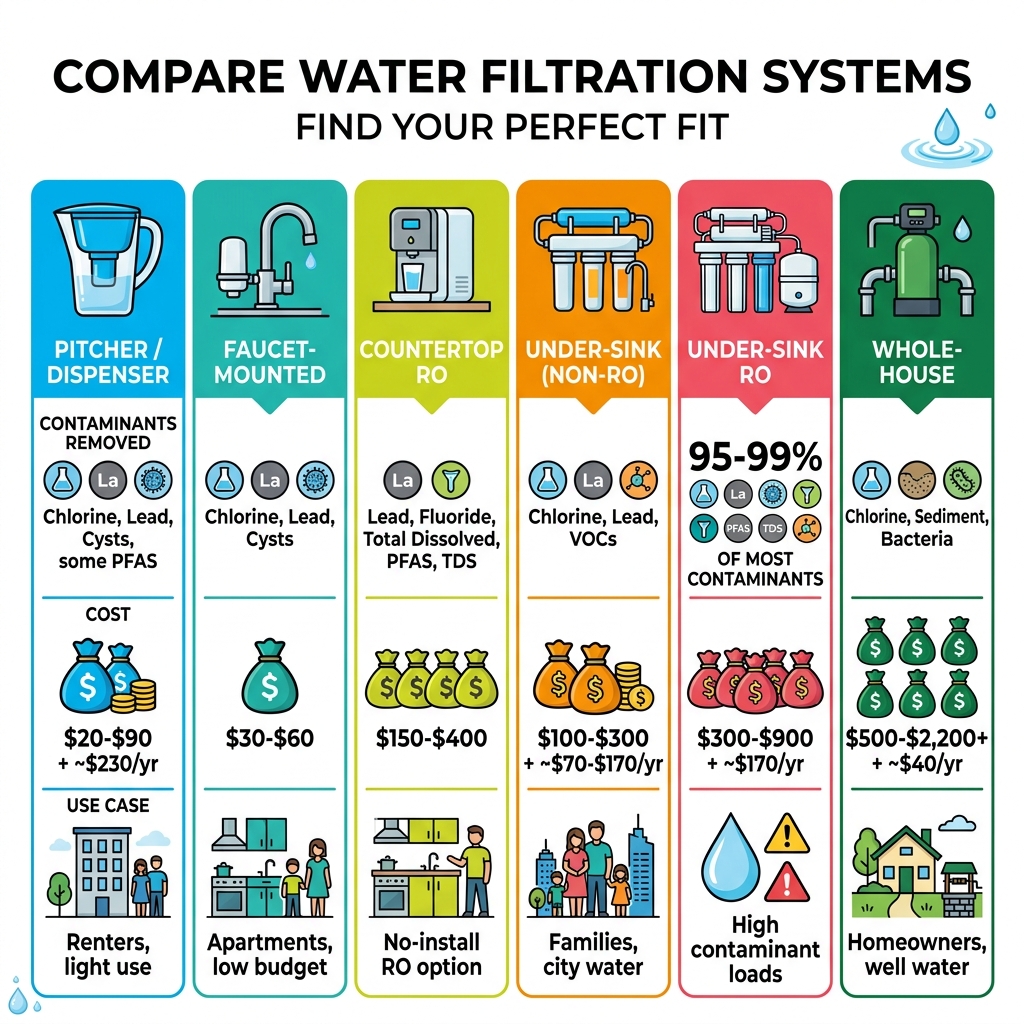
Here’s a quick comparison to match your situation:
| System Type | Best For | Avg. Cost | Key Contaminants Removed |
|---|---|---|---|
| Pitcher/Dispenser | Renters, light use | $20-$90 + ~$230/yr | Chlorine, lead, some PFAS |
| Faucet-mounted | Apartments, low budget | $30-$60 | Chlorine, lead, cysts |
| Countertop RO | No-install RO option | $150-$400 | Lead, fluoride, PFAS, TDS |
| Under-sink (non-RO) | Families, city water | $100-$300 + ~$70-$170/yr | Chlorine, lead, VOCs |
| Under-sink RO | High contaminant loads | $300-$900 + ~$170/yr | 95-99% of most contaminants |
| Whole-house | Homeowners, well water | $500-$2,200+ + ~$40/yr | Chlorine, sediment, bacteria |
The stakes are real. A 2023 U.S. Geological Survey study found that at least 45% of the nation’s tap water is contaminated with PFAS — a group of chemicals linked to serious health risks. And a Consumer Reports investigation found detectable levels of lead, arsenic, or PFAS above recommended safety thresholds in 118 out of 120 tested U.S. locations.
No filter works for every situation. A pitcher might be perfect for a city apartment. A reverse osmosis system is better for households dealing with lead or fluoride. And if you spend time in the backcountry, neither of those helps you at all.
This guide breaks down exactly how each system performs — with real lab data, cost comparisons, and honest tradeoffs — so you can pick the right one without second-guessing.
How to Compare Water Filtration Systems by Type
Choosing the right technology is the first step in ensuring your family drinks safe water. When we compare water filtration systems, we look at how they fit into your daily routine. Some sit on your counter, while others hide under the sink or treat the water the moment it enters your home.
Under-Sink Units (Non-RO)
These are a favorite for busy families. They connect directly to your cold water line and often use multi-stage carbon blocks. A high-quality 3-stage under-sink filter can reduce over 200 contaminants while keeping beneficial minerals like calcium and magnesium in your water. They offer a fast flow rate—filling a gallon in about 60 to 70 seconds—making them much more convenient than waiting for a pitcher to drip.
Reverse Osmosis (RO)
If you want the “gold standard” of purity, RO is it. These systems use a semipermeable membrane to strip away almost everything, including fluoride, arsenic, and up to 99% of lead and PFAS. Modern “tankless” RO systems are game-changers, saving up to 70% of under-sink space and offering faster flow rates of up to 800 gallons per day (GPD). Some even include remineralization stages to balance the pH and improve the taste, which can otherwise be a bit “flat.”
Whole-House Filtration
Also known as Point-of-Entry (POE) systems, these are installed at the main water line. They protect your entire home—your showers, your laundry, and your appliances—from chlorine and sediment. While they are excellent for improving skin and hair health by removing 97% of chlorine, they often aren’t enough on their own for drinking water if you have specific health concerns like lead or PFAS.
Countertop and Faucet-Mounted Filters
For renters or those on a budget, these are the easiest to set up. Countertop RO units offer high-level filtration without the need for drilling holes in your granite. Faucet-mounted options are even simpler but have a shorter lifespan and can’t handle hot water, which might damage the filter media.
Pitcher Dispensers
The entry point for most people. While convenient and low-cost upfront, the long-term maintenance can be surprising. If you go through 40 gallons a month, you could spend $230 a year on replacements. However, some advanced pitchers are now certified to remove lead and PFAS, rivaling the performance of much larger systems.
To see exactly what contaminants might be lurking in your local supply before you buy, we recommend checking the EWG Tap Water Database | Water Filters.
Compare water filtration systems for high-volume households
If you have a large family, several bathrooms, and high daily water usage, a “point-of-use” pitcher just won’t cut it. You need a system that can keep up with the demand without causing a drop in water pressure.
Whole-house systems are designed for this. A high-capacity carbon system can treat up to 1,000,000 gallons—that’s about 10 years of water for a typical home—with almost zero maintenance. These systems excel at chlorine reduction, which is the primary cause of “pool-like” smells in city water. By removing chlorine at the source, you also improve the air quality in your home, as you aren’t breathing in vaporized chlorine during your morning shower.
For those on well water, the needs are different. You’ll likely want a system that includes a sediment pre-filter to catch sand and rust, and perhaps a UV sterilization stage. UV filters are incredible; they can kill 99.99% of bacteria and viruses without adding any chemicals to your water. This is a vital consideration for anyone who loves the outdoors and understands that even “clear” water can hide microscopic threats. For more on how these needs translate to the trail, check out our guide on Essential Water Filtration Systems for Trekking Enthusiasts.
Compare water filtration systems for portability and travel

When we leave the comfort of our kitchens, our filtration needs change entirely. You can’t lug a 50-pound RO tank into the woods! For adventurous hikers, the goal is to remove biological pathogens like Giardia, Cryptosporidium, and bacteria.
- Filter Straws: These are the ultimate “just in case” tool. They are lightweight and allow you to drink directly from a source.
- Gravity-Fed Bags: Perfect for group camping. You fill a bag, hang it from a tree, and let gravity do the work of pushing water through a hollow fiber membrane. It’s hands-free and can provide gallons of clean water while you set up camp. Learn more about why Gravity-Fed Water Filters: The Perfect Solution for Group Camping Trips are a favorite for trekkers.
- Hollow Fiber Membranes: Most portable filters use these tiny “straws” that trap bacteria and protozoa. They are incredibly effective for biological threats but usually don’t remove chemical contaminants like PFAS.
If you are planning a trip, it’s worth looking at the Best Portable Water Filters for Backpackers to ensure your gear matches your destination.
Performance Metrics: Contaminant Removal and Efficiency
When you compare water filtration systems, don’t just take the manufacturer’s word for it. Look for certifications from independent organizations like the NSF (National Sanitation Foundation) or ANSI.
Understanding the Certifications
- NSF/ANSI 42: This covers “aesthetic” effects. It means the filter is proven to make your water taste and smell better by removing chlorine.
- NSF/ANSI 53: This is the big one for health. It certifies that the system reduces specific harmful contaminants like lead, mercury, VOCs, and PFAS.
- NSF/ANSI 58: Specifically for Reverse Osmosis systems. It verifies that the RO membrane is actually doing its job of reducing Total Dissolved Solids (TDS) and other molecular-level pollutants.
- NSF/ANSI 401: This covers “emerging” contaminants, such as trace amounts of pharmaceuticals or pesticides that have recently been found in municipal supplies.
Efficiency and Waste
One of the biggest criticisms of traditional Reverse Osmosis is water waste. Older systems used to waste 4 or 5 gallons of water for every 1 gallon of purified water produced. However, technology has improved drastically. Some high-efficiency RO systems now offer a 1:1 pure-to-waste ratio, and top-tier tankless models can achieve a 3:1 efficiency ratio (meaning they waste only 1 gallon for every 3 gallons of clean water).
Real-World Lab Results
In independent Tap Score lab testing, top-rated systems have shown impressive results:
- Lead and Fluoride: High-end RO systems and specialized 3-stage filters have reduced these to “non-detect” levels.
- THMs (Trihalomethanes): These disinfection byproducts are common in city water. Most quality carbon filters can remove 100% of THMs, significantly improving the safety of your tap water.
- TDS Reduction: While TDS isn’t always a measure of safety (it includes good minerals too), RO systems typically reduce TDS by 85% to 97%, giving the water a very “pure” taste.
Choosing the Right Setup for Your Home and Lifestyle
Your living situation is often the deciding factor when you compare water filtration systems.
For Renters
If you can’t drill into your countertop or mess with the plumbing under the sink, look at high-performance pitchers or countertop RO units. These require zero permanent changes to the apartment and can move with you when your lease is up. Some countertop RO units are even battery-powered and app-tracked, making them incredibly easy to maintain.
For Homeowners (City Water)
If you are on municipal water, your main concerns are usually chlorine, lead from old pipes, and PFAS. An under-sink RO system or a high-end 3-stage carbon filter is usually the best bet. If you hate the smell of chlorine in the shower, adding a whole-house carbon tank will make a massive difference in your quality of life.
For Well Water Users
Well water is a different beast. You are your own water utility, which means you need to protect against bacteria, iron, and sediment. A whole-house system with a UV light and a dedicated iron filter is often necessary. We always recommend testing your well water annually to see if your needs have changed.
DIY Feasibility and Maintenance
Most under-sink and whole-house systems are designed for DIY installation. If you can use a wrench and follow a YouTube video, you can likely install an under-sink system in 30 to 45 minutes. Whole-house systems are more complex and might take 2 to 3 hours, or require a plumber if you aren’t comfortable cutting into your main copper or PEX lines.
Maintenance is generally simple:
- Carbon filters: Change every 6–12 months.
- RO membranes: Change every 2–3 years.
- Sediment pre-filters: Change every 3–6 months (especially if you see a drop in water pressure).
Understanding the difference between these mechanical filters and chemical treatments is also useful for when you’re off the grid. You can read more about Chemical Versus Mechanical Methods of Water Purification for Hikers to see how these principles apply in the wild.
Frequently Asked Questions about Home Filtration
Do I need a professional plumber for installation?
For most point-of-use systems (under-sink or countertop), the answer is no. Most modern kits come with “quick-connect” fittings that snap together like LEGOs. You’ll usually just need a wrench and perhaps a drill if you need to install a dedicated filtered-water faucet. However, for whole-house systems that involve cutting into your main water line, a professional plumber is a safe bet to ensure everything is up to code and leak-free.
How often do water filters really need replacing?
It depends on the “rated capacity” of the filter and your water quality. A standard pitcher filter might only last 40 gallons (about 2 months), while a large under-sink filter can last for 16,000 gallons (up to 2 years). Most systems now have indicator lights or app tracking to tell you exactly when the flow rate is dropping or the media is exhausted. Don’t ignore these—a clogged filter can actually become a breeding ground for bacteria!
Does reverse osmosis waste too much water?
“Waste” is a relative term. While traditional RO systems do send water down the drain to flush away contaminants, modern tankless systems are incredibly efficient. When you compare water filtration systems, look for those with at least a 1:1 or 2:1 ratio. Considering that an RO system provides water that is often purer than expensive bottled water—without the plastic waste—the environmental trade-off is usually a net positive.
Conclusion
At Total Cobre, we believe that access to clean water shouldn’t be a mystery. Whether you are looking to protect your family from PFAS in your kitchen or ensure you have safe hydration on a 20-mile trek, the right filtration system makes all the difference.
Before you buy, we highly recommend getting a copy of your local Consumer Confidence Report (CCR) or using a home testing kit to identify your specific “villains.” Once you know what you’re fighting, you can compare water filtration systems with confidence, knowing you’re investing in your health.
For more specialized guides on keeping your water clean—whether at home or on the trail—visit us at https://www.totalcobre.com/. Stay hydrated, and stay adventurous!
