
Clean Water in the Backcountry: What Every Hiker Needs to Know
Water purification for backpacking is one of the most critical skills and gear decisions you’ll make before heading into the wilderness. Streams and lakes may look pristine, but they can carry invisible threats — Giardia, Cryptosporidium, bacteria, and even viruses — that can turn a great trip into a miserable one.
Here’s a quick look at the main options:
| Method | Removes | Treatment Time | Best For |
|---|---|---|---|
| Mechanical filter | Protozoa, bacteria | 35–52 sec/L | Solo to group, daily use |
| Chemical (chlorine dioxide) | Protozoa, bacteria, viruses | 15–30 min (4 hrs for Crypto) | Backup, ultralight travel |
| UV light (e.g., SteriPEN) | Protozoa, bacteria, viruses | ~90 sec/quart | Solo, clear water |
| Boiling | Protozoa, bacteria, viruses | 1 min rolling boil | Emergency, any group size |
| Purifier (e.g., MSR Guardian) | Protozoa, bacteria, viruses | ~37 sec/L | High-risk or international |
Top picks at a glance:
- Best overall personal filter: LifeStraw Peak Squeeze (82/100 score, 2,000 L life)
- Best value and longevity: Sawyer Squeeze (378,541 L lifetime, ~$40)
- Best for groups: Platypus GravityWorks (4 L gravity capacity, hands-free)
- Best for virus protection: MSR Guardian Purifier (0.02 micron, 10,000+ L)
- Best chemical backup: Aquamira chlorine dioxide drops (~$15)
The stakes are real. One experienced backcountry guide described filling bottles below a decomposing cow in a canyon wash — and being very glad the water had already been treated. You simply cannot tell what’s upstream.
This guide breaks down every major purification method, compares the top-rated gear for 2026, and helps you match the right system to your trip — whether you’re a solo thru-hiker counting every ounce or leading a group through the backcountry.
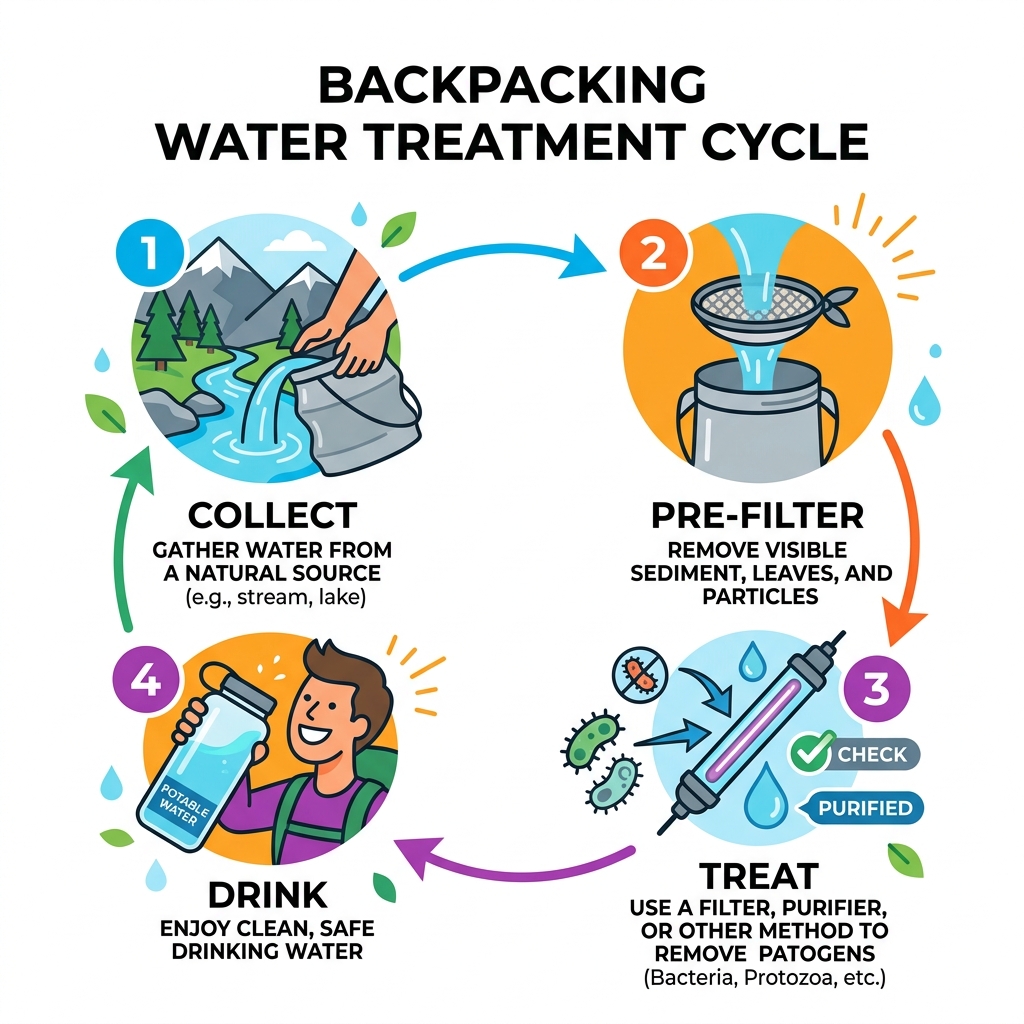
Essential Methods of Water Purification for Backpacking
When we step off the pavement and into the wild, we leave behind the safety of municipal water treatment. To stay healthy, we have to become our own mini-utility company. There are four primary techniques used to make raw water safe to drink. Each has its place depending on where you are and what you’re willing to carry.
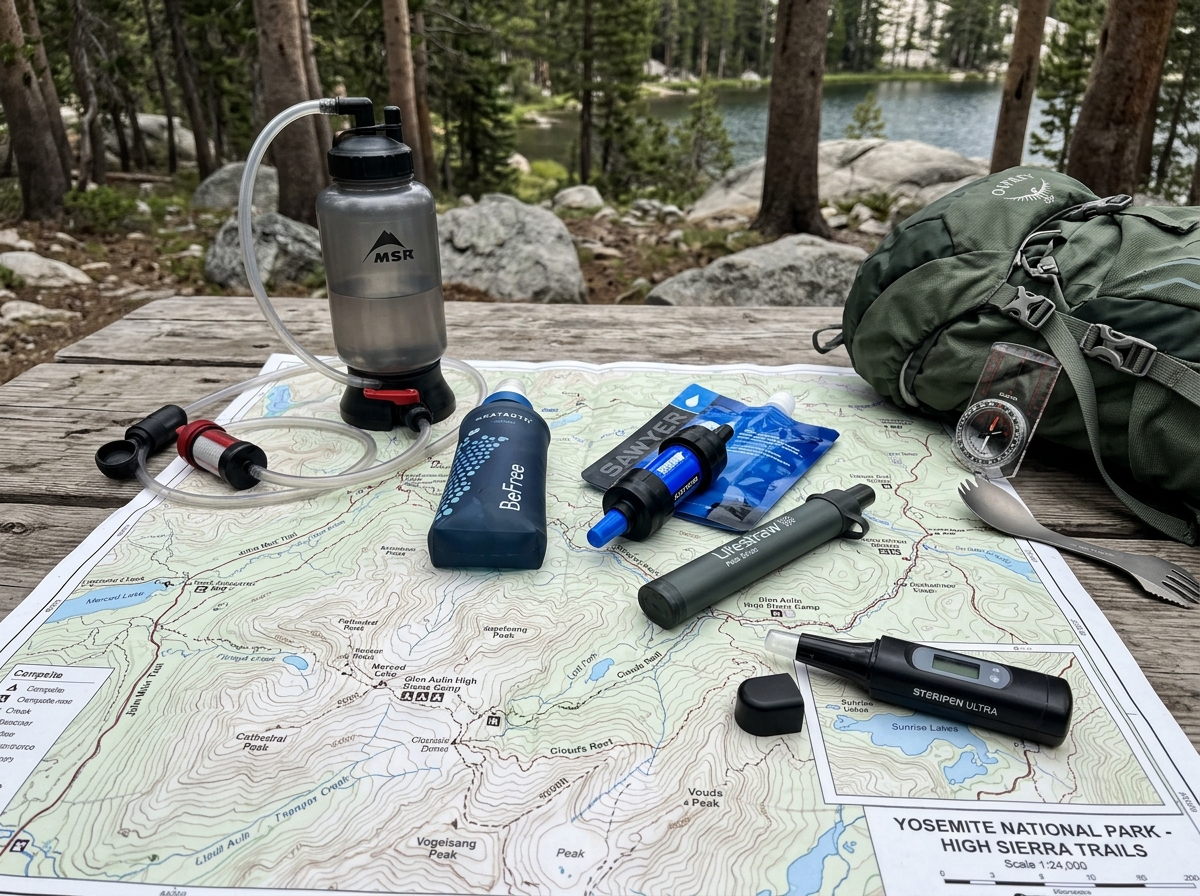
Boiling
The oldest and most foolproof method. Bringing water to a rolling boil for at least one minute (three minutes if you are above 6,500 feet) kills everything: bacteria, protozoa, and viruses. It requires no specialized gear other than a stove and fuel. However, it is time-consuming, uses up precious fuel, and leaves you with a pot of hot water that isn’t exactly refreshing on a summer afternoon. We usually reserve this as a backup or for winter trips where we are melting snow anyway.
Mechanical Filtration
This is the most popular choice for modern hikers. These devices use a physical barrier to strain out contaminants. Most use “hollow fiber” technology—essentially thousands of tiny tubes with microscopic holes that allow water through but trap nasties. Others use ceramic or glass fiber. You’ll find these in several forms:
- Squeeze filters: Lightweight and versatile.
- Gravity systems: Great for groups; let physics do the work.
- Pump filters: Ideal for pulling water from shallow seeps.
To dive deeper into picking the right one, check out our guide on how to choose the best portable water filter for your hiking needs.
Chemical Treatment
Chemicals like iodine or chlorine dioxide are the “set it and forget it” options. They are ultralight and take up almost no space in your pack. While iodine can leave a medicinal taste and isn’t effective against Cryptosporidium, chlorine dioxide (like Aquamira) is highly effective and leaves no funky aftertaste. The main downside? The “dwell time”—you often have to wait 15 to 30 minutes before taking a sip.
UV Light
Devices like the SteriPEN use ultraviolet light to scramble the DNA of pathogens, making them unable to reproduce (and thus, unable to make you sick). It’s fast—usually about 90 seconds for a liter—and works on viruses. However, it requires batteries and only works in clear water. If your water looks like chocolate milk, the UV rays can’t reach the “bugs” hiding behind the dirt particles.
For more foundational info, the American Hiking Society offers excellent resources on wilderness safety.
Pathogen Protection and Water Purification for Backpacking
Understanding what you’re fighting is half the battle. There are three main “tiers” of pathogens we worry about:
- Protozoa (e.g., Giardia, Cryptosporidium): These are the largest (1–15 microns). Most standard filters handle these easily. Cryptosporidium is particularly tough because it has a hard outer shell that resists many chemicals.
- Bacteria (e.g., E. coli, Salmonella): These are mid-sized (0.1–10 microns). Almost all backpacking filters on the market are rated to remove 99.9999% of bacteria.
- Viruses (e.g., Norovirus, Hepatitis A): These are the tiny ninjas of the water world (0.02–0.3 microns). Standard filters do NOT remove viruses. To catch these, you need a “purifier” with 0.02-micron pores, a chemical treatment, or UV light.
In most of North America’s high-altitude backcountry, viruses are less of a concern than protozoa and bacteria. However, if you are hiking in areas with high human traffic, near agricultural runoff, or traveling internationally, a full purifier is a must.
Pros and Cons of Treatment Techniques
Choosing the right method is about balancing weight, speed, and reliability.
| Method | Pros | Cons |
|---|---|---|
| Filtration | Instant results; removes sediment; no chemical taste. | Can clog; can break if frozen; doesn’t kill viruses. |
| Chemicals | Lightest option; kills viruses; inexpensive. | Long wait times; doesn’t remove dirt/floaties; chemical taste (iodine). |
| UV Light | Fast; kills viruses; no taste change. | Needs batteries; doesn’t work in turbid water; expensive. |
| Boiling | 100% effective; no gear to fail. | Uses fuel; takes a long time to cool; flat taste. |
Comparing Top-Rated Filtration and Purification Systems
When we talk about the “best” gear, we aren’t just looking at the price tag. We look at the filter media—the actual stuff inside that does the cleaning.
Best Chemical Water Purification for Backpacking Options
Chemicals are the ultimate backup. Even if we carry a filter, we always have a few tablets in our first aid kit.
- Chlorine Dioxide (Aquamira Drops/Tablets): This is the gold standard for chemicals. It kills most pathogens in 15–30 minutes. However, for Cryptosporidium, you need to let it sit for 4 hours. It’s the go-to for many of our guides because it’s EPA-approved and doesn’t make your water taste like a swimming pool.
- Iodine: Old school and effective against bacteria, but it tastes terrible and doesn’t kill Crypto. It’s also not recommended for long-term use or for pregnant women.
Top-Rated Hardware for Solo and Group Use
1. The Solo Hero: Sawyer Squeeze The Sawyer Squeeze is a legend for a reason. It is incredibly versatile—you can drink through it like a straw, attach it to a standard water bottle, or use it as an inline filter for your hydration bladder. With a lifetime rating of over 378,000 liters, it might be the last filter you ever buy. It filters 1 liter in about 40 seconds.
2. The Group Workhorse: Platypus GravityWorks If you’re hiking with a partner or a group, gravity fed water filters are the perfect solution for group camping trips. You fill a “dirty” bag, hang it from a tree, and let gravity push the water through the filter into a “clean” bag. No pumping, no squeezing, just 4 liters of clean water in about 4 minutes.
3. The International Professional: MSR Guardian Purifier If you’re headed to a region where Norovirus or Hepatitis is a threat, the Guardian Purifier is the king. It uses medical-grade hollow fibers to physically remove viruses. It’s also self-cleaning, meaning it pumps a bit of water back through the filter with every stroke to prevent clogging. It’s heavy (17 oz) and expensive (~$350), but it’s nearly indestructible.
4. The Ultralight Contender: LifeStraw Peak Squeeze Scoring an 82/100 in recent comprehensive testing, this is a fantastic personal option. It filters 1 liter in just 35 seconds and is designed to be much more durable than previous collapsible bottle filters.
Maintenance and Field Reliability for Backcountry Systems
A filter is only as good as its flow rate. If you don’t maintain your gear, you’ll eventually find yourself “squeezing for your life” just to get a sip of water.
Backflushing and Field Cleaning
Most hollow fiber filters (like the Sawyer or LifeStraw) require “backflushing.” This involves using a syringe to force clean water backward through the filter to pop out the sediment and “gunk” trapped in the fibers. We recommend doing this after every trip, or even daily if the water is murky. For ceramic filters like the MSR MiniWorks EX, you can actually scrub the outer layer of the ceramic element with an abrasive pad to restore the flow.
Proper care is the difference between a tool that lasts a decade and one that fails on day three. Learn more about how to maintain your filters for longevity and performance.
Managing Turbid and Silty Water
Silty water (think the Colorado River or glacial runoff) is the natural enemy of filters. The tiny particles of clay and glacial flour will clog a standard filter in minutes.
- The Bandana Method: Always pre-filter chunky or silty water through a bandana or coffee filter. This catches the “big stuff” before it hits your expensive filter.
- Settling: If you have time, let a bucket of silty water sit overnight. The sediment will settle to the bottom, allowing you to scoop the clearer water from the top.
- Self-Cleaning Pumps: The MSR Guardian is specifically designed for this. It flushes sediment out as you pump, making it the best choice for consistently turbid water.
Backup Systems and Redundancy
In the backcountry, “one is none, and two is one.” Filters can break, clog, or freeze.
- Freezing Risks: If the water inside a hollow fiber filter freezes, it expands and cracks the microscopic tubes. The filter will still look fine, but it will no longer be catching bacteria. Always sleep with your filter in your sleeping bag if the temperature might drop below freezing.
- Secondary Chemicals: We always recommend combining multiple purification methods for safe drinking water. Carry a filter for your daily needs and a small bottle of Aquamira or tablets as a fail-safe. If your filter breaks, you aren’t in an emergency situation.
Strategic Selection: Matching Gear to Your Environment
Your choice of water purification for backpacking should change based on where you’re going.
- Alpine/Mountain (Clear streams): A lightweight squeeze filter (Sawyer Squeeze) or UV light is perfect here. The water is usually clear and low-risk for viruses.
- Desert (Stock tanks/Silty rivers): You need something that can handle mud. A pump filter with a scrubbable ceramic element or a self-cleaning purifier is best. Chemicals are a great backup here as well.
- Group Trips: Don’t make everyone wait in line for one squeeze filter. Bring a 4L or 6L gravity system to act as the “basecamp” water source.
- International/Developing Nations: Do not mess around. Use a purifier (like the MSR Guardian) or a combination of filtration plus chemical treatment to ensure you are protected against viruses.
Frequently Asked Questions about Backcountry Water
Should you always purify backcountry water?
Yes. While some “purists” claim that high-altitude springs are safe, the risk far outweighs the reward. A single deer or cow carcass upstream (even if it’s out of sight) can contaminate a “pristine” stream. Giardia can keep you off the trail for weeks. Given that a filter weighs as little as 2 ounces, there’s no reason to skip it.
How do you prevent a water filter from freezing?
The best way is to keep it against your body. During the day, keep it in a jacket pocket. At night, put it in a sealed Ziploc bag (to keep the residual water from leaking) and toss it in the bottom of your sleeping bag. If you suspect your filter has frozen, it is no longer reliable and should be replaced.
What is the difference between a filter and a purifier?
It all comes down to pore size. A filter typically has a pore size of 0.1 to 0.2 microns, which is small enough to catch protozoa and bacteria. A purifier must meet higher standards, removing or inactivating 99.99% of viruses. This is achieved through smaller pores (0.02 microns), chemicals, UV light, or boiling.
Conclusion
At Total Cobre, we believe that gear reliability is the foundation of a successful adventure. Whether you choose the incredible longevity of the Sawyer Squeeze, the hands-free ease of a Platypus gravity system, or the heavy-duty protection of the MSR Guardian, the “best” system is the one you know how to use and maintain.
Don’t wait until you’re standing on the banks of a muddy river to figure out your setup. Test your gear at home, practice backflushing, and always carry a chemical backup. Safe drinking water is the one thing you can’t compromise on.
Explore our top-rated portable water filters for hikers and find the perfect system for your 2026 adventures. Happy trails, and stay hydrated!
