
Every Ounce Counts: Finding the Best Ultralight Water Purification for the Trail
Ultralight water purification is one of the most important decisions you’ll make when packing for a backcountry trip. The wrong choice means either drinking contaminated water — risking serious illness — or hauling heavy gear that slows you down.
Here’s a quick look at the top ultralight options to help you decide fast:
| Method | Example | Weight | Filters Viruses? | Best For |
|---|---|---|---|---|
| Squeeze filter | Katadyn BeFree | 2.3 oz | No | Solo/group, clear water |
| Squeeze filter | Sawyer Squeeze | 3 oz | No | Thru-hiking, high volume |
| UV purifier | Steripen Ultralight | 2.6 oz | Yes | International, all pathogens |
| Chemical drops | Aquamira | 3 oz | Yes* | Backup, ultralight travel |
| Chemical tablets | Katadyn Micropur | 0.9 oz | Yes* | Lightest backup option |
| Purifier straw | RapidPure UltraLight | 2.6 oz | Yes | All-in-one, no maintenance |
*Aquamira and Micropur kill viruses and bacteria but require up to 4 hours to neutralize Cryptosporidium.
There’s a real cost to getting this wrong. Contaminated backcountry water can carry bacteria, protozoa, and viruses — any one of which can end a trip early or worse. And yet many hikers still carry pump-style filters that weigh 8 to 17 ounces, far more than they need to.
The good news: modern ultralight systems weigh as little as 0.9 ounces and can treat thousands of liters before needing replacement. The challenge is knowing which type of system matches your trail conditions, trip length, and risk level.
This guide breaks down the best options so you can pick the right one and move fast.

Understanding Ultralight Water Purification: Filters vs. Purifiers
When we talk about ultralight water purification, it is easy to use the words “filter” and “purifier” interchangeably, but in microbiology, they mean very different things. Knowing the difference can be the factor that keeps you off the bathroom floor-or out of the hospital.
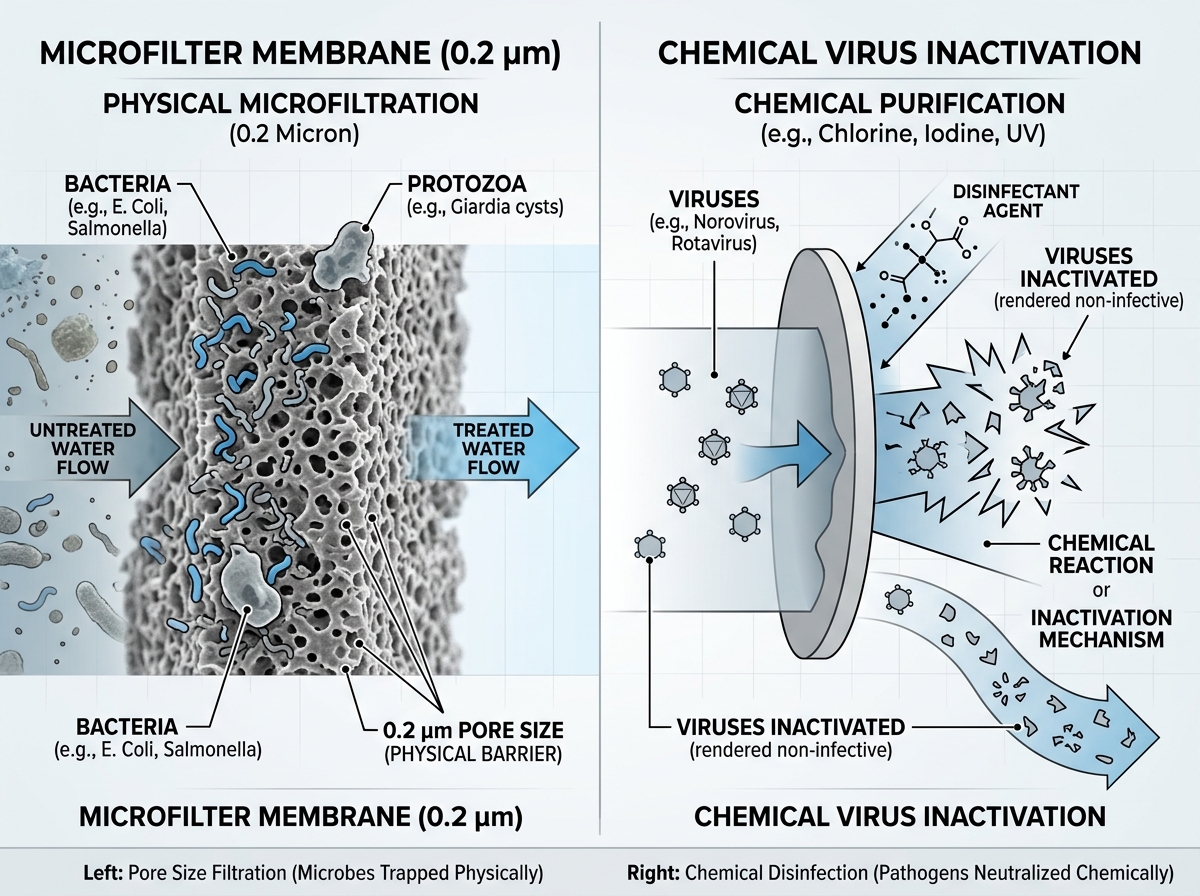
A standard water filter, like the ones most of us carry on the Appalachian Trail or in the Sierras, is designed to physically strain out “large” contaminants. These typically use hollow fiber membrane technology with a pore size of about 0.1 to 0.2 microns. This is small enough to catch bacteria (like E. coli and Salmonella) and protozoa (like Giardia and Cryptosporidium). However, it is not small enough to stop viruses, which are significantly tinier.
A purifier, on the other hand, is the “heavy hitter.” To be classified as a purifier, a device or chemical must also remove or inactivate viruses. This is achieved through smaller pore sizes (like the 0.02 microns found in the MSR Guardian), UV light, or chemical treatment. These standards are often based on scientific research on water safety standards provided by health agencies, including the U.S. Environmental Protection Agency drinking water guidance. For more details on the tech, you can check out lightweight water purifiers for backpacking.
When Do You Need Virus Protection?
For most hikers in the United States and Canada, a standard microfilter is sufficient. Most waterborne illnesses in these regions come from animal or human feces containing protozoa and bacteria. However, there are specific scenarios where we recommend stepping up to full purification:
- International Travel: If you are trekking in developing countries or regions with poor sanitation infrastructure, viruses like Norovirus, Hepatitis A, and Rotavirus are a major threat.
- High-Traffic Areas: Heavily used campsites near stagnant water sources are more likely to harbor human-borne viruses.
- Flood Zones: Natural disasters or heavy flooding can wash sewage into local water supplies, necessitating a purifier.
If you are planning a trip to a remote or international location, evaluating the best lightweight water purifiers for hiking can help you find a system that handles these invisible threats without weighing you down.
The Role of Pore Size in Pathogen Removal
The effectiveness of a physical filter is all about the “absolute” pore size. Most ultralight filters use hollow fiber tubes. Imagine thousands of tiny straws bundled together; the walls of these straws have microscopic holes.
- 0.1 to 0.2 Microns: This is the standard for most “squeeze” filters. It effectively blocks 99.9999% of bacteria and 99.9% of protozoa.
- 0.02 Microns: This is the realm of the “ultrafilter.” At this size, even the smallest viruses are physically blocked from passing through the membrane.
Understanding these specs is vital because a filter that is “too open” might let Giardia slip through, leading to a very unpleasant week of recovery. For a deeper dive into these specs, see our guide on unveiling personal water filtration devices for hiking.
Top Ultralight Filtration Methods Under 3 Ounces
If you are an “ounce counter,” the good news is that the most popular and effective systems are also some of the lightest. You no longer need a 1-pound pump to get clean water.
| Product | Weight | Flow Rate | Lifespan |
|---|---|---|---|
| Sawyer Squeeze | 3.0 oz | 1.7 L/min | 100,000+ gal |
| Katadyn BeFree | 2.3 oz | 2.0 L/min | 1,000 L |
| RapidPure Straw | 2.6 oz | Fast | 75 gal |
| Aquamira Drops | 3.0 oz | N/A | 30 gal |
| Micropur Tabs | 0.9 oz | N/A | 30 L |
Squeeze Filters: The Gold Standard for Ultralight Water Purification
Squeeze filters have revolutionized the trail. They allow us to scoop water into a soft reservoir, screw on a filter, and drink immediately or squeeze the water into a clean bottle.
The Sawyer Squeeze remains the king of the PCT. It is incredibly durable and boasts a “lifetime” warranty (rated for 100,000 gallons). While it requires a bit more maintenance (backflushing with a syringe), its reliability is unmatched. Many hikers now pair it with a Cnoc VectoX reservoir, which is easier to fill than the standard Sawyer bags.
The Katadyn BeFree is the challenger. It is slightly lighter and has a faster flow rate out of the box. Its “shake to clean” method is much simpler than carrying a syringe, but its lifespan is shorter, and the filter can be more prone to permanent clogging if used in silty water.
For those looking for a middle ground, the Platypus QuickDraw offers a great balance of speed and durability with dual-threaded compatibility. You can find more user-specific insights in our post reviewing compact water filters for long-distance hikers.
Chemical Treatments: The Lightest Backup Option
Chemicals are the ultimate “no-fail” system. They have no moving parts to break and no membranes to freeze.
Aquamira (chlorine dioxide) is a favorite among hardcore ultralight enthusiasts. It doesn’t leave a harsh “pool water” taste like iodine and is effective against viruses. The main downside is the wait time: 15–30 minutes for most pathogens, and up to 4 hours for Cryptosporidium.
Katadyn Micropur tablets are the lightest possible choice, weighing less than an ounce for a full trip’s supply. We always recommend carrying a few of these in your first aid kit as a backup in case your primary filter fails or freezes. They are perfect for budget-conscious adventurers who want maximum reliability for minimum weight.
Advanced Technology: UV and Emerging Purifiers
UV purification is like something out of a sci-fi movie. Instead of straining out bugs or poisoning them, you blast them with short-wave ultraviolet light (UV-C). This light penetrates the cell walls of bacteria, protozoa, and viruses, damaging their DNA so they cannot reproduce. If they can’t reproduce, they can’t make you sick.
The Steripen Ultralight is the leader here. It weighs only 2.6 ounces and can treat a liter of water in about 90 seconds. It is a true purifier, meaning it handles viruses that standard filters miss. For many of us, the convenience of not having to “squeeze” or “pump” is worth the small weight penalty. You can learn more about this tech in our article on harnessing UV light purifiers for safe backpacking trips.
The Future of Ultralight Water Purification: UV-C LEDs
Traditional UV purifiers use mercury lamps, which are fragile and take a few seconds to warm up. The next frontier is UV-C LED technology. Products like the LARQ bottle are already using this.
The advantages of LEDs are massive:
- No Mercury: Safer for the environment and the hiker.
- Instant On: No warm-up time required.
- Durability: LEDs are much harder to break than glass bulbs.
- Efficiency: Better battery life, often lasting a month on a single USB charge.
While we are still waiting for a “backpacking-optimized” wand version of this tech that matches the Steripen’s weight, it is the clear future of convenience and efficiency on the trail.
Limitations of Electronic Purification
As much as we love the tech, electronic purifiers have “kryptonite”:
- Water Clarity: UV light needs to reach the pathogens to kill them. If your water is “chunky” or silty, the pathogens can “hide” behind the sediment.
- Battery Dependency: If your battery dies and you don’t have a power bank, you’re out of luck.
- Cold Weather: Lithium batteries struggle in freezing temperatures, which can lead to sudden failures.
For these reasons, electronic systems are best used in clear water sources or paired with a simple pre-filter (like a bandana). To understand how these systems impact your overall trail health, see how UV purification systems enhance your health on hikes.
Maintenance and Longevity of Trail Systems
An ultralight water purification system is only as good as its flow rate. If you have to spend 20 minutes squeezing a single liter of water because your filter is clogged, you aren’t exactly “moving light and fast.”
The most important maintenance task for hollow fiber filters (Sawyer, QuickDraw) is backflushing. This involves using a syringe to force clean water backward through the filter to eject trapped sediment. We recommend doing this daily if you are filtering from murky sources.
For the Katadyn BeFree, the process is different. You simply fill the flask with clean water and “swish” or shake it vigorously. This dislodges debris from the outside of the membrane. Never use a syringe on a BeFree, as the pressure can damage the delicate fibers. For more maintenance tips, check our guide on personal water filtration devices for trails.
Protecting Your Gear in Freezing Temperatures
This is the “golden rule” of hollow fiber filters: Do not let them freeze.
When water inside the tiny hollow fibers freezes, it expands. This expansion causes microscopic cracks in the fibers. The filter will still look fine and water will still flow through it, but the holes are now large enough for pathogens to pass through.
If you expect temperatures to drop below freezing:
- Keep it on your person: Put the filter in a plastic bag and keep it in an inside jacket pocket.
- Sleep with it: Toss it in the bottom of your sleeping bag at night.
- When in doubt, throw it out: If you suspect your filter has frozen, it is no longer safe to use.
This is a common point of failure for compact hiking water filter systems, so always have a chemical backup (like tablets) for cold-weather trips.
Long-Term Storage and Sanitization
When you get home from a trip, don’t just toss your filter in the gear bin. Residual water can grow mold or bacteria inside the housing.
- Sanitize: Run a weak bleach solution (one capful per liter) through the filter.
- Dry: Let it air dry completely for several days.
- O-Rings: Check the rubber gaskets (O-rings). If they are dry or cracked, the filter will leak. A tiny dab of silicone grease can extend their life.
Proper storage ensures your gear is ready for the next season. For more on keeping your gear in top shape, see our deep dive into reviewing compact water filters.
Frequently Asked Questions about Ultralight Filtration
How do I handle silty or murky water?
Silt is the enemy of all filters. It clogs membranes and blocks UV light. To handle it, use a pre-filter. A simple bandana or a clipping of pantyhose over the mouth of your collection bottle will catch the big stuff. If the water is truly “chocolate milk,” let it sit in a container for an hour to allow the sediment to settle to the bottom before filtering the clear water off the top.
What is the typical cost per liter for ultralight options?
- Sawyer Squeeze: Incredibly low. At ~$45 for 100,000 gallons, you are looking at fractions of a penny per liter.
- Katadyn BeFree: Higher. At ~$40 for 1,000 liters, it costs about 4 cents per liter.
- RapidPure Straw: ~$32 for 283 liters, which is roughly 11 cents per liter.
- Chemicals: Aquamira costs about 10–15 cents per liter treated.
Which system is best for groups vs. solo hikers?
For solo hikers, a squeeze filter or UV pen is perfect. For groups, we recommend gravity systems. You can take a filter like the Sawyer Squeeze and use an adapter to connect two bags. Hang the “dirty” bag from a tree, and let gravity do the work while you set up camp. It’s much more efficient than taking turns squeezing a bottle for four people.
Conclusion
At Total Cobre, we know that the right gear makes the difference between a legendary trip and a literal headache. Ultralight water purification doesn’t have to be complicated, but it does require a bit of strategy. Whether you choose the bulletproof reliability of a Sawyer Squeeze, the lightning-fast flow of a Katadyn BeFree, or the high-tech protection of a Steripen, the goal is the same: stay hydrated, stay safe, and keep your pack light.
Clean water is the foundation of every successful adventure. By choosing a system that matches your environment and maintaining it properly, you can focus on the views instead of your stomach.
Ready to dial in the rest of your kit? Explore our specialized guides for adventurous hikers to find more gear that won’t break your back.
