
The Best Water Filters for Camping: Quick Picks for Thirsty Hikers
Water filters for camping reviews point to a clear set of winners for most hikers. Here’s a fast look at the top options by use case:
| Use Case | Top Pick | Why It Wins |
|---|---|---|
| Solo hiker / thru-hiker | Sawyer Squeeze | Lifetime 100,000-gal guarantee, 3 oz, proven on PCT and CDT |
| Fast and lightweight | HydraPak 42MM Filter Cap | 1 liter in 30 seconds, 1.5 oz |
| Small groups | Platypus GravityWorks | Hands-free, 4L capacity, no pumping |
| Dirty or silty water | MSR Guardian Purifier | Self-cleans every pump stroke, handles viruses too |
| International travel | Grayl GeoPress | Removes viruses, heavy metals, and chemicals |
| Budget backup | Sawyer Mini | Ultralight, affordable, wide compatibility |
Few gear decisions matter more than how you treat your drinking water in the backcountry. One bad water source can end a trip early — or worse, leave you dealing with Giardia weeks after you’re home.
The good news? Modern camping water filters are lighter, faster, and more reliable than ever. Whether you’re a solo thru-hiker counting every ounce or a group leader filling up for six people at camp, there’s a system that fits your needs.
This guide cuts through the noise. We’ve pulled from real-world testing data — including filters pushed through thousands of liters of silty glacial water, muddy streams, and even metal-polluted rivers — to show you exactly what works and what doesn’t.
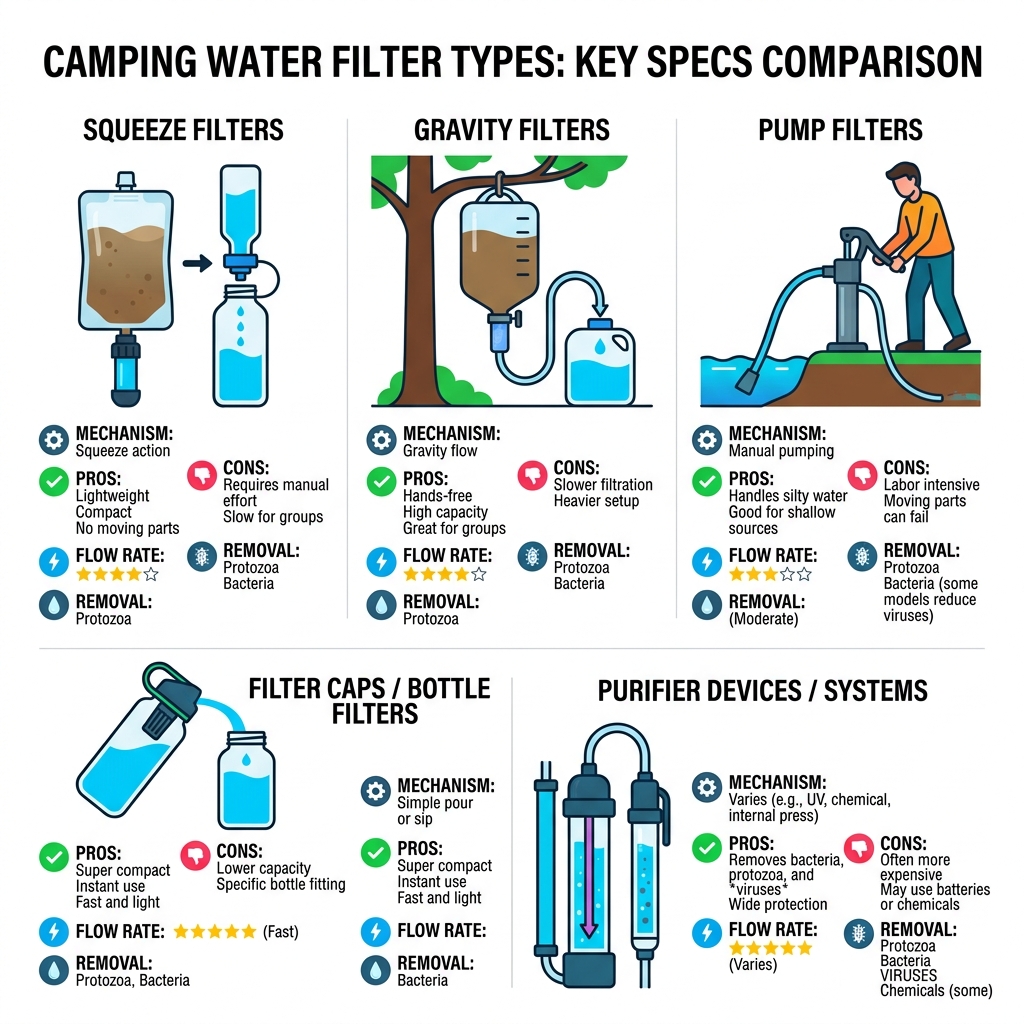
Understanding Different Types of Water Filters for Camping Reviews
When we look at water filters for camping reviews, it is clear that one size does not fit all. The technology has branched into several distinct categories, each excelling in different environments. At Total Cobre, we rigorously test gear to ensure your safety on the trail.
Squeeze Filters
These are the current darlings of the ultralight world. You fill a flexible bladder with “dirty” water, screw the filter onto the top, and squeeze the water through the membrane into your clean bottle. They are prized for having zero moving parts and being incredibly compact.
Gravity Systems
Ideal for groups or basecamps, these use the power of physics. You hang a large bag of dirty water from a tree, connect a hose to the filter, and let it drain into a clean reservoir. We love these because they allow you to multitask—you can set up your tent while your water filters itself.
Pump Microfilters
While some consider these “last-gen,” they remain essential for shallow seeps or puddles where you can’t easily submerge a bag. High-end models like the MSR Guardian actually self-clean with every stroke, making them the kings of turbid, silty water.
UV Purifiers and Chemical Tablets
UV options like the Steripen use light to scramble the DNA of bacteria and viruses so they can’t reproduce. Chemical treatments, such as Katadyn Micropur Tablets ($18), are the ultimate lightweight backup. While they don’t remove sediment, they are foolproof.
Pathogen Protection: The 0.1 Micron Standard
Most mechanical filters use hollow-fiber technology with a 0.1-micron absolute pore size. This is small enough to remove 99.9999% of bacteria (like E. coli and Salmonella) and 99.9% of protozoa (like Giardia and Cryptosporidium). However, standard filters do not remove viruses; for that, you need a “purifier.”
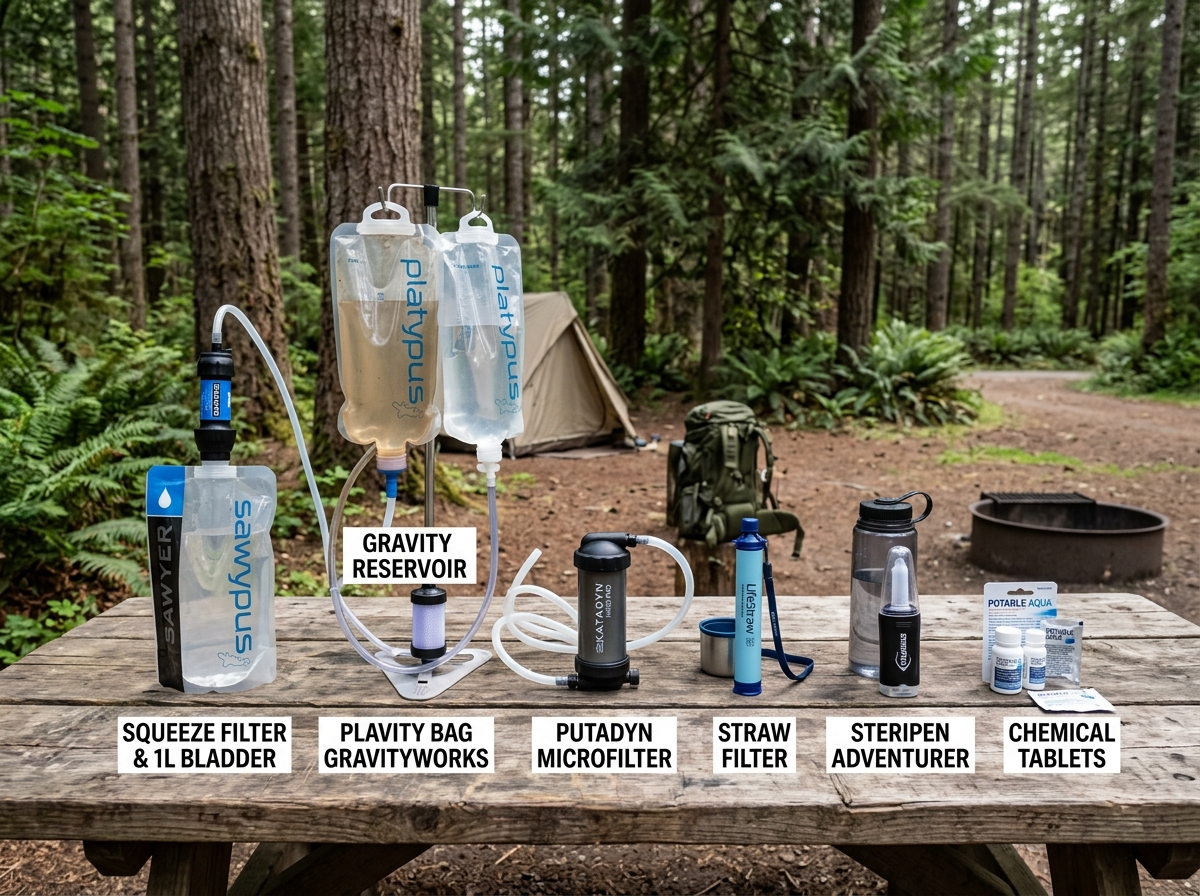
Top-Rated Squeeze and Straw Filters for Solo Hikers
Lightweight Performance in Water Filters for Camping Reviews
For the soloist, weight and speed are everything. The Sawyer Squeeze ($46) remains the gold standard. It has been trusted over 8,000 miles of thru-hikes, including the PCT and CDT. Its standout feature is a lifetime capacity of 100,000+ gallons—essentially enough to last a lifetime of backcountry use.
We recommend pairing it with a Cnoc Premium 2-Liter Bladder because the original bags can be prone to failure under high pressure. This combo earned its place as the best “Filter/Bag Combo” in recent testing.
Another top contender is the HydraPak 42MM Filter Cap ($40). It is incredibly fast, filtering 1 liter in just 30 seconds. While its 1,500-liter lifespan is shorter than the Sawyer’s, its flow rate and 1.5-ounce weight make it a favorite for those moving fast.
If you prefer a soft-flask style, the Katadyn BeFree ($30) is excellent. It allows you to drink directly from the filter while on the go. However, be aware that its membrane is more delicate than the Sawyer’s and can clog faster in silty water.
Ultralight Straws and Emergency Backups
For trail runners or minimalists, the LifeStraw Peak Straw ($25) is a versatile choice. It can function as a straw, a squeeze filter, or part of a gravity system. It boasts a 4,000-liter lifetime and a 3 L/min flow rate.
The Sawyer Mini ($29) and Sawyer Micro ($34) are even lighter (the Mini is a scant 1.8 ounces). While they are fantastic emergency backups, they tend to clog much faster than the standard Squeeze. We suggest keeping a Mini in your day pack for “just in case” scenarios, but sticking to the full-sized Squeeze for multi-day trips.
High-Capacity Gravity and Pump Systems for Groups
Maintenance Standards in Water Filters for Camping Reviews
Maintenance is the difference between a fast flow and a frustrating morning. Most hollow-fiber filters require “backflushing”—using a syringe to force clean water backward through the filter to pop out lodged sediment.
When you are Understanding water filter testing claims, flow rates are often measured in lab conditions with pristine water. In the field, silty or glacial runoff can drop a flow rate by 50% in minutes.
Pro Maintenance Tips:
- Pre-filter: Use a bandana or coffee filter to strain out large chunks of “muck” before it hits your main filter.
- Airlock Prevention: If your gravity filter stops, try shaking the hose to remove air bubbles.
- Replacement Costs: Cartridges for systems like the Grayl GeoPress ($100) cost about $30 and last for 250 liters. In contrast, Sawyer replacements are rarely needed due to their high lifespan.
Heavy-Duty Pumps and Gravity Bags for Harsh Conditions
For groups, the Platypus GravityWorks ($135) is tough to beat. You fill a 4-liter “dirty” bag, hang it up, and clean water flows into the “clean” bag at a rate of about 1.75 liters per minute. It’s perfect for a family of four.
When the water is truly “sus”—think muddy puddles or international sources—you need the MSR Guardian Purifier ($400). This is a military-grade pump that removes viruses, bacteria, and protozoa. It pumps 2.5 liters per minute and self-cleans, meaning it won’t clog even in the murkiest water. It is heavy (over 1 lb) and expensive, but it’s the “Cadillac” of water safety.
For a more affordable group pump, the Katadyn Hiker ($90) is a classic. It’s sturdy, easy to pump, and includes an activated carbon core to improve the taste of the water.
Frequently Asked Questions about Trail Water Filtration
How do I prevent my water filter from freezing and breaking?
This is critical: Hollow fiber filters (Sawyer, BeFree, QuickDraw) are destroyed if they freeze. When water inside the tiny tubes freezes, it expands and cracks the fibers, creating holes that pathogens can swim right through. If you are camping in sub-freezing temps, sleep with your filter in your sleeping bag or keep it in an internal jacket pocket close to your body heat. If you suspect it has frozen, replace it immediately.
Which filters are best for removing viruses during international travel?
Standard filters (0.1 to 0.2 microns) do not catch viruses. For international travel or areas with heavy human fecal contamination, you need a purifier. The MSR Guardian Purifier and the Grayl GeoPress are our top picks. Grayl uses electro-adsorption to pull viruses and heavy metals out of the water, making it a favorite for world travelers.
Are chemical tablets or UV purifiers better than mechanical filters?
It depends on the water source. UV purifiers like the Katadyn Steripen Ultra UV ($130) are incredibly fast but don’t work well in murky water because the silt blocks the light. Chemical tablets like Katadyn’s Micropur are great for livestock-heavy areas but require a 4-hour wait to kill Cryptosporidium. Mechanical filters are generally preferred because they provide instant results and remove actual dirt and microplastics.
Conclusion
At Total Cobre, we believe that clean water shouldn’t be a luxury on the trail. Choosing the right system comes down to four factors: your group size, the quality of your water source, your budget, and how much weight you’re willing to carry.
For most North American hikers, the Sawyer Squeeze + Cnoc VectoX 2L is the most reliable and cost-effective system in existence. If you’re a trail runner, look at the MSR TrailShot ($70). And for those heading into the most rugged conditions on earth, the MSR Guardian is worth every penny of its $400 price tag.
Stay hydrated, practice Leave No Trace by digging your catholes 200 feet from water, and always carry a backup. See you on the trail!
Explore more of our specialized guides:
