
Clean Water on the Trail: Why Your Purifier Choice Matters
The best water purifier hiking options in 2025, ranked by use case:
| Rank | Product | Best For | Virus Protection |
|---|---|---|---|
| 1 | LifeStraw Peak Squeeze | Solo hikers, ultralight | No |
| 2 | Sawyer Squeeze | Thru-hikers, best value | No |
| 3 | Platypus GravityWorks | Groups, hands-free | No |
| 4 | MSR Guardian Purifier | International travel, turbid water | Yes |
| 5 | Grayl GeoPress | Polluted sources, chemicals | Yes |
Every stream looks clean. Most aren’t.
Bacteria, protozoa, and viruses hide in backcountry water sources — invisible to the eye, but very real in their consequences. Getting sick from contaminated water miles from a trailhead isn’t just miserable. It can turn a great trip into a medical emergency.
The problem hikers face isn’t just whether to treat water. It’s how — without adding a pound of gear or losing 20 minutes at every water source.
Different purifiers solve different problems. A squeeze filter that works great on a solo PCT section might be the wrong call for a group basecamp in Southeast Asia. A UV pen that works brilliantly in clear alpine lakes is useless in a silty glacial stream.
Choosing wrong means either carrying too much weight, or not getting enough protection.
This guide breaks down the top options by real-world performance — filtration speed, weight, lifespan, and what contaminants each one actually removes.

Understanding the Best Water Purifier Hiking Options
When we talk about the best water purifier hiking systems, we first have to clear up some terminology. In the outdoor world, “filter” and “purifier” are often used interchangeably, but they mean very different things to your digestive tract.
Most common hiking filters use hollow fiber technology. Think of these as a bundle of microscopic straws with tiny holes in the sides. A standard water filter usually has a pore size of 0.1 to 0.2 microns. This is small enough to physically block bacteria (like E. coli and Salmonella) and protozoa (like Giardia and Cryptosporidium). However, viruses are much smaller—often between 0.02 and 0.3 microns—and can slip right through those 0.2-micron holes.
A true “purifier” must meet much stricter standards, such as the NSF P248 protocol or EPA Guide Standards. These devices are required to remove or inactivate 99.99% of viruses in addition to bacteria and protozoa. If you are hiking in the remote North American wilderness, a 0.2-micron filter is usually sufficient because most waterborne viruses there are species-specific (meaning animal viruses don’t typically jump to humans). But if you’re in a high-traffic area or traveling internationally, you need that 0.02-micron protection.
Knowing How To Choose The Best Portable Water Filter For Your Hiking Needs starts with assessing your water source. Is it a clear alpine spring or a silty river used by livestock? Your choice will determine whether you’re sipping safely or spending your hike behind a bush.
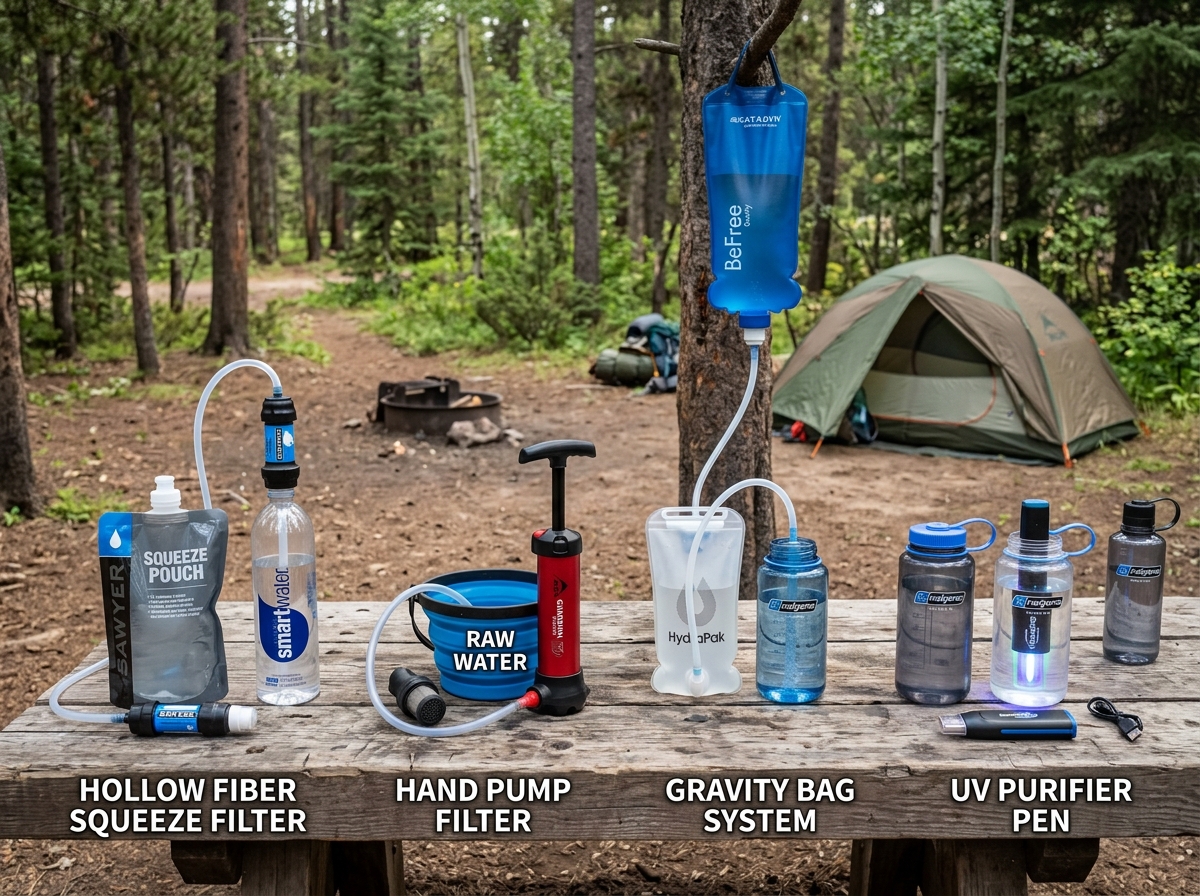
Selecting the Best Water Purifier Hiking System for Solo Treks
For the solo hiker, weight and simplicity are king. You don’t want to carry a heavy pump for one person. This is where squeeze filters have revolutionized the trail.
The Sawyer Squeeze remains a legend for a reason. It is incredibly versatile, weighing only 3 ounces, and offers an astronomical lifespan of up to 100,000 gallons (378,541 liters). You can thread it onto a standard 28mm plastic bottle, use it inline with a hydration bladder, or squeeze water through it from a collapsible pouch.
However, the LifeStraw Peak Squeeze has recently taken a top spot in our testing. It addresses the durability issues often found with collapsible bottles and offers a projected lifespan of 2,000 liters—twice that of its closest squeeze competitors. It’s fast, filtering 1 liter in about 35 seconds, and feels rugged enough to survive being stuffed into a crowded pack.
When Evaluating The Best Lightweight Water Purifiers For Hiking, we also look at “on-the-go” systems. The Katadyn BeFree is a fan favorite because the filter is integrated into the mouth of a soft flask. It’s arguably the fastest “scoop and drink” method, though it requires more frequent cleaning in silty water.
Why the Best Water Purifier Hiking Gear Needs Virus Protection
If your adventures take you to areas with poor sanitation, heavy human traffic, or international destinations, a standard filter isn’t enough. You need a purifier.
The Guardian Purifier Backpacking Water Purifier | MSR – Cascade Designs is the gold standard here. Originally designed for military use, it uses advanced hollow fiber technology with 0.02-micron pores to physically remove viruses without the need for chemicals or batteries. It’s also one of the only devices that can handle freezing temperatures and 6-foot drops onto concrete.
Another heavy hitter is the Grayl GeoPress. Unlike filters that you squeeze or pump, the Grayl works like a French Press. You fill the outer cup, push the inner filter down, and in about 10–15 seconds, you have 24 ounces of clean water. It uses electro-adsorption and activated carbon to remove not just pathogens, but also heavy metals, chemicals, and microplastics. It’s the best water purifier hiking choice for “sketchy” water sources where pollution is as much a threat as parasites.
Top-Rated Hiking Water Purifiers by Category
To help you visualize the trade-offs, we’ve compiled the performance data for the top models currently on the market.
| Model | Type | Weight | Flow Rate (1L) | Lifespan |
|---|---|---|---|---|
| Sawyer Squeeze | Squeeze | 3.0 oz | 40 seconds | 100,000 gal |
| MSR Guardian | Pump | 17.3 oz | 27 seconds | 10,000+ L |
| Platypus GravityWorks | Gravity | 11.5 oz | 52 seconds | 1,500 L |
| Grayl GeoPress | Press | 15.9 oz | 15 seconds | 250 L |
| Katadyn BeFree | Squeeze | 2.3 oz | 30 seconds | 1,000 L |
For those who need a traditional, rugged option, the Katadyn Explorer Pro Purifier offers a unique modular three-stage system. It combines ceramic microfiltration, activated carbon for taste, and a virus membrane. The beauty of this system is that you can leave the virus or carbon stages at home if you’re on a “cleaner” trip, making it a highly adaptable piece of gear.
Gravity Systems for Groups and Basecamps
If you are hiking with a partner or a small group, “squeezing” water for everyone becomes a chore very quickly. This is where gravity filters shine. They offer a “set it and forget it” experience.
The Platypus GravityWorks (available in 2L, 4L, and 6L versions) is the quintessential choice. You fill the “dirty” bag, hang it from a tree, and let gravity push the water through the filter into the “clean” bag. It’s hands-free, allowing you to set up camp while your hydration needs are being met. We’ve found that Gravity-Fed Water Filters The Perfect Solution For Group Camping Trips because they encourage everyone to stay hydrated without the “work” of pumping.
For those needing virus protection in a gravity format, the MSR Guardian Gravity Purifier uses a 10-liter reservoir and filters at a rate of 0.5 to 1 liter per minute. It even includes a carbon stage to improve the taste of the water—a welcome feature when your source is a stagnant pond.
Durable Pump Purifiers for Turbid Water
When water is “turbid”—meaning it’s full of silt, mud, or glacial flour—most filters will clog almost instantly. Pump filters, particularly those with ceramic elements, are the workhorses of these conditions.
The MSR MiniWorks EX Backpacking Water Purifier System | MSR – Cascade Designs is a classic choice. Its ceramic element can be scrubbed clean in the field with a simple scouring pad, restoring the flow rate over and over again. While it’s heavier than a squeeze filter, Choosing The Right Water Purification Pump For Extended Hikes is often the only way to ensure reliability when the water looks more like chocolate milk than a beverage.
A unique feature of the MSR Guardian pump is its self-cleaning mechanism. With every stroke of the pump, 10% of the water is used to flush the filter, meaning you never have to backflush it in the field. In our “sludge tests,” the Guardian was the only filter that didn’t require manual cleaning after every liter processed.
Performance Metrics: Weight, Speed, and Lifespan
In the best water purifier hiking gear, we measure success in seconds and ounces.
Speed: The MSR Hyperflow is currently the speed king for pumps, treating a liter in just 27 seconds. For gravity enthusiasts, the LifeStraw Peak Gravity 3L is the fastest in its class, clocking in at 30–34 seconds per liter. If you’re a thru-hiker who hates stopping, these seconds add up over a 2,000-mile journey.
Weight: If you are an ultralight hiker, every gram counts. The Katadyn BeFree 0.6L and the Sawyer Mini are among the lightest at roughly 2 ounces. However, we often recommend the standard Sawyer Squeeze over the Mini; the extra ounce is well worth the significantly faster flow rate and reduced clogging. Our guide on Lightweight Water Purifiers For Backpacking highlights that “lightest” isn’t always “best” if it means you’re spending an hour a day fighting a clogged straw.
Lifespan: This is where the Sawyer Squeeze is unbeatable. With a 100,000-gallon rating, it will likely outlast your knees. Compare this to the Grayl GeoPress, which requires a new $30 cartridge every 250 liters. For the occasional weekend warrior, the Grayl is fine, but for a long-distance hiker, the replacement costs become a significant factor.
Maintenance and Field Reliability for Backcountry Use
Even the best water purifier hiking gear will fail if you don’t take care of it. Most hollow fiber filters require backflushing—forcing clean water backward through the filter to pop out the gunk.
For the Sawyer Squeeze, this involves a large plastic syringe. We recommend doing this every time you notice the flow slowing down. For the Katadyn BeFree, maintenance is even simpler: you just fill the flask with clean water and “shake it to wake it.”
One of the biggest killers of modern filters is freezing. If water is trapped inside the microscopic hollow fibers and it freezes, the ice expands and cracks the fibers. Once cracked, the filter will still flow (often faster than before!), but it is no longer blocking pathogens. If you are on a winter trek, you must sleep with your filter in your sleeping bag to keep it warm. Check out our tips on Protecting Water Filters From Freezing During Winter Hikes for more cold-weather strategies.
For those who want absolute certainty, some manufacturers provide “integrity tests.” The MSR Guardian, for example, allows you to perform a simple test to verify the filter hasn’t been compromised after a drop or a freeze. Learning How To Maintain Your Filters For Longevity And Performance is the difference between a successful summit and a long, sick walk back to the car.
Frequently Asked Questions about Hiking Water Purifiers
What is the difference between a water filter and a water purifier?
A filter removes bacteria and protozoa (like Giardia) but is generally ineffective against viruses because they are too small for the filter’s pores. A purifier is designed to remove or inactivate all three: bacteria, protozoa, and viruses. Purifiers are essential for international travel or areas with high human waste contamination.
How do I protect my hollow fiber filter from freezing?
The best way is to keep the filter close to your body. On the trail, keep it in an internal jacket pocket. At night, place it in a sealed bag and put it at the bottom of your sleeping bag. If you suspect your filter has frozen, it is no longer safe to use and should be replaced.
Which water treatment is best for silty or turbid river water?
Pump filters with ceramic elements (like the MSR MiniWorks EX) or the self-cleaning MSR Guardian are the best for silty water. If you only have a squeeze filter, let the silty water settle in a bag for an hour, then filter only the clear water from the top to prevent instant clogging.
Conclusion
Finding the best water purifier hiking setup is about matching the technology to your environment. If you’re a solo hiker on the Appalachian Trail, a Sawyer Squeeze or LifeStraw Peak Squeeze is likely all you need. If you’re leading a scout troop through the desert, a Platypus GravityWorks will save your sanity. And if you’re heading into the heart of a developing country, don’t leave home without an MSR Guardian or Grayl GeoPress.
At Total Cobre, we believe gear reliability is the foundation of every great adventure. By choosing a system that matches your group size, water source, and weight requirements, you can stop worrying about what’s in the water and start enjoying the view.
For more deep dives into backcountry hydration, check out our guide on Searching For The Best Water Filters To Keep You Hydrated On Trails. Stay safe, and we’ll see you on the trail!
