
Clean Water on the Trail: Do Straw Filters Actually Deliver?
A camping water filter straw is one of the most useful pieces of gear you can carry — but only if you pick the right one and know what it can and can’t do.
Here’s a quick answer if you’re short on time:
| Question | Quick Answer |
|---|---|
| What does it do? | Filters water from streams, lakes, and rivers directly through a straw |
| What does it remove? | Bacteria, parasites, microplastics — not viruses (most models) |
| How long does it last? | Typically up to 1,000 gallons (about 4,000 liters) |
| How heavy is it? | Usually 1–2 oz — fits in any pocket |
| Best for? | Solo hikers, ultralight trips, emergency backup |
Most hikers have been there: you’re miles from the trailhead, thirsty, and staring at a stream that looks clean. The problem? Water from rivers and lakes — even in remote wilderness — can carry Giardia, Cryptosporidium, and bacteria like E. coli. Getting sick miles from help is a serious risk.
A quality filter straw solves that problem without adding meaningful weight to your pack.
But not all straws are equal. Flow rate, filter lifespan, what contaminants get removed, and how easy the straw is to clean all vary — a lot — between products.
This guide breaks down what actually matters when evaluating straw filters, so you can make the right call before your next trip.
The Versatility of a Camping Water Filter Straw
When we talk about a camping water filter straw, we aren’t just talking about a fancy piece of plastic for sipping out of a pond. These devices have evolved into sophisticated survival tools. Whether you are an ultralight backpacker trying to shave every gram off your base weight or a family camper wanting a “just in case” backup, the straw is the ultimate insurance policy.
One of the biggest reasons we recommend these for every hiker’s pocket is their role in emergency preparedness. Nature is unpredictable. You might plan a three-hour hike and end up spending the night due to a wrong turn or a twisted ankle. In those moments, dehydration becomes your biggest enemy. A straw filter allows you to turn almost any freshwater source into a life-saving drink.
But it isn’t just about the deep wilderness. Water quality issues can happen closer to home than you think. For example, data from the Fruitland Water Special Service District showed that 30 contaminants were detected in the water, with 30 exceeding health guidelines. This affected a population of 120,000 people served by groundwater sources. When municipal systems or groundwater sources fail or become contaminated, having a personal filtration device becomes essential for basic safety.
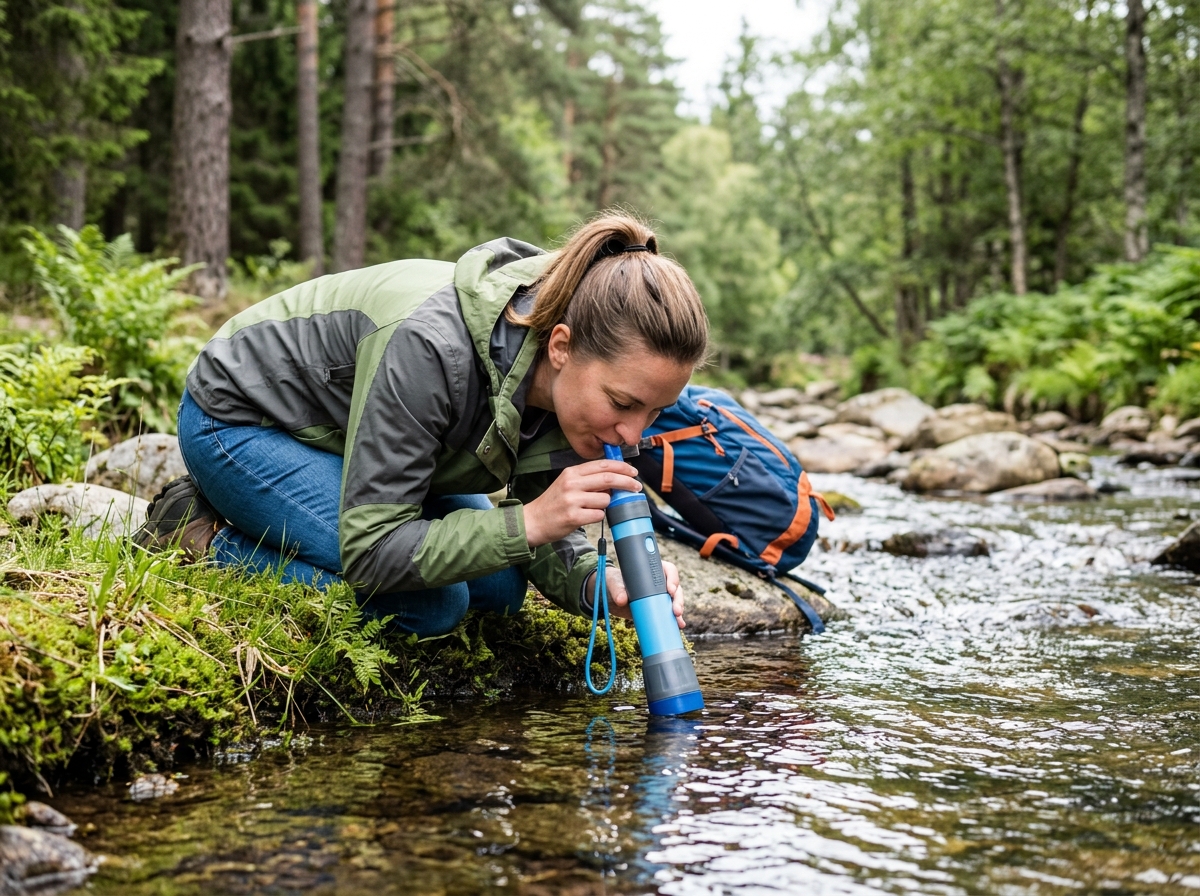
In survival situations, the portability of a straw is its greatest asset. You don’t need a heavy pump or a complex gravity bag setup. You simply lean down and drink. This simplicity is why they are staples in “bug-out bags” and disaster relief kits worldwide. From refugee camps to extreme backcountry expeditions, these straws have proven their worth in the harshest conditions.
If you want to dive deeper into how these fit into a broader safety plan, check out our top personal water filters for every emergency.
Choosing Your Camping Water Filter Straw
When you’re looking to buy, it’s easy to get overwhelmed by the specs. Here is what we look for when we’re testing these out in the field:
- Filtration Rate: This is how fast you can actually get water into your mouth. Some basic straws have a flow rate of about 400ml per minute, while high-performance models can reach up to 3 liters per minute. If you have to suck through the straw like you’re trying to drink a thick milkshake, you’re going to get tired pretty quickly.
- Lifespan: Most quality straws are rated for 1,000 gallons (about 4,000 liters). To put that in perspective, that is enough water to last one person more than five years! Some compact “solo” versions might have a shorter lifespan of around 500 gallons, which is still plenty for several seasons of heavy hiking.
- Portability: The best straw is the one you actually carry. Look for weights between 1.6 oz and 2 oz. If it’s much heavier than that, you might as well carry a full squeeze system.
- Materials: Always ensure the device is made from BPA-free, food-grade materials. You don’t want to remove bacteria only to leach chemicals into your water.
For those who love the data behind the gear, you can find more scientific research on personal filtration to see how these membranes are tested against international standards.
Limitations of a Camping Water Filter Straw
We love these things, but we have to be honest: they aren’t magic wands. There are a few key limitations you need to keep in mind.
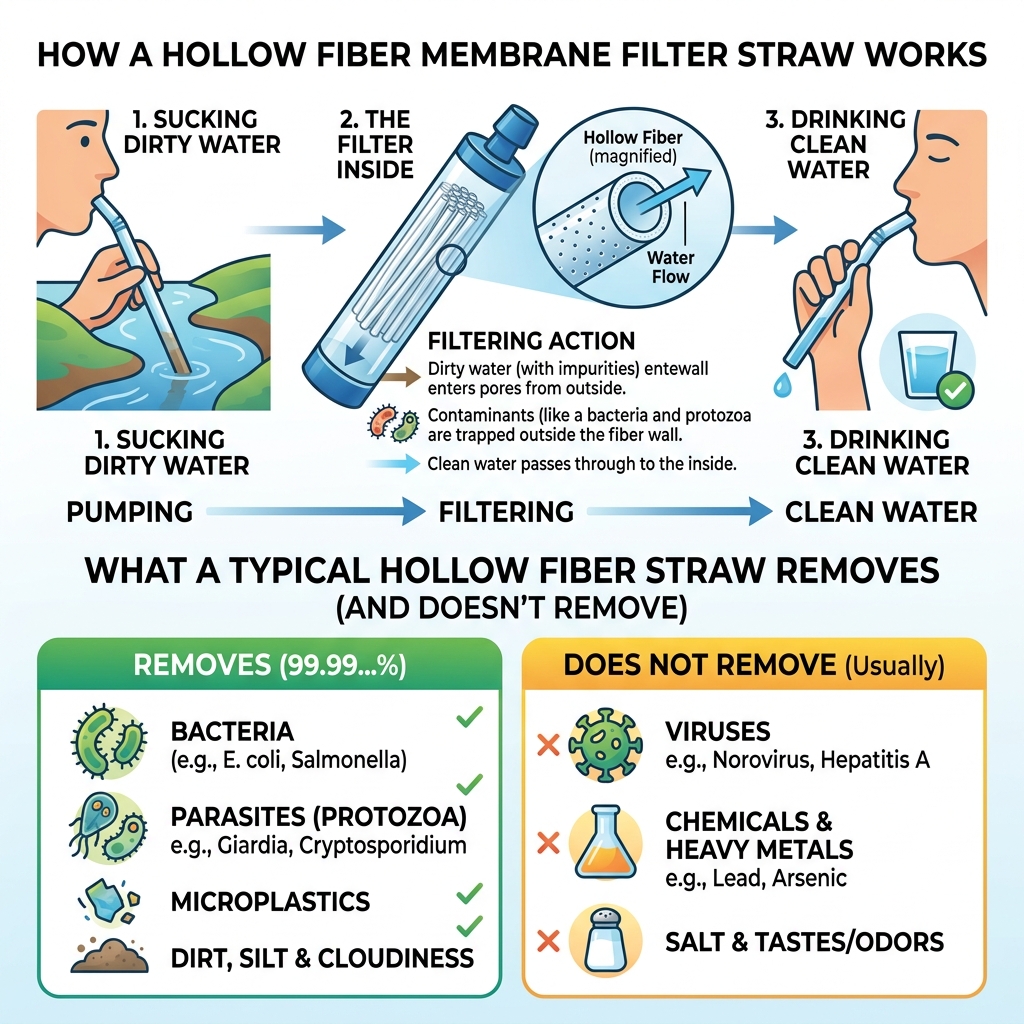
First, let’s talk about viruses. Most standard camping water filter straw models use hollow fiber membranes with a 0.2-micron pore size. This is perfect for stopping bacteria (like E. coli and Salmonella) and parasites (like Giardia), but viruses are much smaller. If you are hiking in the US or Canada, viruses are rarely a concern in backcountry water. However, if you are traveling to developing nations or areas with heavy human waste contamination, you need a “purifier” rather than just a “filter.”
Second is the issue of turbid water. If the water looks like chocolate milk because of mud and silt, your straw is going to clog—fast. While some straws are better than others, highly turbid water requires pre-filtration (like letting the sediment settle in a bottle first) or a device specifically designed for heavy silt.
Lastly, there is the “face-to-puddle” factor. Using a straw directly in a stream requires you to get down on your hands and knees. This isn’t always fun if the bank is muddy or the water is hard to reach. Some modern straws now include extensions or the ability to screw onto a standard water bottle, which we highly recommend for better versatility.
To learn more about what to do when things get really messy, read our guide on portable survival water filters that actually work in a crisis.
Essential Features and Performance Standards
How do you know if a straw actually works? You look at the certifications. We don’t just take the manufacturer’s word for it, and neither should you.
The “Gold Standard” for these devices involves meeting US EPA and NSF P231 drinking water standards. These protocols test the filter’s ability to remove specific percentages of pathogens:
- Bacteria: Should be removed at a rate of 99.9999% (often called “6-log” reduction).
- Parasites/Protozoa: Should be removed at a rate of 99.9% (3-log reduction).
- Microplastics: A newer concern, but most 0.2-micron filters effectively remove these as well.
The technology behind this is usually a hollow fiber membrane. Think of it like a bundle of microscopic straws with tiny holes in the sides. The holes are 0.2 microns wide. Since bacteria are usually 0.5 microns or larger, they simply can’t fit through the holes, while the clean water molecules pass right through.
Independent lab testing is crucial. Brands that are transparent about their results—testing against WHO (World Health Organization) protocols—are the ones we trust. When you’re miles into the wilderness, “close enough” isn’t good enough for your health.
For a full breakdown of the different types of tech available, see our camping water filtration 101 from straws to systems.
Comparing Straws to Other Filtration Methods
Is a straw better than a pump? Or should you just use tablets? The answer depends on your trip style. We’ve put together this comparison to help you visualize the trade-offs.
| Method | Weight | Treatment Time | Pros | Cons |
|---|---|---|---|---|
| Filter Straw | 1–2 oz | Instant | Lightweight, cheap, no wait time | Hard to fill bottles, no virus protection |
| Pump Filter | 15–20 oz | 1L per min | Great for groups, handles turbid water | Heavy, mechanical parts can break |
| Chemical Tablets | < 1 oz | 30–240 mins | Tiny, kills viruses | Bad taste, long wait, doesn’t remove dirt |
| Gravity System | 10–15 oz | 1L per 2 mins | Hands-free, great for basecamp | Requires a place to hang it |
As you can see, the camping water filter straw wins on weight and speed. If you are a solo hiker moving fast, it’s hard to beat. However, if you are camping with a group of four people, trying to share one straw will lead to a very thirsty and grumpy group. In that case, a gravity system or a multi-use kit is a better bet.
Some advanced kits, like the ones mentioned in scientific research on multi-use filters, allow you to use the same filter as a straw, a squeeze system, or a gravity bag. This “modular” approach is becoming very popular because it adapts to your needs.
Maintenance and Field Care for Longevity
If you take care of your straw, it will take care of you. We’ve seen hikers throw a used straw into their closet for six months, only to find it completely clogged and useless the next spring. Don’t be that hiker.
Backflushing
The most important maintenance task is backflushing (or backwashing). This involves forcing clean water backward through the filter to push out all the trapped dirt and sediment. Many straws come with a small syringe for this purpose. If you’re in the field and the flow rate starts to slow down, a quick backflush usually fixes the problem immediately.
Storage
When you get home, don’t just put the cap on. You need to clean it properly. We recommend a light bleach solution (just a few drops in a liter of water) to kill any organic matter inside the membrane. After that, let it air dry completely before storing. Some newer models have specific “long-term storage” procedures to keep the membrane from drying out and becoming brittle.
Winterization
This is a big one: Never let your filter freeze after it has been used. If there is water inside the hollow fibers and it freezes, the ice will expand and crack the membranes. Once that happens, the filter is broken, but you won’t be able to see the cracks with the naked eye. If you’re hiking in freezing temperatures, keep your straw in an inside pocket close to your body heat.
For more tips on keeping your gear in top shape, especially if you use bottle-integrated systems, check out our backpackers guide to using water bottles with built-in filters.
Frequently Asked Questions
How do I know when to replace my filter straw?
Most quality straws are designed with a “fail-safe” mechanism. When the pores are completely blocked and the filter has reached the end of its life, water will simply stop flowing through it. If you find it’s impossible to sip water even after a thorough backflushing, it’s time for a new one.
Can a straw filter remove heavy metals or chemicals?
Standard hollow fiber straws do not remove heavy metals (like lead or mercury) or chemicals (like pesticides). To remove these, you need a filter that includes an activated carbon stage. Some premium straws have a two-stage system: a membrane for bacteria and a carbon capsule for lead, chemicals, and taste improvement. Carbon filters usually have a much shorter lifespan (around 25–100 gallons) than the main membrane.
Is it safe to use a filter straw in freezing temperatures?
As mentioned above, it is only safe if the filter has never been wet or if you keep it warm. A single freeze-thaw cycle can ruin the internal structure of the filter. If you suspect your filter has frozen, it is safest to replace it.
Conclusion
At Total Cobre, we believe that clean water shouldn’t be a luxury reserved for those carrying heavy equipment. The modern camping water filter straw has made safe hydration accessible, lightweight, and incredibly simple.
Whether you’re exploring local trails or heading deep into the backcountry, having a straw in your pocket or clipped to your pack is one of the smartest moves you can make. It’s an insurance policy that weighs less than a pair of socks but can save your life—or at least save you from a very miserable week of stomach issues.
We hope this guide has helped you understand the nuances of these tiny but mighty devices. Remember to check your certifications, maintain your gear, and always have a backup plan.
Visit Total Cobre for more outdoor gear guides to find the perfect equipment for your next adventure. Happy trails!
